
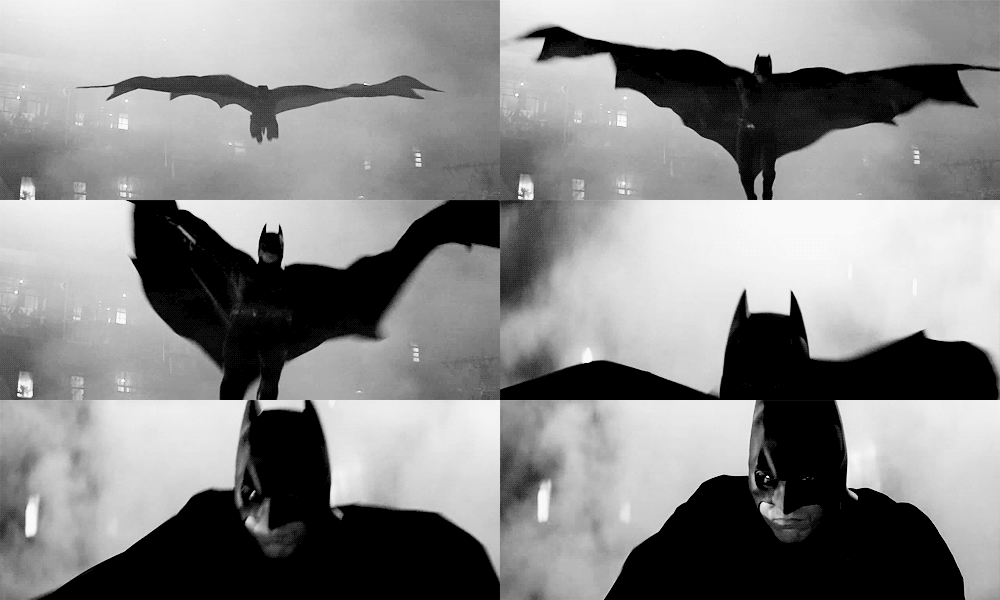
Who knew that being an Uber driver required the skills of a swashbuckling hero?
But that is exactly what it is. I am approaching the end of my first $100 dollar week. And I have already been on a harrowing ride through the world of ride-sharing for money.
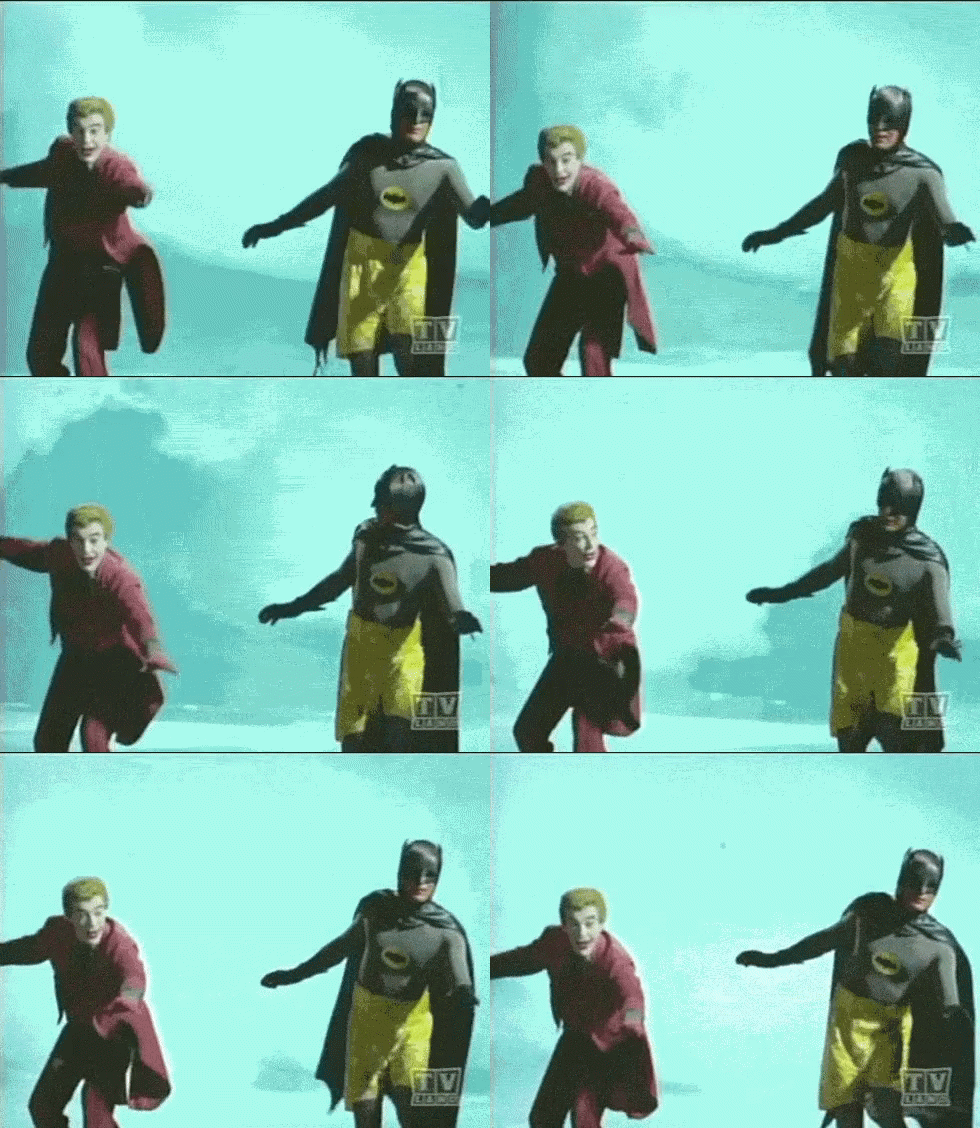
The key to successfully picking up and ferrying passengers to the site of their choosing is a matter of being personable and at ease with driving and talking. Of course, I have talking skills. My whole 31 year career was a matter of learning to effectively talk to kids all day long. And you may not believe this, but adults, people who actually have money and the freedom to choose their own path, are easier to talk to than kids. I have learned about people’s families, people’s jobs, opinions of their bosses, opinions of the government and taxes, and even some tell me about their love lives, both directly, and second hand. If there are two in the car, then they forget that the driver has ears and can hear (within the limitations of really old ears).

One recent passenger was absolutely convinced that no Uber driver actually knows how to drive. That passenger sat in the back seat and sent a barrage of traffic warnings and worries forward for me to deal with at the same time I was watching the road ahead. It was almost exactly as harrowing as driving with my wife as a passenger. I felt like a child again, driving for the meanest teacher I ever had growing up. (Sorry, Ms. Rubelmacher, I learned a lot from you. Don’t give me detention for writing that.)
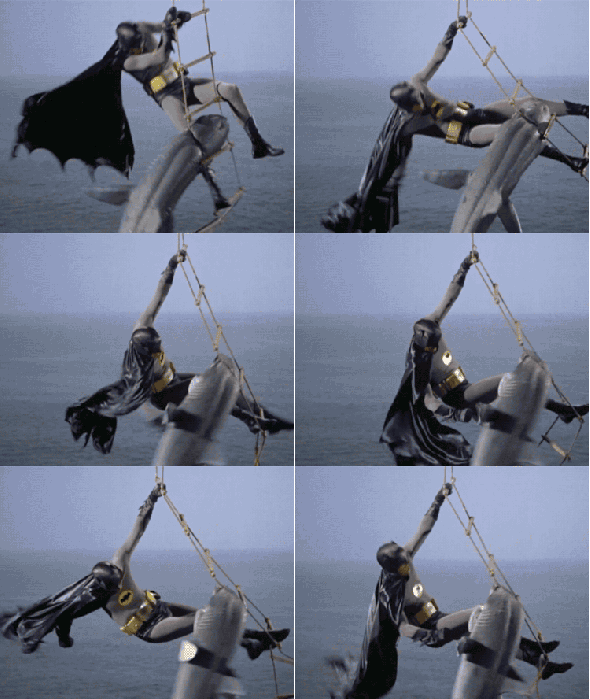
But why did I say “Swashbuckling hero” if I am only going to talk about talking to passengers? And why all the Batman gifs?
Well, I am talking about driving in the Dallas Fort Worth Metroplex, ain’t I? Do you know what Texas drivers are like? On Saturday I picked up a coach headed for a retirement party at a Luby’s on the border of DeSoto (a southwest Dallas suburb. That was a twenty-two dollar trip from east-central Dallas catty-cornered all the way across the city in a diagonal direction on the tollway and then I-35 South. I had three cars cut me off for driving too slow (by which I mean the speed limit. Hey, Uber monitors that through their app.) The Uber Navigator told me to keep right at a time when keeping right nearly threw me off 35 onto an intersecting highway, so I had to make a quick two-wheeled Starsky and Hutch turn through the corner of the median to stay on course. (Fortunately, Uber can’t monitor that.) Dallas drivers are a combination of speedy predators in WASP rockets, Texas killer grandmas in Cadillacs, and Elmer Fudds going too slow in classic cars from the 50’s. They provide you with a booby-trapped obstacle course to drive through, and go so fast that the speed limit becomes dangerously too slow.

So I definitely appreciate Batman for providing me with all the animated illustrations to use for portraying the high-risk life of an Uber driver. It makes driving this way easier to pretend that I am one half of the dynamic duo driving the Batmobile in Dallas downtown traffic. Yes, it’s true, I am saying I pretend to be Batman.


















Reading Other Writers
Nobody who wants to be a writer gets by with just writing and never reading anything by anybody else. It is too easy to devolve into some kind of human mushroom that way, thinking only thoughts a mushroom could think, all fungus-like and having no chlorophyll of their own. You never learn to decode other people and other people’s thinking if you don’t read other people’s thoughts crystallized in writing.
And not every other writer is Robert Frost. Or even Jack Frost who thinks he’s Gene Kelly. There has to be some interpretation, some digging for understanding. What did that writer mean when she said political correctness was like a tongue disease? And what does it mean when a commenting troll calls me a nekkid poofter? Is that how he spells “exceptional genius”? I think it is. Trolls are not smart.
I know people have to make an effort to understand me. When I write, I am writing under the delusion that I can produce literary quality off the top of my head. In fact, I can barely produce hair off the top of my head, and it is gray when I do it. See what I did there? It is the kind of joke a surrealist makes, pretending the idiomatic expression you use is to be taken literally when it doesn’t literally make sense. That kind of nonsense is what my readers have to put up with, and probably also the reason why most of them just look at the pictures. If you have to think too hard when you read, your brain could over-heat and your hair could catch fire. I like that kind of purple paisley prose that folds back in on itself and makes you think in curlicues. But most people don’t. Most people don’t have fire-proof hair like I do.
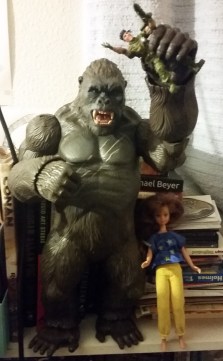
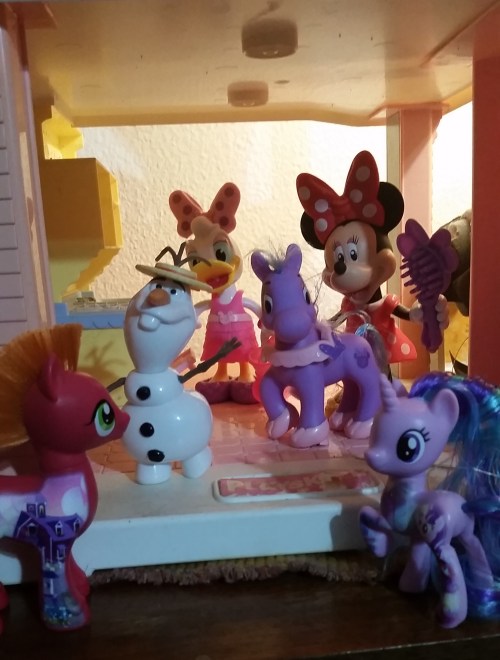
Sometimes, it doesn’t even take a word to make the point. For instance, why, in the picture, is Fluttershy trying to drink out of the toilet in the dollhouse bathroom? For that matter, why does a doll house even need a bathroom? Applejack doesn’t even fit in that yellow bathtub. I know. I tried to stuff her in there for this picture. And, as you read this, doesn’t this paragraph tell you a lot about me that you probably didn’t even want to know?
When I am reading the writing of others, I am looking for a cornucopia of things. I want to not only understand their ideas, I want to detect the limping footprints across the murder scene of their paragraphs and come to know the deeper things about them as well. I spent years decoding and trying to understand the writing of preliterate kids in my middle school English classes in order to be able to teach them to write better. And I learned that no writer is a bad writer as long as they are using readable words. I also learned that very few writers are James Joyce or Marcel Proust. Thank God for that! And given enough time I can read anything by anybody and learn something from it. I read a lot. And it may not always make me a better writer to read it, but it always has value. It is always worth doing.
Leave a comment
Filed under commentary, education, goofy thoughts, humor, irony, photo paffoonies, photos, reading, strange and wonderful ideas about life, surrealism, teaching, wordplay, writing, writing teacher
Tagged as reading for writing, writing advice