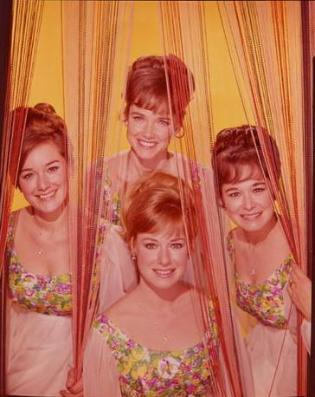
Grandpa and Grandma Aldrich lived on the family farm outside of town, a little more than two miles from the tiny farm town of Rowan, Iowa. I walked it more than once. It was faster to walk the railroad tracks between the two places. About a mile and three quarters as the crow flies… three hours as the boy investigates the critters in the weeds, throws rocks at dragonflies, and listens to the birdsong along the way. But the point is, my maternal grandparents lived close enough to have a profound influence on my young life. Much of what they loved became what I love. And every Saturday night, they loved to watch the Lawrence Welk Show. And that show had highlights that we longed to see again and again… on a show that never really went into reruns. We lived to see Jo Ann Castle play the old rinky-tink piano, Bobby and Cissy doing a dance routine, and most of all… the lovely Lennon Sisters.
I always wanted to be the things they wished me to be in the song “May You Always”. I wanted to “walk in sunshine” and “live with laughter”. They presented a world of possibilities all clean and good and wholesome. As a young boy who hated girls, I had a secret crush on Janet Lennon who was the youngest, though a decade older than me, and on Peggy Lennon, the one with the exotic Asian eyes. They sang to me and spoke directly to my heart.
You have to believe in something when you are young. The world can present you with so many dark and hurtful experiences, that you simply have to have something to hang onto and keep you from being blighted and crippled by the pain. For me, it often came in the form of a lovely and simple lyric sung by the lovely Lennon Sisters. When you are faced with hard choices… especially in those dark moments when you think about ending it all because it is all just too much to bear, the things stored in those special pockets of your heart are the only things that can save you. For me, one of those things will always be the music of the Lennon Sisters… especially when watched on the old black and white TV in the farmhouse where my grandparents lived, and helped to raise me, every Saturday night in the 1960’s.
I have claimed that I am a humorist and all my novels are comic novels, to some degree at least. But it is often pointed out to me that I write about things that make people cry. And I freely admit that I most certainly do.
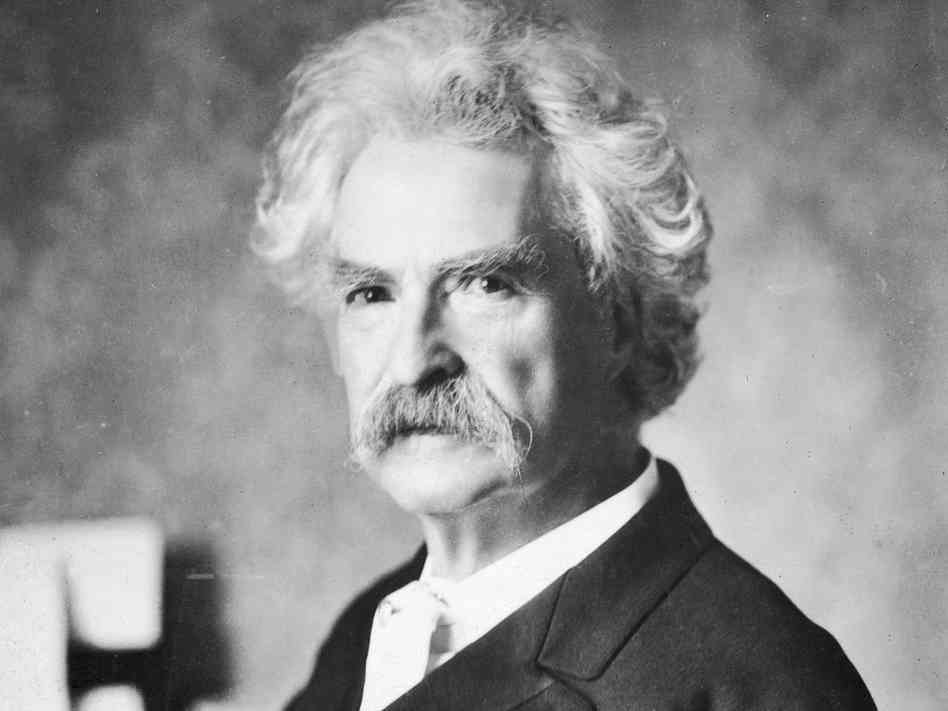
But if you think about it carefully, analytically, or even emotionally, you have to admit, even a book like Mark Twain’s The Adventures of Huckleberry Finn has some weep-worthy moments in it. I have read the book more than once myself, and I never get past the scene where Huck looks down at the body of his young friend Buck Grangerford, killed in the Shepherdson/Grangerford feud about something nobody living even remembers, without shedding gushers and gushers of heart-busting tears.
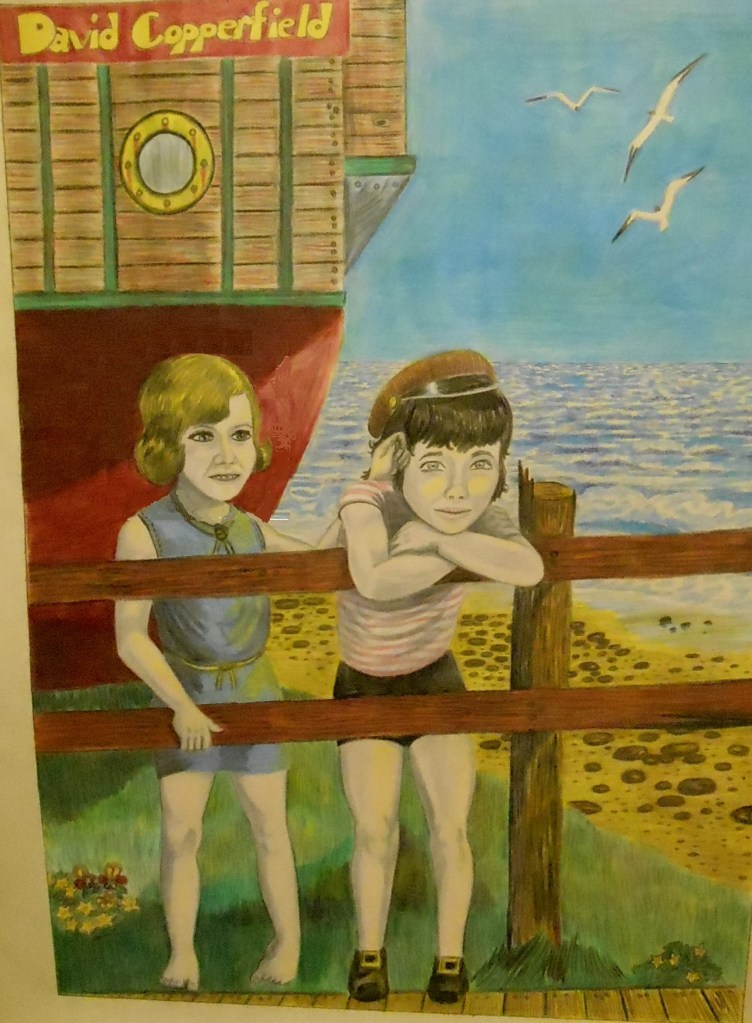
And in Charles Dickens’ David Copperfield, as much as I laugh and guffaw at the antics of quiet Mr. Dick and his kite, or the much deserved downfall of villainous Uriah Heep, it is the drowning of Little Emily on the boat with David’s school friend and idol Steerforth that leaves me surrounded by puddles… nay, lakes… that I have wept.
And I think that I may justify the sad parts in so many of my weary works with the fact that I am merely providing the necessary counterpoints to my merry-making and mirth.
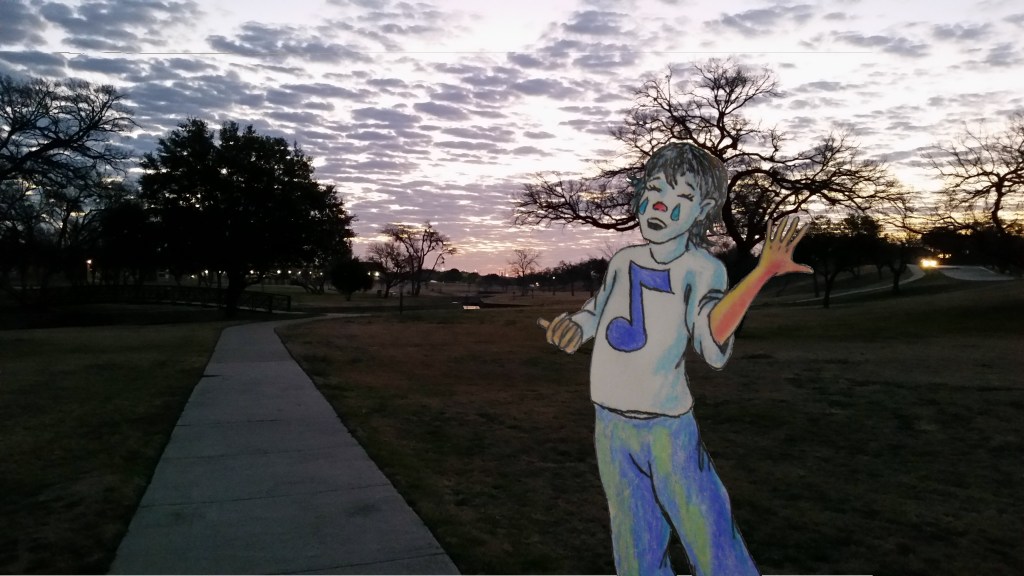
Francois is a character from Sing Sad Songs.
There has to be that necessary balance, that well-rounded-ness, to a story that makes it feel truly complete. And, of course, we know that even in a horror novel by Stephen King, you find humor used as a balance point to lighten the moments just before the monster delivers its liver-shaking, earth-tilting scare.
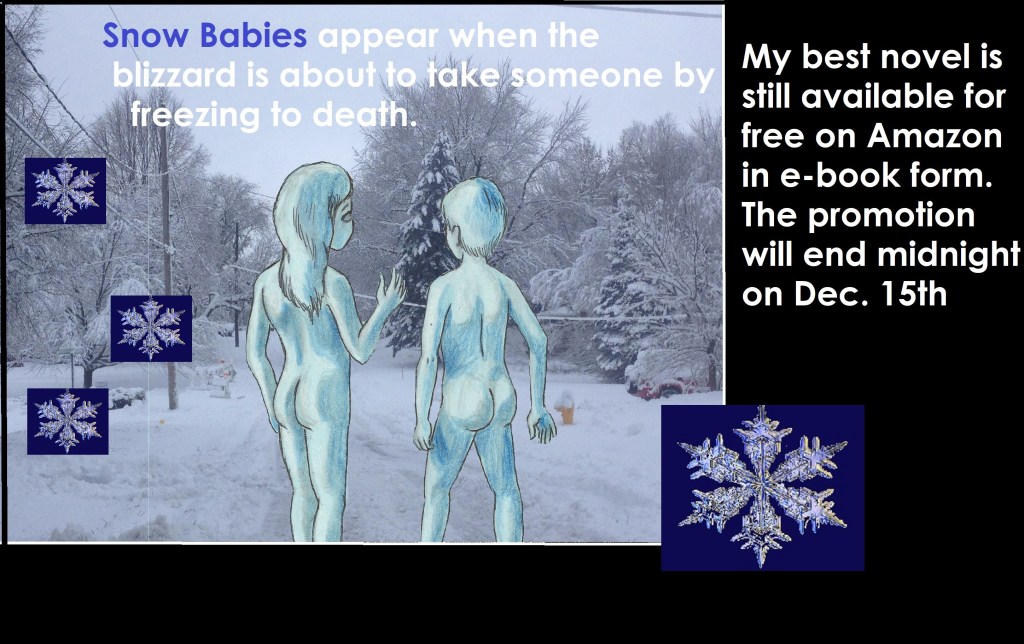
Snow Babies, among my published books, is a good example. It is a story that celebrates how a small Iowa town comes together to survive a deadly December blizzard. And while it tells funny stories of kooky characters battling the elements, and both surviving the blizzard and ’84 Reagan/Mondale political debates, as well as putting up Christmas trees, it is still also about death and loss of loved ones, finding and losing love, and just what sort of self-sacrifice or other accidental happening truly makes someone a hero. Or a bus driver… this book has more than one bus driver in it.
So, I think, in the end, that I have made a cogent case for the notion that in order to be a humorist, you have to manipulate many emotions, not just mirth, but sadness also. As well as fear, bitter irony, and pain. And that may well also be the underlying reason that comedy is harder to write than tragedy.
This holiday is going to be different. Different from the holiday I grew up with. Different than the celebrationless non-holiday I lived with for twenty years. And different from the new traditions we established, my kids and I, as we pulled away from my wife’s religion. The pandemic affects everything.
I was born into a family of Iowa Methodists living in North Central Iowa in a tiny farm town called Rowan.
I remember Christmas being the most magical time of year. I believed in Santa Claus. I felt like the Christmas magic that we saw in seasonal specials on TV in black and white were so real… the realest reality there could be…even if Andy Williams wasn’t the host of the program. Candy canes and Christmas trees and sitting on Santa’s lap being terrified of getting it wrong… and making him think I was asking for a talking Chatty Kathy doll even though I was a boy… FOR MY SISTER, SANTA! FOR MY SISTER… Oh, gawd, that really went wrong. And we had family gatherings where we ate pot-luck family meals with Swedish meatballs and turkey and mashed potatoes with brown gravy and casseroles of fifteen different kinds and nuts and candy…eating ourselves into a semi-stupor as we also did only three and a half weeks before at Thanksgiving.
And presents. Everybody gave presents. And Christmas Carols in Church.
But time goes on. You grow out of believing in Santa Claus. You even grow out of believing in Andy Williams. Perry Como was better. And it was getting so commercial. And Christmas shows we loved as kids seemed so simple and lame when watched again as young adults.
And then I married a Jehovah’s Witness. If you are not aware of it, Christmas originated as a pagan holiday, the Roman Saturnalia. It was a night of feasts and orgies and excess. And Jehovah’s Witnesses believe their beliefs are the only true beliefs, and celebrating Christmas is of Satan. I celebrated Christmas for the last time in 1994. I married in 1995.
For the next twenty years I did not celebrate Christmas. At least, not out loud where Brothers and Sisters in the Truth could hear. And the season became very austere and sanitized for me by the religious integrity of those around me in the faith.
But there were friends in the faith that lost their faith and left the congregation permanently. And the people around me changed. And I was beset by illnesses, mine and my family’s. And Jehovah’s Witnesses are very good at helping the sick. But, apparently only for others, not me and mine. They began turning away.
I am probably disfellowshipped now. They have turned away from me, and I am now isolated from all those who used to be friends and acquaintances. My wife is still a member of the congregation. And this is good because she desperately needs to believe. It is a good life for her and keeps her relatively well. But I know they disfellowshipped me, even though nobody told me so like they always do in such cases. My wife barely talks to me now. And this is probably because members of the congregation are supposed to shun the disfellowshipped, even if they are family.
But I bare no one ill will. That may be part of the problem. The Bible directive is to “Hate what is bad.” And blood transfusions and psychiatry are both bad things according to the Witnesses’ understanding of Bible commands.
I didn’t need any transfusions, and though I have significant stress and diabetic depression, I was never hospitalized for that. But I did kinda fake some disfellowshippable offenses so that I would be the one, and my wife would still be able to be a Witness. She needs it more than I do.
And, to be quite honest, I need to feel a little bit of Christmas now in my old age and infirmity. After all, it is a holiday all about making sacrifices in order to give gifts to others. I know that this post will make Jehovah’s Witnesses cringe. But now that they are shunning me, I guess they won’t be seeing this anyway. And I wish them a Merry Christmas in spite of it all.
No man is an island. John Donne the English poet stated that. And Ernest Hemingway quoted it… and wove it into his stories as a major theme… and proceeded to try to disprove it. We need other people. I married an island girl from the island of Luzon in the Philippines. She may have actually needed me too, though she will never admit it.
When I was a young junior high school teacher in the early eighties, they called me Mr. Gilligan. My classroom was known as Gilligan’s Island. This came about because a goofball student in the very first class on the very first day said, “You look like Gilligan’s Island!” By which he meant I reminded him of Bob Denver, the actor that played Gilligan. But as he said it, he was actually accusing me of being an island. And no man is an island. Thank you, Fabian, you were sorta dumb, but I loved you for it.
You see, being Gilligan on Gilligan’s Island was not a bad thing to be. It was who I was as a teacher. Nerdy, awkward, telling stories about when I was young, and my doofy friends like Skinny Mulligan. Being a teacher gave me an identity. And Gilligan was stranded on the Island with two beautiful single women, Mary Ann and Ginger. Not a bad thing to be. And I loved teaching and telling stories to kids who would later be the doofy students in new stories.
But we go through life searching for who we are and why we are here. Now that I am retired, and no longer a teacher… who am I now? We never really find the answer. Answers change over time. And so do I.
He was one of my all-time favorite students. I know I say that about an awful lot of kids. I can’t help it. Once you get to know them well enough to teach them anything, you tend to be hooked for life. They are your kid. You are their teacher. And that means almost as much as if they were born to you.
I first got to know Johnny on one frightful morning in September of 1984. He was a tiny, frail little seventh-grade boy sitting in the second seat of the second row. And as I was trying to get them to read a short story in the literature book, he kept nodding off, falling asleep. Sleeping is not an effective reading strategy. Three times I tried to wake him up and get him on task. He could have told me then, but he was painfully shy, and the only word I had heard from him was, “Here,” spoken during roll call. So, the fourth time I took him outside the classroom door to ask him what was wrong. He was deathly pale.
“What’s wrong? What do we need to do to make it better?”
He looked towards the boys’ restroom. “I gotta go…”
I told him to go, then followed him down to the restroom because I knew it was something serious. Serious enough to leave my class unattended. But they were deathly quiet, because unlike me, they knew what was wrong. I found him throwing up in the trash can. He told me he was sick in a barely audible voice.
Immediately I went to the office and told the secretary that he was ill.
“They have juice for him in the refrigerator in the ESL room,” Ms. Lawler said. “I’m sorry we haven’t gotten the nurse’s list out to teachers yet. He’s got juvenile diabetes.”
Whoa! I didn’t know much about diabetes then, but I did know it was too deadly of a thing to allow myself not to know everything I needed to know. At the time the school nurse had to take care of all four campuses in the school district, and she was only at the Junior High on Thursdays.
Thankfully, over time, not only did I learn more about handling that disease, but medical science did too. When I would later develop adult-onset diabetes in 2000, treatment for diabetics would become much more effective, rendering the disease far less destructive.
As for Johnny himself, he became a part of the small group of housing-project kids who would come to my apartment on Saturdays, and sometimes after school to hang out, use my computer, and play table-top role-playing games. I made a special effort to engage Johnny in conversations about a little of everything. He was a very bright boy when he felt well. I got to know his seriously diabetic mother too. And his older sister would later become a nurse at the local doctor’s office, so I got to know her as well. Johnny didn’t have a father at the time, which also applied to each of the other boys from the project, except for the Camacho brothers whose father was a seriously depressed Vietnam veteran. I suppose that’s why Johnny became like a son to me, one of five boys who at the time treated me like a second father. I taught him. I entertained him. And occasionally I cooked for him.
One of my two girlfriends at the time that I was mentoring Johnny liked to give him sugar-free candy. She got so accustomed to always having some available at her place that she actually got hooked on it herself.
In school Johnny opened up the way a cactus flower blooms when it gets a little rain. He began to talk to other kids a lot. He made himself into a group leader, and he even went out for high school football. Truthfully, I was amazed by him on the football field. He played defensive back. And he played like a star. I watched him intercept the ball about three times and run it back the other way. The coaches soon felt about him the same way I did. He was part of their family too.
And it turns out that being physically fit practically cures juvenile diabetes.
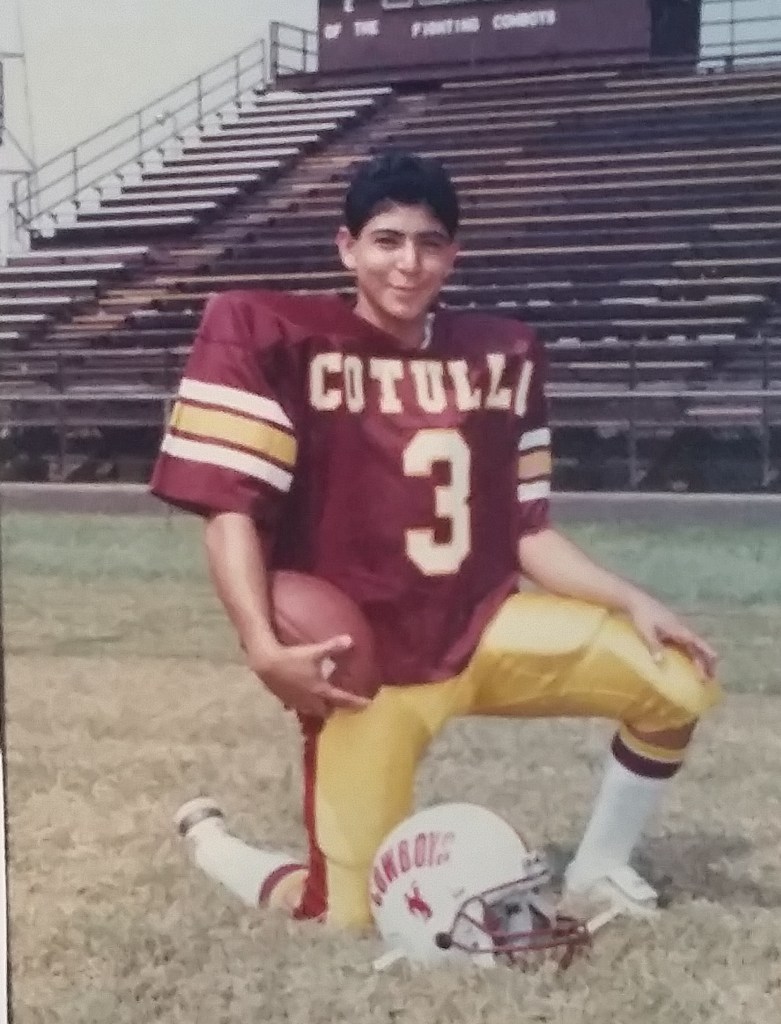
He got stronger and healthier with each season. He gave me the football portrait not because I had anything to do with his success, but because he loved me. I have hugged that boy three times in my lifetime, and each time is a cherished memory that I hope to carry with me to Xibalba, the Mayan Land of the Dead.
When I developed diabetes myself, Johnny’s older sister kept track of my wellness charts herself. Johnny’s family was experienced with handling diabetes, and they looked after me like a member of their family.
The last time I saw Johnny it was in the hallway at school. It was only a year before I left Cotulla for good. He had come especially to see me. I didn’t even recognize him at first because I hadn’t seen him for a decade. I wanted to talk to him and catch up. But I had to pick up my eldest son that day from second grade as he had been ill. I was not feeling well myself. So, I asked for a rain check. He still had that beautiful smile. And he didn’t tell me that that was the only chance he had to see me before leaving town again. It broke my heart when they told me that later.
But I see him again now as I tell you the story of Sugar-Free Johnny. He was probably the sweetest kid I ever taught. He will always be a part of my story. And apparently I am part of his story too.
This foolish essay about berries that mean love to me is only partly inspired by the Beatles song, “Strawberry Fields Forever.” That’s because, of course, their song was only about meditating. In the lyrics they take you to the “Strawberry Fields where nothing is real… but it’s nothing to get hung up about…” They are talking about a blissful place of no worries where we all need to go. And then staying there forever.
This, of course, I could never do. Worrying about the future is tattooed on my behavioral imperatives in the dark part of my stupid old brain. And while I often found that place of no worries, and lingered there for a bit, I found you could never really get anything done if you stayed in that state of strawberry fields forever.
But don’t get me wrong, strawberries are a critical part of every healthy mental diet.
You see, my meditations on strawberries when I was a child of eight, nine, and ten centered on the strawberry patch at Great Grandma Hinckley’s place.
She was, as I incorrectly recall, slightly older than Jesus when I was that age. By that I mean, though she seemed museum-quality ancient to me, I had derived wisdom about life, love, and laughter from her before Sunday School taught me any of those things said in Jesus’s words.
And I was given the task of mowing her lawn in the little plot of land surrounding her little, tiny house in the Northern part of Rowan where I also lived and grew and celebrated Christmas and Halloween and Easter and the 4th of July. And though I was doing it because she was so old, I never even once thought she was too old and frail to do it herself. Grandma Hinckley’s willpower was a force of nature that could even quell tornados… well, I thought so anyway when I was eight. And she gave me a dollar every time I did the lawnmowing.
But there were other things she wanted done, and other things she wanted to teach me. There was the garden out back with the strawberry patch next to it. She wanted me to help with keeping the weeds and the saw grass and the creeping Charlie from overrunning the strawberries and choking them to death. (Creeping Charlie wasn’t an evil neighbor, by the way. He was a little round-leafed weed that grew so profusely that it prevented other plants from getting any sunlight on their own leaves, causing a withering, yellowing death by sunlight deprivation. I took my trowel to them and treated them like murderers. I showed them no mercy.)
And Grandma always reminded me not to be selfish and eat the very berries I was tending in the garden. She taught me that eating green strawberries (which are actually more yellow than green, but you know what I mean) was bad because they could give you a belly ache, a fact that that I proved to myself more than once (because eight-year-olds are stupid and learn slowly.) She also taught me that it is better to wait until you have enough strawberries to make a pie, or better yet, strawberry shortcake with whipped cream. She taught me that delayed gratification was more rewarding in the long run than being greedy in the short run and spoiling everything for everybody.
She always gave me a few of the ripe strawberries every time I helped her with them, even if I had eaten a few in the garden without permission. Strawberries were the fruit of true love. I know this because it says so in the strawberry picture. Even though I probably never figured out what true love really means.
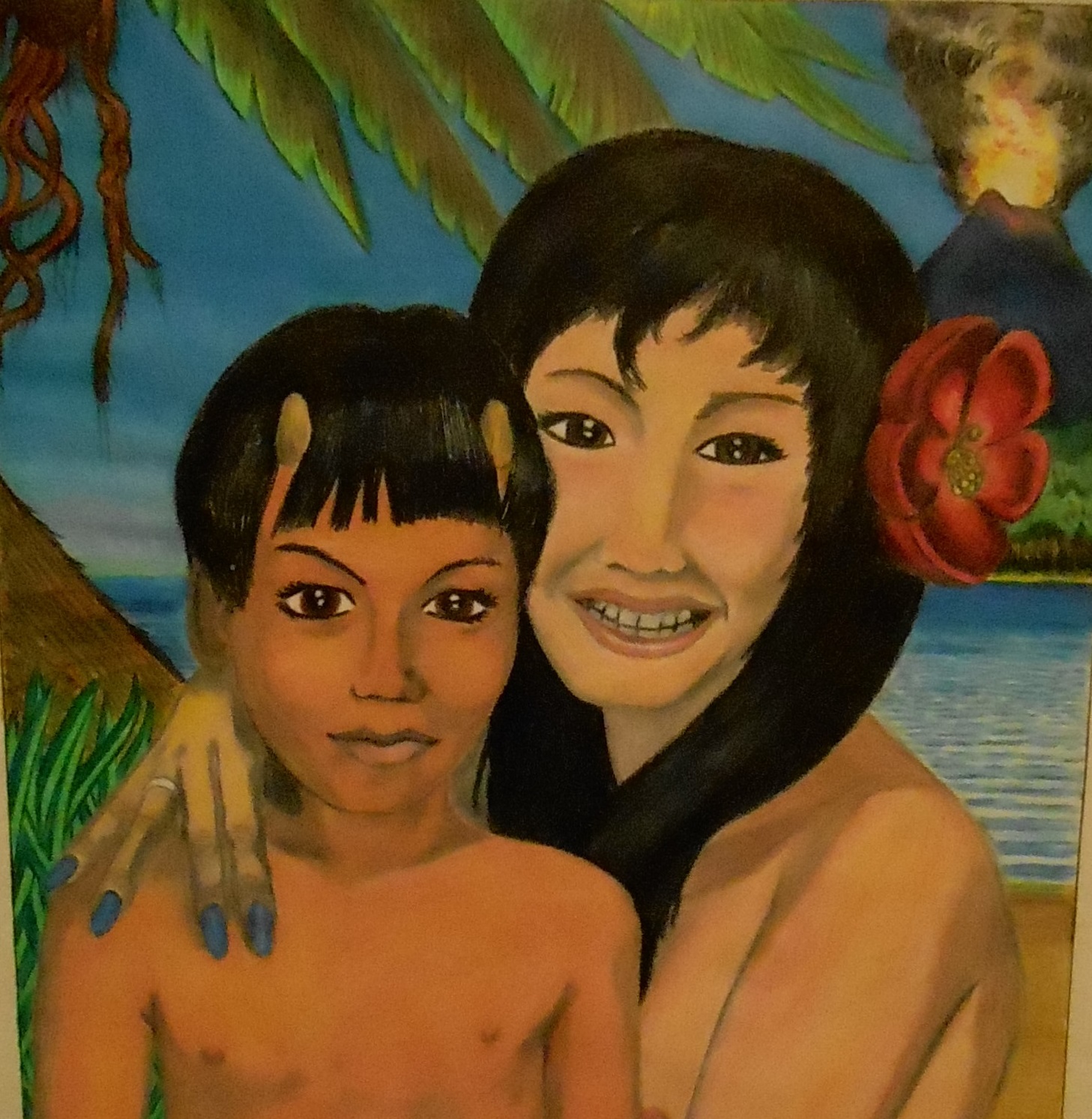
My Great Grandma Nellie Hinckley was the foundation stone that my mother’s side of the family was built on. She was the rock that held us steadily in place during the thunderstorms, and the matriarch of the entire clan of Hinckleys and Aldriches and Beyers and other cousins by the dozens and grandchildren and great grandchildren and even great great grandchildren. I painted the picture of her in 1980 when she passed away. I gave it to my Grandma Aldrich, her second-eldest daughter. It spent three decades in Grandma’s upstairs closet because looking at it made Grandma too sad to be so long without her. The great grandchild in the picture with her is now a grandmother herself (though no one who has seen this picture knows who it is supposed to be because I painted her solely from memory and got it all wrong.) But Grandma Hinckley taught me what true love means. And true love has everything to do with how you go about taking care of the strawberry patch.
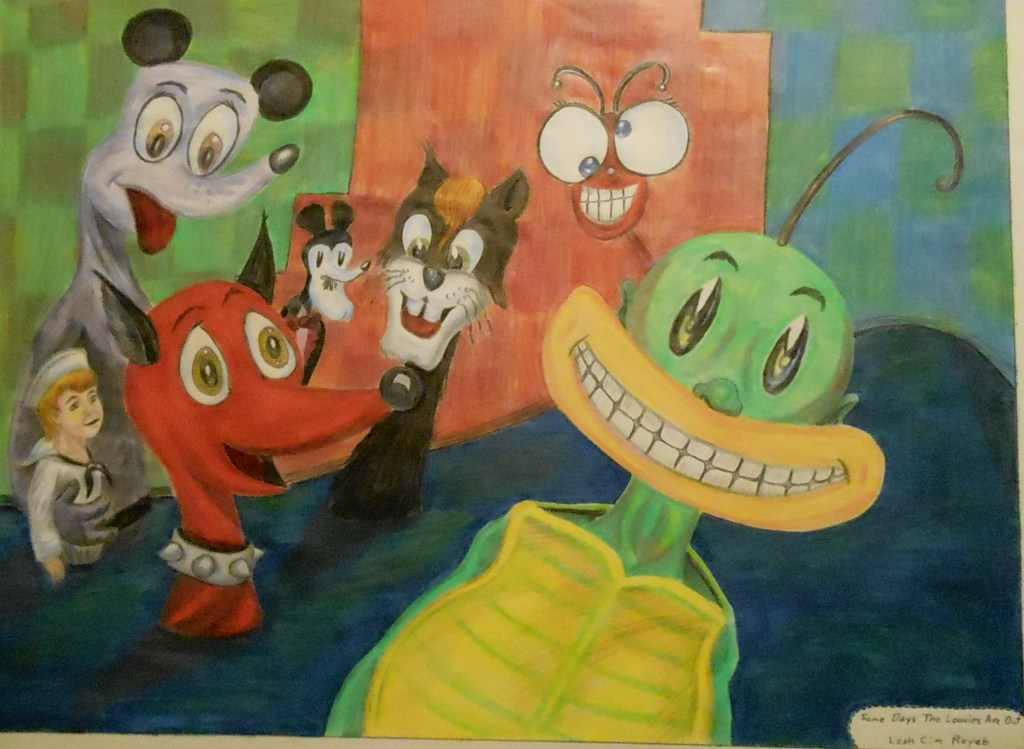
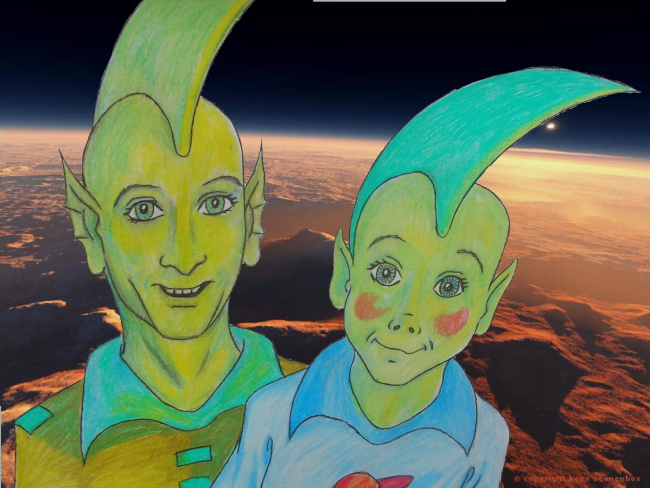
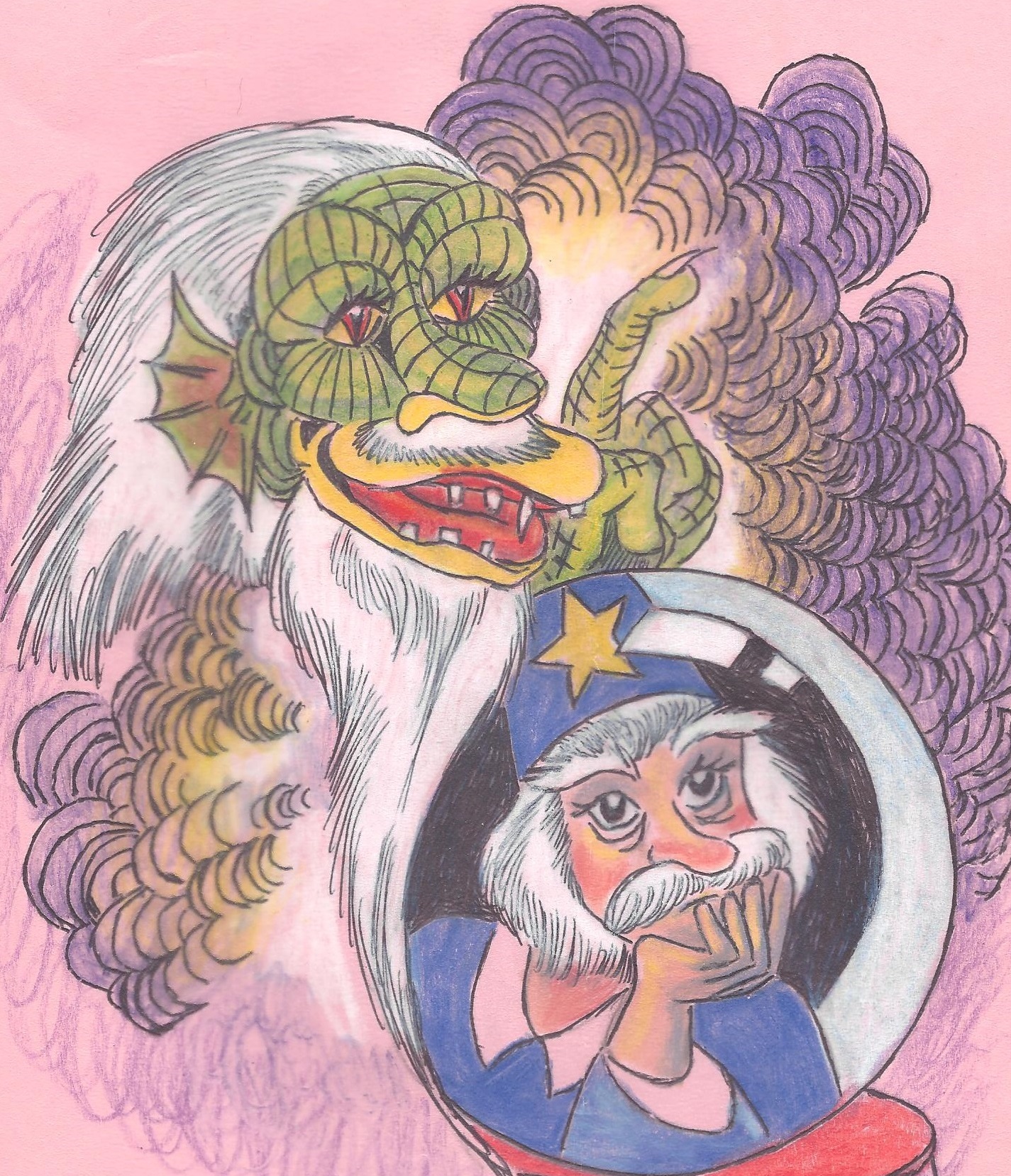
This is an illustration that goes along with my first good published novel, Catch a Falling Star. I don’t talk about that novel in this blog very much anymore since, in order to actually promote that novel, I am under contract to have to spend hundreds of dollars more to use one of their many expensive promotional packages to get this “award winning” novel promoted in the way the publisher thinks it deserves. I wanted to use a picture like this for the cover of the book. They rejected that. Instead they gave me a silhouette picture of a girl flying a kite at night. That, of course, has nothing to do with the novel inside the book. These two, by contrast, are two of the most important characters from the book, both of them aliens. Farbick is the competent space pilot who gets himself shot and captured during the failed invasion of Earth. Davalon is the marooned tadpole, Telleron child, who gets himself adopted by a childless Earth couple. I definitely like my picture better than the one I got stuck with.
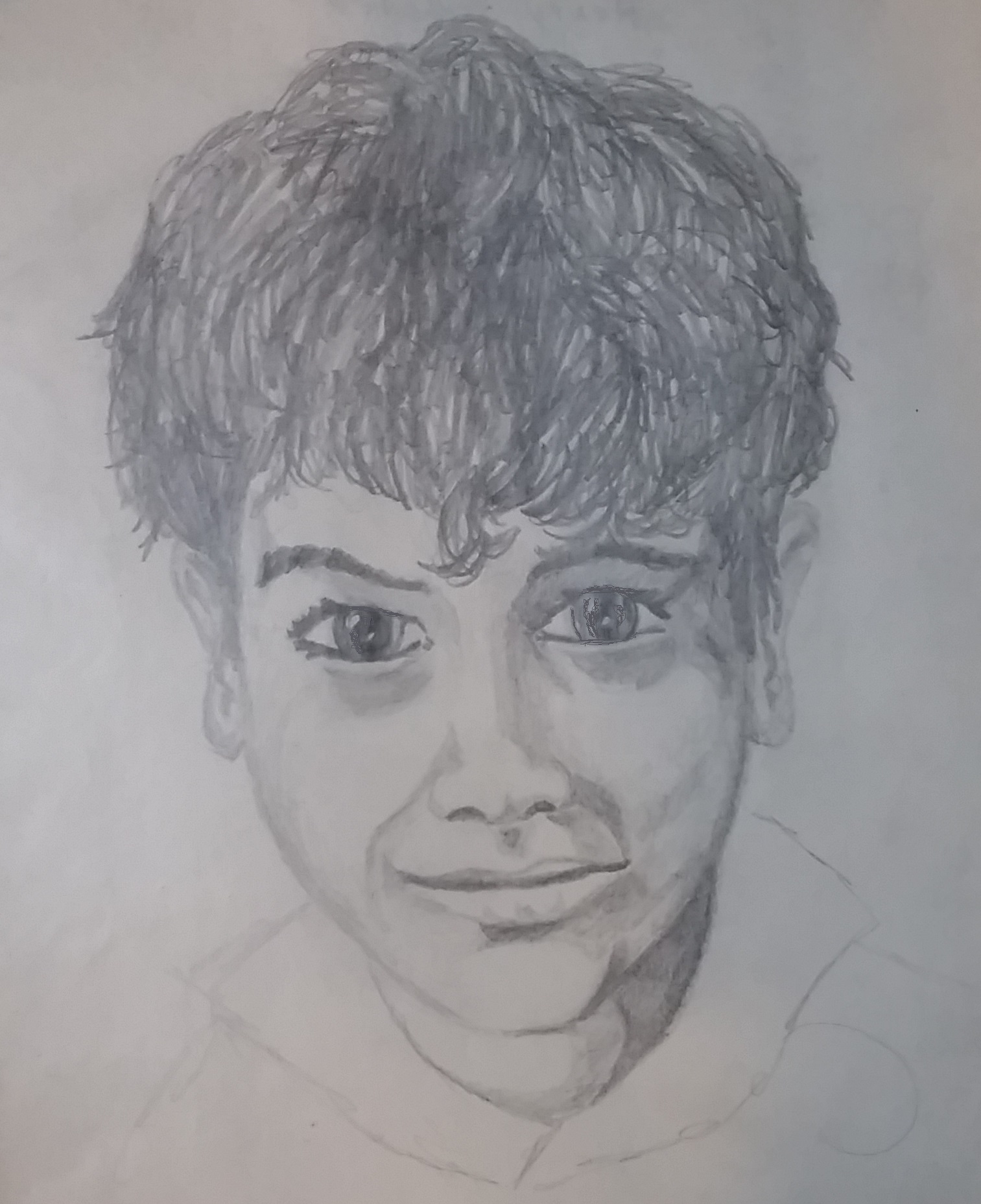
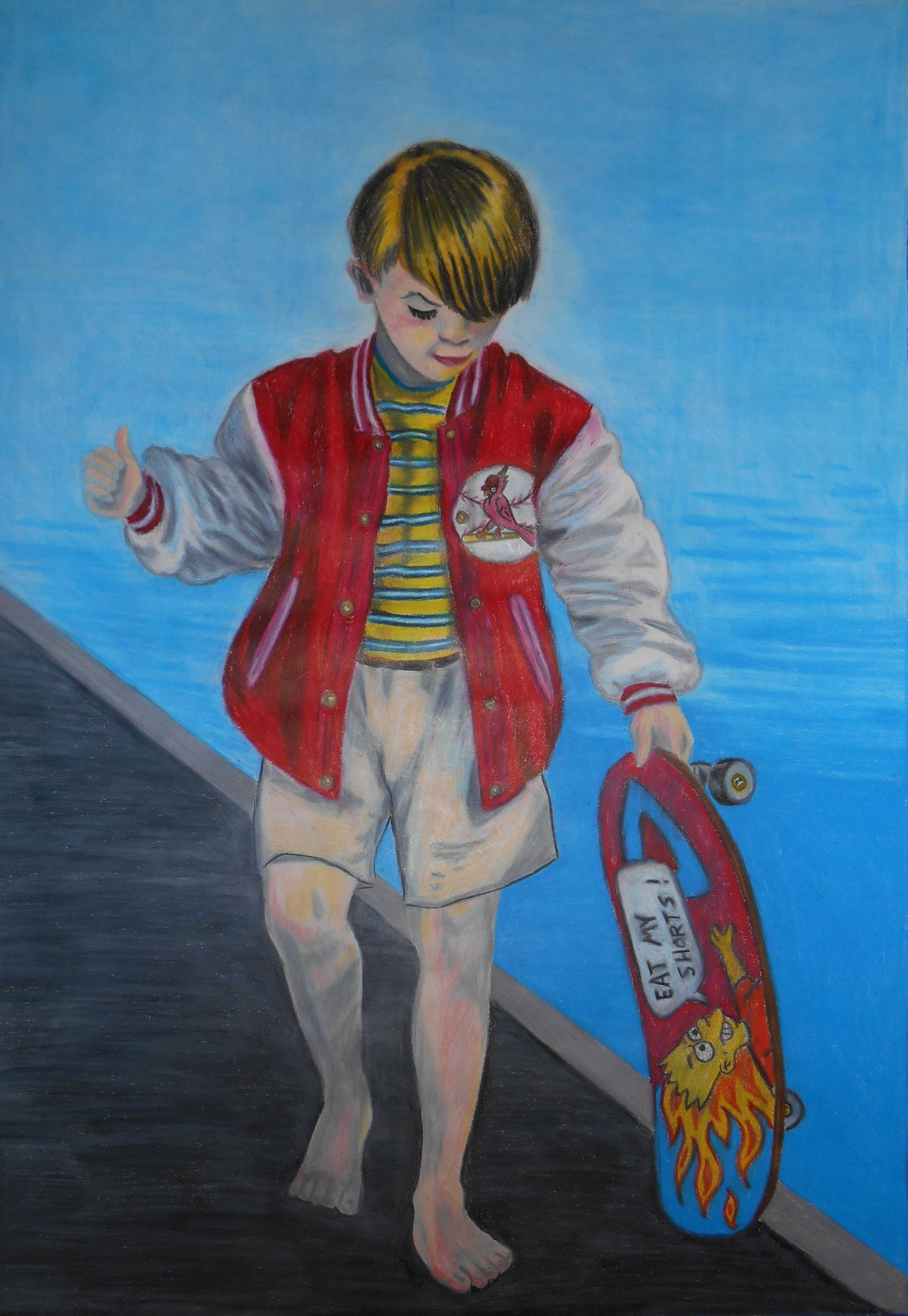
This picture is called, “Long Ago It Might Have Been.” It is a picture I drew in the late eighties, after my girlfriend/Reading-teacher colleague took a job in San Antonio and left me behind. Honestly, she wanted to marry me, and I never got around to telling her that the reason our love life was so difficult was because I had been sexually assaulted as a child, and though I was attracted to her, I hadn’t truly healed enough at that point to become a husband and father. I never told her about my terrible secret. She left. She got married and had more than one blond-haired little girl that probably looked just like her. The boy in this picture looks like a young me with blond hair. He wears a baseball jacket of the St. Louis Cardinals, my favorite team. He’s the child that might’ve been, if only I had grown to adulthood a little sooner.
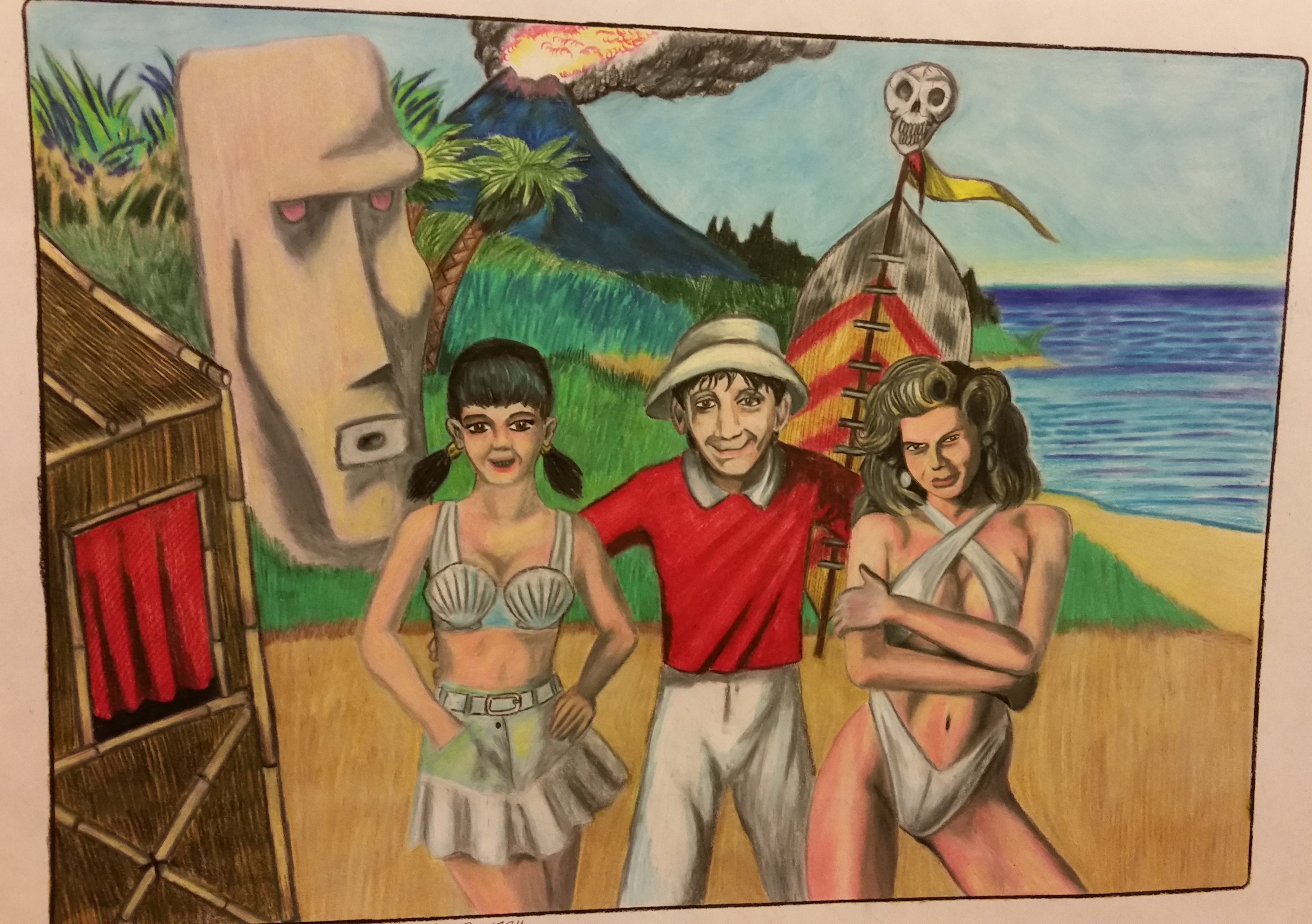
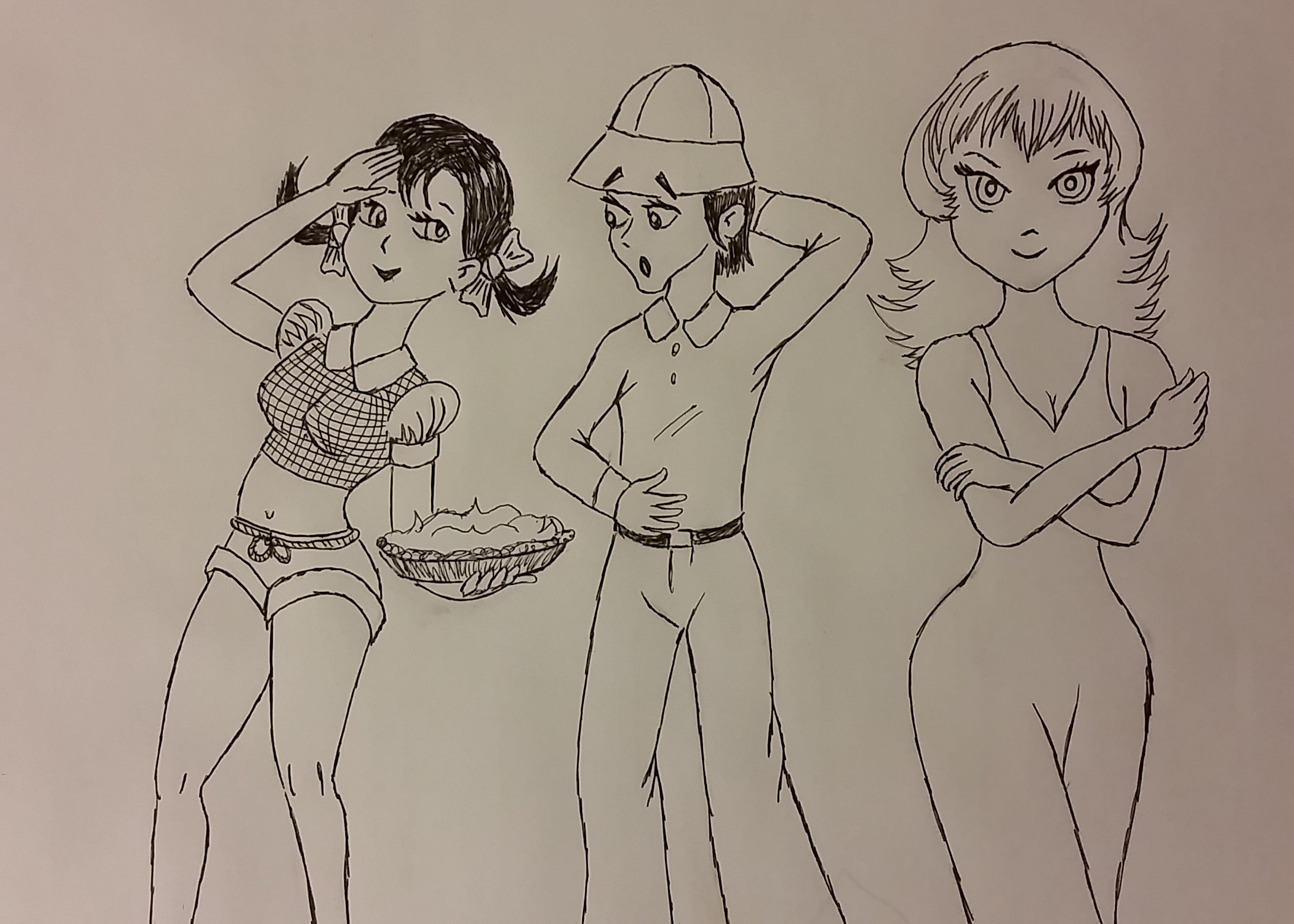
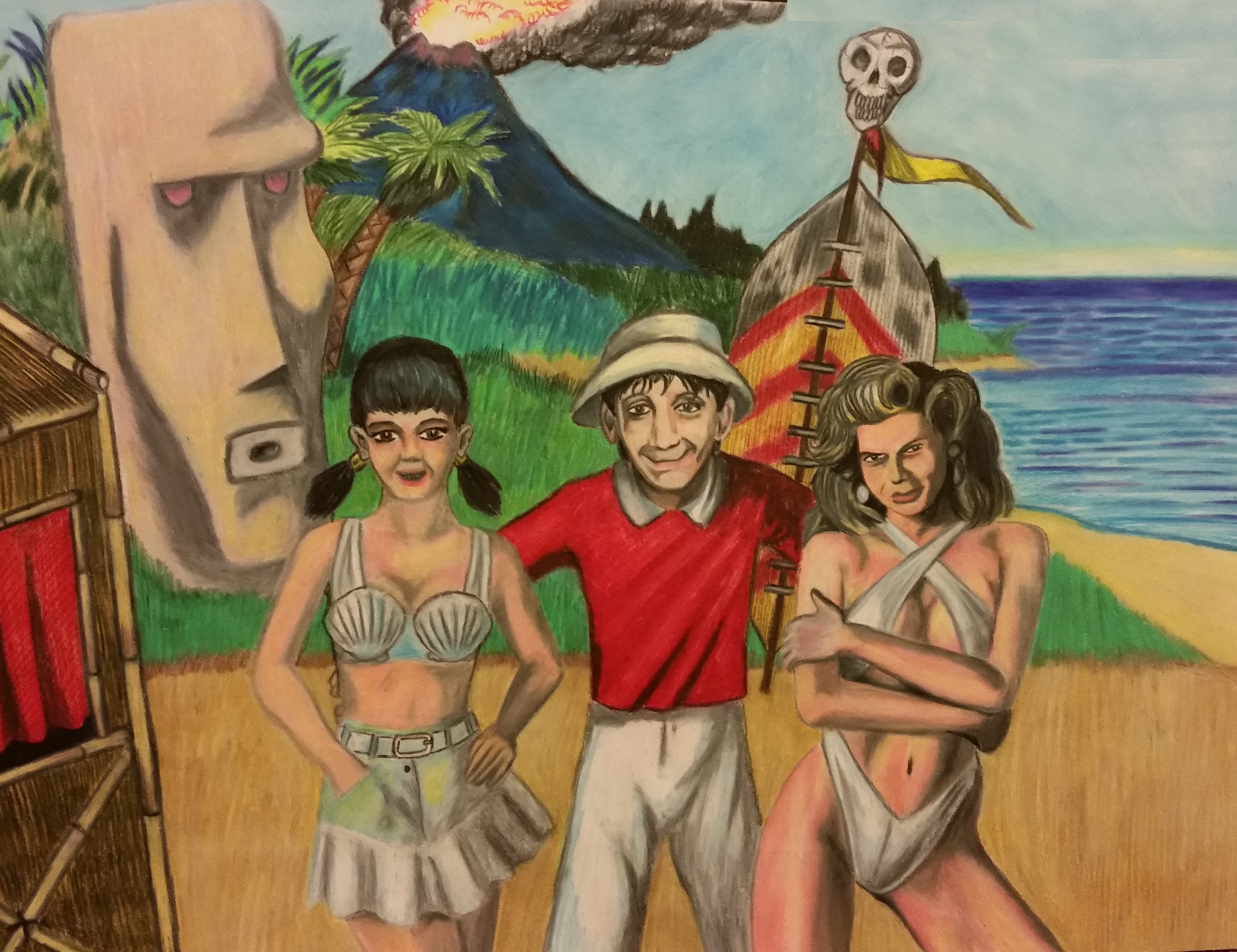
This picture is even harder to explain without me looking like a real fool. After all, if you are a real fool, it’s rather hard to hide that fact. In that last picture, I depicted something that related to one of the two girlfriends that I had to juggle at the same time back in the eighties. You see, I had set my heart on winning over Mary Ann whom I had worked with in the same classroom as she was the teacher’s aide assigned to the Chapter I remedial program I was teaching. She’s the girlfriend I took on visits to the Austin area on weekends. She had a sister in Austin, the one who lived in the nudist apartment complex, where she stayed during those visits. My parents lived in Taylor, Texas at the time, a nearby suburb. We dated regularly. She knew my terrible secret. She was a divorcee and I knew her terrible secrets as well. Ginger, on the other hand, was looking for a mate, and she lived in the apartment next door. She’s the one who would’ve hopped into bed with me anytime I asked. And she made no bones about wanting me to be hers. Needless to say, I could’ve written a TV sitcom about the majority of my love-life back then. It could’ve starred Jack Ritter as me. And I ended up with neither of those two young ladies. The picture, of course. is in honor of the kids in the eighties calling my classroom Gilligan’s Island because they thought I looked like the Gilligan actor, Bob Denver.
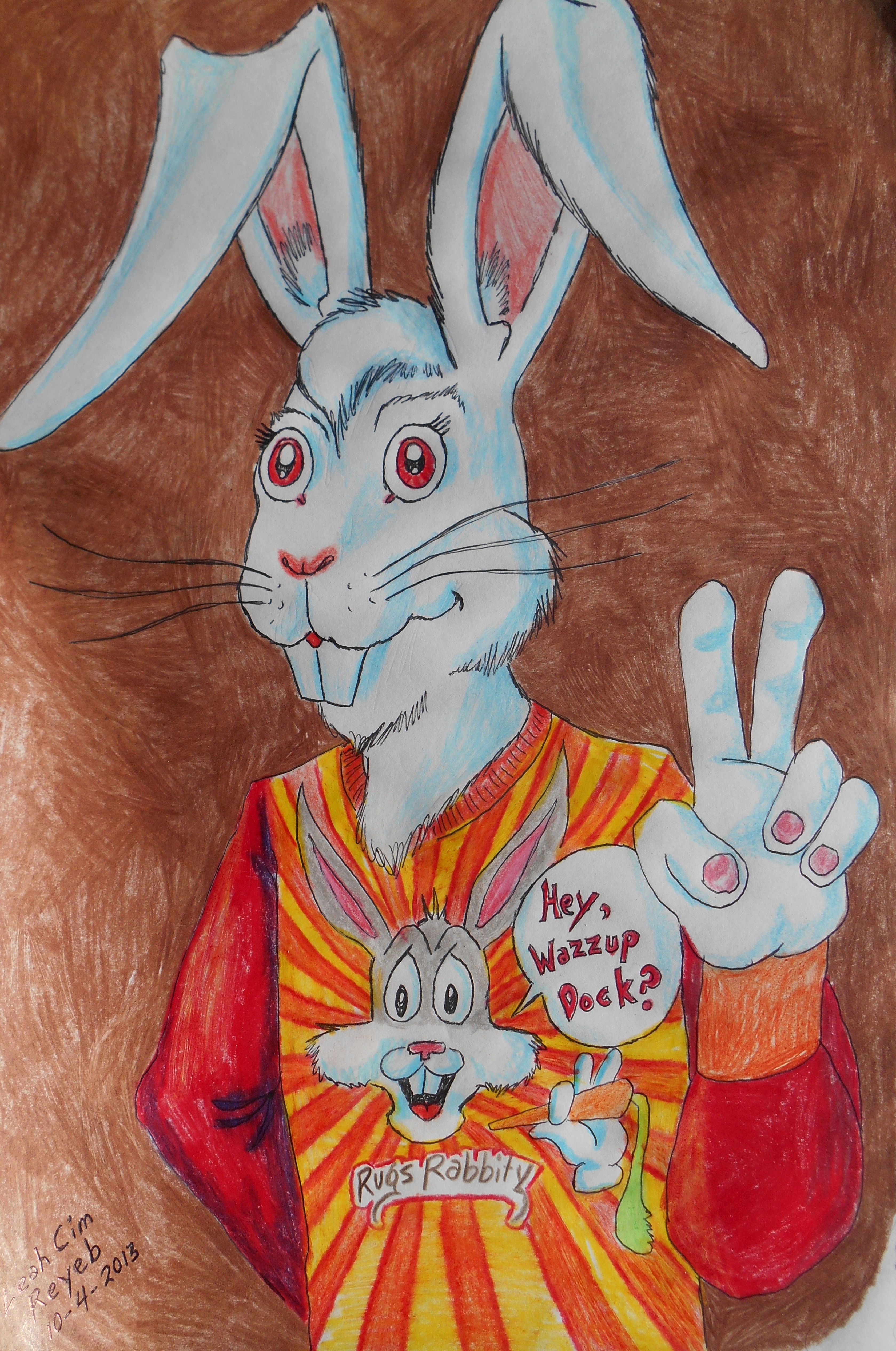
This is, of course, a portrait of Millis the rabbit in his accelerated-evolution form as a rabbit-man from my novel The Bicycle-Wheel Genius. That book, obviously, is a science-fiction comedy with a lot of unexpected plot twists. But the story behind the picture is one of a boyhood spent as a town kid in a farm-town community. Unlike the other kids in the Iowa Hawkeyes 4-H club, I couldn’t raise a calf or a pen of hogs as my 4-H club project. So, instead, I got in as a keeper of rabbits. Of my two original rabbits, a buck and a doe, I had a black one and a white one. The white one was a New Zealand White, a purebred white rabbit with red eyes, because the entire breed was albino. I called the white rabbit, the buck, Ember-eyes because his eyes glowed like fire in the night under the flashlight beam. The doe was a black rabbit I called Fuzz. Out of the first litter of babies Fuzz had, eight of the ten were white And of the two black babies, one died in the nest, and the other passed away shortly after he got big enough to determine that he was a male rabbit. I won’t go into how you determine the sex of a juvenile rabbit. So, almost all of the rabbits I raised before I discovered what a Dutch-belted rabbit was, were white with red eyes.
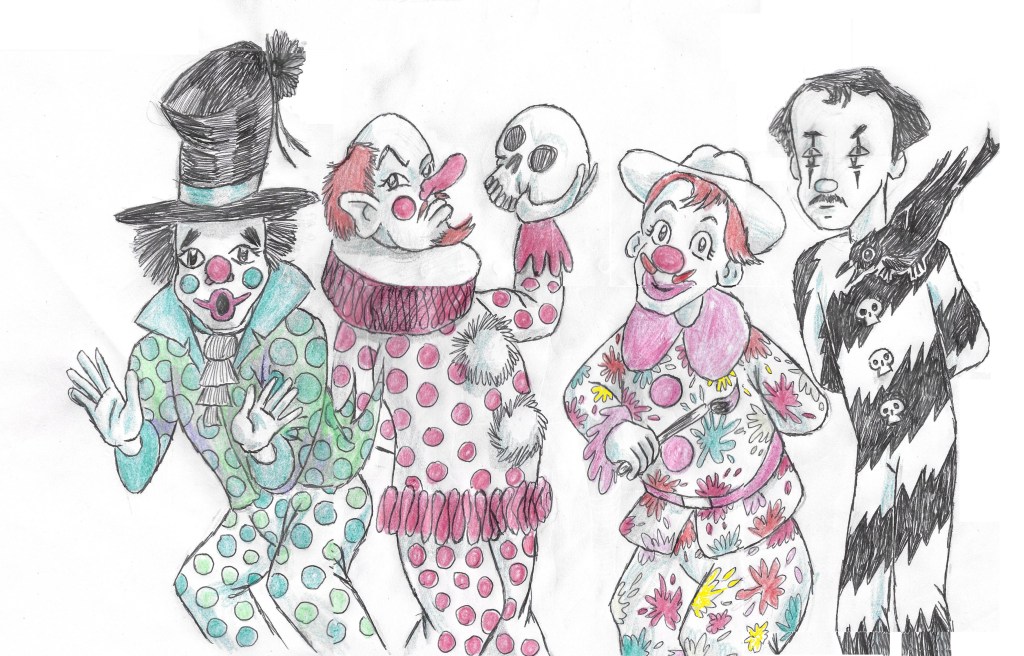
So, it is my thesis for today that every picture I make has some kind of story behind it. It may be totally boring, but still technically a story. So, there.
How do you foretell the future? Simply put, you don’t. But if you approach each new day, each new week, or each new set of circumstances without a plan and a rough idea of the near future, you are even more of a hopeless fool than Mickey is.
While it is true that a crystal-ball connection to the future would be really handy for figuring out what to do next with our little lives, it is also provably true that crystal balls, Ouija boards, and divining rods don’t actually work. Statistically even the best users of these fortune-telling devices are no better at foretelling the future than are well-informed guessers.
Ghosts are not provably real. You cannot actually talk to them. Not even in a graveyard at midnight with a dead cat to throw at the devil.
Oh, and that reminds me, the devil is not provably real either.
But I admit to talking to the dead.
My Grandma Beyer was one of the wisest people I knew in my childhood. She advised my Dad who was her son. She was a guide for the Beyer side of the family. And I talk to her a lot when I have a tough decision to make.
In 2017 I irrationally made a commitment to write for a nudist website. The article assigned was to go to a nudist park or resort and write about my first-time experience there. Of course, getting my wife to go along with her RV camper was out of the question. She was a Jehovah’s Witness in good standing then, and was sure that nakedness in a group was a terrible sin. But I had known nudists back in the 1980s when a previous girlfriend’s sister was living in a clothing-optional apartment complex in Austin, Texas. We visited there a number of weekends. I never actually stayed there or got nude while visiting. I saw naked people there, male, female, and children. And after my eyes popped out on the first visit, I picked them up, put them back in, and learned a lot about nudists while at the same time turning down all invitations… which I could do because my parents were living nearby, and I could stay with them and keep all my clothes on. But the nudist website assignment weighed heavily on me. Grandma Beyer had been the one that threatened to spank me before I was supposed to take a bath at her house because I wanted to run around the house naked rather than get in the tub with my sister. I was five at the time, not in high school… honest. So, she was the one I consulted when it came time to decide if I would actually go to a nudist park and be naked in front of other people just because I had made a commitment to a writing assignment.
Of course, she had been among the no-longer-living for fifteen years when I asked her about it.
The thing is, however, that I knew my grandmother well enough to know what she would say as I basically discussed it with her memory rather than her ghost. I even saw what facial expressions she used as she explained that it was more important to keep my word than it was to be a little bit embarrassed. And besides, it was not like I was going to an orgy or anything. Nudists are merely ordinary people who are dedicated to the belief that getting your vitamin D directly from the sun without any clothes between you and nature was good for you.
So, I made the visit, got naked, and wrote the article, as well as articles on this blog that were used on other nudist websites as well. It is how I came to be a member of the nudist writing community on Twitter. And that has helped me promote my books whether there were nudists in them or not.
Even with consulting a Ouija Board you are not really talking to ghosts. You get an answer from somebody with their fingers on the piece of plastic that picks the letters and is accessing their unconscious mind, or even their conscious mind if they are a bit of a dershenbugle (a word which doesn’t mean anything at all, just like the answer they picked.)
I often use a coin-flip to make decisions, adding an element of total chance to the decision I am making. (I admit, that’s how the decision to accept the writing assignment from the nudist blog was made.) If either answer to the question being asked is acceptable, but one causes a bit of anxiety, I flip a coin. Not just one coin. I throw three. Yes is three heads. No is three tails. Ten straight no decisions is indication not to decide at that time. In truth, this only works for me because it forces me to take an arbitrary amount of time to think about the decision. And often, I toss three heads when I have already decided to say no. And then I go with no.
So, divining the future is silly superstition, and I don’t do superstition. But that is not to say I don’t try to divine the obstacles ahead and prepare for them. And what looks like Mickey being an idiot about consulting coins or other signs, is really only Mickey being only slightly an idiot as he makes up his own danged mind.
Yes, she was a real car. My dad bought her in the 60’s as a used car. But she was a hardtop, not a convertible. She was the car he drove to work every day in Belmond. We called it the “Pink and White Pumpkin”, my sisters and I, referring to the pumpkin in Cinderella which the fairy godmother changes into a coach. But it would only later become the car of my dreams.
You see, she was killed in the Belmond Tornado of 1966. Her windows were all broken out and her frame was twisted. So the pictures of her, though they look exactly like my memories of her, minus the rust spots, are not actual pictures of the car in question. Our next door neighbor, Stan the Truck Man, was a mechanic always on the lookout for salvage parts. He took her apart piece by piece while she sat in our driveway. We continued to sit in her and play in her until all that was left was the bare frame. My friend Werner told me for the first time about the facts of life and where babies really came from in the back seat while she was being gradually dismantled. Of course, I was nine at the time and didn’t really believe him. How could that grossness actually be true?
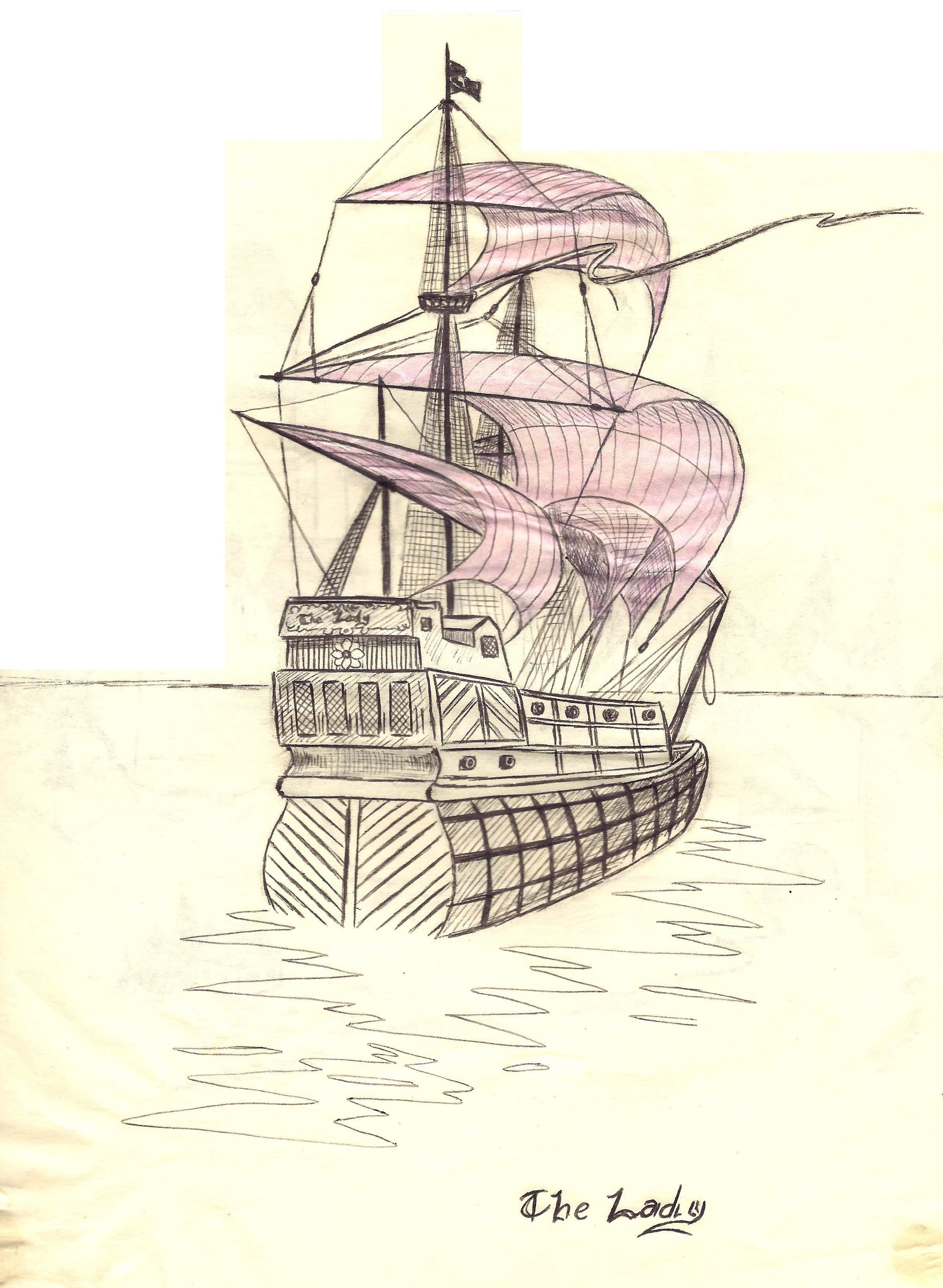
But she still lives, that old dream car… She is the reason that I objectify my imagination as a ship with pink sails. My daydreams, my creative fantasies, and those long, lingering plays in the theater of my imagination as I am drifting off to sleep all start in the three-masted sailing ship with pink sails. And that dream image was born from the Pink and White Pumpkin. I have sailed in her to many an exotic place… even other planets. And when I die, she will take me home again.
It came to an end for Justice Ginsberg after 87 years. It will come to an end soon for my father too. He is in hospice care at 88 years and eleven months. Her turns 89 in October. But he is deteriorating every day now. The final destination can’t be too much farther down the road for me either.
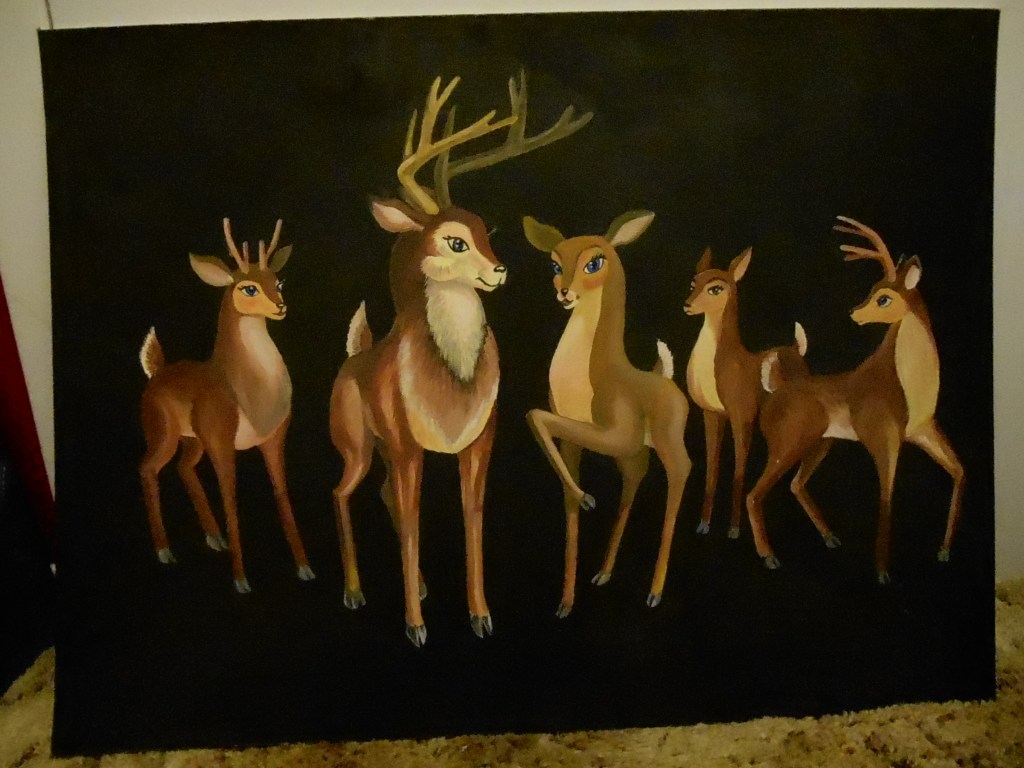
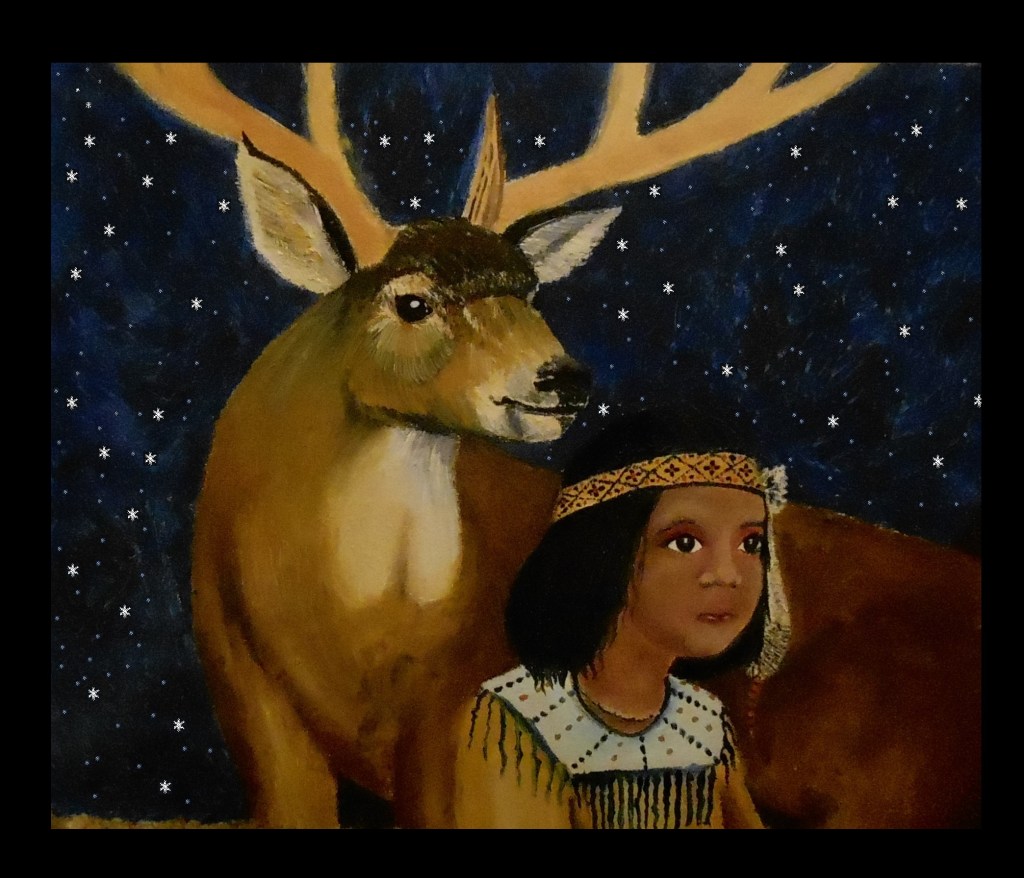
Life is not a Disney movie with Bambi in it. My mother made it out of the meadow alive when I was small.
But, when you think about it, after a cute and funny childhood, there was that moment behind the car tires when trauma struck, at age ten, and after that I had to grow up faster than should have been necessary. And in my youth and in my prime, I had to struggle to prove myself. Against other bucks, and hunters with guns, and… at the end of the movie, it seems like the whole world is on fire.
So, maybe life is like a Disney movie with Bambi in it. And maybe I have to make my own happy ending.
Perhaps Bambi is my spirit-animal. The one who protects my family. My patronus. My guardian angel.
No matter how I take it on, it has been a long and wearying road to follow. And the journey now is nearly complete. But the last few miles are always the hardest to bear. Still, I know the journey has been worth it. And there will be rest to be had in that last meadow. RGB already knows it. Soon my father will too. Peace be upon us, for we have earned it.







 Catch a Falling Star
Strawberry Fields
This foolish essay about berries that mean love to me is only partly inspired by the Beatles song, “Strawberry Fields Forever.” That’s because, of course, their song was only about meditating. In the lyrics they take you to the “Strawberry Fields where nothing is real… but it’s nothing to get hung up about…” They are talking about a blissful place of no worries where we all need to go. And then staying there forever.
This, of course, I could never do. Worrying about the future is tattooed on my behavioral imperatives in the dark part of my stupid old brain. And while I often found that place of no worries, and lingered there for a bit, I found you could never really get anything done if you stayed in that state of strawberry fields forever.
But don’t get me wrong, strawberries are a critical part of every healthy mental diet.
You see, my meditations on strawberries when I was a child of eight, nine, and ten centered on the strawberry patch at Great Grandma Hinckley’s place.
She was, as I incorrectly recall, slightly older than Jesus when I was that age. By that I mean, though she seemed museum-quality ancient to me, I had derived wisdom about life, love, and laughter from her before Sunday School taught me any of those things said in Jesus’s words.
And I was given the task of mowing her lawn in the little plot of land surrounding her little, tiny house in the Northern part of Rowan where I also lived and grew and celebrated Christmas and Halloween and Easter and the 4th of July. And though I was doing it because she was so old, I never even once thought she was too old and frail to do it herself. Grandma Hinckley’s willpower was a force of nature that could even quell tornados… well, I thought so anyway when I was eight. And she gave me a dollar every time I did the lawnmowing.
But there were other things she wanted done, and other things she wanted to teach me. There was the garden out back with the strawberry patch next to it. She wanted me to help with keeping the weeds and the saw grass and the creeping Charlie from overrunning the strawberries and choking them to death. (Creeping Charlie wasn’t an evil neighbor, by the way. He was a little round-leafed weed that grew so profusely that it prevented other plants from getting any sunlight on their own leaves, causing a withering, yellowing death by sunlight deprivation. I took my trowel to them and treated them like murderers. I showed them no mercy.)
And Grandma always reminded me not to be selfish and eat the very berries I was tending in the garden. She taught me that eating green strawberries (which are actually more yellow than green, but you know what I mean) was bad because they could give you a belly ache, a fact that that I proved to myself more than once (because eight-year-olds are stupid and learn slowly.) She also taught me that it is better to wait until you have enough strawberries to make a pie, or better yet, strawberry shortcake with whipped cream. She taught me that delayed gratification was more rewarding in the long run than being greedy in the short run and spoiling everything for everybody.
She always gave me a few of the ripe strawberries every time I helped her with them, even if I had eaten a few in the garden without permission. Strawberries were the fruit of true love. I know this because it says so in the strawberry picture. Even though I probably never figured out what true love really means.
My Great Grandma Nellie Hinckley was the foundation stone that my mother’s side of the family was built on. She was the rock that held us steadily in place during the thunderstorms, and the matriarch of the entire clan of Hinckleys and Aldriches and Beyers and other cousins by the dozens and grandchildren and great grandchildren and even great great grandchildren. I painted the picture of her in 1980 when she passed away. I gave it to my Grandma Aldrich, her second-eldest daughter. It spent three decades in Grandma’s upstairs closet because looking at it made Grandma too sad to be so long without her. The great grandchild in the picture with her is now a grandmother herself (though no one who has seen this picture knows who it is supposed to be because I painted her solely from memory and got it all wrong.) But Grandma Hinckley taught me what true love means. And true love has everything to do with how you go about taking care of the strawberry patch.
Leave a comment
Filed under artwork, autobiography, commentary, family, health, humor, mental health, Paffooney, philosophy, strange and wonderful ideas about life