
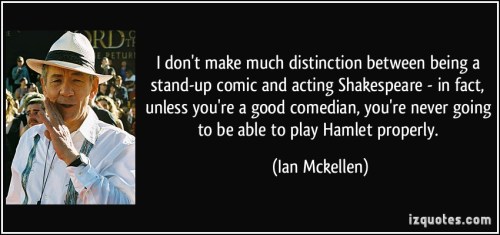
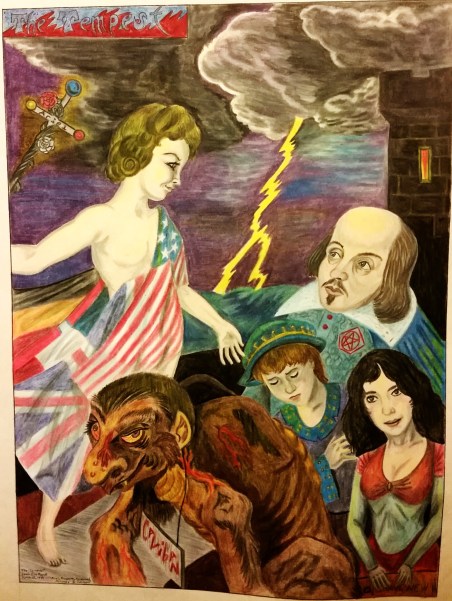
The fact that Shakespeare was a master of the art of creating and mocking fools does not really help decide the question of who Shakespeare really was. A stage actor who owned a theater in Elizabethan times and apparently focused on being the bit player, the butler, the second man on the castle wall in the great plays, would certainly know enough of flim-flam, being a con man, or artfully throwing turds at kings and queens in ways that get rewarded rather than beheaded. But a nobleman who has unpopular and unwelcome-but-probably-wise insights into the back-stabbing-goings-on of the royal court of England would equally be capable of putting the most memorable of critiques of humanity into the mouth of the fool or the clown in the great stage-play of life. Even the most depressing and violent of the Shakespearean tragedies is enhanced and made pointed by the presence of the fool and the comic relief. In some ways everything that Shakespeare wrote was a comedy.
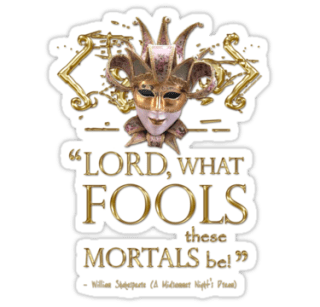
Whoever Shakespeare was, he shared Mark Twain’s overall assessment of “That damned human race” and often declared all men fools in the eyes of the playwright. Puck’s observation on humanity is delivered about not only Bottom and the other poor players who carry on their vain attempts at performing Pyramus and Thisbe while Bottom magically wears the head of an ass, but also the easily fooled lovers who mistake their true loves for one another, and even the clueless mortal King Theseus of Athens.
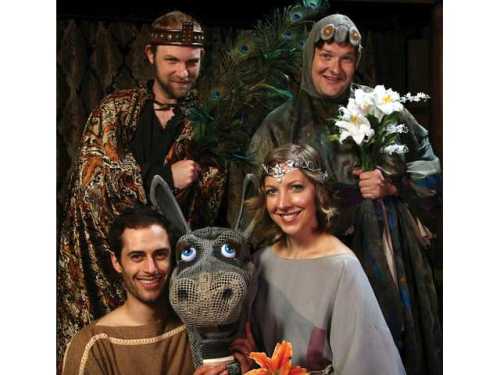
In the play within a play, Nick Bottom wants to be not only his own role, Pyramus the romantic lead, but argues that he should be Thisbe, the lion, and Pyramus all at once, making a satire of human nature and its overreaching ways that we could only pray Donald Trump will one day watch and magically understand. In fact, Shakespeare’s entire body of work is an extended investigation of foolishness versus wisdom, and with Shakespeare, the verdict always goes to the fool.
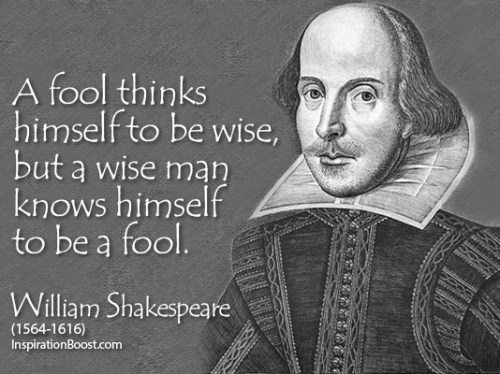
The plays of William Shakespeare are filled with fools doing foolish things… and fools being accidentally wise. (Think Jacques in As You Like It giving his famous “All the world’s a stage” soliloquy in which he elucidates the seven ages of man.) There are fools too who prove to be wise. (Think of the ironic advice given by the jester Touchstone in As You Like It, or the pithy commentary of King Lear’s fool). The fools in Shakespeare’s work are not merely the comedy relief, but the main point that Shakespeare makes about humanity.
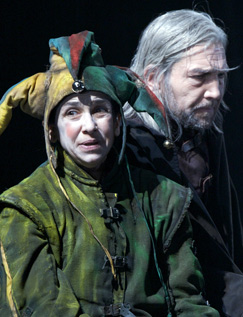
Whoever the man was who wrote the plays of Shakespeare, he was someone who had a deep understanding of the basic irony underlying all of human life. And someone with that vital sense of the bittersweet, a philosophy of life that encompasses the highest heights and lowest depths that a soul can reach, is someone who has suffered as well as known great joy, someone who has experienced loss as often as profit, and has known real love as well as real hatred. It is the fool that Shakespeare shakes us by the neck with to make us recognize the fool in all of us which makes the plays resonate so deeply within us. It is watching the path of the fool unfolding that makes us shake our head and say to ourselves, “Yes, that is what life is really like.”
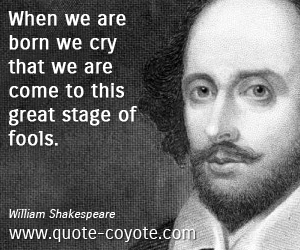
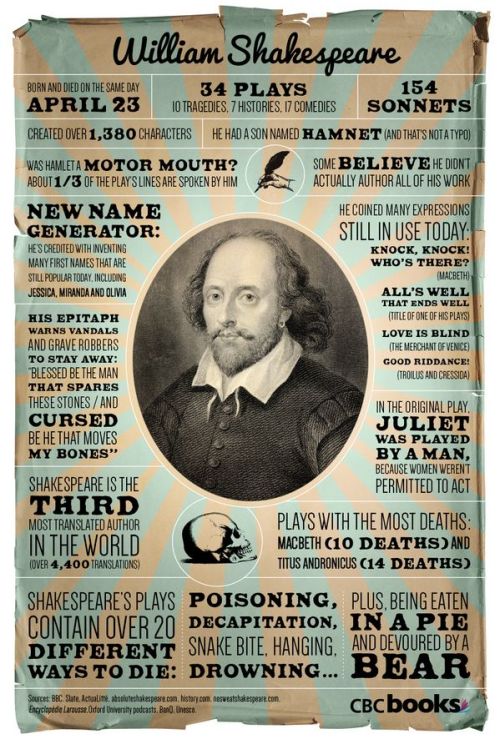








 Catch a Falling Star
Infinite Monkeys
The theorem goes, “If you sit an infinite number of monkeys behind an infinite number of typewriters and let them tap away at random for an infinite amount of time, they will eventually come up with all the works of Shakespeare, and in addition to that, all the works of literature that have ever been written and ever will be written.”
Now, that is a daunting theorem. All the great works of literature by Mickey will be recreated by monkeys? And even worse, they will probably produce much better versions of all of it. Plus versions of it written in German, Mandarin Chinese, Urdu, and Californian (a really difficult language to translate.) All languages ever created on all the planets of the universe, as a matter of fact. The proof is there. It hinges on the mathematically precise definition of “Infinite.”
But you have to remember, infinite is the biggest number there is.
So many variations will be there in the truthfully infinite amount of stuff that infinite monkeys will produce that one version of Shakespeare’s Hamlet will have a final act where, instead of everyone dying or accidentally killing themselves, Hamlet will talk them all into putting on yellow chicken costumes and dancing with hula hoops as a means of acquiring absolution for their sins.
And a version of it will also exist where all the letter “B’s” will be replaced by “P’s” and all the vowels will be doubled so that Hamlet’s famous soliloquy will begin, “Too pee oor noot too pee, thaat iis thee quueestiioon…”
Accurately imagining the conditions required to have infinite monkeys tapping out infinite works of literary art means that any ridiculous thing that Mickey thinks of will have to actually be typed out by one or more (or infinite) monkeys in all of that infinite monkey writing. Somewhere Eugene Ionesco’s play Rhinoceros will have nothing but characters who are rhinoceroses at the beginning of the play who turn into human beings by the end of the play. (That is the exact opposite of the real French absurdist’s play, for those of you who did not have to read such stuff in college literature courses.)
In fact, in order to think up all the ridiculous variations of every work of literature would take Mickey an infinite amount of time. Mickey probably doesn’t really want to live that long.
‘
And then there is also the question of the physics of infinity. Is the universe itself, I mean, the one we all live in presently, actually infinite? Astrophysicists don’t think so according to current observable data on the astronomical model of this universe. And then you have the problem of infinite monkeys made of infinite matter. The universe would be filled to overflowing with infinite monkey-matter. And that leaves no matter or space to be used for infinite typewriters. The whole universe would be monkey-matter. And that would also mean no room for bananas, or, in fact, any monkey food of any kind. What is going to motivate the infinite monkeys to work for an infinite amount of time on their monkey literature which they won’t have typewriters to write on anyway?
And then there is another horrible thought that occurs to me. In this picture to the left, do you see the evil monkey? Believe me, if you have an infinite amount of monkeys, one or two (or possibly an infinite number of them) will definitely be evil geniuses.
And evil monkeys do evil monkey-business.
At least one or two (or possibly… you know…) evil monkey geniuses will disassemble infinite typewriters to make infinite doomsday devices. Typewriters will be re-engineered into computers and will become filled with monkey-viruses that will rewrite the operating software of the universe. And then, everything becomes an infinite monkey-villain paradise where the evil geniuses among the monkeys will live the perfect life for monkey criminals full of monkey crimes and monkey debauchery and the kind of infinite chaos that infinite monkey-villains enjoy.
This thinking about infinite monkeys leads to one very definite infinite-monkey conclusion; WE DO NOT WANT TO MESS WITH GIVING INFINITE TYPEWRITERS TO INFINITE MONKEYS!!!
1 Comment
Filed under commentary, goofiness, goofy thoughts, humor, philosophy, strange and wonderful ideas about life