Canto 36 – Aerobase Frieda
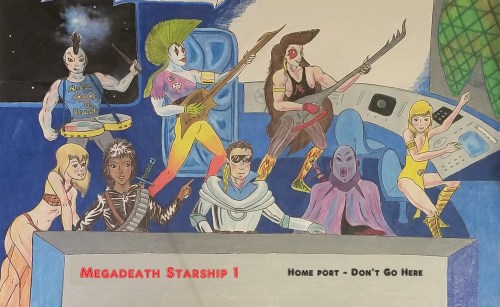
Frieda began to enjoy lots of company both from the planet Don’t Go Here and from the Imperium beyond. Tron Blastarr had shared Frieda’s location as an open port to all his merchant and corsair friends. Arkin Cloudstalker’s Lady Knights were frequent visitors and one of them, Tabitha Blue Arrow, opened an inn and entertainment center at the starport. Don’t Go Here Downport began producing merchant ships of a superior kind designed by Frieda with no input from anyone else. The controls were so high-tech and simple that even cave children from Don’t Go Here could fly them.
Frieda found herself entirely too limited with the spaceport as her only body. She needed a more humanoid-friendly interface, and began work on a human-shaped robot body. She scanned Tara Salongi as her model, but improved upon the design by making the body out of gleaming, chromium-alloy high tech metal with black adamant metal for the hair. She made the body anatomically correct and even designed for herself modest black synth-leather attire.
It was during a high-activity business day that the Monopoly Brigade came to visit. Fez Amin docked three Brigade Corsairs at the starport with a password that Frieda would later determine came from a tortured prisoner, a captured Pinwheel Corsair.
Trouble began at the administration desk at the center of Aerobase 1. Fez Amin and two tattooed cohorts started an argument there with the Dion girl who was working the desk for the Salongi family.
“I don’t show any of my documents to a Scaly who isn’t even a Galtorrian,” said Ox, the Monopoly Brigade Lieutenant who wore snake tattoos all over his naked chest and arms.
“Yeah,” said Fez Amin. “How does a low-level Scaly like you get such a job? They must really be raking the bottom of the barrel at this world.”
The girl was a brown-skinned Dion. She was as naked and as vulnerable as the day she hatched from her egg, but you really couldn’t tell by looking at her. She could have been wearing a dino-skin swimsuit as far as her outward appearance went. She had no hair, as with all Dions, male and female alike. Her shapely brown tail switched nervously back and forth as she stared at the tattooed men before her.
“All right! What’s the problem here?” asked Bam-Bam Salongi, approaching the desk.
“No problem, Alley Oop. We just don’t want our papers examined by a Scaly witch like this one,” growled Ox.
Mustapha Aga, the third Brigade Commander, added, “She’s been staring at our human beauty with those ugly snake eyes of hers.” He flexed a bicep with a tattoo of a woman on it.
“Let me see your documents,” said Bam-Bam coolly.
“Look at this,” said Mustapha Aga. He pulled out a laser pistol and shot it. Bam-Bam was wearing a leather administrator’s suit, more protection than his old Fredsuits would’ve afforded, but the ray burned right through his chest, killing him instantly.
The Dion girl began screaming. Ox grabbed her and put a gun to her head. Everyone in the spaceport office froze with fear and indecision.
Tara came storming into the room, livid with the offenses against her people, and shocked with the suddenness of her father’s death. A spear of raging hatred lanced out of her mind and turned Aga’s brain into boiled peanut butter. The tattooed pirate fell dead in writhing agony that lingered for ten minutes.
“Well, well. Some of the cave people have some real fight in them.” Fez Amin folded his arms and grinned at Tara, daring her to try the same on him.
“Let Taquira go, pirate!” Tara ordered.
“Make us,” said Amin, putting a booted foot on the back of Mustapha’s corpse. “I dare you.”
Tara didn’t waste a heartbeat with her deep probe. Most men would’ve crumbled before her powerful mental attack, but Fez Amin radiated a powerful mental shield. He was not a telepath, but no stronger mind could be found among non-telepaths. She tried to probe and take control of Ox instead, but he had some sort of metal plate in his head that reflected Psion energy.
“What do I have to do to make you release the girl and go away?” asked Tara.
“I like you,” said Amin. “You have spunk. Take the Scaly’s place and come with us. Your life for hers.”
“You will leave this planet alone?”
“You have my word as a gentleman bandit.”
Frieda’s robot self had arrived in the office and stood looking at Amin with expressionless silver eyes. “Don’t do it, Tara. You are more valuable than the Dion. I can destroy him and his ship if I don’t have to worry about you being on board.”
“My, my! What a testy little toaster you are,” said Amin. “Go away and leave this between the girl and me.”

“If I assume I’m somehow superior to the rest of my people, then I am no better than he is,” said Tara. She looked at Frieda with a hard set to her jaw. “Tell Ged Aero that I love him, and I will come back to him as soon as I can.”
“How can I help you now?”
“Keep this world safe for me. Don’t let any more creeps like this in if you can stop it. Goodbye, Frieda!”
Tara dropped her guard and let Ox take her. Taquira the Dion girl ran to Frieda as soon as Amin let her loose. Tabitha had also shown up to see the end of the exchange. She ran to the body of Bam-Bam Salongi and cradled his head in her lap. Fez smiled like the fox that just ate the fattest hen in the coup. He and Ox backed away toward their ships with their prize.
“I can ready my corsair and go after them, Frieda,” offered Tabitha Blue Arrow.
“We cannot put Mistress Tara’s life at risk,” said Frieda. “Trust that the girl is clever and powerful enough to find her own means of escape. I don’t believe we’ve seen the last of either one of those two people, the Princess or the Bastard.”
Taquira, the Dion girl, cried on Frieda’s cool metal shoulder. Frieda petted her comfortingly with a metalloid hand.