
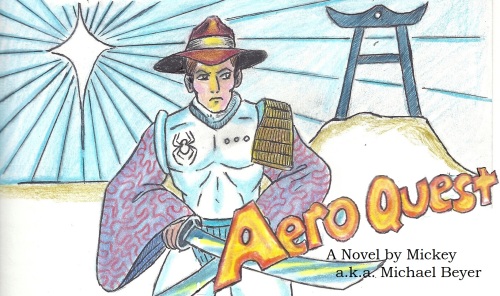
The question may arise if anyone who wasn’t forced to read the novel Aeroquest because they have the misfortune of being my relative ever actually reads the book, “Why did you ever write such a gawd-awful thing?”
The truth is, I didn’t write it, not by myself at any rate. The essential plot of the novel is such a jumbled mess because the story is lifted directly from a game of Traveller, an RPG from Game Designer’s Workshop. The basic characters in the novel were all player characters. Their design and personalities are created by adolescent boys in the 80’s and the paths they chose in the story strongly reflect the chaos of youth.


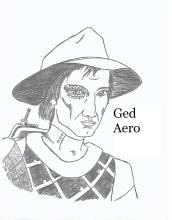
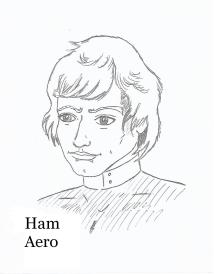
The Aero Brothers, Ged and Ham were both created by one of my favorite students of all time. I will refer to him here as Armando Carrizales, though that was not his real name. I am trying to explain the novel here, not mortify an adult former student living somewhere in Texas, or even elsewhere. Armando’s idea was to use Star Wars characters. Hamfast Aero was actually Han Solo in the game. And when Armando wanted to create an all-powerful psionic character, he created brother Ged Solo, using the first name of Larry Winslow’s character Ged Stryker (And Larry did not know how to spell “Jed”). Because I really liked Armando, and he was bright, creative, and a good problem solver, I eventually chose his characters as the main characters of the novel. He was good at organizing expeditions, collecting gear and matching it to the purpose in the adventure before him. But you do need more than heroes for an adventure game, or for a novel.


Emilio Jalapeno was a very different kind of kid, but also Armando’s real-life best friend. He was a skinny kid with a goofy grin, and was always ready with a joke or prank that would either make you laugh, or make you palm your forehead and consider murder. His first Traveller character lasted all of fifteen minutes because he decided he wanted to take his shiny new pistol and kill everyone on the entire planet they were on. That character, whose name I have forgotten, was actually gunned down by his own adventuring party. So Emilio had to start again.
He created the character Trav Dalgoda. He got the name from the first syllable of the Traveller game and a name he spotted on the cover of a magazine laying on the table. Trav was simply Emilio in an RPG form. He wanted to have an eye patch like a pirate, but he wanted to have two eyes. He wanted to wear wide ties with messages on them, like a cartoon screw next to a baseball. And he dearly loved to blow things up. A time would come in the adventure where he had access to really big weapons, and we had to let him experiment with killing everybody on an entire planet. This, then, was the needed comedy relief that kept us laughing through shared adventures. And Trav’s ability to get into really big trouble would eventually drive the plot forward.
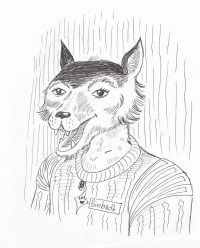
Sinbadh the Lupin, a dog-headed humanoid alien, was also Emilio’s character. The fact that he based his entire character on talking like a pirate from Treasure Island was a source of endless hilarity.

Tron Blastarr, the scar-faced villain, was created by Armando again. There was a time when Larry Winslow wanted to create a villain character in the most desperate way possible. But the evil villain Mantis, who was really just a living head on a robotic body, and the enigmatic psionic Xavier Trkiashav never really got their chance to be truly villainous. One became a laughable boob while the other became a hero and the leader of the Psionics Institute. Tron, however, was a perfect pirate. He led the band of adventurers on merry chase after looping, curling space chase, eventually becoming the first player character to get married and have children. He retired as a villain with a fleet of stolen space ships, and a planet (the airless world Outpost1) as his pirate treasure.
So, to claim I wrote the novel Aeroquest on my own is to completely overlook my collaborators. It is a mess of a comedy sci-fi novel that I am still trying to iron out and rewrite, but it is also a story I shared with some who were very near to my writer’s heart.







Writing the Critical Scene
It is a novel I started writing in 1998 with an idea I first got in 1976. So I have been working on this book for either 20 years, or 32 years, depending on when you want to credit the actual work to have started.
It got it’s theme from the fact that I was sexually assaulted when I was ten in 1966, and the feeling the repressed memory of the trauma caused in me whenever I asked myself the question, “Am I a monster?”
Unfortunately the answer to that question, for practically everybody, is, “Sometimes yes.”
Psychological damage sticks with you for the rest of your life. It makes you flinch at things that other people don’t. More than once I must have confused both my mother and old girlfriends when I was compelled to wriggle out of hugs and physical contacts by panic. I felt unlovable. I felt like a monster. And for a lot of that time, I didn’t know why. But it is a novel critical for me to write. Pain needs to become art in order to completely go away. I need to imprison the feelings and ideas in a book.
I am now at the point in that novel where I must write the scenes at the crisis point, the high point of the action, and I have to control the flinching. I have to control the reactions I could so easily fall into. It is critical that I get the scene right. The success or failure of the whole novel is at stake.
I have played it over and over in the cinema in my head a thousand times… several thousand times. It is difficult. But it is there. Soon I will have it down, crystallized in words. It make take considerable time to publish it, though, because editing it will be at least as hard as writing it. And I seriously have to get it right.
Leave a comment
Filed under commentary, Depression, feeling sorry for myself, horror writing, monsters, novel, NOVEL WRITING, Paffooney
Tagged as The Baby Werewolf