My title for today has at least a double meaning, if not a triple or fourple one.
“Fourple?” you say.
Yes, four plus the color purple. Purple, after all is the dominant color used in the video game “The Legend of Hoodwink“.
And, of course, the video game is not real. It is the virtual reality video game used in the story as the secret land that the orphans and their mother’s friend flee the authorities to live in after the deaths of the Brown family’s parents.
So, I have been living in the world of Glammis, the imaginary game world inside a mainframe supercomputer. I started this story back in the 1980’s, inspired just a little bit by the Disney movie Tron. Of course there are all kinds of more current technological details to employ to make the story more up to date. The story has been reset to 1999. (I don’t write stories set in the 21st Century. I just don’t. Mark Twain never set one in the 20th.) And one of the ways to create the game-world of the story is to draw pictures of it that I can use as illustrations in the book.
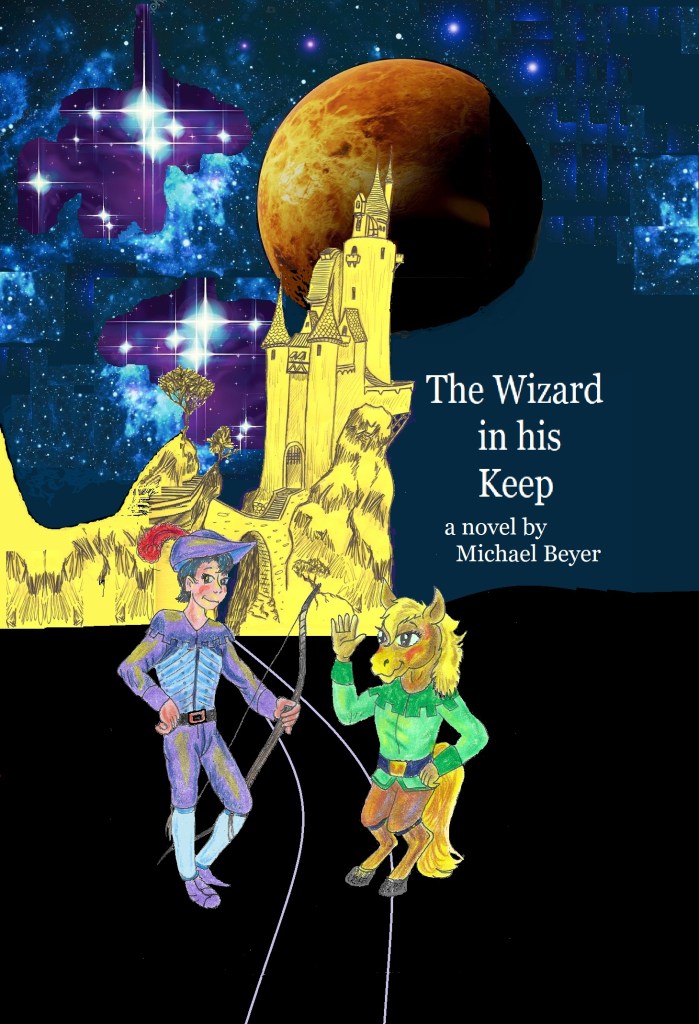
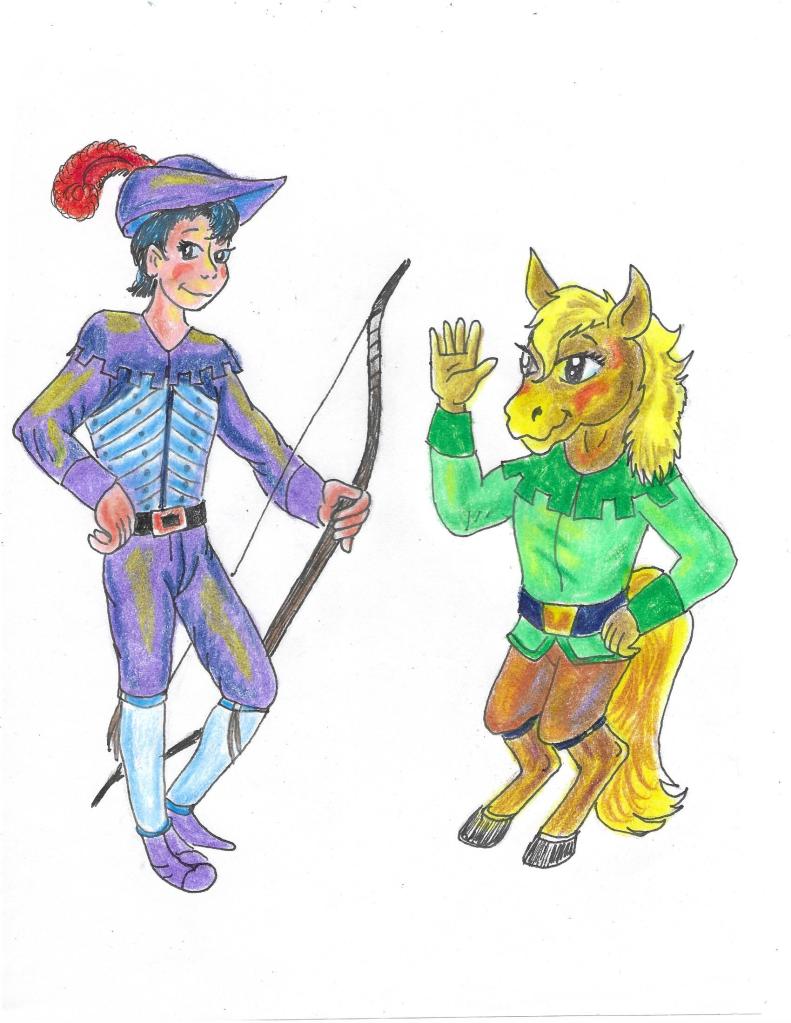
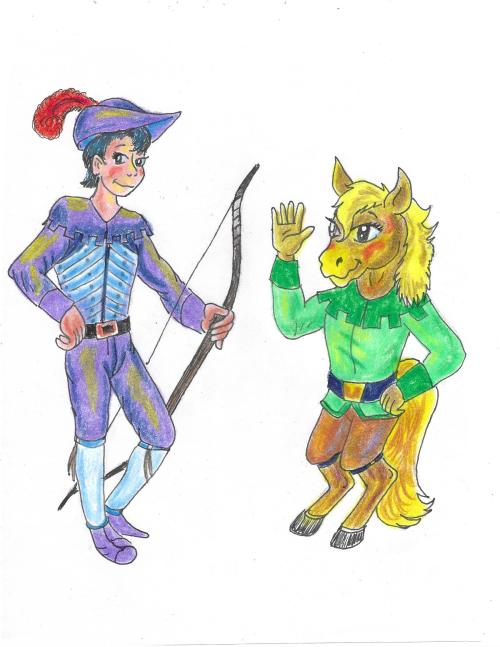
Hoodwink and Babbles (the horse-headed Kelpie) are both game characters that play key roles in the story. They transform from game characters following the script to real people fighting for their lives and honor in the course of the story.
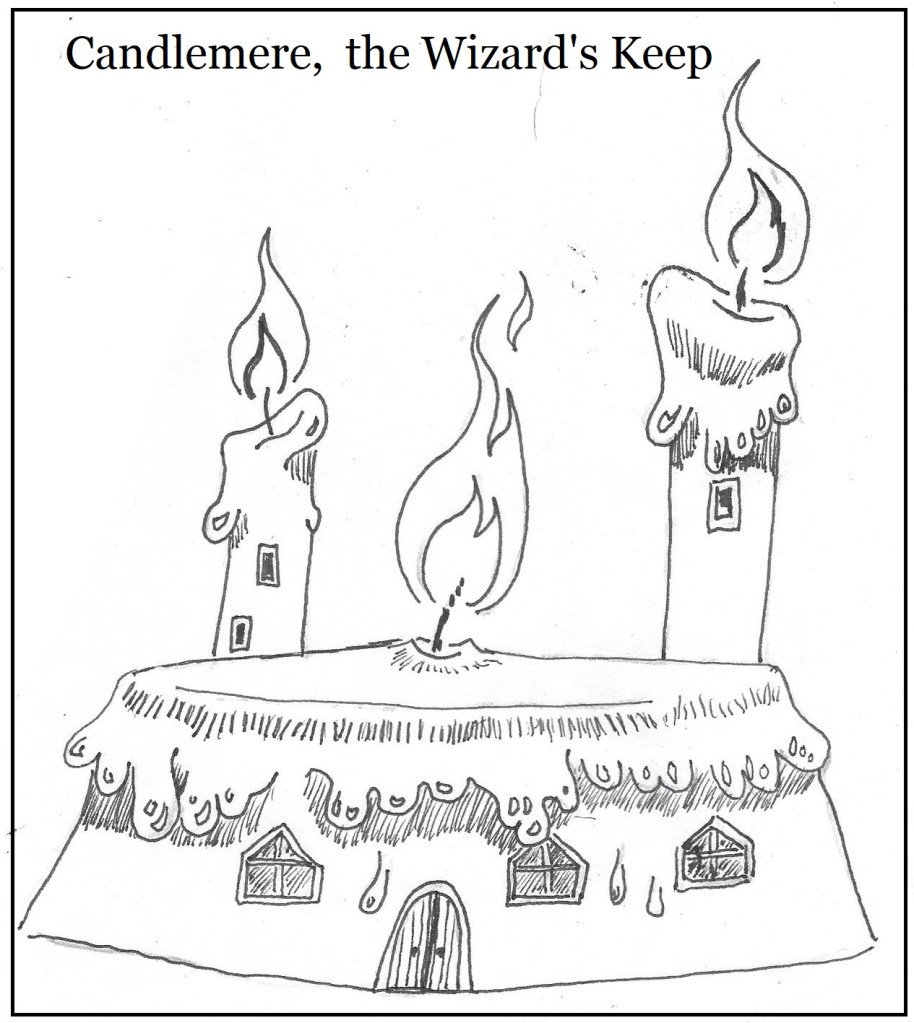
A key setting is the candle-castle called Candlemere, for obvious reasons. The wizard, Milt Morgan, lives there, though he is a real person from Iowa living in Texas as a game designer.
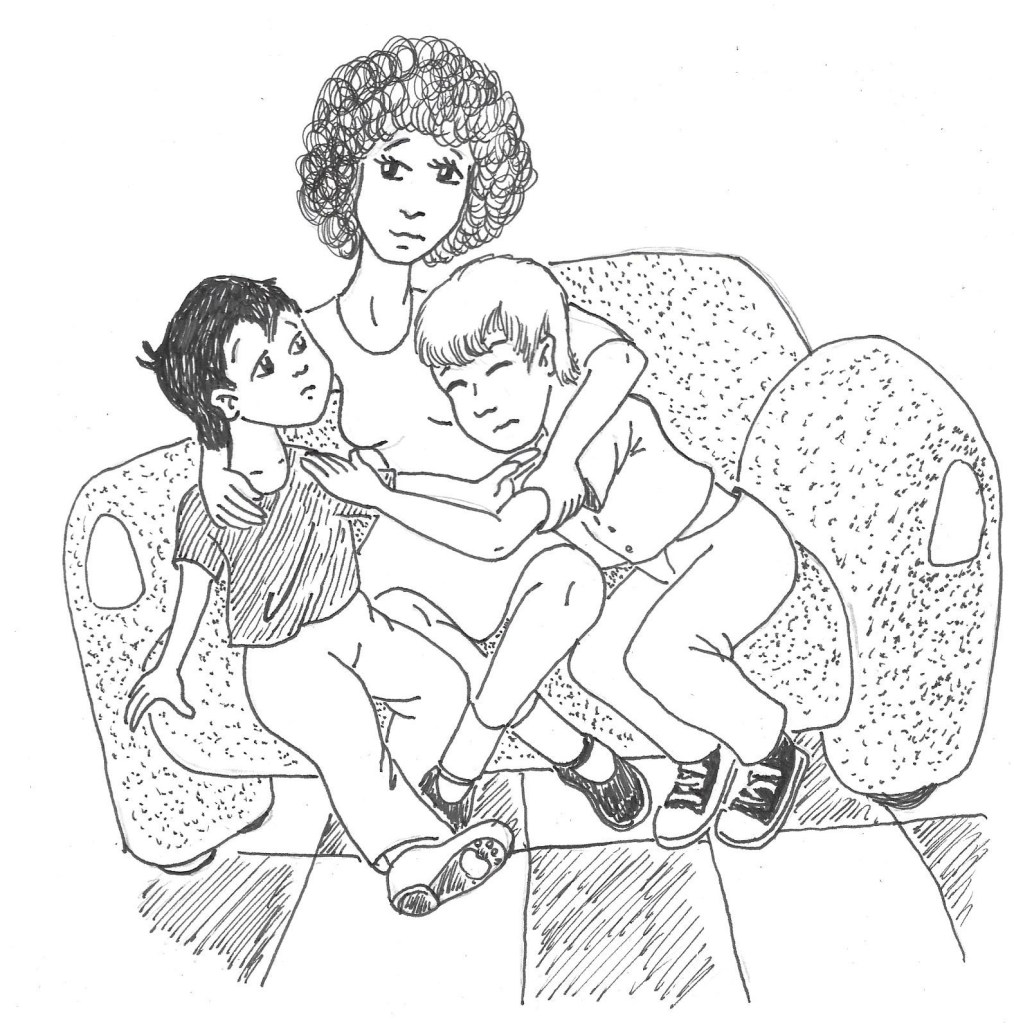
These are the three orphans that Milt Morgan has rescued after the car crash. Mortie Brown, Daisy Brown, and Johnny Brown now live in Glammis after the deaths of their parents, Brom and Stacy Brown.
The three orphans are being pursued in the real world by an FBI agent, a relentless tracker and pursuer named Agent Brent Clarke. What the kids don’t know is that Agent Clarke is trying to find them for their grandparents that they don’t realize are still alive. And Clarke is also their uncle, their mother’s older brother.
In the video game, they are pursued by the evil Daniel Quilp, who is in the video game playing the wicked King Murdstone of the Chelsrod’s Spire. He is not a relative. He is secretly the enemy of their parents and the wizard Milt Morgan.
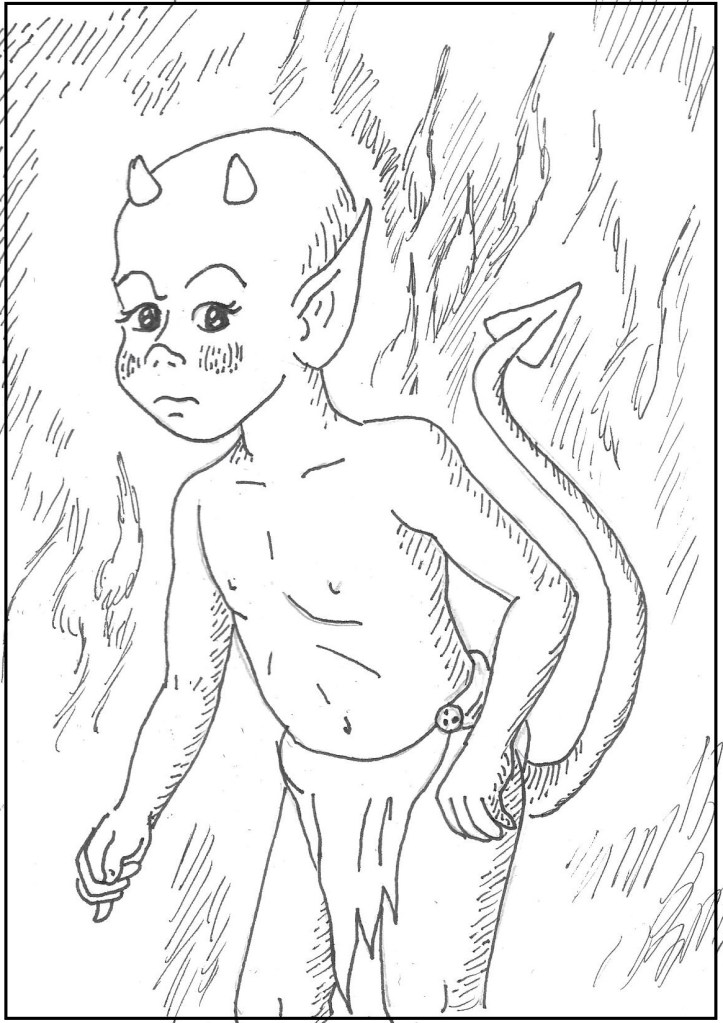
The servant of Murdstone in the game is Errol of the Devylkind. He is more than he appears to be as well. He is another player character who is also very much acquainted with Daisy in the real world, and has a huge crush on her.
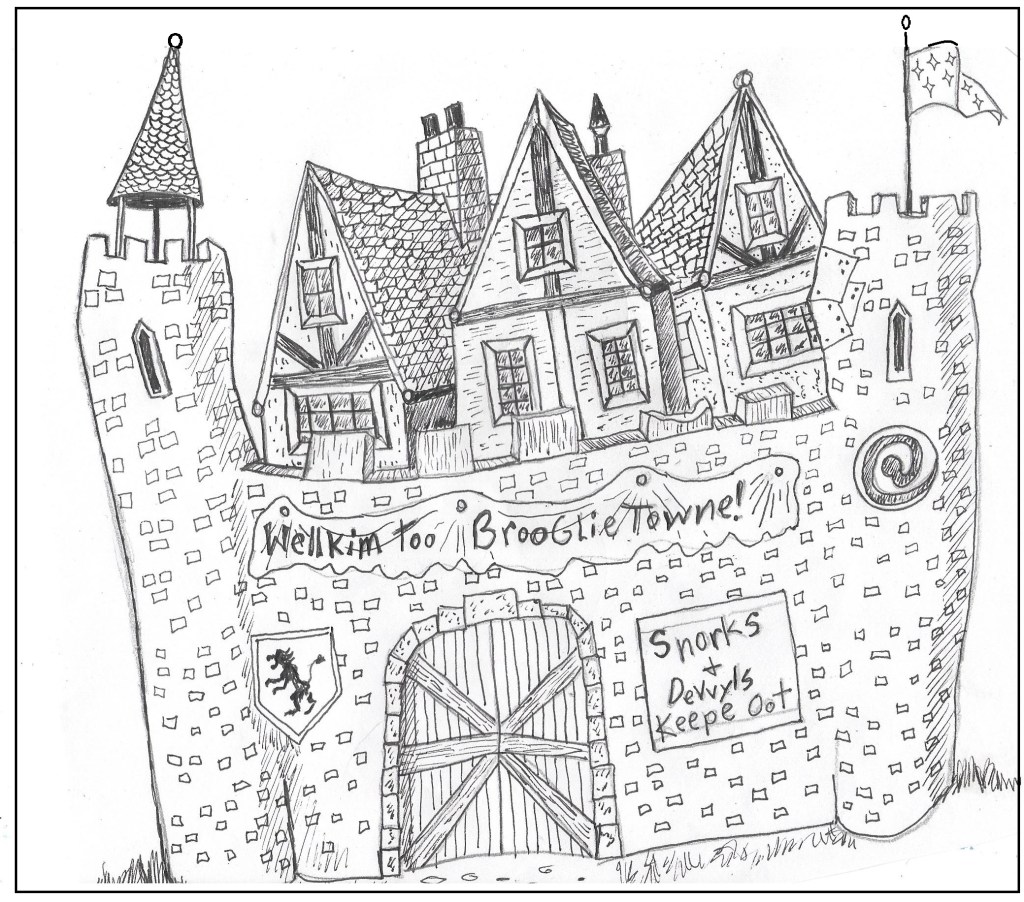
But, at present, I haven’t yet reached that part of the story, the latter half of Act One. Instead, I am today establishing setting further by narrating the visit to BrooglieTown, the home of the chocolate dwarves (literally made of chocolate and not a racist faux pas by any means.)
So, in the middle of writing a novel, I am describing the world-building I have been doing… and drawing… while pretty much living in this made-up game world due to the ongoing pandemic and intense heat of Texas in July. It is a better place to be living for now, though it is soon to heat up too as the plot gets churning and the Devylkind, rather hot-blooded fantasy characters, get further involved.
Science fiction, even if it is comically trying to exaggerate everything and satirize current-world character types, oh, and parody Star Wars and Star Trek, it still needs to truthfully engage with science facts and the basic truths that make the universe operate.
My book that has space pirates as central characters uses a fundamental truth about people. People who lead hard lives and have a lot of difficulties to overcome tend to become better people. But people who have things handed to them (by inheriting a planet because you are immortal or by the magic powers granted to you by Ancient artifacts) tend to become corrupt and criminal.
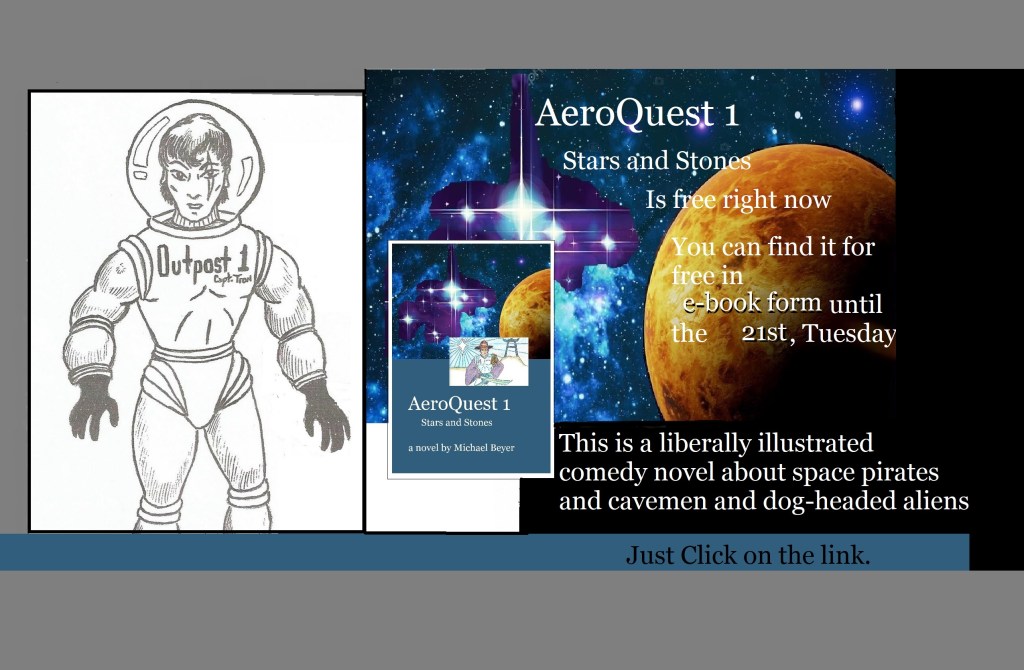
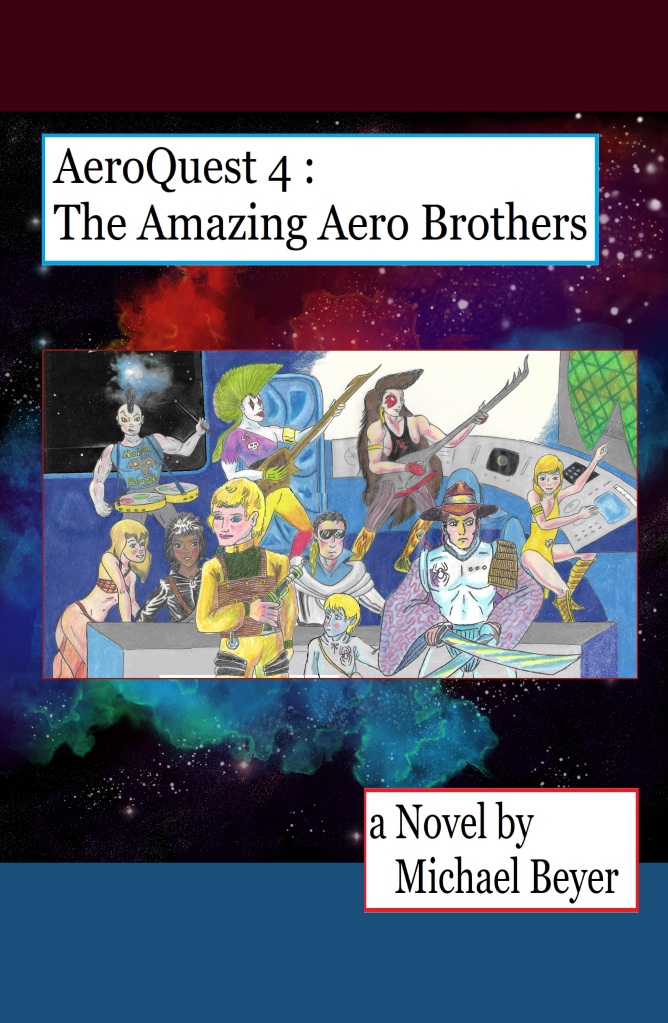
The book is the first of a five-part series of which the first three are already published and available on Amazon. And this book is free from now until Tuesday, the 21st. Click on the link above and get yourself a copy of the e-book.
Today, instead of dropping a pile of pictures into my Art Day post, I decided to explain a single work of art, what the idea was, and how I think it succeeded.
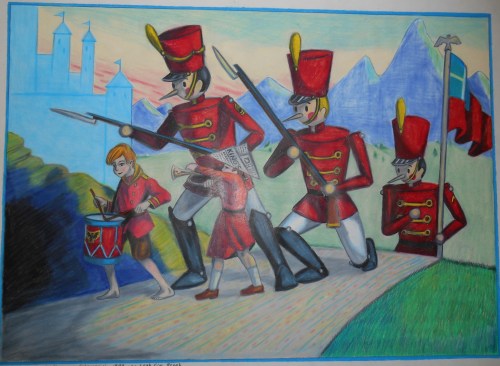
This picture, called “March of the Tin Soldiers” was created in 1994. It was done on a large sheet of white art paper from a super-sized art pad purchased a decade before in an Art Store in Austin, Texas. I did the initial drawing with a pencil and then colored over that with colored pencils, mostly art-grade pencils from Prismacolor. It took most of a month to complete because I was in the middle of a busy school year at the time, teaching mostly at-risk and special-programs kids.
The idea is that these toy soldiers are larger than life-size. They are marching up a hill, and now that they have reached the top, they are in various stages of making ready for battle. They will be moving into the darkness on stage left. They are leaving the bright pastel world behind and moving into potential future conflicts. The drummer boy is basically me. I am leading the way. The trumpet girl is the young Math teacher that I proposed to that year. The news is in the newspaper hat that is on her head, and she is in the act of trumpeting the upcoming charge.
The army, you may have noticed, are not real soldiers. They are imaginary and inspired by the soldiers in the Disney movie, Babes in Toyland. Thus, I am relying on the powers of my imagination to move forward into the future in this picture.
Now that I have exposed the thinking that was in my stupid head when I made this picture, I may have spoiled it for you. Ultimately, it is supposed to be up to the viewer to interpret a work of art. And I have added information to it that you couldn’t possibly have known if I hadn’t told it all to you. But art is always more complicated than the viewer can ever know. This is why my family gets impatient with me whenever we go to an art museum. I get stuck in front of paintings where I ponder all the unknowables that make it look like what it is, and may be hidden in it somewhere if only I can look hard enough and long enough to see it.
The number three is important in this composition. You may notice that there are three tin soldiers. The three blue towers in the upper left of the picture are spatially related to the positions of the three soldiers on the hill. This is an intentional echoing. There are also three folds in the flapping flag the third soldier is carrying. The three mountains between and above the three tin soldiers are also spatially echoing the soldiers, though in the opposite direction, symbolizing possible retreat. There are only two children in the picture, but the tin soldier leader is positioned so that he can share a single leg with each child, making three and three, symbolizing support and protection, the big three, husband and wife supported by God’s blessing.
Now I have successfully revealed way too much about this picture, more than you could possibly want to know. But if you have questions, you can always ask in the comments. Though I can’t promise honest answers. That kinda depends on what you want to know.
If you are as goofy and cartoon-obsessed as me, you may remember that Popeye the sailor was known for the catchphrase, “I yam what I yam”. And if you do remember that, it will not surprise you that, when told a yam is another name for sweet potato, Popeye was furious. “It cannot be!” he argued. “I would not say I sweet potato what I sweet potato! That’s ridicumess!”
Well he has a point.
But I would like to talk today about the things that I sweet potato, and why I sweet potato those things.
First of all, I yam a humorist.
I yam this thing not because I am funny. You may think I yam funny because I say really goofy things for no apparent reason, and then keep on talking long enough to convince you that I did have a point to make, but my brain leans so far to the left that I am hardly right about anything.
And I make bad puns a lot.
You see, I have to use humor constantly to deal with all the hard things in life, because being too serious in the face of the world’s basic uncaring cruelty only leads to depression and taking a beating from life. In fact, I can think of any number of situations in my past where I avoided a beating only because I made a joke that made the bully laugh.
So, being a humorist is a survival tactic. Humor keeps you alive.
You see someone like me has to face all the pain and heartache and cruelty the world has to offer by using humor. The real reason is that, when faced with a bad situation, if the humor gland can’t empty itself of all the jokes it produces, it will begin to swell. The humor gland is located either in the brain or maybe in the behind (I am not medically qualified to tell you which it really is), and it can only swell to a certain point, and then it will explode. This is very bad thing for you, if you survive it, and certainly unpleasant for anybody nearby.
But the joke, properly launched at the target, will make somebody laugh, even if it is only the humorist himself. And laughter is the best medicine. Unless it kills you. You have to be careful not to die laughing. The angels will be offended, and the demons will all laugh too.
But I yam not only a humorist. I yam also a teacher.
I began to realize that I might be a teacher when, in graduate school to get a remedial master’s degree to help with the fact that plain English majors all starve to death, I discovered I had a talent for explaining things in simple terms. And then, immediately afterwards, I discovered I had an even greater talent for being ignored while the people I was explaining to made the mistakes they wouldn’t have made if only they had listened to me, before they failed spectacularly, and then realized how the solution I had explained would’ve made them succeed instead. There is apparently no better way to learn an important lesson.
Teaching is, of course, a pretty cool job. You tend to have the summers off. And you get paid for summer because they split the amount of money you earn for the year (which considering what a babysitter makes on average per child and per hour is far too little for the hours you put in) into twelve monthly pittances.
Of course you are expected to have a university degree (although no teacher college in the world can teach you what you really need to know in order to face that many little monsters… err, darlings… every day) and preferably some grad school, and a certification to teach in your chosen subject, and an additional certification if you are going to teach more than one subject (and ESL and Speech and Journalism, all of which I was expected to teach, are separate certifications) and you have to take hours of additional training every single year, and you have to get re-certified every five years, and… Well, you have to be basically smarter and much better-educated than Bill Gates… But the school janitor will probably be making more money per month than you do.
Anyway, it’s a job you just gotta love. I yam a teacher.
And really, there are a whole lotta yams in my basket yet that I could tell you about. I yam a Red Skelton fan. I yam sometimes a nudist (when I don’t have to put on clothes to keep myself from scratching all my psoriasis-plagued skin off). I yam also an artist (of the type known as a cartoonist). I yam pig-headed sometimes, and I yam Grumpy sometimes (so I go from being Porky to one of the Seven Dwarfs.) I yam a lotta things. And my sweet-potato basket is large.
But I can’t talk about all of my yams today. Too many yams are bad for my diabetes.
But here’s one last yam. I yam a storyteller. And I have a free Kindle e-book promotion this weekend. The book is the first in my series of AeroQuest books. It is a science fiction story with a humorous bent. And I mean, it is seriously bent in some places.
So, click on the link and get yourself a copy. It’s funny. And I will save the other sweet potatoes for another day.
Right off the bat, I’m sure you’re wondering what sort of nutshell is the right size for Mickey’s entire childhood to be put into?
Is it a coconut shell? That would certainly be big enough to contain a lot of big words, complex sentences, and stuff that Mickey is likely to write repeatedly in this book. His paragraphs are filled with purple paisley prose that use way too many adjectives and lists of things pointlessly put together in difficult and unlikely ways. And he’s known for using lots of details when only a few would do quite well for making the pictures he is describing pop into the movie theater that is your imagination.
Or is it a walnut shell? Mickey’s brain is all twisty and has deep grooves in the middle of it, lots and lots of wrinkles, and probably looks exactly like the walnut’s own nut meat.
Or maybe it is a Brazil nut, as those things are dark and had to crack like the themes that rattle around on the inside of nutcase Mickey’s peanut head.
But it is not a peanut. It just isn’t. Mickey’s childhood can’t be put in a peanut shell. Because peanuts grow underground. They are not actually a pea, nor are they a nut… by definition of each. And Mickey did sometimes have to pee, but he was also not a nut. So, not a peanut. Definitely not.
Anyway, Mickey was born in Mason City Iowa. It was mid-November, and a blizzard was raging. And it was somewhere in the middle of the night. It was 1956. Dwight Eisenhower was President. Richard Nixon was nefariously somehow the Vice President.
It was the age of television, but mainly in black and white. My parents watched shows like “Garry Moore’s Variety Show” with Carol Burnett and Durward Kirby on it, “What’s My Line?” the blindfolded guessing-game show, and, of course, the Lawrence Welk Show with the champagne orchestra music and wild polka dancing to the accordion stylings of Myron Florin.
Mickey was not much more than a little, fat, and stupid thing until the 1950’s ended and Mickey turned at least four.
He lived in Mason City where his sister was born in 1958. He was moved to Garner, Iowa, a place he barely remembered at all, and then to Rowan, Iowa. It was a little farm-town where his mother’s family lived while she was growing up. Lots of blood relatives lived in the area. Which led to big family reunions with many Aldriches, Hinckleys, Beyers, Hoaks, and Utzes attending. There was lots of German food, as well as Swedish meatballs, casseroles with who-really-knew-what in them, potato salad, deviled eggs, carrot salad, tuna salad, and other salads with meat and mayonnaise and lots of gooey green bits in them. You were all right as a kid if you remembered not to ask what was in the food. You could eat it until you had a basketball where your stomach used to be, and you would need a nap or lots and lots of running around Grandpa’s or Uncle Larry’s farm yards.
Mickey went to grade school in Rowan, where he could walk to school by himself, even in the snow, and walk home the long way home so he could get into trouble with Larry from next door, Alan the preacher’s kid, the other Mike and his brother Danny, Verner from the old house with the cinders in the basement, or sometimes with Bobby or Richard from the other side of town, a whopping five blocks away.
He had a huge crush on Alicia but could never tell her, even though he often sat next to her in class because of last names arranged alphabetically. He kept up the story that he hated girls, the same story all the other boys told, and was surprised to eventually learn that they all had a crush on Alicia too.
He had to survive not only chickens from Grandpa Aldrich’s hen house, with occasional roosters who would chase you like they wanted to eat you, but also the constant fear of those Muscovy ducks with red wattles on their faces and bills. Those feral ducks, when they had ducklings with them, were even more terrifying than the roosters who regularly got their heads cut off. Muscovies would chase you down the farm lane, out onto the gravel road, and all the way to Uncle Don’s place if you didn’t find something along the way to distract them into thinking about their deadly vendetta and need to slay you. Dried cattails at the railroad crossing worked. A well-aimed stone raised a cloud of snowy white things rising into the cool autumn breeze like some alien creature that could actually scare wild ducks. And wild ducks never got beheaded because, except for Grandpa’s original pair bought from a catalog, they didn’t have their wings clipped and could simply fly away. They only stayed around because of the duck pond in the south pasture, and the fact that Grandpa always fed them kernel corn from the corn crib.
Roosters, once their heads were gone, actually deserved to be cooked in the oven after hours of cleaning, removing pinfeathers, and extruding weird smells in Grandma’s kitchen as they had their chicken guts removed. We didn’t know it until Mickey grew up and went to college, but chickens are related to bird-hipped dinosaurs like Tyrannosaurus Rex, and they longed to live up to the deadly reputation of their distant ancestors. Yes, they definitely deserved to die in the cook pot. Chicken-pot-pie was a well-earned fate. Mickey never liked eating chicken much, even though it was a form of revenge. It wasn’t that he just wasn’t vengeful enough in spirit. He was an Iowa farm boy, after all. But he really didn’t admire the taste with the gusto his cousins all had for it.
Mickey was fifty-percent raised by television in the 60’s. He learned a lot of moral lessons from “Gunsmoke,” but never actually got any practice shooting bad guys with a six-gun, though he did have a cap gun more than once that he wasn’t allowed to point at anybody… ever.
And he learned about real life problems from “I Love Lucy” and “The Beverly Hillbillies.” But he was confused by never seeing a real-life chocolate factory like the one Lucy and Ethel worked in and then got to eat most of the chocolate on the fast conveyor belt. And he was confused when the only “cement pond” he knew about, the public one in Belmond, didn’t allow “critters” to “swim wif the young-uns.”
And he learned about love from “Gilligan’s Island” where Mickey was definitely “Team Mary-Ann,” even though if Gilligan ever got the girl in any episode, Mickey never saw it.
And Mickey learned that Mr. Howell and Mr. Magoo were the same man. Wow!
And Tarzan Johnny Weissmuller and Jungle Jim Johnny Weissmuller were both the same guy, but Jungle Jim wore actual clothes. And Tarzan Ron Ely was on Friday Nights along with “Daktari” while both Johnny Weissmullers were on Saturday Afternoons along with, sometimes, Flash Gordon Buster Crabbe. And if you took any of them for role models and began swinging on the pipes in the cellar ceiling at Grandpa Aldrich’s place, something would break and your Mom and Dad would get very mad, though Grandpa just fixed the pipes and told it as a funny story every Thanksgiving after that.
So, what kind of nutshell can actually contain all of that? It would have to be a nut with a funny name. Cashews would qualify because the name sounds a lot like a sneeze. That’s an undeniable rule in life, “Sneezes, burps, and farts are all funny.” But Mickey learned that, while nuts are, in fact, seeds, roasted salted cashews do not grow into trees when you plant them.
Macadamia nuts also have a name that would qualify. But the macadamia nut is round and a pile of them can look too much like goat poop. But when they are sliced and baked into cookies by old German ladies who really know how to cook, they are good enough to make your toes curl up and your smile to get so big you risk having the corners of your mouth meeting in the back of your head, causing the whole top part of your head to fall off. So, that’s too dangerous of a nut for Mickey’s childhood.
No, I think it has to be the humble hazelnut. Because, after all, not only does it have a witchy sort of name, it is also called a filbert. Now there’s a funny name if ever I heard one. Imagine if SuperMickey had to assume a secret identity as a newspaper reporter. You couldn’t call him Clark because that name was already taken. But Filbert! Ah, comedy gold! And therein lies the true nutshell, round and stumpy-small, a nut you can’t just crack with your fingers. Along with the Brazil nuts, it was always the last available nut in the Christmas nut bowl at Grandma’s house, the perfect little place to store childhood memories for winter. And there’s a lot of winter in Iowa. I know. I was born there.
Here’s an old post I love that I would like to share once again. You need to look at the whole thing because your life depends on seeing as many Maxfield Parrish pictures as you can in this lifetime.
One of the most beautiful things I have ever seen in the art world are the paintings of Maxfield Parrish. That’s why this post needs to be about his work instead of mine. He made his mark painting ads for tire companies and on the ends of orange crates. The secret to his melancholy beauty is the cobalt blue underpainting he always did. Of course, the dominant color over all is a ghostly, iridescent blue. It fills his paintings with quiet grace and powerful emotions. I love that laughing blue quality more than any other thing I’ve ever seen in the realm of art. I love to use the term “laughing blue”. It’s an oxymoron that sums up me better than any other descriptive phrase. It is the laughter that goes on so long and so hard that it causes tears, and at the same time…
The pandemic has been wearing on us all. It keeps us home-bound. It prevented me from making the annual trip to Iowa to visit my octogenarian parents, even though my father is now in hospice care because Parkinson’s is winning the five-year battle he has been fighting against it. My mother got me to stay in Texas by telling me that my father no longer recognizes even her, and it would do him no good to see me through a glass window if he didn’t know me anyway. I may not even get to attend his funeral because of COVID.
My daughter too has been dealt a difficult hand of hearts to try to win a card-game of life with. She missed having a regular high school graduation. This is already her second time losing a grandfather. And she has been desperately worried about me with my six incurable pre-existing conditions catching my death of coronavirus flu just because I go to the grocery store to buy food.
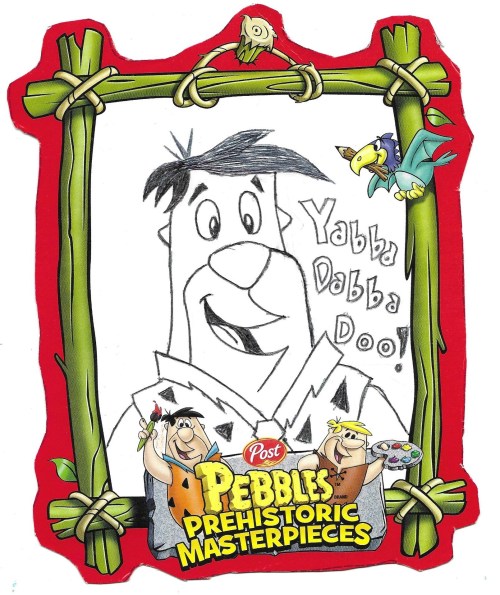
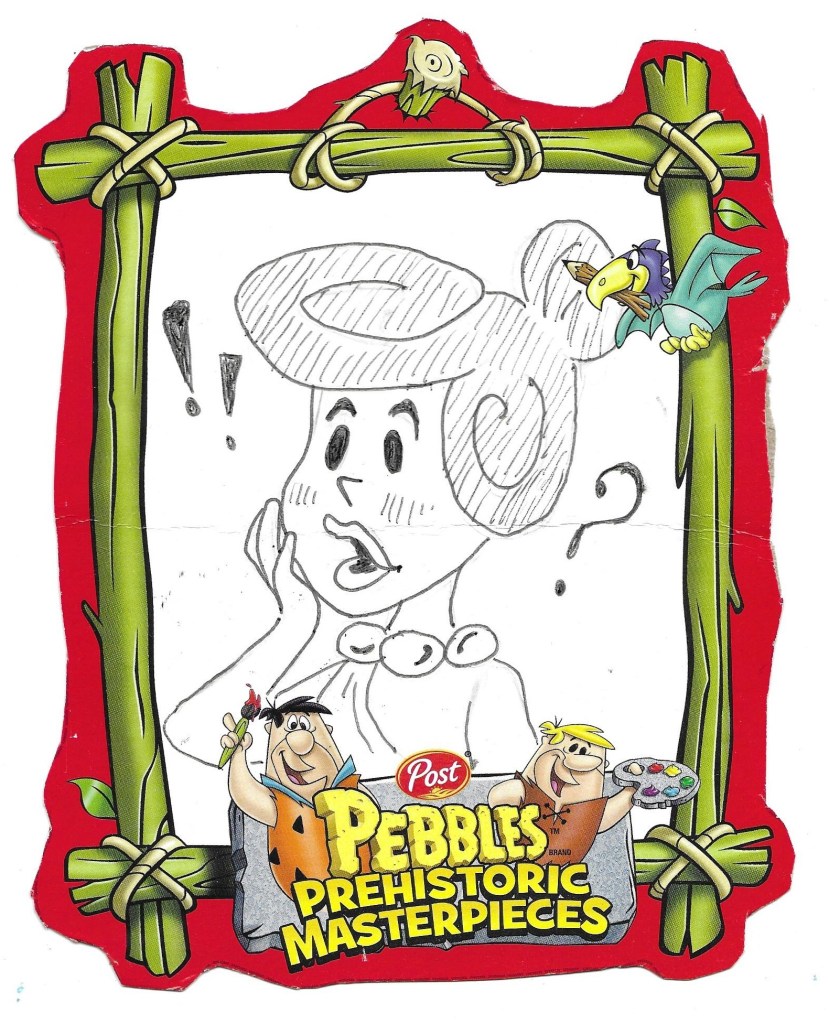
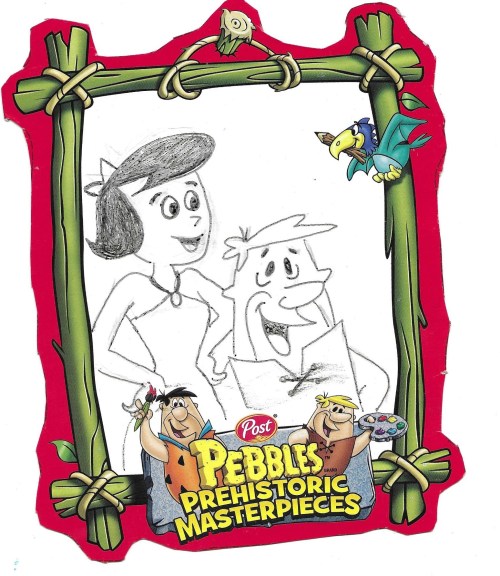
But I am not suggesting that my family is the Flintstones, even though Fred, Wilma, and Pebbles have been a part of my life since the 1960’s. Instead I am showing you how we have been coping with it all. My daughter has taken to doing oil-paintings in her room, and today she registered online with the local Junior College. She has also developed an addiction to Fruity Pebbles cereal. They are putting these blank frames on the backs of her cereal boxes, and I have been addicted to cutting them out and drawing Flintstones characters on them. We have developed happy little artistical quirks to carry on the work of the Church of Bob Ross where we create whatever little worlds with our art that we feel like making today. And it is entirely up to us to make our world however we want it to be, just like Bob always says.
And, of course, we choose to make friends and neighbors a part of that world too.
The many hours of time separating the arrival of the Leaping Shadowcat and the much later arrival of the First Half-Century was something no one really wanted to probe too deeply for causes. Sometimes it is nice to be able to keep that one particularly “special” friend at more than arms’ length.
Trav “Goofy” Dalgoda was such a friend.
“First Officer Cole! Can you explain why it took us a whole extra day to reach this Outstation?”
“No, Captain Trav… Honeypot… I have no idea why.”
Dana Cole had been working overtime trying to keep the Goofy one’s mind on romance rather than that evil Ancient artifact, the Tesserah, that he had become so obsessed with. The device was constantly percolating with menacing alien sounds and radiating oddly unsettling colors while making everybody but Trav wonder what the evil thing was thinking about. Trav Dalgoda was much more concerned with what he could get the thing to do. Specifically, what he could get the thing to blow up or otherwise destroy.
“Ham, the old jester, will be wondering what happened to us. He arrived at least twenty-three hours ahead of us. You know I can’t leave my one truest friend alone for that long. What if he needs me to blow something or someone up?”
“You know, Trav… beloved… we could take another shower together… or have some wine to celebrate arriving here.”
“Nonsense. Who put you up to trying to slow me down with your evil ways? Was it Ged Aero? I know it wasn’t Ham. The robot T-Bop maybe?”
T-Bop was a maintenance Metalloid. Dana had no idea why Trav might have brought the thing up.
“Shall we take the recommended docking port?” asked a crewman on the bridge.
That was a good save by the nameless crewman in the red uniform. Dana did not know them all by name. After all, many of them were probably going to die in service to Goofy Dalgoda. But she did appreciate any effort anybody could make to distract Trav from the Tesserah.
“Are you sure you don’t want to go take that shower together?” Dana offered yet again.
“Do you know where all the waste water in the fresher goes?” Trav asked, switching his eyepatch from the right eye to the left eye, which made no sense, since there was nothing wrong with either eye.
“It goes back to the molecular processors for the ship’s main material synthesizer units.”
“Exactly. We use it to make the clothes we wear and the food we eat. Do you know what that means?”
“No. What does it mean?”
“It means our food is made from poo. And our clothes we put on every day are made from poop too. Isn’t that an icky thought?”
The Tesserah seemed to like that observation, changing its internal lighting to make it look more like a large, electrified turd.
“Oh, yuck,” said a crewman on the bridge. Dana briefly thought about gutting him with a knife for being unhelpful, but then remembered the red uniform and took pity on the doomed young man.
“Captain Dalgoda, as First Officer, I request we dock at the designated docking bay. We could all stand time away from the ship.”
“I am reluctant to leave my beautiful Tesserah. But I do need to see Ham Aero again, the old jester.”
“Crewmen, please make it so,” said Dana to the doomed.
I would like to dwell on yesterday’s topic for a change. Usually when I do a daily blog topic, I use my goldfish-brain swimming ability to totally forget what I wrote about yesterday. Relating one topic to the next is not something I normally do.
To be clear (see that nod to yesterday’s topic?) I had to link lessons and daily topics religiously as a teacher, going through review checklists after warm-ups and discussing prior learning daily before proceeding with new content. So, I’m not UN-intentionally failing to do that here. I am merely trying to recover from a lifetime of ingrained teacher habits.
My purple mouse avatar does actually have two ears.
Yesterday I wrote about not measuring myself by the standards most people use to think about whether or not a writer is successful. I concluded that if you are going to limit that assessment to financial realities or wide readership and critical acclaim, I am a failure. But here are some key points that deserve consideration.
I do have a fan base, even if it is not large. I have been given honorary membership in the group of pro-naturist writers on Twitter even though, as a nudist, I am hardly ever naked myself. I discovered them as I was researching nudism for my book Recipes for Gingerbread Children through the website https://www.clothesfreelife.com/. They discovered my book which only has two naturist characters in it, both of whom try to promote naturism to the other kids in their circle of friends, and liked it enough to review it and include me in their Twitter group. The story is really more about fairy tales and Nazi Germany in World War II than it is about nudists, but they liked it never-the-less.
I have also gathered a Twitter following among other unique groups. The international Twitter fan group that idolizes Tom Hiddleston as Loki regularly fill up my notifications inbox. One Russian member of this group bought and liked Sing Sad Songs, for reasons that were explained, but not in clear enough English for me to understand.
As I spent most of a decade as an ESL Teacher, I probably have been read by more Honduran refugees and Vietnamese immigrants than any of the other writers I know on Twitter and Facebook. And while that is mainly because they were in my High School ESL Class, that does not negate the fact that my writing has a truly international reach.
I am also proud of the fact that I was able to give a copy of the best novel I have written so far, Snow Babies, to the girl I grew up with and named the main character after. She read it, loved it, and recommended it to the school where she works, the school we both graduated from in 1975.
But I don’t want you to take either this post or yesterday’s as some sort of bragging. I humbly submit to you, my accomplishments as a teacher in public schools far outweigh anything I have done as a writer. Still, it is not nothing. And even if I die tomorrow (with my health problems and the current pandemic, a very real possibility) it is enough.
And, hopefully, that covers what I should’ve added yesterday.
Mai Ling uses psionic ninja powers to separate the flowers from the weeds, a thing that is not easy to do.
I suppose that if I were to be insightfully honest for a moment, I would have to admit that I am a failed novelist. If you take “success” as meaning “financial success”, the fact that I only make less than five dollars a month for my writing means I am a failure at it. If you specify that success means my books find readers, then evidence would suggest that my books are mostly ignored. A majority of those who have responded favorably to my work are actually members of the nudist community on Twitter. I admit that I have cultivated that a bit with nudist characters in about a fourth of my books. But that is a result of having experienced fascinating people and situations that I felt I had to write about because I happened to meet, totally by chance, interesting nudists in real life.
I have lost a lot of writing-community followers on Twitter because of my interactions with Twitter nudists. My work gets dismissed on occasion because your standard teacher-turned-writer on Twitter, usually female and usually fundamentalist Christian, doesn’t want to be contaminated by sinful nudist associations. Ah, such a life. But I don’t wish to destroy anyone’s faith in a God who will apparently burn them for an eternity in Hell if they are tempted to frolic with no clothes on. I would rather be blocked by them on Twitter than have them give up on whatever paradise they are pursuing.
But I am basically on the Brad Bird side of the argument about whether or not you can choose to be a hero even if others will see you as a monster. My fiction does not cause demonic possession and probably does not cause spontaneous bouts of joyful nudism either. Even my werewolf story, which was too much for one potential reviewer, does not have actual werewolves in it. Although it does describe some things that really happened to me as a child in a fictionalized, sort-of-truthful way.
So, by those criteria, I judge myself to be a failed writer.
But I am definitely not giving up on writing in despair. Those were never the reasons I wrote novels to begin with.
I write because I have something to say to the world and stories to tell. And I mean to have my say, even if the world is too stone-deaf and stupefied to listen.
I have things to say about living and learning.
I have things to say about finding love, and losing love, and finding it again.
I have things to say about how I think the world works, and why I’m pretty sure I’m completely wrong about all of that. And what I intend to do about it.
To that end, I have started writing a book full of essays like the stuff and garbage and lovely wisdom I write in this goofy little blog. And I shall call it Laughing Blue. Because, you know, nobody is going to read it anyway, and I can call it whatever the heck I want to call it.










 Catch a Falling Star
Treading Water with Swimming Talent
I would like to dwell on yesterday’s topic for a change. Usually when I do a daily blog topic, I use my goldfish-brain swimming ability to totally forget what I wrote about yesterday. Relating one topic to the next is not something I normally do.
To be clear (see that nod to yesterday’s topic?) I had to link lessons and daily topics religiously as a teacher, going through review checklists after warm-ups and discussing prior learning daily before proceeding with new content. So, I’m not UN-intentionally failing to do that here. I am merely trying to recover from a lifetime of ingrained teacher habits.
Yesterday I wrote about not measuring myself by the standards most people use to think about whether or not a writer is successful. I concluded that if you are going to limit that assessment to financial realities or wide readership and critical acclaim, I am a failure. But here are some key points that deserve consideration.
I do have a fan base, even if it is not large. I have been given honorary membership in the group of pro-naturist writers on Twitter even though, as a nudist, I am hardly ever naked myself. I discovered them as I was researching nudism for my book Recipes for Gingerbread Children through the website https://www.clothesfreelife.com/. They discovered my book which only has two naturist characters in it, both of whom try to promote naturism to the other kids in their circle of friends, and liked it enough to review it and include me in their Twitter group. The story is really more about fairy tales and Nazi Germany in World War II than it is about nudists, but they liked it never-the-less.
I have also gathered a Twitter following among other unique groups. The international Twitter fan group that idolizes Tom Hiddleston as Loki regularly fill up my notifications inbox. One Russian member of this group bought and liked Sing Sad Songs, for reasons that were explained, but not in clear enough English for me to understand.
As I spent most of a decade as an ESL Teacher, I probably have been read by more Honduran refugees and Vietnamese immigrants than any of the other writers I know on Twitter and Facebook. And while that is mainly because they were in my High School ESL Class, that does not negate the fact that my writing has a truly international reach.
I am also proud of the fact that I was able to give a copy of the best novel I have written so far, Snow Babies, to the girl I grew up with and named the main character after. She read it, loved it, and recommended it to the school where she works, the school we both graduated from in 1975.
But I don’t want you to take either this post or yesterday’s as some sort of bragging. I humbly submit to you, my accomplishments as a teacher in public schools far outweigh anything I have done as a writer. Still, it is not nothing. And even if I die tomorrow (with my health problems and the current pandemic, a very real possibility) it is enough.
And, hopefully, that covers what I should’ve added yesterday.
Leave a comment
Filed under art criticism, autobiography, blog posting, commentary, humor, novel writing