
I came to believe that William Shakespeare was a made-up character pretty much by the same means as the world first noticed the inconsistencies. In 1848, a young religious scholar named Samuel Mosheim Schmucker, put forward a parody of arguments against the physical existence of a historical Jesus Christ. The fact that no written works by Jesus own hand had ever been seen or discussed in historical documents was used to claim that Jesus was very possibly a made up character created by the Apostles Paul, Peter, and John. No physical evidence of his existence remained that wasn’t tainted by the fervor for relics, even fabricated ones, that ruled the Middle Ages. He posited, as a joke, that in the same way Shakespeare hadn’t written his own plays. After all, here was an unlikely person, an actor who had never been far from the city of his birth who became famous for writing stories from other lands, stories that had the ring of truth, as if the bard had walked the streets of Venice and Verona himself, as if he had spent time in royal courts among courtiers whom he portrayed with unfailing accuracy, and as if he had a deep personal knowledge of literature, including literature that had never been translated into English. Wait a minnit! Why does this comic parody sound so logical and profoundly obvious?
I didn’t believe at first. How could that story I had always heard about the greatest writer who ever lived be anything less than gospel truth?
Yet, inconsistencies were glaring in front of my eyes. The physically real William Shakespeare was a mere actor, not even a lead actor, a bit player who specialized in old men and jesters. His father was illiterate. The man apparently couldn’t even spell his own name correctly. He had spelt it at least three different ways in places that, with difficulty, could be verified as coming from his own hand. The likelihood that this little, insignificant man was the worldly author with a wisdom for the ages grew further and further away from the obvious truth.
Even Mark Twain, whom I revere as a role model and one of the greatest writers I have ever read, doubted that Shakespeare wrote plays. In his essay, “Is Shakespeare Dead?” Twain wrote, “So far as anybody actually knows and can prove, Shakespeare of Stratford on Avon never wrote a play in his life.”
Do I actually believe that someone else wrote Shakespeare’s plays? I was not willing to even consider it until the right candidate came along. Francis Bacon? No. Christopher Marlowe? Marlowe would’ve had to write some of the best plays after he was dead. No way! So did the right candidate appear? Most assuredly, thou addle-pated reader. Hold your breath and wait for the reveal in part two. Er, maybe you shouldn’t literally hold your breath.
 Catch a Falling Star
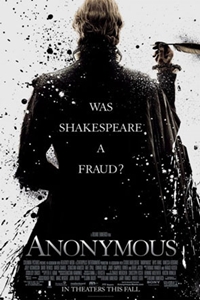
I watched the film. Intriguing tale. The problem with history, especially those written when there’s chaos around, only the surviving accounts get the attention. That’s how some of the myths are born.
Back to Shakespeare. I can’t possibly say with certainty if he wrote the plays or not. The literature is more important now than the writer.
I agree. The only way we can know the writer is through what he has written, and Shakespeare is a fascinating writer, no matter what his name really was.
You’re right. 🙂
Also, the Bible is the most distributed book in the world and we do not really know who the author/authors. The writings endure. 🙂
Reblogged this on Catch a Falling Star and commented:
If you didn’t have enough to think about with Trump and Russia, then here’s a neat little conspiracy problem that I love to play with.