
Today during the school-drop-off downpour, I was forced to pull into the Walmart parking lot and pass out for a few rainy minutes. Good times, huh? But life is like that with diabetes. I have been a diagnosed diabetic since April of 2000. I have learned to live with my sugars out of whack, my mind potentially turned into Swiss cheese with cream gravy at any moment, and a strangely comforting capacity to weather headaches, both the heartbeat in the temples like a timpani kind, and the red-hot needles of Nyarlathotep boring into my skull kind. I suffer, but I also survive. In fact, the terrible incurable disease most likely to kill me is, in some ways, a sort of a back-handed blessing. I certainly don’t take life for granted with it. I am more conscious of how food can affect me and make me feel. I have had to learn how to take care of myself when taking care of myself is tricky like an Indiana Jones’ adventure in the Doomed Temple of Mickey’s Body. I take going to the doctor seriously and have learned what questions to ask. I have been to the heart specialist and the endocrinologist and the dietitian more than most people, though not more than most people should see them. I have also learned how to make fun of dread diseases… a skill I never imagined I might develop later in life.
My first experience of diabetes wasn’t even my own illness. Back in 1984 I had a boy in my seventh grade class who seemed to be falling asleep constantly. He was a shy little Hispanic boy with curly hair who was usually whip-smart and very charming. But I couldn’t seem to keep his head off his desk. So I asked him what the matter was. He was too shy and worried that he had done something wrong to answer me. So I asked him to get some water to wake himself up. The reading teacher across the hall told me, “You know, Juanito is diabetic. His blood sugar might be low.”
So I asked him, “Is that your problem?”
He nodded and smiled.
“The office keeps some orange juice in the refrigerator for him,” the reading teacher said.
So, I saved his life for the first time in my career without even knowing what the problem was or how to solve it. He came back from the office perky and smiley as ever. And I realized for the first time that I needed to know what diabetes was and what to do about it.
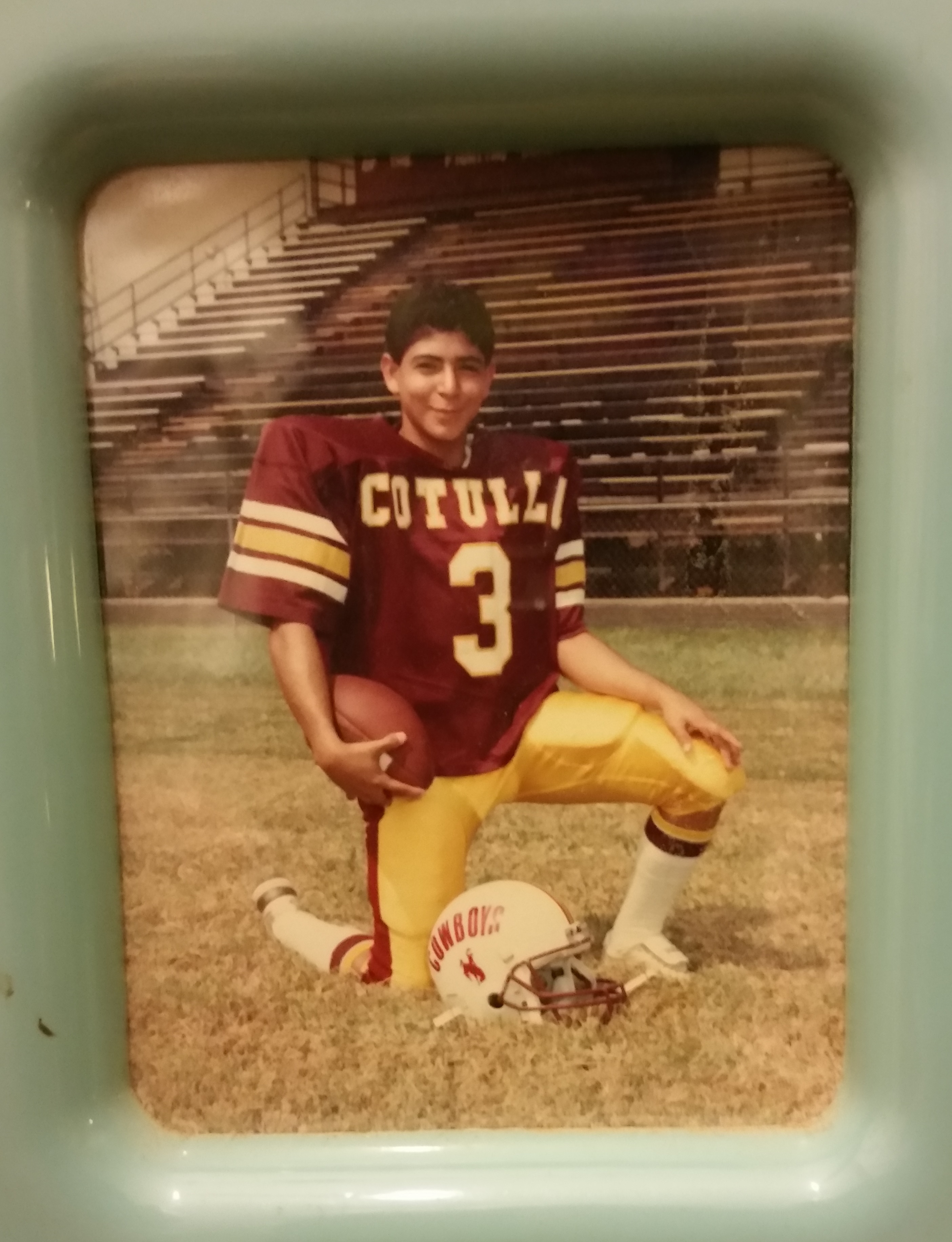
Juanito became one of a number of fatherless boys that adopted me and spent Saturdays hanging out with me to play video games and role playing games. He was one out of a pack of kids that swarmed my home in the off hours and would do anything I asked in the classroom no matter how hard. He was a juvenile diabetic, the son of a woman with severe type-two diabetes (adult-onset). His older sister had become a nurse at least partly because of the family illness. Juvenile diabetics, though their lives can be severely at risk, have the capability of growing out of it. As a seventh grader he didn’t really know how to take care of himself. Teachers who unknowingly offered candy as a motivator could’ve put him in a coma because he was too polite and shy to say no. But I fed him a few times, befriended him a lot, encouraged his interest in sports, and he grew up to be a star defensive back on the high school football team. He gave me the portrait I share with you here for attending so many of his football games and rooting for him to overcome the odds. When he visited me at the school years later, he was basically diabetes-free.
Juanito’s story gives me hope. I know I will not overcome the dreaded Big D disease of South Texas. I will live with it until it kills me. It caused my psoriasis. It gives me episodes of depression and chronic headache. But at this point, I am still controlling it through diet and exercise, not taking insulin or other drugs. (In fact, it was one of those other drugs that was making me pass out at work constantly from low blood sugar. Diet works better than pharmaceuticals.) One day it will give me a fatal infarction or a stroke and be the end of me. But until that time I will continue to do the difficult dance with it and get by, because, after all, dancing is exercise, and exercise overcomes the effects of the disease. Just ask Juanito.



 Catch a Falling Star
Twenty-Six Years a Diabetic
My bloodwork first revealed my diabetes in the Summer of 2000. So, the first of my two grateful notations is my diabetes. Surprise you, does it? There are very good reasons why this bad thing that happened to me has helped me more in life than some of the things most people identify as the best things in life.
Diabetes is a chemical nightmare that you fall into by a compounding of your worst daily habits. Your body turns food into a form that your blood carries to every cell in your body to provide the energy that every living cell runs on. But that form of chemical is glucose, a sugar. And sugar is not only the fuel for cellular life and activity, it is a poison.
Blood sugar is like highly combustible gasoline in an internal combustion engine. If you have too much gas causing too large of an explosion with every spark from the sparkplug, the longer you run it with your foot on the gas, the more likely you are to blow the engine up. This is the reason diabetes causes heart attacks, strokes, and can damage or destroy so many of your body’s essential organs.
The regulatory liquid that controls the sugar’s poison power is insulin. It is produced in the pancreas as a peptide hormone, a chemical that cooks and flavors the blood sugar to make it delicious enough to be more easily eaten up by the cells of the body. But sometimes the pancreas gets lazy or overworked enough to become rebellious and it stops producing enough insulin to cook the sugar. And sometimes, as in my case, the pancreas begins producing insulin who simply aren’t very good cooks. I have way too much insulin in my bloodstream, but it is wimpy and weak and couldn’t win a sugar cook-off if my life depended upon it. And my life does depend on it.
The reason I am grateful for diabetes is the plethora of fundamental life lessons that I had to learn in order to keep living a good life.
How well you can think and feel and move around depends on how well you manage what you eat.
Candy is out. If you like sweetness in your meals, natural fruit sugars like fructose, especially when combined with helpful, cancer-suppressing antioxidants like you find in strawberries, are a much better choice. Niacin is the name of a chemical you need to know when choosing what to eat. Niacin helps balance your blood sugar level, making your insulin gain levels in cooking skill chemically. You find niacin in foods like peanut butter, pork sausage, chicken wings, and mushrooms, as well as many other foods. For nearly twenty-one years, I have regulated my blood sugar successfully by making adjustments to my dietary habits.
And that leads to the other thing that I am grateful for. I am grateful for my ability to change my daily habits when necessary. I have learned that even deeply entrenched habits can be altered over time by small changes I make, noting them and constantly examining my progress. It has not only helped me navigate numerous health problems, but it has also aided me in completing my 5-year Chapter 13 bankruptcy. So, I am grateful for diabetes and changeable habits.
Leave a comment
Filed under commentary, healing, health, humor
Tagged as diabetes, diet, health, nutrition, wellness