I came to Texas from Iowa. I was well-versed in how to speak Iowegian. (I was, don’t-ya-know, and spoke it fluently, you-betcha.)
Then I arrived, fresh-faced and ready to change the world as a twenty-five-year-old teacher, and began working in a mostly Hispanic middle school in deep South Texas. Dang! Whut language do they speak? (Yes, I know… Spanish. But my students straight from Mexico couldn’t understand the local lingo either. South Texas Spanish and Castilian Spanish from Mexico are not the same language.) I couldn’t talk to the white kids either. It is possible to communicate with Texicans, but it took me years to learn the language. It takes more than mere usage of “ya’ll” and “howdy”.
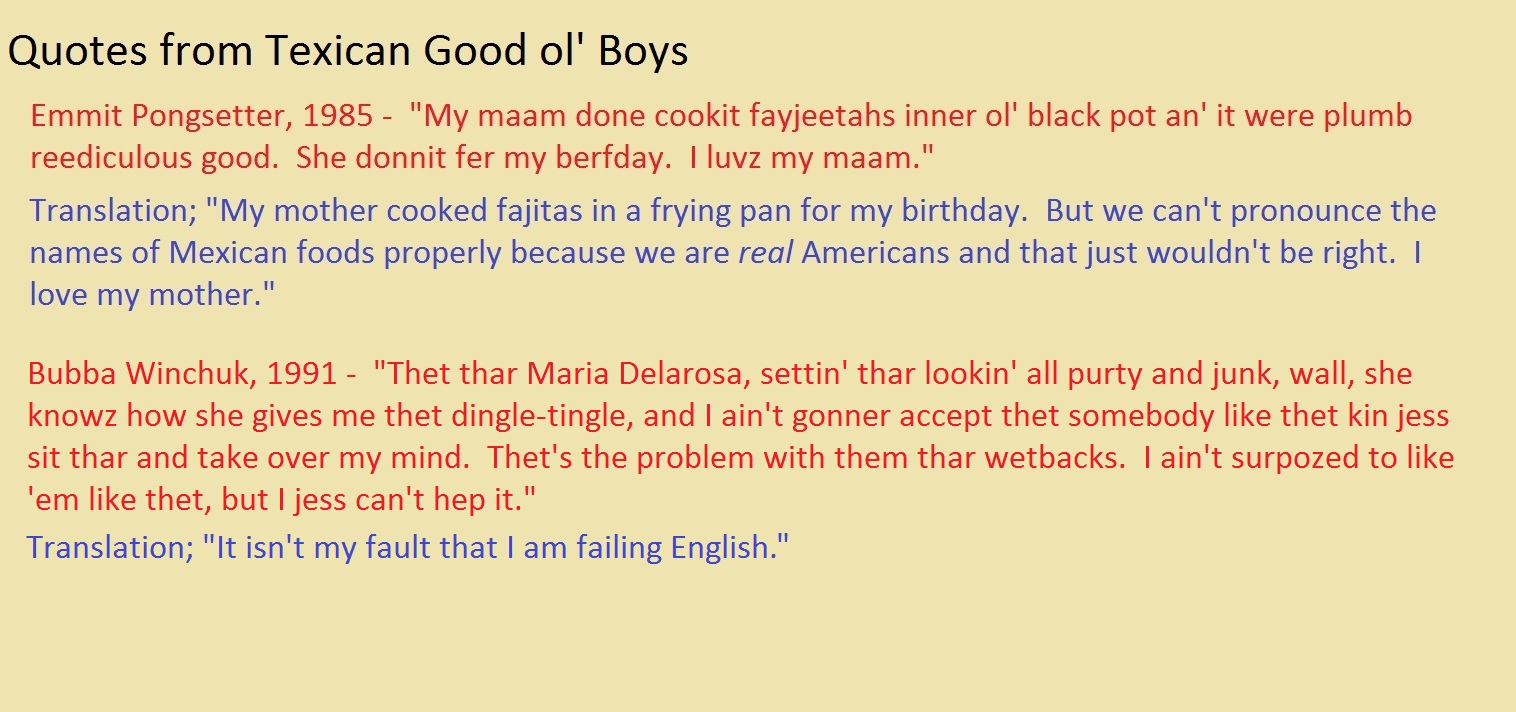
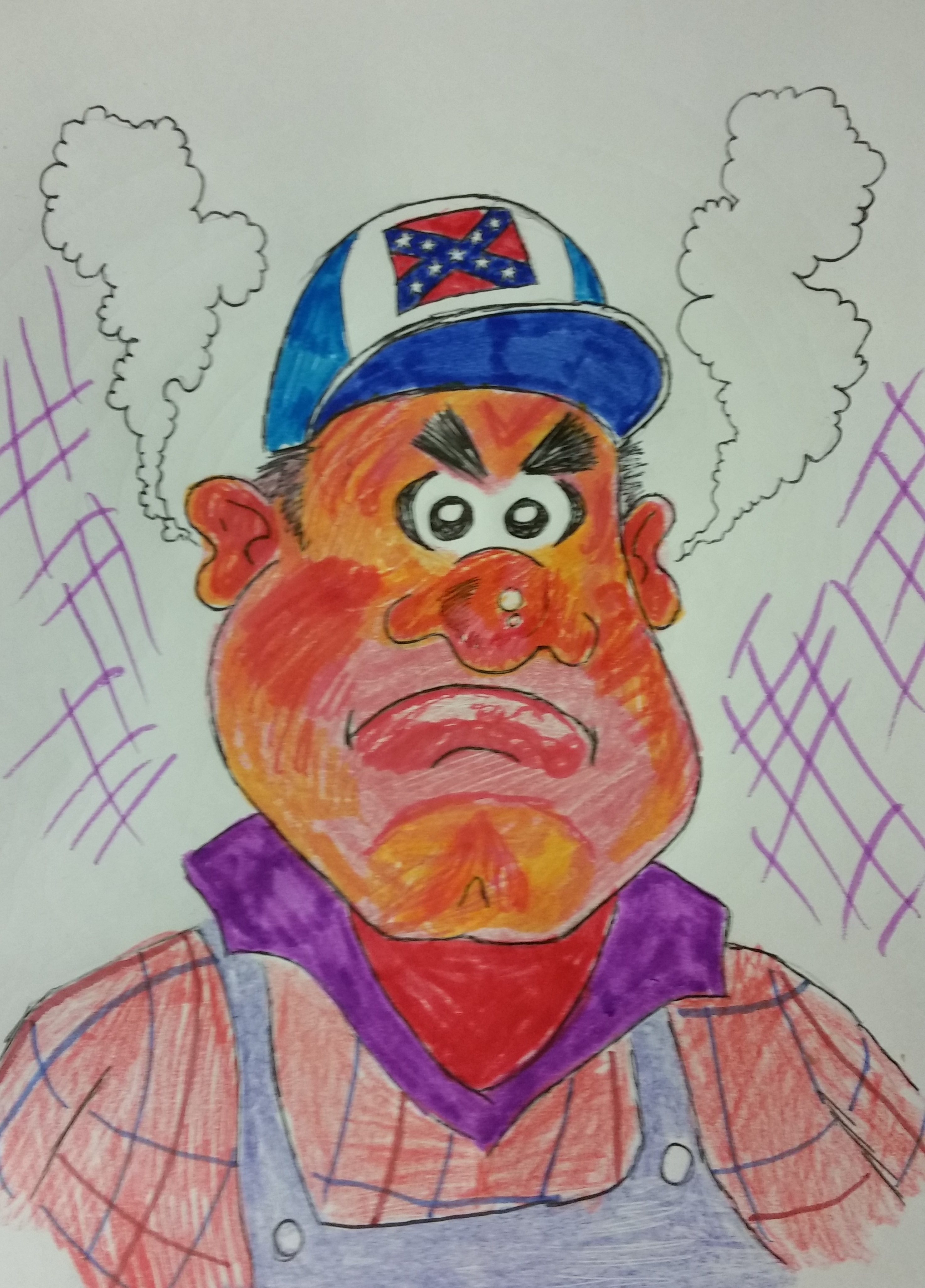
You can probably see what I mean when you look at these fake quotes based on the things real Texicans actually once said to me. Of course, I can be accused of being a racist by interpreting things this way. Texicans are concerned that you understand that they are not racists. They merely rebel against being “politically correct”. Apparently the political-correctness police give them all sorts of unfair harassment about speaking their minds the way they always have. I should note, however, that I had to use a quote from Bubba rather than Dave Winchuk. Dave is so anti-political-correctness concerned that he regularly said to me things with so much racial heat in them that they would even melt the faces off white people. Face-melting is bad. If you don’t believe me, re-watch the end of Raiders of the Lost Ark.
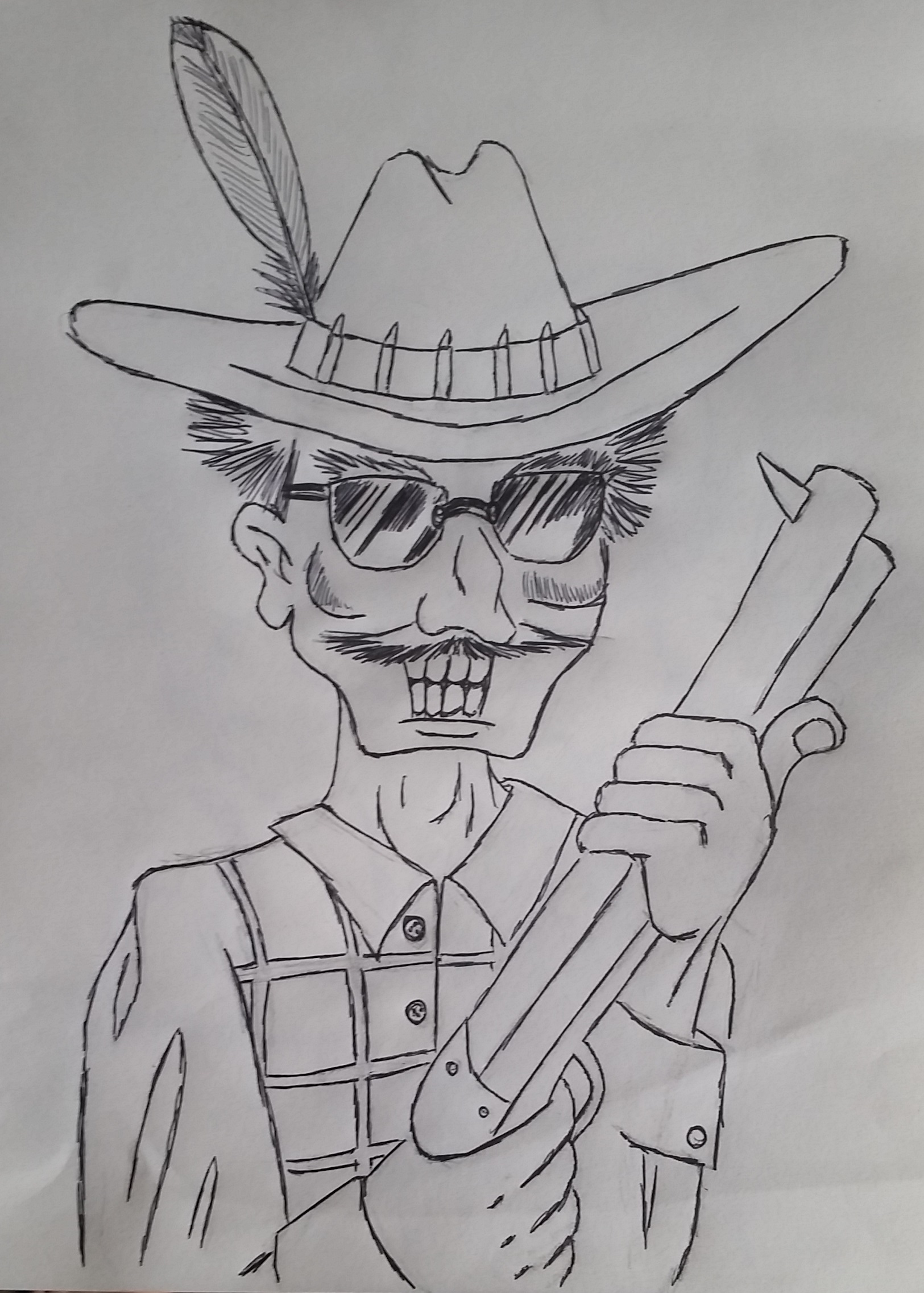
And to speak Texican, you must actually learn a thing or two about guns. Yes, Texas is an open-carry State. Apparently, Second Amendment rights are the most important rights in the Constitution. My two sons grew up in Texas; the oldest is a Marine, and the younger is in the Air Force. Guns are important to them. I have those same arguments with former students, too. I have learned to say the right things so that they will tolerate my unholy pacifist ideas about how the world might be safer if everybody didn’t have five guns in the waistbands of their underpants. So gun-stuff ends up as a part of the Texican language I have learned to speak.
The point of it all is, language is a fascinating thing that grows and changes and warps and regresses. I love it. I try to master it. And the mistakes I make usually sound purty funny.
I will attempt to share with you now a bit of hard-earned Stoic wisdom learned not from Greek philosophers, but from long years worth of trying with all my power to teach anything at all to twelve-and-thirteen-year-olds. Bear with me, I am not crazy. I am a retired middle school teacher.
*No matter how naturally gifted you are with teaching skills, you have to learn everything about teaching the hard way, trying and failing repeatedly until you get it right, or until the students kill and eat you.*
*The only person whose behavior you can control is you yourself. Student behavior is chaos.*
*While you can’t control student behavior, you can use your behavior to corral attention and lead them towards something that resembles civilized behavior. (But learning how to corral those little piggies can take forever.)*
*You will want to do everything “the easy way” because that is the only way you can reach classroom goals in a reasonable amount of time. Of course, it takes practically no time to learn that there is NO EASY WAY!*
*Most teachers rely on drill and practice, and this is why there are so few excellent teachers. Drill and practice is the most effective way to teach students to hate the subject you are trying to teach.*
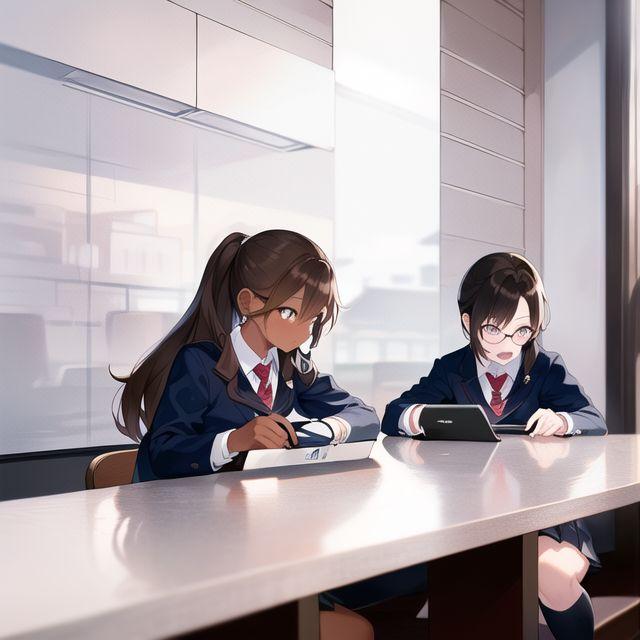
Students quietly studying, a thing no students in real life actually do (except for the fact that some of the pages in his textbook have obviously been torn and folded on the left side of the book to conceal love notes.)
*Students learn best in a “Laughing Classroom” where they talk to each other, activities are creative and sometimes loud, and learning becomes fun.*
*Many principals consider “Laughing Classrooms” to be a good reason to punish or dismiss a teacher.*
*Good teaching is a subversive act. Only the people who are supposed to teach or learn really want it to take place in most schools.*
*All of your students will misbehave at one time or another. Some only briefly and very mildly. Others for an endless period of time that you hope ends short of murder.*
*When a student misbehaves and you have to take them into the hallway to yell at them and/or murder them, you secretly tell them that you believe in them, describe the behavior and why it disappointed you, and then describe what they should have done instead. Follow that by asking them if someone else needs to get involved, parents, principal, police, or executioner, or if they would like to go back in the room and try again.*
*Your worst students are the ones who need you the most. You better learn somewhere along the way to love past the ugly.*
*Nothing you will ever do in your career will beat reaching the unreachable and teaching the unteachable. I pray that you will get to experience it at least once. And no one but you and that student will ever know about it.*
Now you can go be a school teacher and be all Stoic like Epictetus and Marcus Aurelius. And there was no secret code for anything evil in that last one. If you ever experience it, you will know then what I am talking about. Not everything you are proud of doing in life has to get a gold medal on a stage to be worth doing. But if you are a teacher, you already know that.
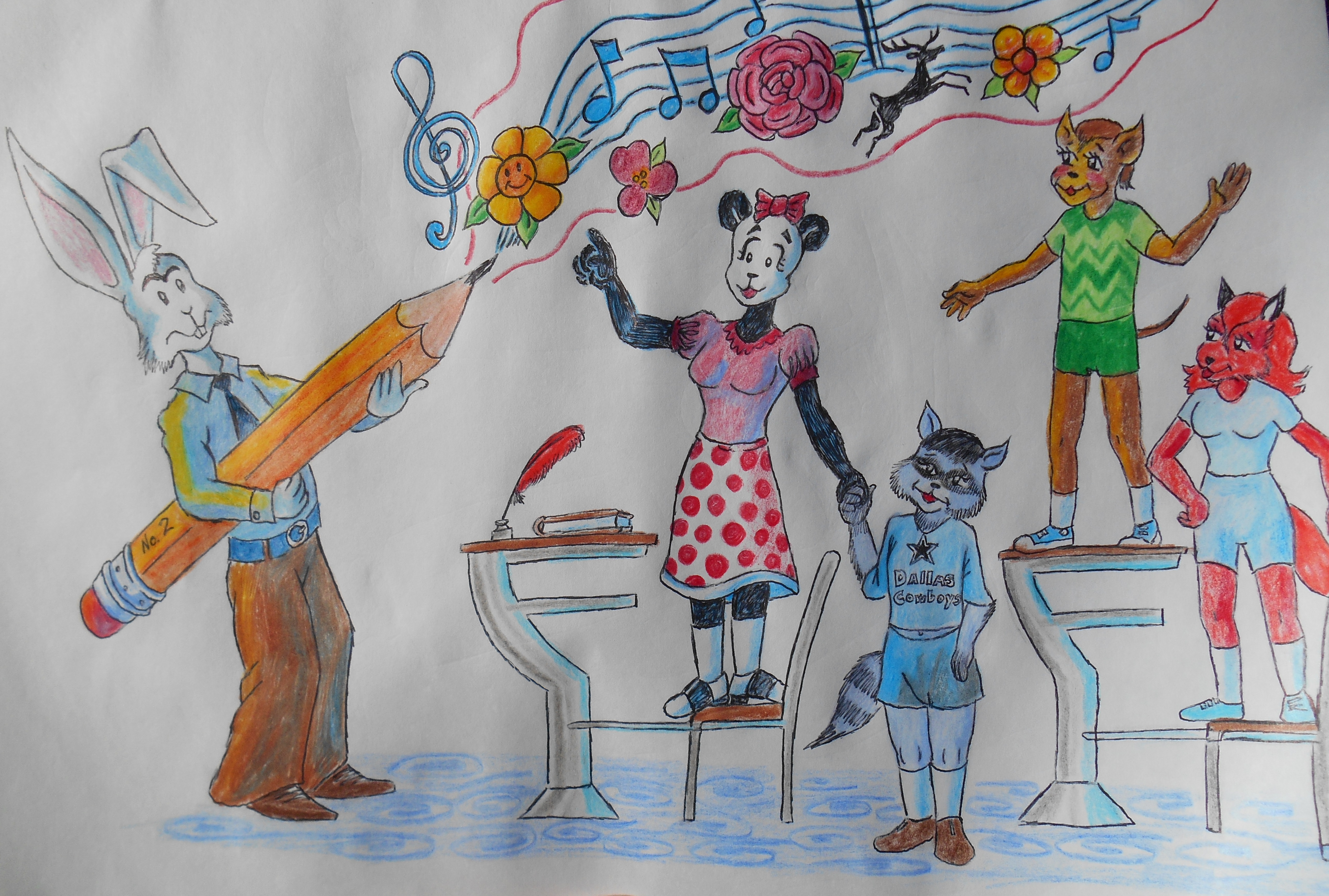
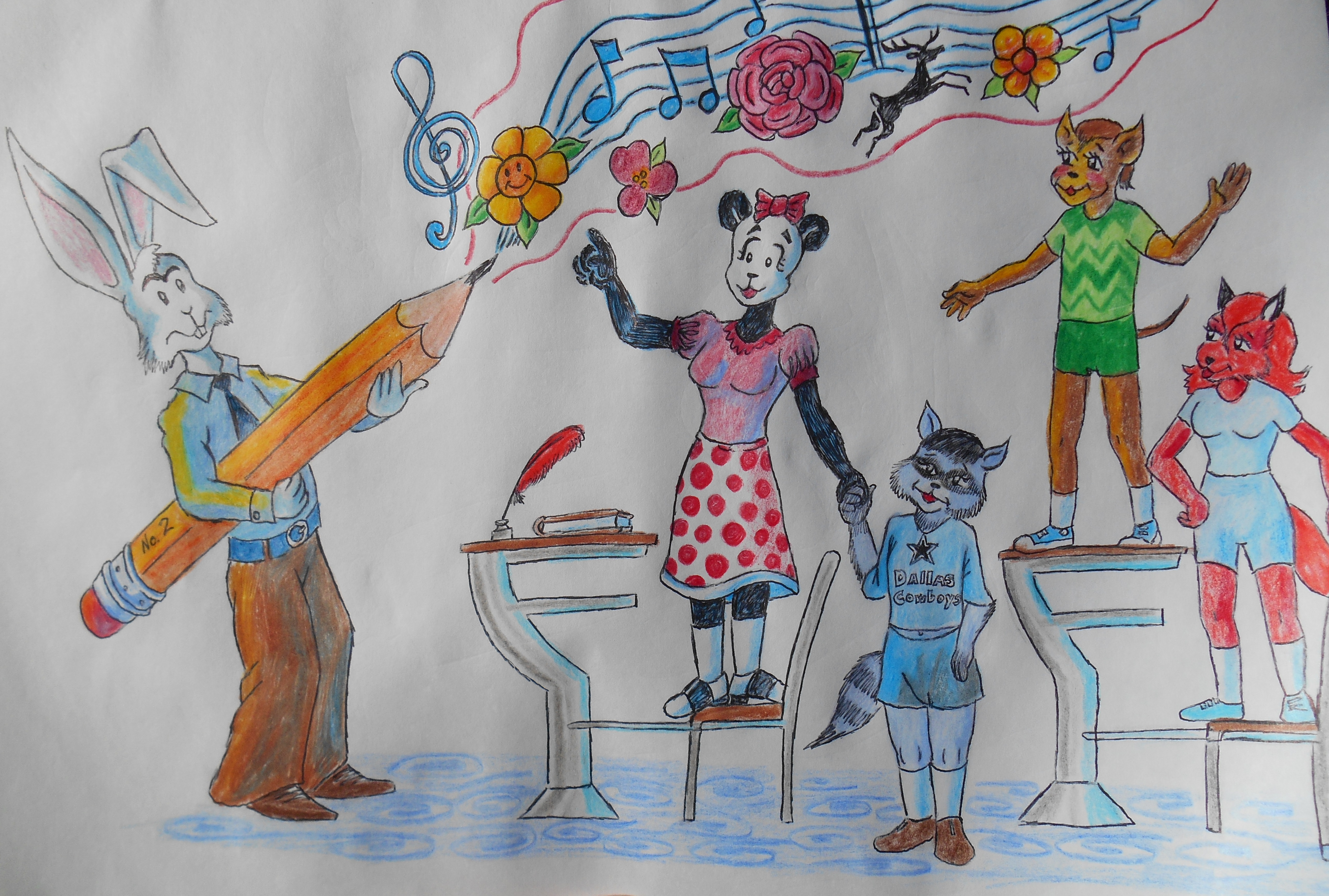
Mister R. Rabbit is a school teacher. He is not the scariest animal in the world, but he is quick and eats carrots, and for thirty-one years he started off the first week of school as the one holding the BIG pencil. He was the one that planned and carried out the lessons. He was the one with the carrot of irony in his pocket and the carrot of good humor tucked away in his desk drawer. For thirty one years he stood in front of the class just as you see him here.
But tonight, he is contemplating the end of the first week of no school. This week, this school year, Mr. Reluctant R. Rabbit has no class. He is now retired. No more F’s and no more A’s. No more students standing on desks to get a different perspective a la The Dead Poet’s Society. No more giant pencils. No more carrots of irony in the pockets.
This bit of a classroom rules poster is from 1982. The old rabbit had it on his classroom wall for most of the first five years that he taught. She didn’t know it at the time, but this girl is a colored pencil portrait of one of the quietest little mice that he ever taught. She didn’t know it was a picture of her, but many others recognized her. When he taught her son twenty two years later, the boy asked because he thought he recognized her. Mr. Rabbit lied and said it was somebody else in the picture.
Mr. R. Rabbit has stopped crying about it now. You can’t plant carrots of wisdom in your garden forever, and sooner or later the carrots of irony get chewed. But he still misses it mightily. He still wonders if he couldn’t have lasted one… more… school… year…
Back in the 1980’s I was given the gift of teaching the Chapter I program students in English. This was done because Mrs. Soulwhipple was not only a veteran English teacher, but also the superintendent’s wife. She was the one gifted with all the star kids, the A & B students, the ones that would be identified as the proper kids to put into our nascent Gifted and Talented Program. That meant that I would get all the kids that were C, D, & F in most of their classes, the losers, the Special Edwards, the learning disabled, the hyper rocketeers of classroom comedy, and the trouble makers. And I was given this gift because, not only was I not a principal’s or superintendent’s wife, but I actually learned how to do it and became good at it. How did I do that, you might ask? I cheated. I snooped into the Gifted and Talented teacher training, learned how to differentiate instruction for the super-nerd brain, and then used the stolen information to write curriculum and design activities for all my little deadheads (and they didn’t even know who the Grateful Dead were, so that’s obviously not what I meant). I treated the little buggers like they were all GT students. Voila! If you tell a kid they are talented, smart, and worthy of accelerated instruction… the little fools believe it, and that is what they become.
Even the goofy teacher is capable of believing the opposite of what is obvious and starts treating them like super-nerds because he actually believes it. I soon had kids that couldn’t read, but were proud of their abstract problem-solving skills. I had kids that could enhance the learning of others with their drawing skills, their singing ability, and their sense of what is right and what is wrong. I had them doing things that made them not only better students for me, but in all their classes. And I did not keep the methods to my madness a secret, either. I got so good at coercing other teachers to try new ideas and methods that I got roped into presenting some of the in-service training that all Texas teachers are required by law to do. And unlike so many other boring sessions we all sat through, I presented things I was doing in the actual classroom that other teachers could also use with success. The other teachers tried my activities and sometimes made them work better than I did.
Yes, I know this all sounds like bragging. And I guess it probably is. But it worked. My kids kept getting better on the standardized tests and the State tests that Texas education loves so much. And Mrs. Soulwhipple was still the superintendent’s wife, but she did not stay a teacher forever. She eventually went to a new school district with her husband. And guess who they started thinking of when the question of who would be the next teacher for the nerd classes was considered. That’s right, little ol’ Reluctant Rabbit… that goofy man who drew pictures on the board and made kids read like a reading-fiend… me.
So, a new era began in Cotulla. In addition to still getting to teach all the deadheads (because they weren’t going to trust those precious children to anyone else, naturally), I began teaching at least one edition of Mr. B’s famous Nerd Class every school year. We actually assigned long novels and great pieces of literature for the kids to read and discuss and study in depth. Novels like To Kill a Mockingbird by Harper Lee and Across Five Aprils by Irene Hunt were read. We began talking about “big ideas”, “connections to the wider world”, and how “things always change”. We began taking on ideas like making our world better and how to help our community. Kids began to think they were learning things that were important. We did special units on Exploring Our Solar System, The World of Mark Twain, Finding the Titanic, and The Tragedy of Native American History. And we spent as much as a third of the year on each. I am myself cursed with a high IQ and a very disturbing amount of intelligence. I am the deepest living stockpile of useless facts and trivia that most of my students would ever meet in their lifetimes. And even I was challenged by some of the learning we took on. That’s the kind of thing that makes a teaching career fun. It kept me teaching and meeting new students and new challenges long after my health issues made it a little less than sensible to keep going. And if I manage to tell you a few Nerd Class stories in the near future, then at least you stand a chance of knowing a little bit about what-the-heck I am talking about. So be prepared for the worst. I am retired now, and have plenty of time for long-winded stories about being a teacher.
Being a teacher at heart… I want to recommend that career…even though I know full well it is a super-hard crappy job of glorified baby-sitting that pays in literal peanuts and nobody in their right minds recommends it to smart young up-and-comers as a glamorous choice… and it is only getting worse under a new anti-education administration.
Being a teacher at heart… I can’t help remembering how it all started for me. The last thing in the world I imagined myself being when I was in high school was a teacher. I wanted to be a cartoonist or a comic book artist. I wanted to write best-selling science fiction novels and maybe direct a movie. You know, the kind of thing millionaires line up to bestow on college grads with a degree in English and a transcript filled with mostly A’s in my art classes.
But after my remedial master’s degree gave me a provisional teaching certificate, and my one and only interview for an illustrator’s job resulted in compliments on my portfolio and best wishes for my teaching career, I headed to Texas, one of only two states actually hiring teachers in 1981. (The other was Florida, which it turns out it was a very lucky thing my family had already moved to Texas to help me make that decision. Have you seen the education news coming out of Florida? I now know where Satan gets his mail.)
Turns out the only job available in 1981 was all the way South on Interstate 35 in Cotulla, Texas. I was there to teach English to 8th graders. Mostly Spanish-speaking 8th graders. And the previous year the 7th grade English teacher had run out of the classroom screaming after the little darlings exploded firecrackers under her chair and put scorpions in her coffee cup. I was given her classroom and the same students that forced her to re-think her career choice. El Loco Gongie, El Loco Martin, Talan, El Mouse, El Boy, El Goofy (whose one and only talent was to turn his whole head purple at will), La Chula Melinda, and the Lozano Twins were the nicknames I had to learn because practically everyone was named Jose Garcia… even the girls. Talan and El Mouse were the first ones to threaten my life. They picked up a fence post on the way to lunch (we had to walk four blocks to the elementary school to get lunch because the junior high building had no cafeteria). Talan said something threatening in Spanish that I didn’t understand and added the name “Gringo Loco” menacingly to whatever he said, and El Mouse pantomimed using the metal fence post as a sword to cut me in two. All this because I was trying to get them to keep up with the rest of the class on our little hike in the 100 degree heat. (I think I knew then why Satan moved to Florida.) Fortunately they must’ve decided that murdering me wasn’t worth the hours of detention they would have to spend, and dropped the post. Class was definitely disrupted when handsome El Boy and La Chula decided to break up, or rather, El Boy decided he like brown-eyed Alexandra better after she got blue-eyed contact lenses that made her eyes look yellow-green. Girl fights are harder to break up than boy fights because girls fight to the death over matters of the heart, and they really don’t care who dies once the fight is started.
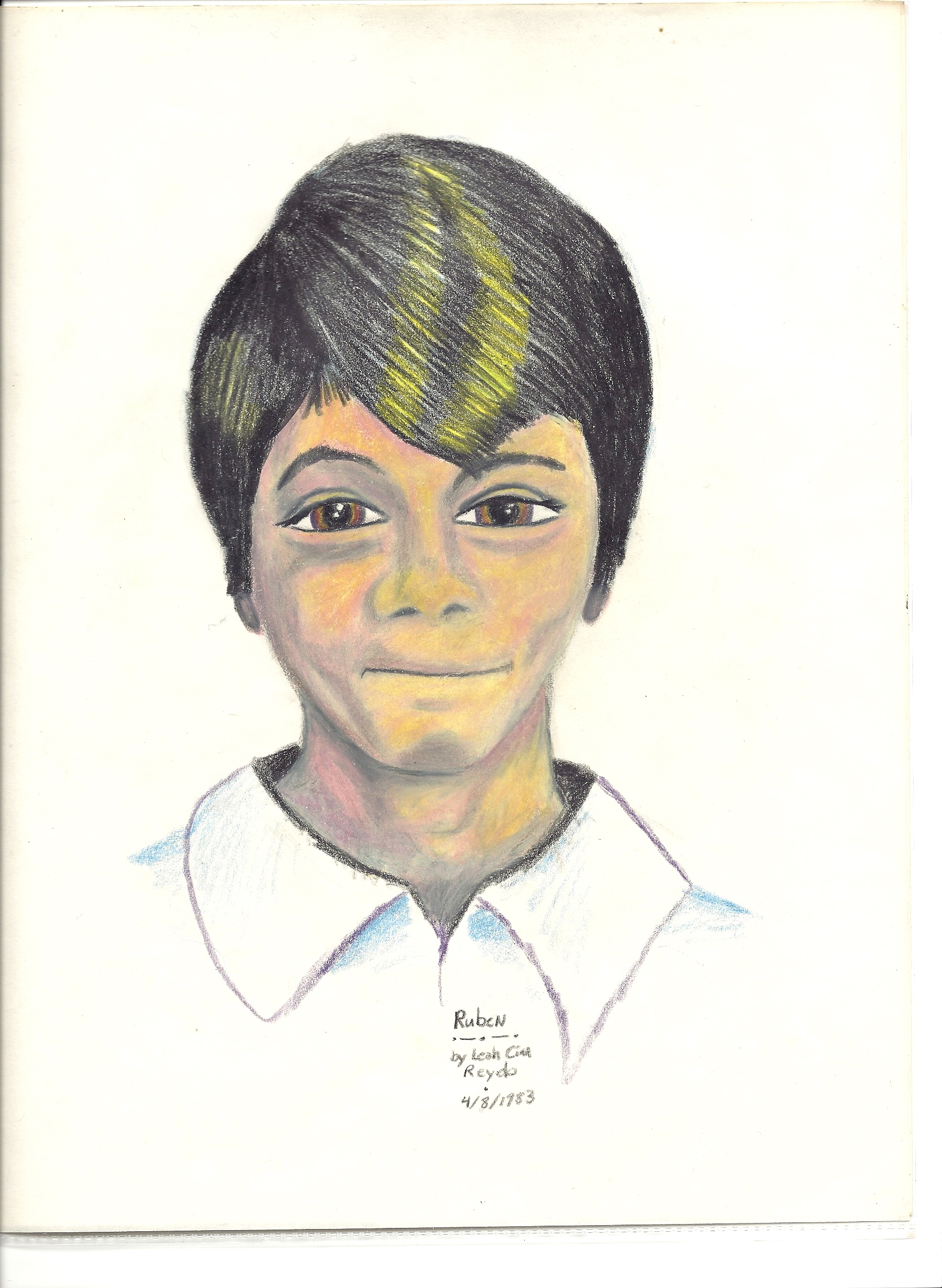
Now you may think my account of my first horrible year as a teacher must be exaggerated and expanded with lies because you know I am a humorist and that I went on to teach for many more years. But I swear, only the names have been changed. The nicknames and the incidents all are real. (Yes, he really could contort his face in a way that turned his entire head purple. It was freaky and made the girls scream.) As I reached the spring of the year that year and had to decide whether or not to sign my contract for the next year, I really was planning to get out of teaching all together. But I was standing on the playground one day that spring glaring at the vatos locos to prevent fights from breaking out again when Ruben came up to stand beside me and talk to me. Ruben was one of the brightest and physically smallest of all my kids that year. But he had such a charm about him that the bullies left him alone (except for the time he got in trouble for forging El Boy’s mother’s signature on a failing report card). He said to me, “I want you to know, you are my favorite teacher. I learned a lot from you this year.” I had to bite my lower lip to keep from crying right there and then. It was the moment when I decided I had to be a teacher. They were not going to make me run away in defeat. I was going to work at it until I knew how to do it right. For Ruben. And for all the other boys and girls like Ruben who liked me as a teacher… and laughed at my jokes… even the really corny ones… and needed me. That made all the hard stuff worth it.
Being a teacher at heart… I recognize now that there was never anything else I was going to be. It was what God chose me to be. And my only regret about my choice is that I had to retire and can’t do it any more for health reasons. I still miss it.
I had a lost crown on a molar that turned into a tooth crater that became infected. The dentist was happy. I took on almost two thousand dollars of medical debt to stop the pain. She extracted the molar and apparently, the infection is still there. After a week of antibiotics, it still hurts as if the infection is still there. Good opportunity for the Grim Reaper to use sepsis and a blood infection to do me in.
So, I am anticipating death in the near term, but hoping to avoid it. There are still several things I can do even if my dentist is a Sadist.
No matter what happens, my life is complete.
I was a teacher for 31 years. I managed to be an English department head, an ESL teacher, a teacher rated exemplary on evaluations many more times than the one time I was fired and treated like an incompetent. I made a difference for far more students than I failed. Many of them told me so later in life. I taught students whose parents I taught, and I almost lasted in one place long enough to teach a student whose grandparents were former students. I created an Odyssey of the Mind team for my Gifted and Talented students. I read to them. I even fed some of them on weekends.
I was married for thirty-plus years. I was a father of three, a band parent, a military parent, and a beloved parent.
I experienced life and art and music. I knew what beauty was. I know what wisdom is.
None of these things can the Grim Reaper or the Devil take away from me.
Any time the race actually ends, I am guaranteed to win. After all, I was only racing against myself.
Others may judge me as a fool, an egomaniac, or a buffoon. But I am okay with that. I learned early on to laugh at myself, even when others point at me and accuse me of my shortcomings. I wished to be a humorist after all. There is no one left behind me who has wronged me that I have not forgiven.
I am not ready to die, but Death cannot deprive me of anything.
It has been more than a semester now that I have not been a teacher. I am missing it mightily. I even miss the yelling and screaming, the name-calling and the crazy-eyed threats against life and limb. And that’s just me. I miss what the kids always did too. This was driven home to me as I tried to move my middle child from one school to another. We were hoping to get a bit of a break on his placement. He is a gifted child with a penchant for bizarre and long-lasting obsessions. He has a talent for building huge, monumental structures in Minecraft. He is very computer-nerd and history-wonk. (Yes, I know those are not pure predicate adjectives, but I am a retired English teacher and just don’t care any more.) I was hoping they could overlook his burnout/blowout eighth-grade brain meltdown from the previous year and give him the chance to be a ninth grader for at least half a year. No. Arbitrary rules must be obeyed. (That isn’t even how she said it. More like, arbitrary rules MUST be obeyed). That meant of course that he has to continue to repeat the mindless indoctrination of year number 9, (eight numbered grades plus K), (And Pre-K, come to think of it.) Make that year number 10. No high school yet, though he is more than mature enough, intelligent enough, motivated enough, and sweet-natured enough. We are not loving and forgiving people. We are strict and by-the-book people! Forgive me, Lord. I am writing my own book. (In more ways than one.)
This is what we are doing wrong in Education;
1. We are putting people in boxes. (Little people. Kids mostly. We are calling those boxes things like ADHD, Special Education, trouble-maker, learning disabled, emotionally disturbed, disobedient, truant, and “in need of alternative education”… here meaning kid-prison.)
2. We are sealing those boxes with heavy-duty red tape. (Read special or remedial classes as waste-baskets for keeping the rabble and the riff-raff out of the good teachers’ hair.)
3. We are routinely handing those boxes to the box-bangers and package manglers. (The semi-incompetent teachers who have discipline problems because in teacher college nobody tells you what to do with the kid who sits in the corner and sings to himself instead of paying attention, or the girl who gets out of her seat every time the teacher turns his back to go flitting around the room like a bumble bee going flower to flower (except that it is a more hormonal attraction and goes boy to boy); or the competent teacher like me who incurs the principal’s disfavor for having classes that always make noise and are given such classes in boxes as a punishment because that kind of principal is too limited in intelligence to understand that those kinds of boxes are not really a punishment if you merely take a moment to examine the treasures they contain.)
4. We keep the boxes air-tight so that no oxygen or light gets in. (To suffocate learners under piles of worksheets and endless drill and practice is murder. We are killing the precious learners with boring stuff and teaching them to be zombies who all act alike and hate learning because their brains are rotted masses of goo.)
This is what we must do instead;
1. Open the boxes up again and thoroughly mix the contents. (The rich suburban parents will resent the heck out of having their precious honors student sitting in class next to the poor black kid from the projects, but studies show that both kinds of learners do better when they are mixed together.)
2. Notice, we don’t need two any more, because learners are already distributed to different and diverse boxes based on what they individually need and want to learn about and have talent for. Groups should be more like the Shakespeare-loving group or the talkative-socializing group or the Tinker-toy builders group or the vampire-literature-writing group and less like groups of kids all the same color or all the same culture or all the same age.
3. All the teachers need to be trained to handle all the possible… no, make that probable problems that may come up in the classroom. Every classroom needs a proven veteran teacher and an enthusiastic young apprentice teacher. Neither one should have to face the evil hordes alone. And most important of all, any teacher who doesn’t love working with kids (and doesn’t love the kids in a way that will not lead to a prison term) needs be utilized in some way other than as a classroom teacher.
4. Every classroom is a laboratory and every teacher is a creative and daring mad-scientist-type intent on trying new things and only re-doing things that really work well. Forget this nonsense about standard curriculum goals and common core curriculum. Those are only buzz words for suffocating learners and being too lazy to think on your feet in the middle of the every-day classroom battle in the on-going War on Ignorance.
Now you see… I have all the answers and I know everything. The only mystery is… why don’t more people listen to me?
Life is making music. We hum, we sing to ourselves, movie music plays in our head as the soundtrack to our daily life. At least, it does if we stop for a moment and dare to listen. We make music in many different ways. Some play guitar. Some are piano players. And some of us are only player pianos. Some of us make music by writing a themed paragraph like this one. Others make an engine sing in the automotive shop. Still others plant gardens and make flowers or tomatoes grow. I chose teaching kids to read and write. The music still swells in my ears four years after retiring.
The 1995 movie, Mr. Holland’s Opus, is about a musician who thinks he is going to write a magnificent classical orchestra opus while teaching music at a public high school to bring in money and allow him time to compose and be with his young wife as they start a new family.
But teaching is not, of course, what he thought it was. He has to learn the hard way that it is not an easy thing to open up the closed little clam shells that are the minds of students and put music in. You have to learn who they are as people first. You have to learn to care about what goes on in their lives, and how the world around them makes them feel… and react to what you have to teach. Mr. Holland has to learn to pull them into music appreciation using rock and roll and music they like to listen to, teaching them to understand the sparkles and beats and elements that make it up and can be found in all music throughout their lives. They can even begin to find those things in classical music, and appreciate why it has taken hold of our attention for centuries.
And teaching is not easy. You have to make sacrifices. Big dreams, such as a magnum opus called “An American Symphony”, have to be put on the shelf until later. You have children, and you find that parenting isn’t easy either. Mr. Holland’s son is deaf and can never actually hear the music that his father writes from the center of his soul. And the issue of the importance of what you have to teach becomes something you have to fight for. Budget cuts and lack of funding cripples teachers in every field, especially if you teach the arts. Principals don’t often appreciate the value of the life lessons you have to give. Being in high school band doesn’t get you a high paying job later.
But in the end, at the climax of the movie, the students all come back to honor Mr. Holland. They provide a public performance of his magnum opus, his life’s work. And the movie ends with a feeling that it was all worth it, because what he built was eternal, and will be there long after the last note of his music is completely forgotten. It is in the lives and loves and memories of his students, and they will pass it on.
But this post isn’t a movie review. This post is about my movie, my music. I was a teacher in the same way Mr. Holland was. I learned the same lessons about being a teacher as he did. I had the same struggles to learn to reach kids. And my Mr. Holland moment wasn’t anywhere near as big and as loud as Mr. Holland’s. His was performed on a stage in front of the whole school and alumni. His won Richard Dreyfus an Academy Award for Best Actor. But his was only fictional.
Mine was real. It happened in a portable building on the Naaman Forest High School campus. The students and the teacher in the classroom next door threw a surprise party for me. They made a lot of food to share, almost all of which I couldn’t eat because of diabetes. And they told me how much they would miss me, and that they would never forget me. And I had promised myself I would never cry about having to retire. But I broke my promise. In fact, I am crying now ten years later. But they are not tears of sadness. My masterwork has now reached its last, bitter-sweet notes. The crescendos have all faded. But the music of our lives will still keep playing. And not even death can silence it completely.
Back in the 1980’s I was given the gift of teaching the Chapter I program students in English. This was done because Mrs. Soulwhipple was not only a veteran English teacher, but also the superintendent’s wife. She was the one gifted with all the star kids, the A & B students, the ones that would be identified as the proper kids to put into our nascent Gifted and Talented Program. That meant that I would get all the kids that were C, D, & F in most of their classes, the losers, the Special Edwards, the learning disabled, the hyper rocketeers of classroom comedy, and the trouble makers. And I was given this gift because, not only was I not a principal’s or superintendent’s wife, but I actually learned how to do it and became good at it. How did I do that, you might ask? I cheated. I snooped into the Gifted and Talented teacher training, learned how to differentiate instruction for the super-nerd brain, and then used the stolen information to write curriculum and design activities for all my little deadheads (and they didn’t even know who the Grateful Dead were, so that’s obviously not what I meant). I treated the little buggers like they were all GT students. Voila! If you tell a kid they are talented, smart, and worthy of accelerated instruction… the little fools believe it, and that is what they become.
Even the goofy teacher is capable of believing the opposite of what is obvious and starts treating them like super-nerds because he actually believes it. I soon had kids that couldn’t read, but were proud of their abstract problem-solving skills. I had kids that could enhance the learning of others with their drawing skills, their singing ability, and their sense of what is right and what is wrong. I had them doing things that made them not only better students for me, but in all their classes. And I did not keep the methods to my madness a secret, either. I got so good at coercing other teachers to try new ideas and methods that I got roped into presenting some of the in-service training that all Texas teachers are required by law to do. And unlike so many other boring sessions we all sat through, I presented things I was doing in the actual classroom that other teachers could also use with success. The other teachers tried my activities and sometimes made them work better than I did.
Yes, I know this all sounds like bragging. And I guess it probably is. But it worked. My kids kept getting better on the standardized tests and the State tests that Texas education loves so much. And Mrs. Soulwhipple was still the superintendent’s wife, but she did not stay a teacher forever. She eventually went to a new school district with her husband. And guess who they started thinking of when the question of who would be the next teacher for the nerd classes was considered. That’s right, little ol’ Reluctant Rabbit… that goofy man who drew pictures on the board and made kids read like a reading-fiend… me.
So, a new era began in Cotulla. In addition to still getting to teach all the deadheads (because they weren’t going to trust those precious children to anyone else, naturally), I began teaching at least one edition of Mr. B’s famous Nerd Class every school year. We actually assigned long novels and great pieces of literature for the kids to read and discuss and study in depth. Novels like To Kill a Mockingbird by Harper Lee and Across Five Aprils by Irene Hunt were read. We began talking about “big ideas”, “connections to the wider world”, and how “things always change”. We began taking on ideas like making our world better and how to help our community. Kids began to think they were learning things that were important. We did special units on Exploring Our Solar System, The World of Mark Twain, Finding the Titanic, and The Tragedy of Native American History. And we spent as much as a third of the year on each. I am myself cursed with a high IQ and a very disturbing amount of intelligence. I am the deepest living stockpile of useless facts and trivia that most of my students would ever meet in their lifetimes. And even I was challenged by some of the learning we took on. That’s the kind of thing that makes a teaching career fun. It kept me teaching and meeting new students and new challenges long after my health issues made it a little less than sensible to keep going. And if I manage to tell you a few Nerd Class stories in the near future, then at least you stand a chance of knowing a little bit about what-the-heck I am talking about. So be prepared for the worst. I am retired now, and have plenty of time for long-winded stories about being a teacher.
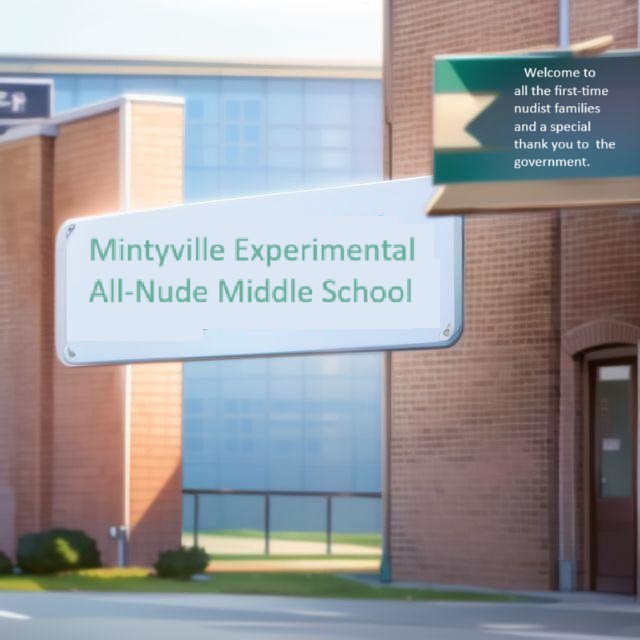
Yes, I survived all the Bible-belt monster hunters who came after me for writing my first naked middle school post. And I am no wiser for the experience. I mean to tell you why I would really like to do my whole teaching career over again in a middle school where mandatory nudity is the dress code. And if that makes me insane and somehow dangerous, remember, this is a humor blog, and we like to laugh at mentally warped individuals like me and their strange behavior.
Iris is an imaginary top student at Mintyville Experimental Middle School. History is her top subject, and she wants to be a lawyer or a political leader.
Although this essay’s argument is totally facetious and farcical, that doesn’t mean it lacks truth. Some things would obviously be easier for teachers if the school opted for a totally nude dress code. For instance, no gang colors could be worn in school. And Bloods, Crips, Ambros, Latin Kings, and future Skinheads would all be bare with their tattoos covered by the appropriate flesh-colored Band-Aids. Cell phones could be concealed in pockets only by students who had undergone painful plastic surgery to create kangaroo pouches in their thighs, and even then, they would be readily visible whenever the students stood up from desks. There would be no jealousy over expensive fashions for the rich kids or embarrassment for the poor kids with ratty clothes from Goodwill and smelly underwear that never gets washed in anything but quarter-hungry washeterias. School uniforms would be free unless you counted the expense of the original birthday suit. Textile coverings required by the outside world would remain in lockers all day along with all social media devices used for creating depression in others and suicidal thoughts in yourself. And AR-15s and pistols and other weapons would have to be left in parents’ cars for after-school Texas-style social interactions. All of these consternations and nightmares would no longer be things the teacher had to worry about.
Teachers would not have to worry about how they dress either. First, teachers would not necessarily be required to be nude. If you had an unmarried male teacher in a classroom by himself with lots of naked young ladies in all his classes, that could lead to things we hear too much about in the news already when the schools are full of textile-wearing people. If the teachers are dressed in the usual frumpy-dumpy suits and dresses from Walmart, they will not be the object of hormonal fantasies from students, as there are so many other naked targets to be fascinated by. And if the faculty decides that the only way to be fair to the students is to be nude in school too, perhaps that is an area where two teachers for every class is an optimal idea, one male and one female in every class to serve as a check on each other. Hence, both sexes have the appropriate adult role model. One English teacher and one Science/Math teacher to provide the learning guidance necessary for a truly intellectual, discovery-method curriculum where they would learn problem-solving in depth. Students would become accustomed to seeing their friends, enemies, and teachers nude and it wouldn’t take long for everyone to be desensitized to the sexual aspects of everybody being naked. Of course, there would have to be detailed “no-touching” rules enforced constantly by teachers, administrators, and fellow students. It is an opportunity to master behaviors that students don’t really get detailed instruction in during their real lives, either at home or in school.
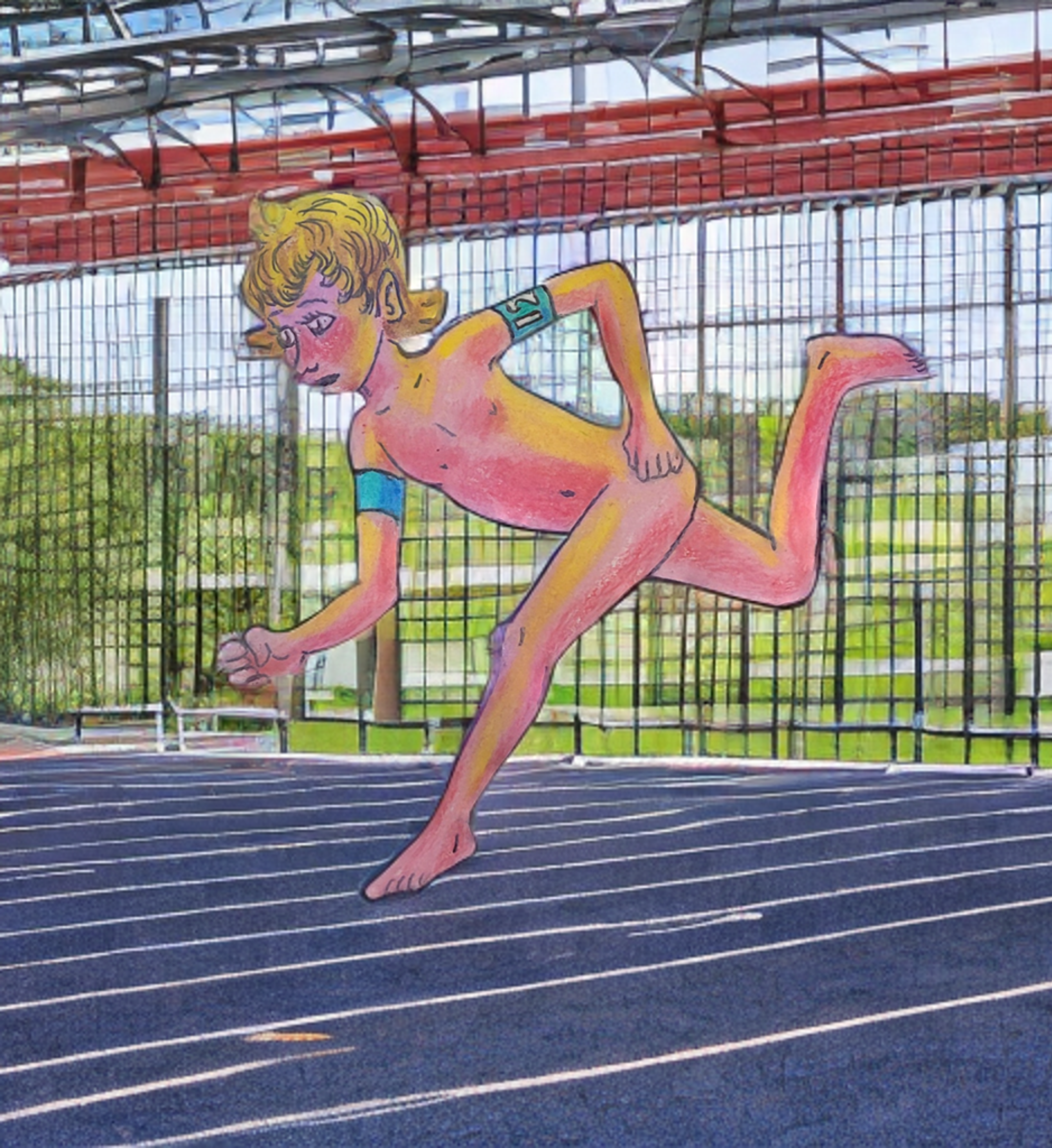
So, what’s that red sash thingy that Sasha has in the library? Miss Shortwheeler suggested it’s the twirling ribbon she will use for the halftime performance in Tuesday’s basketball game.
In real-world middle schools where everybody wears clothes and conceals the truth and gets lots of practice at lies and prevarications, students are metaphorically naked all the time. They reveal inappropriate details about their lives at inappropriate times daily. And if the teacher tries to ignore it, they will reveal it much louder and with more inappropriate words.
Nude students, on the other hand, are more open to sharing intimate ideas and feelings in more positive discussions where everyone is equally vulnerable, and can be trained to be equally sensitive to the feelings and needs of others. It is the appropriate place to learn things like proper consent, permission, respect, safe spaces, personal spaces, and appropriate sharing of things that might’ve been too personal to consider discussing in a world hidden beneath clothing. Naked people are more vulnerable and therefore more aware of the world around them and their relationships to everyone and everything. So, I am actually saying literally naked kids are easier to teach than kids who are only metaphorically naked.
Again, naked schools are not a thing in the real world of public education. This essay is only foolish speculation and idea mangling. But I really do think that a nude school is worth studying experimentally. When you come to my house after midnight again spurred onward by the religious fervor of the Westboro Baptists, remember, I will be the one laughing loudly as I flee full speed for my very life.









A Mr. Holland Moment
Life is making music. We hum, we sing to ourselves, movie music plays in our head as the soundtrack to our daily life. At least, it does if we stop for a moment and dare to listen. We make music in many different ways. Some play guitar. Some are piano players. And some of us are only player pianos. Some of us make music by writing a themed paragraph like this one. Others make an engine sing in the automotive shop. Still others plant gardens and make flowers or tomatoes grow. I chose teaching kids to read and write. The music still swells in my ears four years after retiring.
The 1995 movie, Mr. Holland’s Opus, is about a musician who thinks he is going to write a magnificent classical orchestra opus while teaching music at a public high school to bring in money and allow him time to compose and be with his young wife as they start a new family.
But teaching is not, of course, what he thought it was. He has to learn the hard way that it is not an easy thing to open up the closed little clam shells that are the minds of students and put music in. You have to learn who they are as people first. You have to learn to care about what goes on in their lives, and how the world around them makes them feel… and react to what you have to teach. Mr. Holland has to learn to pull them into music appreciation using rock and roll and music they like to listen to, teaching them to understand the sparkles and beats and elements that make it up and can be found in all music throughout their lives. They can even begin to find those things in classical music, and appreciate why it has taken hold of our attention for centuries.
And teaching is not easy. You have to make sacrifices. Big dreams, such as a magnum opus called “An American Symphony”, have to be put on the shelf until later. You have children, and you find that parenting isn’t easy either. Mr. Holland’s son is deaf and can never actually hear the music that his father writes from the center of his soul. And the issue of the importance of what you have to teach becomes something you have to fight for. Budget cuts and lack of funding cripples teachers in every field, especially if you teach the arts. Principals don’t often appreciate the value of the life lessons you have to give. Being in high school band doesn’t get you a high paying job later.
But in the end, at the climax of the movie, the students all come back to honor Mr. Holland. They provide a public performance of his magnum opus, his life’s work. And the movie ends with a feeling that it was all worth it, because what he built was eternal, and will be there long after the last note of his music is completely forgotten. It is in the lives and loves and memories of his students, and they will pass it on.
But this post isn’t a movie review. This post is about my movie, my music. I was a teacher in the same way Mr. Holland was. I learned the same lessons about being a teacher as he did. I had the same struggles to learn to reach kids. And my Mr. Holland moment wasn’t anywhere near as big and as loud as Mr. Holland’s. His was performed on a stage in front of the whole school and alumni. His won Richard Dreyfus an Academy Award for Best Actor. But his was only fictional.
Mine was real. It happened in a portable building on the Naaman Forest High School campus. The students and the teacher in the classroom next door threw a surprise party for me. They made a lot of food to share, almost all of which I couldn’t eat because of diabetes. And they told me how much they would miss me, and that they would never forget me. And I had promised myself I would never cry about having to retire. But I broke my promise. In fact, I am crying now ten years later. But they are not tears of sadness. My masterwork has now reached its last, bitter-sweet notes. The crescendos have all faded. But the music of our lives will still keep playing. And not even death can silence it completely.
Leave a comment
Filed under artwork, autobiography, commentary, happiness, insight, kids, movie review, teaching
Tagged as education, learning, music, music-education, teachers, teaching