Tag Archives: humor

Here Comes DeVos and Her Army of Orcs

maxresdefault

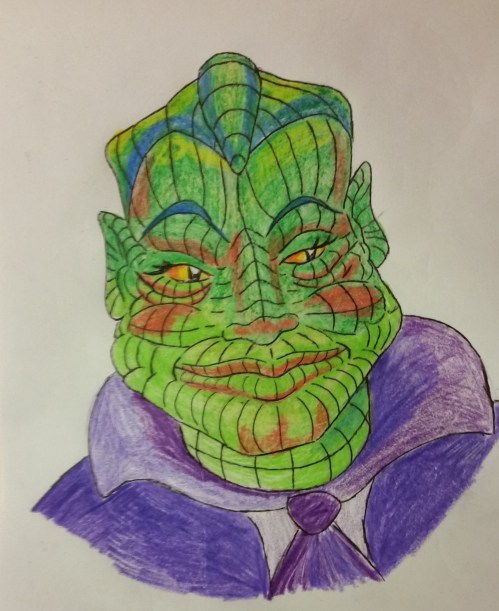
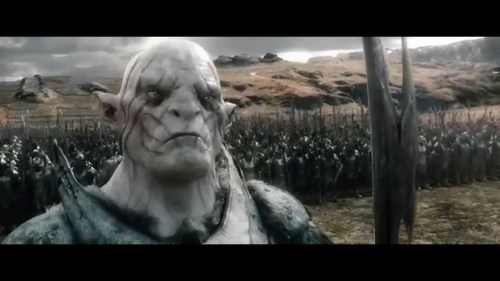
This is not a picture of Betsy DeVos.  This is an orc used as a metaphor, something children will no longer learn how to use in the dark new future of education.

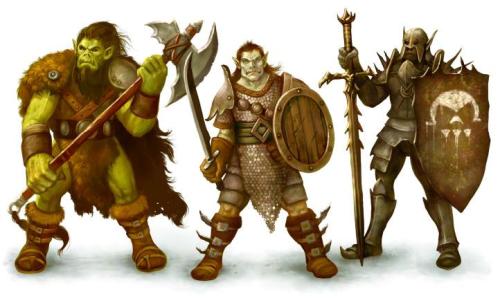
Orcs, as depicted by Tolkien in his epic work The Lord of the Rings, are an unhappy lot, hating everyone, especially themselves and their masters whom they serve only out of fear.  Sound like modern-day Republicans?  Well, that’s probably not a fair comparison.  Shame on you for thinking like that.  Although, I must admit, looking at the Secretary of Education that Donald Trump has foisted upon us with the aid of senate Republicans, there is probably good reason you might think that.

Orcs, according to Tolkien, create no beautiful things.  They live out their lives violently destroying everything and everyone they touch.  They are greedy, corrupt, disloyal, and generally the very definition of ugliness.  And they have been the opponents of good public education for as long as I have been associated with schools and teaching.

16649509_1690833154260989_2908161558671318178_n

Here is an actual portrait of DeVos.  Sorry to spring something so foul and gut-wrenchingly horrible on you, but I thought you ought to have some idea how hideous this orcishness really is.

Orcs always tell me, “You can’t solve education’s problems by throwing money at them.”   What they really mean when they say this is either, “I can afford to put my kids in a good school that will only teach them what I want them to know, and I don’t think any of my money should be taken from me by taxation to pay for the education of poor people’s kids, especially not stupid poor people’s kids.”  Or, more likely, “I am too dumb not to believe rich white people when they say the world will be better for me and mine if I let rich white people keep all the money they make and make all the money they want.”   Either way, in Texas where the orcs have ruled since the Reagan Revolution first won over the rich white orcs that carry their orcish tribal banners all over oil-rich Texas, money has never been an issue for Texas public schools.  There simply is no money for public schools in Texas.  Over the past decade the State has always chosen to cut school funding before dipping into their vaunted billion-dollar rainy day fund whenever the Republican legislatures create a huge budget shortfall.  And whenever there has been a budget surplus, education funds are not restored.  Things like the fight against evil Planned Parenthood clinics take precedence.
2460352586_7bd5e8815c_o

Members of the Texas State Legislature

Now Betsy DeVos, who became our current Secretary of Education despite resistance from all non-orc members of the US Senate, plus two orcs, will now give the orc hordes everything they want for education.  The federal Department of Education will be dismantled from the inside.  Privatized for-profit schools will become the new normal and receive funding disproportionate to the work they actually do.  All the cream belonging to rich folks will be skimmed off the top of the educational milk vat, and the rest will be left to fester and spoil in public school vats, becoming, at best, really really stinky cheese.

And so, let me end by saying, “Thank you, orcs, for doing such a wonderful job of protecting my children and grandchildren from the horrors of education and the ability to think for themselves.  You have protected them from ever learning enough to pull themselves out of the poverty and slavish lives you have put them in.”
 

Leave a comment

Filed under angry rant, education, feeling sorry for myself, humor, metaphor, monsters, politics, red States, satire

Stardusters… Canto 33

galtorr-primex-1

Canto Thirty-Three – Aboard Golden Wing Thirteen

Shalar looked at the readout on the control panel in front of her.  There was no mistaking that signature.  It was the same kind of supra-magnetic photon drive used in a Golden Wing, and it was no longer operational.  It also appeared to be crash-landed in the middle of a debris field, and that couldn’t be good.  In addition, it also had to be the tadpoles’ ship, because Farbick and Biznap on the other missing ship were too capable to have crashed in that manner.

“Is it them?” asked Harmony Castille.  The beautiful young Earth woman who was really an old lady made young and beautiful by Commander Biznap’s own de-evolution machine.  She had a grim face, like someone who expected the answer could only be bad news.

“I don’t see how it could be anybody else.”

“Life signs?”

“I register bodies with no breathing and considerable signs of disease.  No living bodies… but no confirmation that the dead ones are our missing tadpoles.”

Harmony seemed to stifle a sob.

“Why are you so affected by Telleron tadpoles, Harmony?  I understand how much you are in love with Commander Biznap, but none of these tadpoles are his.”

“I have never in my long life had children of my own.  I have always loved children vicariously through the young brats and evildoers I taught in Sunday School at the Methodist Church back in Iowa.”  A tear escaped the beautiful young woman’s eye and rolled down her powdered and rouged cheek.  Shalar couldn’t help but notice that even though the woman’s face was young, her eyes held a certain look of wisdom and experience, as well as pain.

“I will be very sad if I have lost young Tanith and Davalon.  They are very probably children from my own eggs, even though we usually only keep track of the male parents.”

“I will miss young mistresses Brekka and Menolly, too,” said Harmony sadly.  “Their immature giggles and love of dancing always seemed to brighten the room whenever I tried to teach them important life lessons from the Bible.”

“I thought the way you talked to them while teaching them meant you loathed their immature behavior.”

“Oh, I did hate most of the behavior, but I adored those girls.  Underneath the death-eye frowns I gave them, I was always secretly laughing at their antics.”

“I never realized that about you before, Harmony,” Shalar said with some sympathy.

“What kind of mean old fuddy-fuss did you take me for, Shalar?”  Harmony gave a small chuckle with the reply.

“The kind you were pretending to be, apparently.”

“I will miss the Morrells, too.  They were a little dim sometimes, but basically good Christian people.”

“…And how about little George Jetson?”

Harmony’s eyebrows raised in disbelief of some sort.  “That little heathen?  He was almost as full of Satan and evil ways as one of our Earth boys from the Norwall Methodist Church!  He made me wonder sometimes if he actually had a little bit of wicked Baptist in his demon blood.  I never met such a child for pranks and playing with his privates when he should be listening to some good, soul-saving advice!”

Shalar was amused by that reaction.  She was beginning to understand how self-contradictory Earther primates actually were.  In fact, she understood that the reaction actually meant that Harmony would miss that little rapscallion more than all the rest put together.  Shalar had come to see that the old church lady always claimed to hate most what she really loved and adored.

“Studpopper, can you land this wing near the wreckage down there?  We need to find our missing children.”

“I will certainly do my very best, my lady.”

Harmony quickly grabbed Studpopper’s pointy green ear and twisted.

“You’d dang well better do better than that!” the young old lady cried with passion.

*****

1 Comment

Filed under aliens, humor, novel, NOVEL WRITING, science fiction

Special Snowflakes

snowflake12

When conservative cultural warriors, Twitter Trolls, or dyspeptic gasbags like Rush Limbaugh call you a “Special Snowflake”, I have discovered, to my chagrin, that they don’t mean it as a compliment.  In their self-centered, egotistical world you have to be as emotionally tough and able to “take it” as they believe (somewhat erroneously to my way of thinking) they themselves are.  They have no time for political correctness, safe spaces, or, apparently, manners polite enough not to get you killed on the mean streets where they never go.  Being a retired school teacher who was once in charge of fragile young psyches trying to negotiate a cruel Darwinian world, I think I disagree with them.

in-snow-big

Have you ever tried to draw a snowflake?  Believe me, it is difficult.  Snowflakes are hexagonal star-shapes with enough lace and  filigrees in them to make it a nightmare to draw it with painfully arthritic hands.  The one above took me an hour with ruler and compass and colored pencils, and it still doesn’t look as good as a first grader can create with scissors and folded paper.  Much better to use a computer program to spit them out with mathematical precision and fractal beauty.  That’s how all the tiny ones in the background were created.  But even a computer can’t recreate the fragile, complicated beauty of real snowflakes.

You see how the fragile crystalline structures will break in spots, melt in spots, attach to others, and get warped or misshapen?  That is the reason no two snowflakes are alike, even though they all come from the same basic mathematically precise patterns generated by ice crystals.  Life changes each one in a different way.

4f0f6392eb9ed-image

And that, of course, is the reason this essay is really about people rather than mere physical artifacts of cold weather.  Our fragilities and frailties are earned, and they make us who we are.  I have a squinky eye like Popeye from playing baseball and getting hit by a pitch.  I have a big toe that won’t bend from playing football.  They both represent mistakes that I learned from the hard way.

As a teacher, I learned that bipolar disorder and anxiety disorders are very real things.  I lost a job once to one of those.  And I spent a long night talking someone out of suicide one horrible December.  Forgive me, I had to take fifteen minutes just there to cry again.  I guess I am just a “special snowflake”.  But the point is, those things are real.  People really are destroyed by them sometimes.  And they deserve any effort I can make to protect them or help them make it through the night.

snowflake1

But people are like snowflakes.  They are all complex.  They are all beautiful in some way.  They are all different.  No two are exactly the same.

snowflake13

And I really think boorish bastards have no right to insist that we need to take safe spaces and sanctuaries away from them.  Every snowflake has worth.  Winter snow leaves moisture for seedlings to get their start every spring.  If you are a farmer, you should know this and appreciate snowflakes.  And snowflakes can be fascinating.  Even goofy ones like me.

snowflake_with_cartoon_face_0521-1012-0818-0641_smu

1 Comment

Filed under 1000 Voices Speak for Compassion, artwork, battling depression, commentary, compassion, humor, metaphor, Paffooney, self portrait, Snow Babies, strange and wonderful ideas about life

How To Write A Mickian Essay

mickeynose

I know the last thing you would ever consider doing is to take up writing essays like these.  What kind of a moronic bingo-boingo clown wants to take everything he or she knows, put it in a high-speed blender and turn it all into idea milkshakes?

But I was a writing teacher for many years.  And now, being retired and having no students to yell at when my blood pressure gets high, the urge to teach it again is overwhelming.

So, here goes…

c360_2017-01-02-10-17-06-058

Once you have picked the silly, pointless, or semi-obnoxious idea you want to shape the essay around, you have to write a lead.  A lead is the attention-grabbing device or booby-trap for readers that will draw them into your essay.  In a Mickian essay, whose purpose is to entertain, or possibly bore you in a mildly amusing manner, or cause you enough brain damage to make you want to send me money (this last possibility never seems to work, but I thought I’d throw it in there just in case), the lead is usually a  “surpriser”, something so amazingly dumb or off-the-wall crazy that you just have to read, at least a little bit, to find out if this writer is really that insane or what.  The rest of the intro paragraph that is not part of the lead may be used to draw things together to suggest the essay is not simply a chaotic mass of silly words in random order.  It can point the reader down the jungle path that he or she can take to come out of the other end of the essay alive.

Once started on this insane quest to build an essay that will strangle the senses and mix up the mind of the reader, you have to carry out the plan in three or four body paragraphs.  This is where you have to use those bricks of brainiac bull-puckie that you have saved up to be the concrete details in the framework of the main rooms of the little idea-house you are constructing.  If you were to number or label these main rooms, this one you are reading now would, for example, be Room #2, or B, or “the second body paragraph”.  And as you read this paragraph, you should be thinking in the voice of your favorite English teacher of all time.  The three main rooms in this example idea house are beginning, middle, and end.  You could also call them introduction, body, and conclusion.  These are the rooms of your idea house that the reader will live in during his or her brief stay (assuming they don’t run out of the house screaming after seeing the clutter in the entryway).

Teacher

The last thing you have to do is the concluding paragraph.  (Of course, you have to realize that we are not actually there yet in this essay.  This is Room C in the smelly chickenhouse of this essay, the third body paragraph.)  The escape hatch on the essay that may potentially explode into fireworks of thoughts, daydreams, or plans for something better to do with your life than a read an essay written by an insane former middle school English teacher at any moment, is a necessary part of the whole process.  This is where you have to remind them of what the essay is basically about, and leave them with the thought that you want to haunt them in their nightmares later.  The last thing that you say in the essay is the thing they are the most likely to remember.  So you need to save the best for last.

So, here, finally, is the exit door to this masterfully mixed-up Mickian Essay.  It is a simple, and straightforward structure.  The introduction containing the lead is followed by three or four body paragraphs that develop the idea and end in a conclusion that summarizes or simply restates the overall main idea.  And now you know why all of my former students either know how to construct an essay, or have several years left in therapy sessions with a psychiatrist.

Leave a comment

Filed under commentary, education, humor, Paffooney, teaching, writing, writing teacher

The Oxford Obfuscation

queen-elizabeth-iIf you are going to entertain a completely absurd notion like, “Shakespeare wasn’t really written by Shakespeare”, then you have to have some knowledge of the times and the context within which such a profoundly counter-intuitive thing could possibly be true.  And it also helps to understand more precisely what the “writing of Shakespeare” actually means.  Now, I know it is not particularly fair to confuse you, dear reader, right before I try to dazzle you with my complicated and over-thunk lackwit conspiracy theory, but that is, after all, what obfuscation actually means.

The plays, sonnets, and other poetry of William Shakespeare reveal the mind of a genius.  Whoever wrote the works has to be a complicated man living a complicated life.  He has to be a sensitive, empathetic, highly intelligent, observant, and troubled man.  You don’t write the dark and deeply troubled suicidal tragedy of Hamlet without ever having thought of taking your own life.  You cannot portray the madness of King Lear without ever having experienced the turmoil of the mind that threatens to tear your soul apart.  And you don’t write about the complexities of love found in As You Like It or Romeo and Juliet without ever having experienced the massive thunderstorms of the mind that go along with falling in love.  And we are talking true love, not necessarily the domestic love you have for the wife you are stuck with.   You see what I did just there?  I put you into the head of the writer, and started you thinking like you yourself are Shakespeare.  As goofy a mental gymnastic exercise as that is, bear with me and keep thinking it.

At the time of Shakespeare’s ascendancy as the Bard Laureate of English Literature, England was not a safe place to be either a noble or a playwright.  Queen Elizabeth’s mother had her head cut off for bad politics even though she was married to the King of England at the time.  Lady Jane Gray, one of Elizabeth’s predecessors, lost her head when she was no more than a sixteen-year-old girl.  During Elizabeth’s reign, one of her court favorites, Robert Devereaux, Earl of Essex, attempted to seize the queen herself after a riot fomented by a performance of Shakespeare’s play, Richard II, at which eleven of Essex’s noble supporters were said to be present stirring up the emotions of the crowd.  It was a near thing for the writer of the play (about the life of a king whose reign ended in controversy about succession and which led eventually to the War of the Roses) to escape without also being caught up in the rebellion’s failure and round of executions that separated Essex from his head.  Elizabeth banned numbers of plays with religious or political content, bans that never seemed to touch the writer of Shakespeare’s plays, even when they touched on political themes.  You didn’t have to rebel against the Queen to lose your head either.  Elizabeth was trying to reinstate Anglican Protestantism against the critical tides of Catholic Europe.  You could be banished, put to death, or impressed  by force into the English Navy for being suspected of ideas that were too Catholic.  And witchcraft, or consulting with witches, as Macbeth depicts, earned you a nice warm fire in the public square to cleanse your immortal soul.

edwarddevereattribmarcusgheeraerts

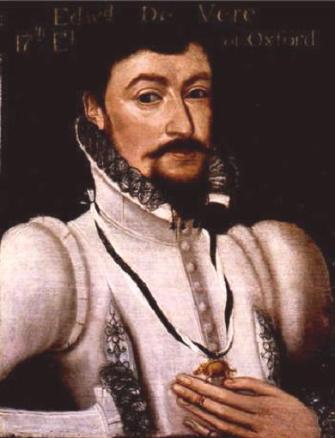
Edward de Vere, 17th Earl of Oxford

So, if one were to be both a playwright and a nobleman, known to and beloved by Queen Elizabeth, might there not be good reason to write under a pseudonym?  And numerous people who write about Edward de Vere mention the fact that he wrote poetry and plays, and the plays were very popular.  Some scraps of poetry by the Earl of Oxford still exist, but whatever happened to the manuscripts of his plays?  It is a conspiracy theory so delicious, that I have to take at least one more bite.  (You understand, I try to stick to a 500-word target for these posts, and even this 600+ is really too long.  So that means there has to be an Earl of Oxford Part II at least.)

Leave a comment

Filed under conspiracy theory, foolishness, humor, politics, William Shakespeare

Stardusters… Canto 31

galtorr-primex-1

Canto Thirty-One – Moonbase Gundahl

Commander Biznap was a capable pilot and Farbick admired the way he simply turned the Golden Wing in the air and took off towards the mother ship.  Simple and elegant was always the mark of skill.

“Now that your commander has gone and left you to die…” said Stabharh, the scrawny little Galtorrian lizard-man enforcer, “you need to show us how to work the space tech devices.  And hurry because I know some Galtorrians that are dying to eat you.”

“Have you ever eaten a Telleron before, Stabbie?” asked the cruel and obese Lord Bahbahr.

“Of course not.  But we haven’t had food in so long, I was beginning to consider eating you, my lord.  And don’t call me Stabbie.”

“Ah, we will have none of that!  You are required to lay down your life to serve me.   It is the law, and I own you body and soul.”

“Who besides me is left to enforce the law?” asked the skinny lizard with an evil grin.

The smile vanished from the face of the corpulent Galtorrian ruler.  Farbick carefully noted the malevolent glares passing between the two lizard-men and vowed secretly to himself to take maximum advantage of such a situation.

“What device would you like to learn about first, my lord?” asked Farbick with a timely interruption.  Then he strategically added, “the skortch pistols perhaps?”

“I am much more interested in the force-field thingy that kept the cannonballs from destroying that spaceship.  You have no idea how useful that could be if Senator Tedhkruhz learns that we have returned here.”

The little enforcer seemed to whole-heartedly agree with Bahbahr.  So Farbick moved near to the force-field control and activator box lying at the foot of the pile of Telleron tech.

“That is a very wise choice,” said Farbick as Starbright looked on encouragingly.  “May I turn it on and demonstrate?”

“Please do,” said Bahbahr.

Farbick ignited the control box with the click of a button and a sudden electrical humming noise that sounded reassuring and powerful.

“By adjusting the three-dimensional coordinates like this,” said Farbick, “I can place an invisible shield around you and Stabharh.  You can’t see it, but it is impervious to kinetic attacks and weak energy attacks.  Gunpowder will never pierce it.  Show them, please, Starbright.”

“How?”

“Pick up that chair there and hit Stabharh over the head with it.”

“Now, hold on there, frog-boy!” growled the lizard man.

Before Stabharh could even flinch, Starbright picked up the chair and threw it at him.  It shattered in the air as it encountered the generated field.

“Impressive!” said Bahbahr.

“Do you want to know what I find most impressive?” said Farbick, laughing.  “It can be shaped in the form of a box.  Just as the chair can’t penetrate the walls of the force field, neither can the two of you.  You are our prisoners now.”

The two lizard-men seemed stunned.  It was entirely possible that Farbick had won the day already.  He could now pick up a skortch pistol and finish these two threats in a blink.  Yet, somehow, that didn’t feel right.  He could not do a deed that was just as bad, if not worse, than what the lizard-men themselves were capable of.

From the courtyard above in the ruined fortress, Farbick and Starbright suddenly heard voices and the sound of someone scrambling hastily through rubble.

“I thought we were alone on this moon,” said Starbright, horrified.

“We were…” said Stabharh with a sneer, “at least we were not burdened with anyone who counts.  But the remaining inhabitants of Gundahl are coming now, because of my silent alarm.  And hopefully they have weapons to kill you two with.  Who is the clever fellow now, hmm?”

*****

senator-tedhkruzh

1 Comment

Filed under aliens, humor, novel, NOVEL WRITING, Paffooney, science fiction

The Heart of Shakespeare

3a8307f6bb01311fc90478857d32e891

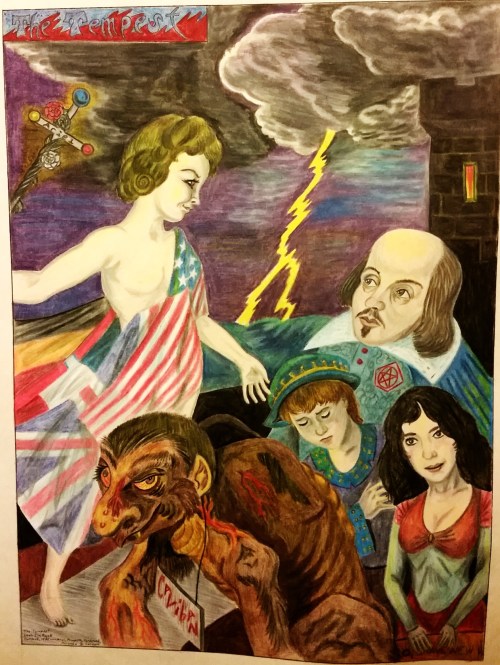
Despite my skepticism about the accepted wisdom in regard to the historical William Shakespeare, I do deeply love the body of work that is Shakespeare.  My most favorite play is The Tempest, the final play in the canon.  I also have read and loved As You Like It, Romeo and Juliet, Hamlet, A Midsummer Night’s Dream, The Merchant of Venice, Henry V, Richard III, Julius Caesar, Macbeth, Othello,  and King Lear.  I know that is not all of the plays, but that is probably more than most people have read.  And of course, as an English major in college, and later as a teacher, I have actually analyzed, compared, studied, and taught some of these plays.  So, the Shakespeare I know is the Shakespeare of the writer’s own mind, his communicated wit and wisdom, imagination and intellect.

shakespeare

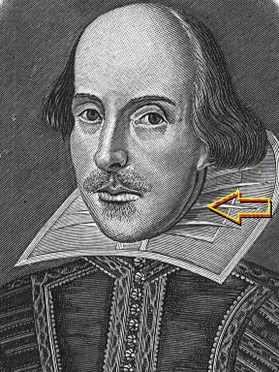
And I do not have any disdain or disrespect to give the Stratford guy.  To say that, in the Elizabethan world, the actor son of a tradesman with only a grammar school education could not have been the mind behind the literary masterworks is foolish.  The Stratford guy owned and operated the Globe theater at a time when “the play was the thing”.  All of London society, rich and poor, gloried in the theater, and Shakespeare did for Elizabethan plays what Babe Ruth did for baseball.  He was a good enough business man to make himself a decent fortune.  Although, apparently, this world-shaking author didn’t spend any of his money on owning books, which in my experience is extremely rare among writers.  His life, bound up in an urban existence that never traveled outside of the country also somehow produced great works that were set in places in Europe, especially Italy, that described those settings in accurate detail.  As a working actor, he also apparently had the time to study law and somehow learn the inner workings of the royal courts of more than one country.  And the plots were not original.  He took existing stories that already were a part of European literature and lore and wove them into rich tapestries of human striving, laughable foibles, and a deep understanding of basic human character.  But I do have doubts that the businessman and actor from Stratford was the real writer of the plays.

I have already told you that I don’t believe Sir Francis Bacon was secretly Shakespeare.  Christopher Marlowe wasn’t either.  And I have unsuccessfully made a case against Shakspere, the Stratford guy.  So who could possibly be the real William Shakespeare?  Well, I am not going to be able to make a decent case for him in the 100 words that I have left to end this essay with.  So there has to be more to come.  (And stop screaming obscenities at the computer screen.  I am going to reveal the name before the end of this essay.  And I promise not to make my case for him in coming days too boring and horrible.)  I have to show why I believe that the true heart of Shakespeare could only have beaten within the body of Edward deVere, the Earl of Oxford.


6 Comments

Filed under conspiracy theory, goofy thoughts, humor, strange and wonderful ideas about life, William Shakespeare

Green and Fuzzy Blue Brainwork

100207H1

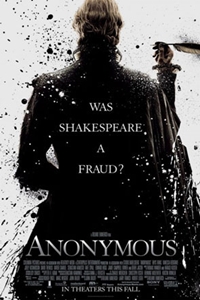
There is reason to believe I have to reroute some of the back roads on the road map of my thinking parts.  I have been spending a lot of time in Elizabethan England lately due to my obsession with who I think Shakespeare really was.   There are a lot of dark alleys to be plumbed on that section of the map.  I really admire the Roland Emmerich film Anonymous about Edward deVere, the Earl of Oxford being the real writer behind the works of Shakespeare, but I do recognize that it is a work a fiction, and an altered-history work of fantasy fiction at that.    So I find myself not yet ready to tackle that particular essay in the Shakespeare series as yet.  More think time and creative-mixing time is needed.  I need to stop at one of the quaint little mental inns on that particular Elizabethan back road and get some much needed rest for my Elizabethan conspiracy muscles.

Meanwhile back in the real world, Trumpzilla has been busy wrecking the world I live in with a bleak inauguration speech written by Steve Bannon that works its fire-breathing magic to blacken the hearts and perceptions of people I love and care about who also happen to be staunch conservatives.  My Facebook feed is up in arms about how many people actually attended the inauguration ceremony and how unfair the media is for trying to make it seem like Trump’s celebration parade was a deserted wasteland when in reality it was… well…  what’s a synonym for deserted wasteland that won’t offend conservatives who will bend or break any truth to defend Trumpzilla’s turkey-tweets?

trumpasaurus

But then, as I was going to QT for my morning caffeine-addict’s fix of Diet Coke, I heard Lionel Richie’s song “Say You, Say Me” playing on the radio.  Ah, the perfect metaphor.  It is a song used as the theme song from the 1986 movie White Nights about a Russian ballet star who has defected to the US during the Cold War and then was in a plane accident-incident that put him back in the Russians’ clutches.  The movie stars Mikhail Baryshnikov, an actual Russian ballet star turned defector, and Gregory Hines, the American tap dancer.  It is a beautiful movie that features amazing dance sequences, Russian conflict of interests because the dancer wants to be free and yet misses his homeland and culture, and a resolution involving intrigue and escape.  In many ways, the plot, centered around a Russian threat and dark days in a place where the sun doesn’t set, is exactly what we are going through with Trumpzilla.  But the song is about two people communicating and eventually “coming together, naturally”.

It started me thinking about the purpose of this blog.  I mean, you obviously know that this blog is really about me talking to myself about myself, if you are one of those crazy few who actually read this far through a goopy blog post like this.  I use this blog to think about myself, the world around me, and even sometimes, like now, to think about thinking.  Yet, I have a duty to the reader to reach that point where our thinking comes together, naturally.  If not, then why bother to post and publish at all?

So here’s what I think about the Shakespeare question, written in the tavern room at the inn on parchment… with a quill pen.  The real Shakespeare was a writer just like me, writing for himself.  And he discovered through the play-writing process that he had to share that writing for himself with the great wide world, because the Prospero’s magic of it could change the world for everybody.  That is the real purpose of Shakespeare’s existence, no matter who he really was.  And that is the real purpose of my existence as well, even if I turn out to be nothing more than one of the top hundred best writers that no one ever actually read.

c360_2017-01-13-19-11-50-170


1 Comment

Filed under blog posting, conspiracy theory, feeling sorry for myself, goofy thoughts, humor, sharing from YouTube, soliloquy, strange and wonderful ideas about life, William Shakespeare

Kit Marlowe, Secret Agent

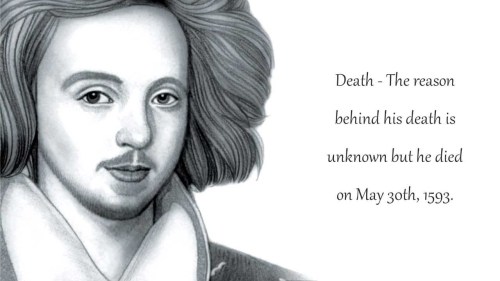
christopher_marlowe

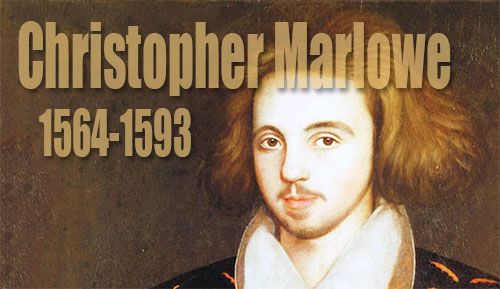
Christopher Marlowe is often sited as the real Shakespeare, a problematic assertion given that he would’ve been forced to write a number of plays after he was dead, giving new meaning to the term “ghost writer”.  But I would like to add to the assertion that “Marlowe is NOT Shakespeare!” that I also believe he did not die as they claim that he did.  Marlowe is a fascinating character of debauchery and misbehavior, intrigue and mystery, and undeniable genius.  As a writer, he was a maverick and risk-taker, having begun the ascendance of the theatrical play as one of the heights of Elizabethan literature with his play Tamburlaine the Great, about the historical figure who rose from shepherd boy to monarch.  This play, and its sequel, Tamburlaine the Great Part II, were among the very first English plays to be written in blank verse, meaning there is a very definite connection between the style of writing established by Marlowe and the later work of Shakespeare.  It is probable that for a few years, Kit Marlowe was a member of the Gray’s Inn group along with Sir Francis Bacon and several other suspicious literary luminaries like Sir Walter Raleigh and possibly Ben Jonson.  (I have to admit at this point that if I am wrong about the Stratford guy and he did write the plays, then he was a member of this group as well, because it was not closed to commoners, only to stupid people.  The Stratford guy was in no way stupid or a villain, no matter what you may believe about the authorship question.)  But here is where the link to Shakespeare’s plays and poetry both begins and ends.  Yes, Kit Marlowe was a capable enough author to have written such sublime plays.  He has all the individual skills to make up the whole.  But if you read his masterwork, The Tragicall History of the Life and Death of Doctor Faustus, you will see that the voice, the unique literary style of the work is simply not by the same author.  Although Shakespeare revisits some of the same themes that Marlowe used in his plays, his manner of development, handling of character, style of humor, and underlying conviction in the existence of God are all different and opposed to Marlowe’s.  Marlowe is NOT Shakespeare.  Shakespeare’s works have more in common with Bacon’s than Marlowe’s.  And I have already said that, “Shakespeare is NOT Bacon… or eggs either.”  And if I said it, it must be so.  (Don’t throw eggs and tomatoes at your computer screen when you read this.  Just call me stupid and vain in the comments like everybody else does.)

maxresdefault

And an even more compelling reason to those of you who don’t obsess over reading Shakespeare and Marlowe and Ben Jonson is that, at the time Shakespeare’s plays were probably written, Kit Marlowe was busy either being stone cold dead, or, having faked his death, was busy being a secret agent for Queen Elizabeth.


And why would a goofball like me think that Christopher Marlowe cunningly faked his own death and went into his own thrilling quest to be like James Bond more than 300 years before Ian Fleming?  Well, because I know how to read and am not generally bright enough not to believe what others have written about him and his connections to world of spying in Elizabethan times.

These authors have brought out the fact that Marlowe’s frequent absences from college and later public obligations coincide with things like the mysterious tutor called “Morley” who tutored Arbella, niece of Mary Queen of Scots, and a potential successor to Queen Elizabeth, in 1589.  He was also arrested in the Netherlands for allegedly counterfeiting coins related to the activities of seditious Catholics.  He was brought back to England to be dealt with by Lord Treasurer Burghley, the closest adviser to Queen Elizabeth, and was then not so much punished as let off the hook and even rewarded monetarily.  Still think he was not a spy?  Well, his demise probably came about through his relationship with Lord Francis Walsingham and his friendship with Walsingham’s son.  You see, Walsingham was Elizabeth’s “M”, leader of her spies and intelligence units.  After Walsingham died, there was deep concern that no one was still able to protect Marlowe from possible consequences of being both a homosexual and an atheist.  (Being gay was obviously not as serious a sin as atheism for which torture and death penalties lay in wait.)  It was possible that rival spies and nefarious forces could kidnap Marlowe and get information out of him that the Queen needed to be kept secret.

So, when Lord Burghley tortured Marlowe’s friend and sometime roommate, Thomas Kyd, into naming Marlowe a heretic and sending men out with a warrant to arrest Marlowe, Kit’s other friend, Thomas Walsingham probably warned Marlowe.  The bar fight that supposedly ended Marlowe’s life was witnessed by two friends of his, Nicholas Skeres and Robert Poley, both provably con men and professional liars.  The knife that stabbed him in the forehead above his right eye was wielded by Ingram Fizer, another of Marlowe’s disreputable friends, allegedly over an unpaid debt.  Fizer, of course, though he freely admitted killing Marlowe, was acquitted of the murder.  And the coroner’s report is suspect.  Rules of investigation were not followed, and the body was never independently identified by someone other than the three friends at the scene of the crime.  And the body was hastily buried before anyone else could get a close look at it.

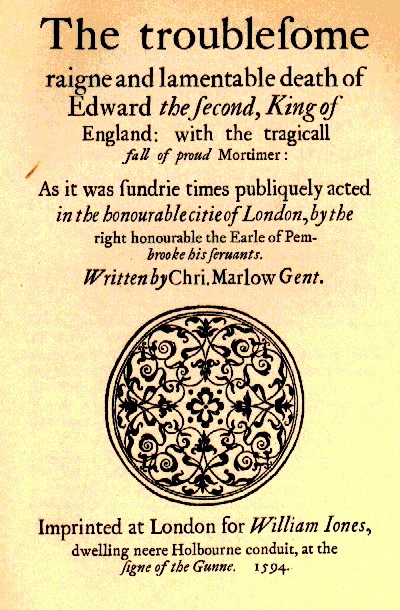
edward2a

I am not only telling you that I believe Christopher “Kit” Marlowe was NOT Shakespeare… or eggs either (though that joke doesn’t really work here), but I believe he didn’t die the way it has been reported to us by history.  And why do I believe these things?  Because I think the story of Christopher Marlowe is a really great story, and it exists as a story whether it is historically true or not.


Leave a comment

Filed under angry rant, artists I admire, conspiracy theory, goofy thoughts, humor, poetry, satire, telling lies, William Shakespeare

Shakespeare is NOT Bacon

3475b987-6c5d-4699-ba5d-e6008559028f

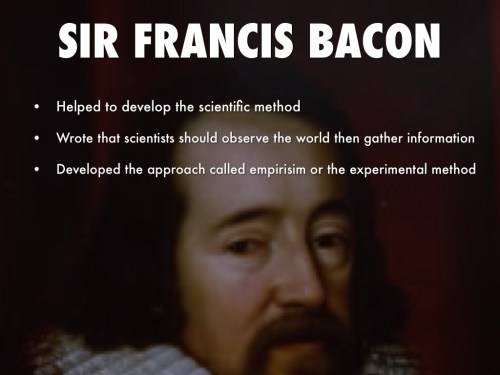
Yes, Sir Francis Bacon is at least as interesting and obscure as William Shakespeare.  But let me assure you, I can confidently state, “Shakespeare is NOT Bacon!”  He is not eggs either… or any other breakfast food.  Sir Francis Bacon was the breakfast, the first meal in the great Elizabethan banquet of literature, poetry, and culture.  And William Shakespeare is a more important main course, the royal dinner, as it were.  But it has to be acknowledged that Bacon was essential to the very existence of William Shakespeare.  Breakfast always comes before dinner.

t2ec16dhjgoffvtvhuebslhohksvg-60_35

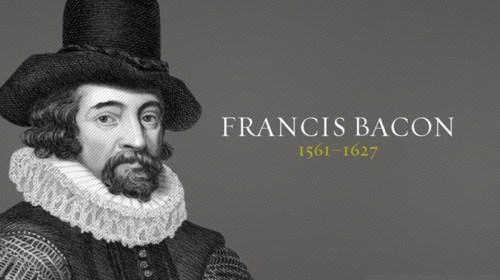
In 1845 a female author by the name of Delia Bacon (nothing suspicious about that coincidence, by the way) put forward an idea that William Shakespeare’s plays were actually written by a group of men under the leadership of Sir Francis Bacon.  She thought the group intended to inculcate into English culture an advanced system of politics and philosophy which they themselves could not take credit for publicly.  She would later write a book in 1857 called The Philosophy of the Plays of Shakspere Unfolded which advanced the notion that the plays were written for Baconian purposes beyond mere theatrical entertainment.  Numerous people, including the American poet Ralph Waldo Emerson supported her in her quest to find proof, sending her to England to research the crazy conspiracy theories she founded by noting ciphers in the plays, and in the essays of Bacon, that led her to believe all she had to do was dig up the gravestone of Shaksper in the chapel at Stratford to find written proof in Bacon’s own hand that he was, in fact, the author or primary motivator of the plays of William Shakespeare.  She spent one cold and creepy night in the chapel, just her and her spade and her crow bar, along with the bones of the Stratford guy, trying to work up the courage to do a bit of grave-robbing… and failing.    It is a good story, but very poor archaeology.  She was denounced by the literary historians and establishment figures who supported the Stratford guy.  They said her scholarship was sloppy, her cipher analysis goofy and unfounded, and her conclusions more questionable than a pig in theatrical make-up.  (My words, not theirs.  English critic George Henry Townsend was entirely too stuffy and boring to simply be quoted here.)

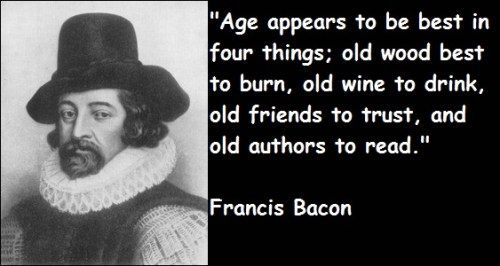
francis-bacon-quotes-francis-bacon-quotes

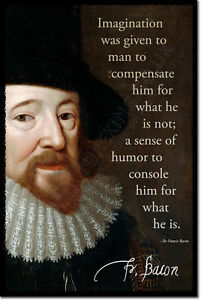
Now, I, of course, strongly disagree with the Bacon lady.  As I said in the very title, “Shakespeare is NOT Bacon.”  But I do think there was merit in sniffing out old Frankie’s scent and fingerprints on the whole Shakespeare/Shaksper thing.  The Stratford guy was not Shakespeare either.  When he died in 1616 there was no public outcry at the loss of England’s most popular poet and playwright.  Even King James who was Shakespeare’s number one fan and constant audience member, didn’t mourn the passing of the actor/theater-owner/businessman from Stratford.

Francis Bacon, on the other hand, was a powerful intellect, educated in the ways of science, the law, and government in the Elizabethan age.  Bacon gathered other men of powerful intellect and accomplishment at Gray’s Inn to hold debates about things philosophical and things scientifical.  It is not unreasonable to imagine that the man who really wrote the plays attributed to Shakespeare sat at that table and participated in those debates.  And Sir Frankie had good reason to keep lots of this business a secret.  There exists evidence that though he was apparently happily married to a fourteen-year-old girl, he did a little bit of swaying toward the other gender too, a thing not too popular with the average Anglican Englishman.  He also dabbled a bit in the occult (think witches in Macbeth sort of thing).   And his essays indicate a strong correlation to the philosophies and ideals of the German Rosicrucian Movement.  In 1593 during a Roman Catholic plot against Queen Elizabeth, Frankie managed to take a position on the investigation that totally offended the old virgin queen.  He was on the outs with Liz for the rest of her difficult and anger-management-challenged life.  He did rise to prominence under her successor, James I, but never-the-less managed to die amidst total ruin and scandal.  There is a lot in Frankie’s life to indicate that he had a direct influence on the content of Shakespeare’s plays.  Some of the characters in the plays may actually be, at least in part, based on Frankie himself.  But  this guy never hung out with the Stratford guy that anyone knows of.

So, if Shakespeare is NOT Bacon, or eggs either… and the Stratford guy isn’t Shakespeare, then who is?  Come on!  You knew I had a lot more to say about this crazy conspiracy thing, right?

67489

4 Comments

Filed under conspiracy theory, education, foolishness, goofy thoughts, humor, philosophy, strange and wonderful ideas about life, William Shakespeare