It is cloudy outside. The sky is a cool, damp gray. No rain. No snow. Just dreary and gray. The world is gray today.
We have now been in a lockdown and wearing masks for an entire year. I have lost a lot of ground. Color-blindness runs in my family on my mother’s side. Great Grandma Hinckley was completely color-blind by the time she was in her 70’s.
I myself have known I had the color-blindness problem since I was in high school and the school nurse gave me a vision test that proved it.
In the dotted circle, I could see the blue-green number 29, but I could also see the red number 5. I was told that I had a slight color-blindness on the red/green scale. Believe me, I had no idea what that meant. Still don’t. I just know I have never seen colors the way other people with normal vision do.
But now, after twelve months of lockdown, I can definitely detect the fact that I have lost some more of my color vision.
Great Grandma saw the world in black and white and gray since she was 70. That, for me, is now less than six years away.
As a cartoonist I use a lot of pen and ink. I also love black-and-white movies. Being partially colorblind, you might think that I would be okay living in a film-noire world. But I am not. It is simply not enough. I have always craved color. I particularly love to create with bright primaries, red, yellow, and blue.
I will sorely miss color when it is gone.
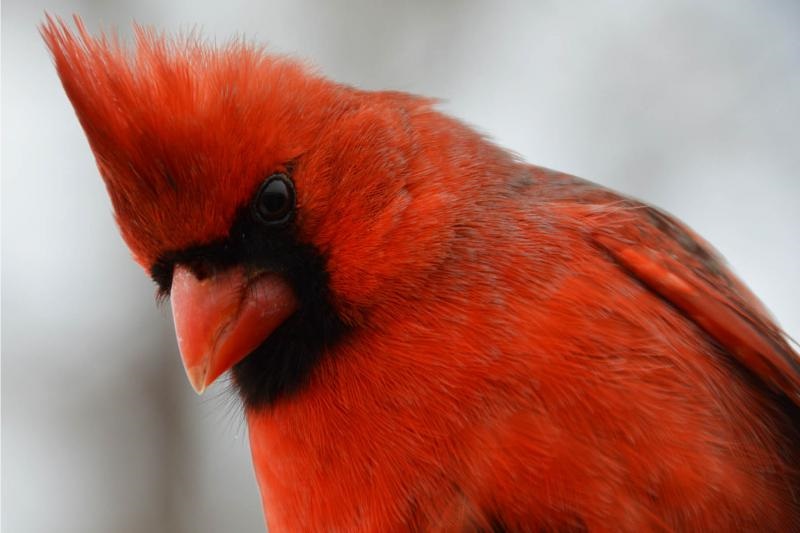
And I have always loved cardinals. Not only because they are bright red songbirds, like the one singing outside in our yard on this gray and slightly blustery day. But because they never fly away when the winter comes. They stay even in the snow and cold. Trouble doesn’t drive them away. I shall not give up when I lose all the colors.
I remember the world being gray when I was a boy back in the 1960’s too. TV was only black-and-white… and gray at our house. I watched the funeral parade for JFK on the black-and-white… and gray TV. And around that time the three astronauts Grissom, Chaffee, and White had a similar funeral parade… also black-and-white-and-mostly-gray.
The Viet Nam conflict on the TV news with Walter Cronkite. The riots at the Democratic Convention in 1968 with the Chicago Seven going on trial. The world was very, very gray.
But then, in the Summer of ’69, Neil Armstrong landed on the moon. A giant leap for mankind! And I saw that also in black-and-white-and-mostly-gray.
There was a hope of color in my life after that. And we got a color TV in the later 70s after that. And even with my partially color-blind eyes, I saw color everywhere.
And now again is a good time to anticipate color coming back into my life. I am on the waiting list for vaccination. My eldest son has a steady girlfriend living with him now. And we have a better President who actually seems to care if we live or die. Good things are over the next hill.
There are magical flowers in Mrs. Pennywhistle’s garden.
And what do I mean by that?
She grows snapdragons, pansies, and nasturtiums like any good granny-gardener would.
But amongst the children of our little town, the rumor is that she’s actually a witch.
A good witch.
Not a bad witch.
Her spells only fascinate, never glammer, never take over your little-boy or little-girl mind.
This is the magical blossom she got from old Dr. Mirabilis. He’s a wizard from Peru that she found in the nursing home in Belle City. He gave it to her as a gift when his arthritic hands could no longer keep it alive on the hospital window sill. She cares for it like it was her own baby.
It’s magical power is as an aid to contemplation. It’s gentle purplish-pink color is calming when you stare at it. Its odor is mesmerizing. She uses it to talk to the doctor now that he is gone, and she can no longer visit him to talk about her flower garden.
These pretty posies are planted all around the edges of the garden.
Especially around the carrots and cabbage.
Do not stick your little noses between the pink and white petals.
They have an awful smell.
But their magic is keeping the rabbits out.
Especially from the cabbages and carrots.
And the pansies are the clowns and punchinellos of the flower bed.
See their angry eyes under bushy-black eyebrows? And their too-serious little broomlike moustaches?
How can you do anything but laugh?
And the White Rose…
That’s the avatar of Mrs. Pennywhistle herself.
When she can no longer keep that one growing, it means the gardener has gone.
And the garden will soon be gone for good as well.
We had to walk for a considerable distance in the leafy, greenish-blue shade of the soybean field until we located the errant skull. We were not alone of course. Master Eli recruited a half-dozen Gingerbreads as scouts to help us locate the thing and make sure the bone-walker’s pilot didn’t escape alive.
Gingerbreads, as I’m sure you probably already know, are actually fairy golems. Their bodies are gingerbread-boy-and-gingerbread-girl cookies baked by the cook-witch Gretel, Anneliese’s mother. The souls that inhabit the cookie-bodies are the spirits of children murdered in Nazi death camps during a slow-one event apparently known as Were-Wore Two over in what the fairies call the Continent of Cernunnos the Horned One and Wotan the Wise. They were gingerbread-cookie fairies that, if any animal or slow one bit a bite out of them, could immediately grow it back from the stores of magical gingerbread dough stored in Cair Tellos.
It was a gingerbread boy named Johan that located the skull and took us straight to it.
It was Master Eli Tragedy, Mickey the Wererat, and me that moved to surround the skull and its occupants with the six gingerbreads.
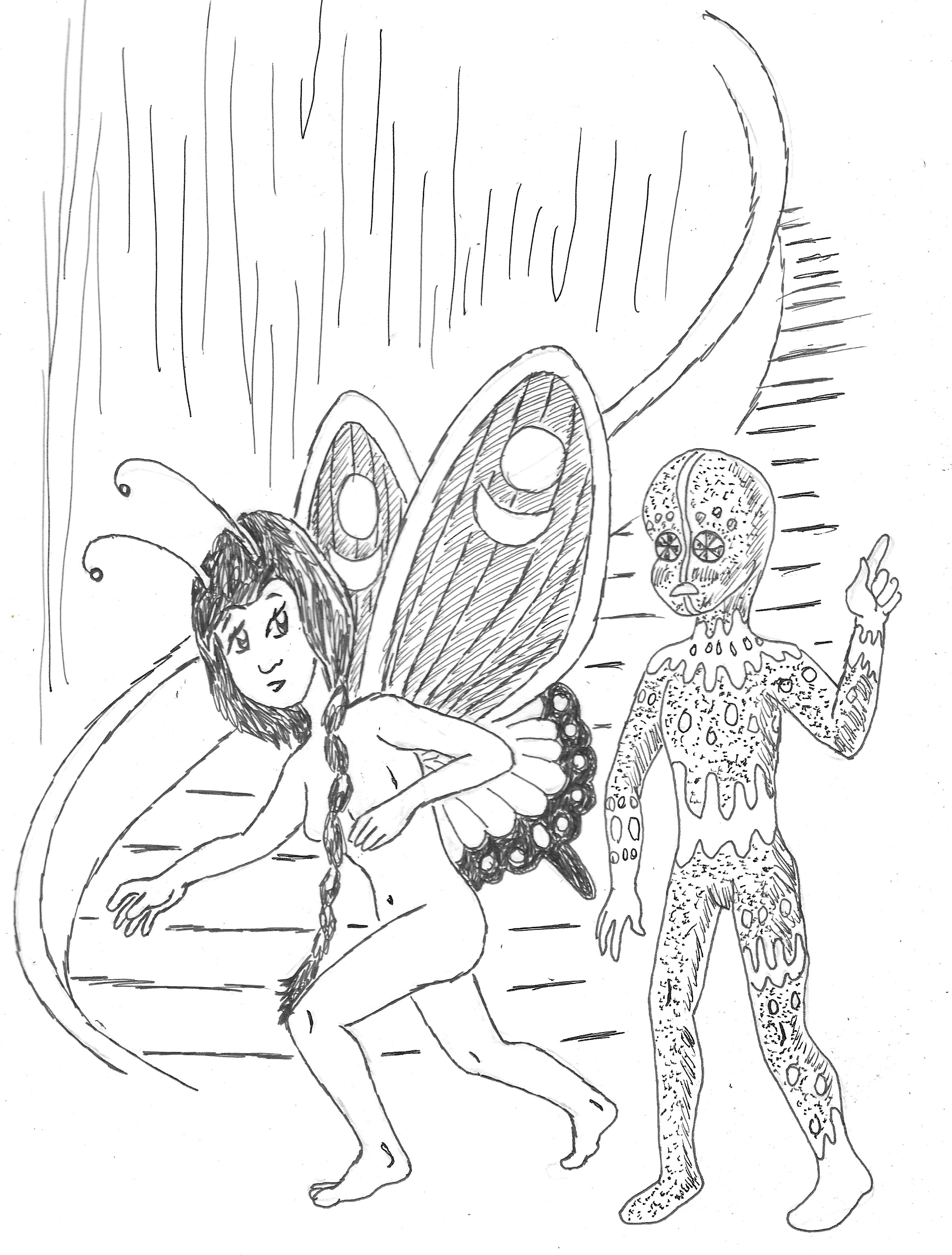
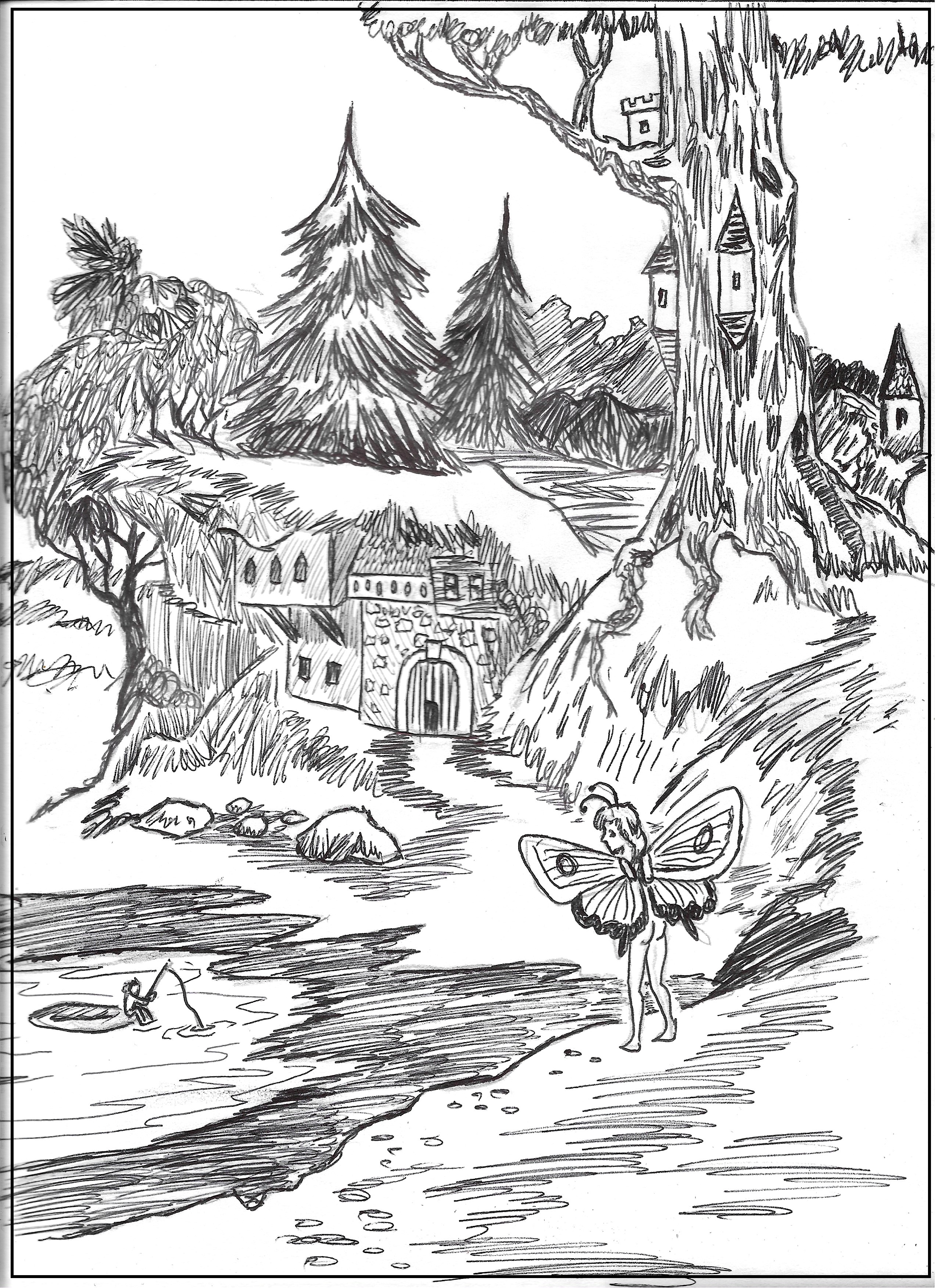
But I caught my breath when I saw her. It wasn’t a little green wartole, or one-eyed Cyclopes that had been piloting the bone-walker, but a nude, young Sylph girl, holding what looked like a demon skull and talking to a pair of full-sized crows.
“So, what’s going on here?” roared Master Eli. “You are not a Gobbulun!”
“Call me later, Derfy! I can hear your thoughts. Gotta fly now!” said one of the two crows as they both turned and flapped away.
The girl turned to look at us. Her eyes were cold and gray, but they were also streaming with tears.
Eli pointed his magic wand at her with his finger tightly on the trigger. “Confess, child. How did the necromancer come to send the likes of you?”
“You are going to kill me anyway. So, why should I tell you anything?”
“How is it that you were able to make a non-magical crow talk? Your demon-head doesn’t normally have a power like that. Tell me, or I use the dragonfyre in this wand upon you.”
“I don’t know.”
“What?”
“I said I don’t know.”
Eli lifted the wand higher as if he was going to incinerate her. But, of course, he wasn’t. There was only one charge left in the wand, and he wanted to save it. It was unclear to me if he even had any reloadable charges for it.
“Tell me the name of your little demon head, and I will let you live for a little while longer.”
“No. I won’t tell you that so you can control the master’s demon head.”
“My name is Kackenfurchtbar. Please don’t kill my Derfentwinkle. I love her,” said the demon skull with the broken horn.
I looked at Mickey and he looked at me. Both of us had our mouths hanging open and our eyes nearly bugged out.
“Kack, why did you…?”
“Kackenfurchtbar, you will now only take commands from me, the great and powerful Sorcerer, Eli Tragedy!”
“Dammit, Kack!”
“Yes, oh, great and powerful Sorcerer, Eli Tragedy.”
“So, now you are finally gonna kill me?” she said softly to Master Eli.
“No, probably not,” said Master Eli.
“Oh, good! Does that mean we can use her to learn necromantic sexual practices and try them out on her?”
“Don’t be gross, Mickey,” I scolded.
“Mickey, whatever you and Bob decide to do with her on your spare time is between the three of you. You will not abuse a captive, no matter what else you do. And you know I give you two very little spare time.”
“Yes, Master,” Mickey said glumly.
“Kackenfurchtbar, what is the name of the necromancer?”
“Kronomarke, Necromancer to the Kingdom of the Valley-Eaters, and servant of the mighty King Stoor.”
“Oh, of course it is. Old Blue-bottom from Mistress Schulelehrer’s school for cursed youngsters. I knew the principal should’ve put him to death in the second grade for eating a classmate.”
“You know the necromancer?” I asked.
“Personally?” asked Mickey.
“I had Basic Runes classes with him about six hundred years ago. Ugliest damned kid in whole cursed school.”
“If you went to school with Kronomarke, why does he hate you so much?” asked the girl.
“Oh, told you about me, did he? By name?”
“No.”
“Ah, that’s a lie. My truth spell tells me you know about his oath of vengeance.”
“You don’t have a truth spell. At least, not active.”
“And how would you know that?”
“My magic tingle wasn’t tingling at any time during this whole encounter. And the electrical tingle I get is always accurate.”
“So, how could you possibly know that Bluebottom hates me more than any other boy from the whole cursed school? Are you a mind-reader?”
“Yes. Pretty much.”
“Kackenfurchtbar? How did Miss Doofy-Twinkle make that crow talk?”
“The crow claims to be her natural familiar.”
“I see. She has magical potential herself. Does Bluebottom know about that?”
“Not that he ever told me. I was only his fifteenth-best demon-slave when I was alive. And he sent us both on a suicide mission.”
“Ooh! Can we keep her? I will feed her and take care of her, and… um, she can even sleep in my bed,” shouted Mickey.
“We will keep her for a while anyway. I can put her in the iron cage we use for monsters and keep her there for a while.”
“Ooh! Good, good, good!” crowed Mickey.
“Bob, you, of course, will be in charge of the keys to the cage. You and Mickey will find out what magic she knows instinctively and write it all down in scrolls.”
“Yes, Master Eli, sir.”
“There you go again with the sir stuff.” Master Eli smiled at me.
I took charge of the prisoner, and we headed back to Cair Tellos. The gingerbreads surrounded us to protect us with their peppermint swords.
A full life, well lived, is dependent on good daily habits. What you do when you get started in the morning sets up a successful day. A successful day, done every day, adds up to a successful career, a successful year, a successful life.
Remember the old Dunkin Donuts commercial where the alarm goes off before dawn, the donut chef climbs out of bed. and says to himself, “It’s time to make the donuts!” as he goes to work? I did that as a school teacher for more than twenty years. I said to myself, “It’s time to make the donuts!” Then I dragged myself to school before anyone else and didn’t make any donuts, but I did prepare lessons and got the classroom ready to tutor early birds and teach kids to read and write.
I accomplished most of what I have done in life by taking just a few small steps every day. That’s how a teacher delivers a lesson. Introduce two or three ideas, practice them, and connect them to what has been learned before and what will come after.
That’s also how I have written and published 21 books so far. I wrote 500 words a day, edited what came the day before, and outlined what would come the day after.
Most of what I have said in this post is simply repackaged Stoic philosophy. We can only control those things we have control over. And we exert ourselves to control those things in ways that move us forward to better things. The things we have no control over, we simply choose not to worry about.
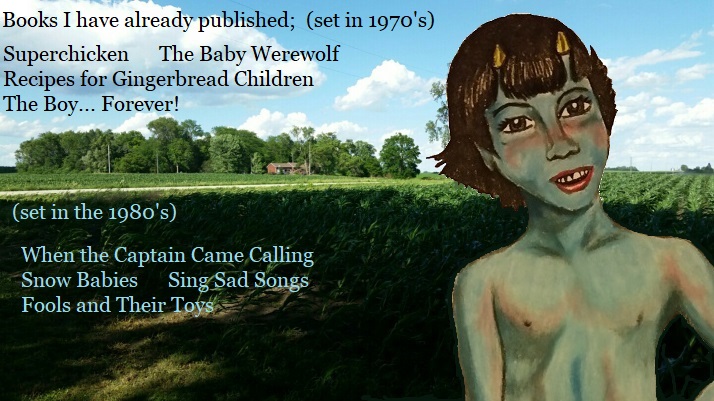
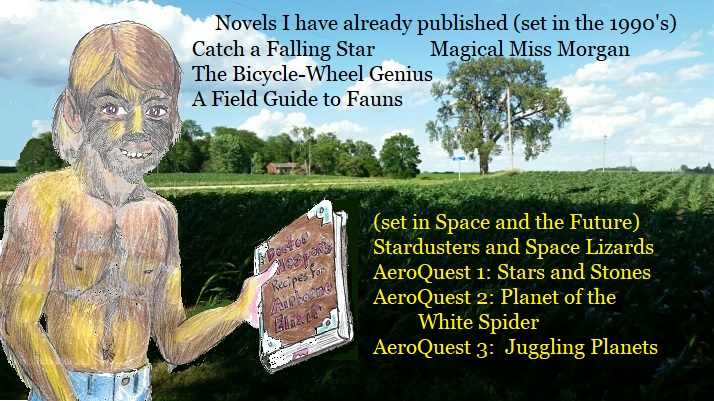
I have spent a lot of time reading and reviewing other people’s books. And at the same time I have invested some of my free-reading time in re-reading my own novel, The Baby Werewolf. The thing about all of it together is that it represents the actual life-force of the author. We all do it. Authors put their own experience, their own heart, and their own precious world into their work. We do it at different levels of confidence, competence, and creativity. But we all do it. And because we do it, someone needs to read it.
A story…
contains the characters that the author has known, the author has loved, and especially the people the author has lost over the course of his or her life.
At least, the competent authors do that. They put real people into their work. You can tell, even in really awful, poorly written novels, that flashes of what the authors really observed, really hated, or really fell in love with about the people in their lives are there to be read and absorbed.
Places
are also crucial to the story. Fiction or nonfiction, you will be taken to other homes, other cities, other worlds than the one you yourself inhabit.
What more can you truly say about your life than where you lived it, where you are from, and what background defines you as an author?
And plot…
that which happens in a story, is probably the most important thing of all. Because reading gives you a share in someone else’s life, in someone else’s experience. A chance to walk about in someone else’s shoes.
You can comfortably learn what others have learned before you. You can share in their ups and downs and all-arounds to experience the same chills and thrills and sadness as they have lived, and loved, and laughed about.
So, in this essay, I contend that human life on the planet Earth is a very good thing. And you multiply its goodness a thousand-fold if only you will only pick up and read someone else’s book.
Yes, Friedrich Nietzsche, the philosopher of “der Ubermensch,” the Superman, and the famous quote, “God is dead,” is not very smart. Of course, that’s probably because he’s been dead since 1900. It is a little difficult to think once you are no longer alive and your brain has turned to stinky muck in your coffin under the ground. And you cannot hope to defend your recorded intelligence in the written works you have left behind if you are totally dead and unaware of how people may be misinterpreting your ideas.
This is old crazy Fred with his pet hairy caterpillar which he always kept right under his nose his whole adult life.
Crazy Fred was born in 1844. He was multi-talented, being a philosopher, poet, musical composer, and a writer of fiction. He was something of a genius for a while. At the age of 24 he became the youngest person ever to hold the prestigious Chair of Classical Philology at the University of Basel, His radical philosophy created a critique of truth that leaned in favor of perspectivism. And as he continued down paths of making ironic aphorisms and exercising his wits to wander into thinking that life is meaningless and the roots of nihilism, he more or less stumbled into the view of his philosophy that there was no hope for the future but the improvement of the self.
I think it could be argued that Crazy Fred did indeed become a monster with the abyss staring back at him. At the age of 44 he had a complete mental breakdown. After that, for the remaining 11 years of his life, he had to be cared for by his mother… until she died in 1897, and then by his sister Elizabeth until he died in 1900. If street stories are to be believed, he escaped from his home, found a horse being beaten by its owner, stepped in to save the horse from the beating, then turned to the horse, hugged its neck, and died.
This drawing by Hans Olde shows Crazy Fred during his insane years. It was used as a textbook illustration for dementia.
His writings were inherited by his sister Elizabeth. And she was an ultra-nationalist. Under her management, his writings were edited to fit her agenda for a new Germany, and so his ideas were credited with founding the Nazi movement and the quest for Aryan superiority… eugenics and genocide were to follow.
Ironically, Crazy Fred was radically opposed to anti-Semitism and most of the ideas that Hitler and the Nazis would give him credit for.
Don’t get me wrong. There are a lot of good things in Crazy Fred’s philosophical teachings that make him worth reading and studying. He identified two distinct forms of thought that operate in culture. He called them Apollonian and Dionysian styles of thinking. Apollonian is associated with the sun god Apollo, rationalism, logic, order, and clarity. Dionysian is associated with the god of wine and sensuality, Dionysius, emotionality, chaos, intuition, and obscurity. These cultural definitions are very useful for understanding human behavior.


But Crazy Fred is controversial to this day. I am not the only one that thinks he’s a coocoo bird and wrong about a lot of things. And, yet, his work led to very good things as well as the questionable. Much of the philosophy of the 1960’s owes its progress to him, from the Apollonian Bertrand Russel to the Dionysian Albert Camus.
Nietzsche said, “What doesn’t kill us, makes us stronger.”
Clearly, I believe I myself am proof that Crazy Fred was wrong about that one. After six incurable diseases, surviving skin cancer, and making it most of the way through the Covid Pandemic alive, an awful lot of things didn’t kill me so far. By rights, if what Fred said is true, then I should be stronger than Superman. X-ray vision and the power of flight too. You can tell by the picture that if I am like Superman, then I have seen entirely too much Kryptonite up close.
A 1951 Schwinn Spitfire like mine in 1963 when the world was golden.
My bicycle was red. It was red and looked just like the ones that Captain Kangaroo had in his commercials that we watched on a black-and-white TV every day before we walked or rode our bicycle to school, across town a whole long seven blocks away. After school I could ride it out a whole mile and a half to Jack’s farm with Bobby and Richard and Mark the preacher’s kid to go skinny dipping in the cold creek in Jack’s South pasture. Jack was younger than any of us except Bobby. And it was a golden age.
Spiderman comic books and Avengers comic books cost twelve cents to own, but they were forbidden. And as much as we sneaked them and passed them around until they fell apart, usually in Bobby’s hands, we never knew that Dr. Wertham had gone to Congress to make our parents believe that comic books would make us gay and violent. He was a psychiatrist who wrote a book, so even if you didn’t believe him, you had to worry about such things.
I believed in Santa Claus until 1967. And after I found out, I only despaired a tiny little bit, because I began to understand you have to grow up. And adults can lie to you, even if they don’t do it to be mean. And the world is a hard place. And the golden age ended in November of 1963 when JFK was assassinated.
In June of 1968 I rode my bicycle out to the Bingham Park woods, Once there, I took off all my clothes and put them in the bicycle basket, and then I rode up and down the walking paths through the trees with nothing between me and God but my skin. I had a serious think about how life should be. All the while I was terrified that someone might see me. I was naked and vulnerable. A mere two years before that I had been sexually assaulted and was terrified of older boys, especially when I was naked and vulnerable. But I was a fan of the St. Louis Cardinals and Bob Gibson. They were repeated World Series winners. And they beat the Yankees in the series in 1964. And more important than that, cardinals were the little red songbirds who never flew away when the winter came. You don’t give up in the face of hardship. You face the trouble. No matter how deep the snow may pile up.
And in 1969, the first man to walk on the moon showed that a Star Trek world was in reach of mankind. Star Trek was on every afternoon after school. I watched a lot of those episodes at Verner’s house on his family’s black-and-white TV. The Klingons were always bested or beaten because the crew of the Enterprise outsmarted them. You can solve the problems of the universe with science. I know this because of all the times Mr. Spock proved it to me not just by telling me so, but by showing me how you do it. And what you can achieve is greatly enhanced if you work together like Spock and Kirk and Bones… and sometimes Scotty always did.
So, what is the way it should be? What did Mickey decide while naked in the forest like a Dakota Sioux shaman on a spirit-quest?
JFK’s 104th birthday was on May 29th. Dr. Wertham has been dead for 40 years. Bob Gibson was 85 when he passed away in October of last year. Captain Kirk turned 90 in March of this year.
The Golden age is long gone. There is no single set of rules that can clearly establish how it should be now. But I like those ideas of how it should be that I established for myself while naked on a Schwinn Spitfire in a forest long ago.
It is not an easy thing to explain. Artists don’t see things using only their eyes. The brain intrudes in the process. For instance, you are welcome to interpret the picture above any way you like. But the way I see it will be nothing like what you thought this picture is about. You probably see two very different girls here. There is actually only one. I know because, as the artist who drew both parts of this picture, I actually know where the ideas came from. There is only one girl in the picture. Dilsey Murphy, in front and wearing her Carl Eller Minnesota Vikings’ jersey, is based about 33% on the older of my two sisters. On the outside she is pragmatic, no-nonsense, and focused on living a family life that is as normal as possible. But the inner Dilsey is the African leopard-princess. She dreams of going on Tarzan adventures in the movie-jungles of the mind with a handsome male hero. She is fierce, loyal, and completely independent, not even needing the hero she adventures with. In fact, she often saves him.
This picture is about the idyllic parts of my childhood. The mother figure is doing a ritual dance. She is in tune with the music of daily life. She is closely attuned also to her responsibilities of stewardship in her society. Both children are nude. I cropped this picture so that it is not rude and showing Smiling Boy’s penis. But both children are bathed in nature and sunshine, not just because I am pro-nudism personally, but because clothing covers up innocence and joy.
This one is easier to interpret. I was an ESL teacher. I had students who spoke Spanish as their first language and students who learned to speak Mandarin Chinese as their first language. It makes for a classroom that becomes a cultural mixing bowl. You have to learn how to deal with people who are very different than you,, but are benefitting from learning English together.
Every picture the artist draws or paints has its own weirdness embedded inside it. The way the artist sees it is probably never the same as how the viewer thinks about it. And that is as it should be. But as a viewer of art, it is hoped that you will at least try to think about what the artist means to say..
Yes, I am saying the world I live in is a low-budget commercial movie made without literary or artistic pretensions. You know, the kind where movie makers learn their craft, taking big risks with smaller consequences, and making the world of their picture reflect their heart rather than the producer’s lust for money.
Mostly what I am talking about are the movies I remember from late-night Saturday TV in black and white (regardless of whether or not the movie was made in Technicolor) and the less-risky as well as more-likely-good Saturday matinees on Channel 3. Movies made in the 1950s, 1960s, and early 1970s. They were perfect, of course, for the forbidden Midnight Movie on the show called Gravesend Manor. I had to sneak downstairs to watch it on Saturday nights with the volume turned way down low. (Not that Mom and Dad didn’t know. Well, maybe they didn’t know how many of those I watched completely naked… maybe.)
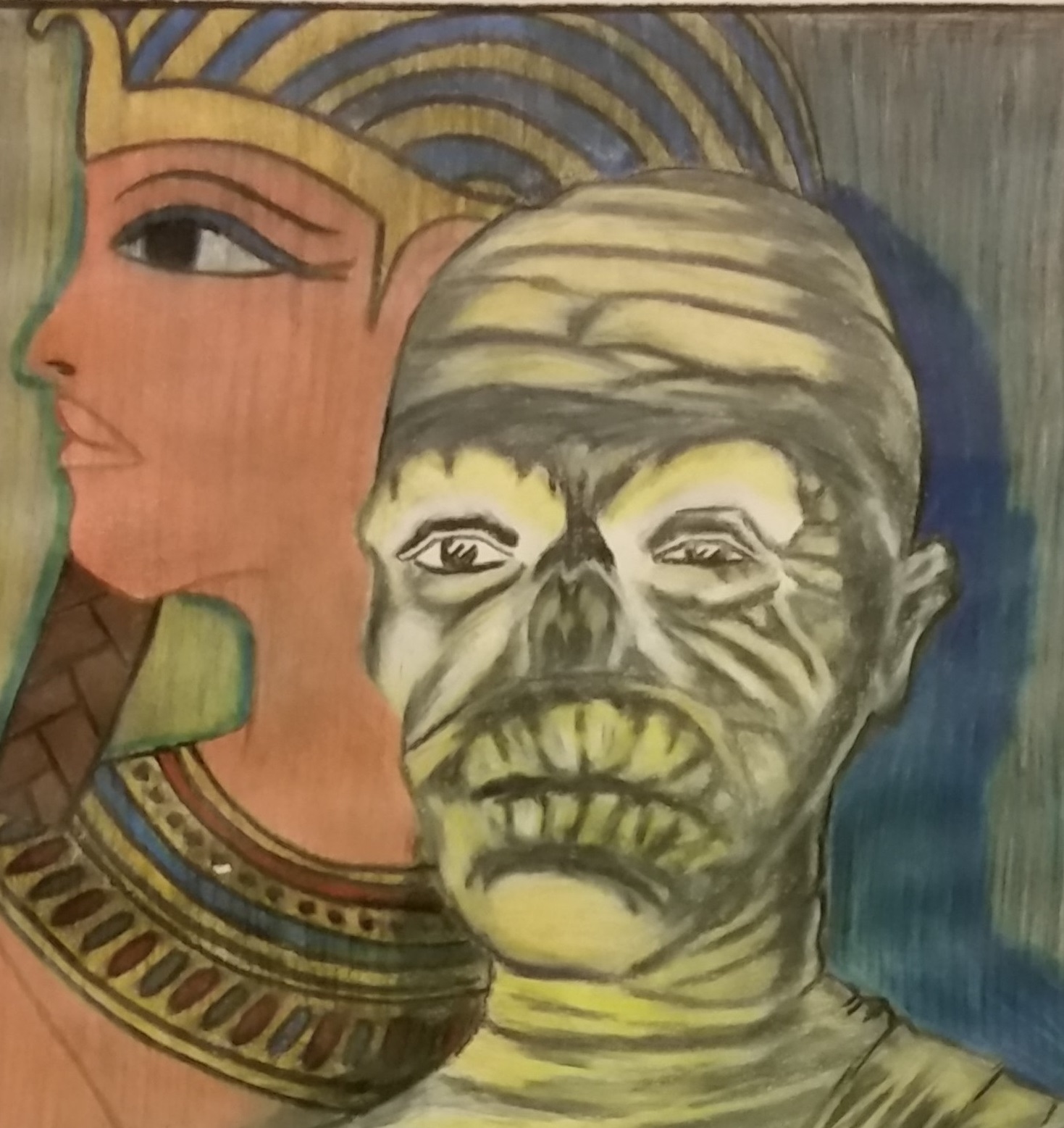
I watched this one when I was twelve, late night on an October Saturday. I had a bed-sheet with me to pull over my head at the scariest parts. Frankenstein was a crashed astronaut brought back to life by the magic of space radiation. He was uglier than sin, but still the hero of the movie, saving the Earth from invading guys in gorilla suits and scary masks (none of which looked like the movie poster.)
This one, starring James Whitmore, a really good B-Movie actor, was about giant ants coming up from the sewers and the underground to eat the city.
I would end up watching it again twenty years later when I was wearing clothes and not alone in the dark house lit only by a black-and-white TV screen.
I realized on the second viewing that it was actually a pretty good movie in spite of cheesy special effects. And I realized too that I had learned from James Whitmore’s hero character that, in times of crisis, you have to run towards the trouble rather than away from it, a thing that I used several times in my teaching career with fights and tornadoes and even rattlesnakes visiting the school campus looking to eat a seventh-grader or something (though it was a bad idea for the snake even if it had been successful.)
This one, of course, taught me that monsters liked to carry off pretty girls in bikinis. And not just on the poster, either. But it was the hero that got the girl, not the monster. This movie taught me that it sucks to be the monster. Though it also taught me that it was a good movie to take your pajamas off for and watch naked when you are thirteen.
But not all B-movies had to be watched late night on Saturdays. This movie was one of the first ones that I got to go to the movie theater to see by myself. (My sisters and little brother were still too young and got nightmares too easily to see such a movie.) It came out when I was in my teens and Mom and Dad began thinking of me as an adult once… or even possibly twice in a month.
And not all B-movies were monster movies, gangster movies, and westerns. Some, like a lot of Danny Kaye’s movies, were movies my Dad and my grandparents were more than happy to watch with me. I saw this one in both black-and-white and color. And I learned from this that it was okay to take advantage of happy accidents, like a case of mistaken identity, and using your wits, your creative singing ability, and your inexplicable good luck to win the day for everybody but the bad guys armed only with your good sense of humor.
And some of the best movies I have ever seen, judging by what I learned about movies as literature from Professor Loring Silet in his Modern Film Class at Iowa State University, are by their nature B-movies.
I am using movie posters in this blog post only from movies I have personally seen. (And I admit that not all of them are strictly “good” movies according to Professor Silet, but I like them all.)
Feel free to tell me in the comments if you have seen any of these movies yourself. I am open to all opinions, comments, and confessions.
This one is based on Shakespeare’s The Tempest.
I saw this one in college. You had to be 18 at the time to even buy a ticket.
I actually think that this is one of the best movies ever made. It will always make my own personal top-ten list.
I live in a B-movie world. The production values around me are not the top-dollar ones. But the stories are entertaining. The real-life heroes still run towards the problem. And it still sucks to be the monster. But it has always been worth the price of the ticket. And during my time on Earth here, even in 2020, I plan on staying till the end of the picture. I go nowhere until I see the Best Boy’s name in the end credits. And maybe not even then.
Still being under the weather and filled with sinus head-pain, I decided to go back to a subject I love so much that the post will simply write itself. You know I love Norman Rockwell and his art, and I fervently believe that kind of mass media oil-painting does not put him in a lesser category than Rembrandt or Michelangelo or Raphael or any other painter with a ninja turtle namesake. He is a genius, and though he is not a realist in so many ways, his work is more truthful than practically any other kind of painting. If you are taken by surprise and didn’t know I had this passionate obsession, maybe you should go back and look at this post; Norman Rockwell
Now that I got that out of my system, here is another Saturday Evening Post artist that is often confused with Rockwell. His name is Amos Sewell.
Sewell was an amateur tennis player who was talented enough to win tournaments. He was an employee of Wells Fargo who was headed towards anything but an art career until he decided to make a leap of faith in 1930. He started as an illustrator for Street and Smith pulp fiction, and soon caught the notice of the big-time magazine markets for his art. He published art for Saturday Evening Post, Country Gentlemen Magazine, and Women’s Day.
Like Rockwell, he was able to find the funny in everyday scenes, like the dance party to the right. That young man at center stage is trying so hard not to step on the feet of the red-headed girl, that you want to laugh, but can’t because it’s obvious how embarrassed he would be, and the charm of the picture leads you to shun the thought of interrupting. The scene is so real the boy would hear you laughing as you looked at the Post cover.
More expert on this kind of art than I am is the Facebook site that I first got turned on to Sewell by. Children in Art History
There is no doubt that Amos Sewell belongs in the same pantheon of artists as Norman Rockwell, Thomas Kinkade, or Paul Detlafsen. They are all artists who achieve in their work exactly what I have always striven for. I want to be able to hold the mirror up to our world the way they did. I want to capture both the fantasy and the reality in the subject of everyday family life. I also want to share this work with you because I cannot stand the idea that such artistic ambrosia could one day be forgotten in archives where no one ever looks at it and feels the message in their heart.
The World is Gray Today
It is cloudy outside. The sky is a cool, damp gray. No rain. No snow. Just dreary and gray. The world is gray today.
We have now been in a lockdown and wearing masks for an entire year. I have lost a lot of ground. Color-blindness runs in my family on my mother’s side. Great Grandma Hinckley was completely color-blind by the time she was in her 70’s.
I myself have known I had the color-blindness problem since I was in high school and the school nurse gave me a vision test that proved it.
In the dotted circle, I could see the blue-green number 29, but I could also see the red number 5. I was told that I had a slight color-blindness on the red/green scale. Believe me, I had no idea what that meant. Still don’t. I just know I have never seen colors the way other people with normal vision do.
But now, after twelve months of lockdown, I can definitely detect the fact that I have lost some more of my color vision.
Great Grandma saw the world in black and white and gray since she was 70. That, for me, is now less than six years away.
As a cartoonist I use a lot of pen and ink. I also love black-and-white movies. Being partially colorblind, you might think that I would be okay living in a film-noire world. But I am not. It is simply not enough. I have always craved color. I particularly love to create with bright primaries, red, yellow, and blue.
I will sorely miss color when it is gone.
And I have always loved cardinals. Not only because they are bright red songbirds, like the one singing outside in our yard on this gray and slightly blustery day. But because they never fly away when the winter comes. They stay even in the snow and cold. Trouble doesn’t drive them away. I shall not give up when I lose all the colors.
I remember the world being gray when I was a boy back in the 1960’s too. TV was only black-and-white… and gray at our house. I watched the funeral parade for JFK on the black-and-white… and gray TV. And around that time the three astronauts Grissom, Chaffee, and White had a similar funeral parade… also black-and-white-and-mostly-gray.
The Viet Nam conflict on the TV news with Walter Cronkite. The riots at the Democratic Convention in 1968 with the Chicago Seven going on trial. The world was very, very gray.
But then, in the Summer of ’69, Neil Armstrong landed on the moon. A giant leap for mankind! And I saw that also in black-and-white-and-mostly-gray.
There was a hope of color in my life after that. And we got a color TV in the later 70s after that. And even with my partially color-blind eyes, I saw color everywhere.
And now again is a good time to anticipate color coming back into my life. I am on the waiting list for vaccination. My eldest son has a steady girlfriend living with him now. And we have a better President who actually seems to care if we live or die. Good things are over the next hill.
But still… the world is, for now… gray today.
2 Comments
Filed under autobiography, battling depression, coloring, commentary, feeling sorry for myself, insight, Paffooney, poetry, self pity