People accused of doing magical thinking are basically being accused of doing something awful. Like Republicans telling us that if we cut taxes for millionaires and billionaires, working class and middle class citizens will prosper because of it. Of course, they actually know better. So, it isn’t really magical thinking. It is really evil magical thinking.
But when I am actually guilty of magical thinking, it is more along the lines of me pinning my hopes on an intuition brought about by calculations in my overcrowded imagination that are probably horribly miscalculated but that I need to turn out to be accurate and miraculously pull me out of my current difficulty. And then, because I intuit really, really hard… it turns out all right.
Magic is after all, merely what we call science and situations where something amazing is created, but we have no idea at all how and why.
Our movies nowadays are really quite chock full of magical thinking. Wish-fulfillment, fantasy, and violence-laden revenge stories are what fill the cinema with seekers of escapism and relaxation. That is magical thinking of an epic sort. Go see the Black Panther movie and “Wakanda forever” solves racism.
So, what is the point of this little essay? What am I actually thinking about the subject of magical thinking? Well, I needed a topic today to keep my every-day-in-April posting goal alive. And magically…
If you are as goofy and cartoon-obsessed as me, you may remember that Popeye the sailor was known for the catchphrase, “I yam what I yam”. And if you do remember that, it will not surprise you that, when told a yam is another name for sweet potato, Popeye was furious. “It cannot be!” he argued. “I would not say I sweet potato what I sweet potato! That’s ridicumess!”
Well he has a point.
But I would like to talk today about the things that I sweet potato, and why I sweet potato those things.
First of all, I yam a humorist.
I yam this thing not because I am funny. You may think I yam funny because I say really goofy things for no apparent reason, and then keep on talking long enough to convince you that I did have a point to make, but my brain leans so far to the left that I am hardly right about anything.
And I make bad puns a lot.
You see, I have to use humor constantly to deal with all the hard things in life, because being too serious in the face of the world’s basic uncaring cruelty only leads to depression and taking a beating from life. In fact, I can think of any number of situations in my past where I avoided a beating only because I made a joke that made the bully laugh.
So, being a humorist is a survival tactic. Humor keeps you alive.
You see someone like me has to face all the pain and heartache and cruelty the world has to offer by using humor. The real reason is that, when faced with a bad situation, if the humor gland can’t empty itself of all the jokes it produces, it will begin to swell. The humor gland is located either in the brain or maybe in the behind (I am not medically qualified to tell you which it really is), and it can only swell to a certain point, and then it will explode. This is very bad thing for you, if you survive it, and certainly unpleasant for anybody nearby.
But the joke, properly launched at the target, will make somebody laugh, even if it is only the humorist himself. And laughter is the best medicine. Unless it kills you. You have to be careful not to die laughing. The angels will be offended, and the demons will all laugh too.
But I yam not only a humorist. I yam also a teacher.
I began to realize that I might be a teacher when, in graduate school to get a remedial master’s degree to help with the fact that plain English majors all starve to death, I discovered I had a talent for explaining things in simple terms. And then, immediately afterwards, I discovered I had an even greater talent for being ignored while the people I was explaining to made the mistakes they wouldn’t have made if only they had listened to me, before they failed spectacularly, and then realized how the solution I had explained would’ve made them succeed instead. There is apparently no better way to learn an important lesson.
Teaching is, of course, a pretty cool job. You tend to have the summers off. And you get paid for summer because they split the amount of money you earn for the year (which considering what a babysitter makes on average per child and per hour is far too little for the hours you put in) into twelve monthly pittances.
Of course you are expected to have a university degree (although no teacher college in the world can teach you what you really need to know in order to face that many little monsters… err, darlings… every day) and preferably some grad school, and a certification to teach in your chosen subject, and an additional certification if you are going to teach more than one subject (and ESL and Speech and Journalism, all of which I was expected to teach, are separate certifications) and you have to take hours of additional training every single year, and you have to get re-certified every five years, and… Well, you have to be basically smarter and much better-educated than Bill Gates… But the school janitor will probably be making more money per month than you do.
Anyway, it’s a job you just gotta love. I yam a teacher.
And really, there are a whole lotta yams in my basket yet that I could tell you about. I yam a Red Skelton fan. I yam sometimes a nudist (when I don’t have to put on clothes to keep myself from scratching all my psoriasis-plagued skin off). I yam also an artist (of the type known as a cartoonist). I yam pig-headed sometimes, and I yam Grumpy sometimes (so I go from being Porky to one of the Seven Dwarfs.) I yam a lotta things. And my sweet-potato basket is large.
But I can’t talk about all of my yams today. Too many yams are bad for my diabetes.
But here’s one last yam. I yam a storyteller. The book is the first in my series of AeroQuest books. It is a science fiction story with a humorous bent. And I mean, it is seriously bent in some places.
So, click on the link and get yourself a copy. It’s funny. And I will save the other sweet potatoes for another day.
My experience of the works of Kurt Vonnegut is limited to the reading of three books; Cat’s Cradle, Breakfast of Champions, and Slaughterhouse Five. But it was enough to make me love him and use him as a shaper of my soul.
I deeply apologize for the fact that even though he only wrote 14 books and a bunch of short stories, I have not read everything I could get my hands on by Kurt. Three novels and one short story (Harrison Bergeron) is not really enough to compare to the many, many things that I have read by Mark Twain, Terry Pratchett, Louis L’Amour, and Michael Crichton. I can’t begin to count how many books of each of those four I have read and reread. But it is enough that I read those three novels and have a lifelong regret of never buying and reading Slapstick when I had the chance. Vonnegut writes black humor. The ideas are painful, and burn away flesh from your personal body of being. And at the same time, you cannot help but laugh at the pure, clean, horrifying truths his ridiculous stories reveal.
If, in the course of telling a story, you can put the sublime, the ridiculous, and the horrendous side by side, and make the reader see how they actually fit together, then you can write like Vonnegut.
Let me give you three quick and dirty book reports of the Vonnegut I have read in the order I have read them;
I read Cat’s Cradle in college. I was young and idealistic at the time, foolishly convinced I could be a great writer and cartoonist who could use my work to change mankind for the better.
In the book, Dr. Felix Hoenikker (a fictionalized co-creator of the atomic bomb) is obsessively re-stacking cannonballs in the town square in pursuit of a new way to align water molecules that will yield ice that does not melt at room temperature. Much as he did with the A-bomb, Hoenikker invents a world-ending science-thing without any thought for the possible consequences. The narrator of the novel is trying to write a humanizing biography of the scientist, and comes to observe the inevitable destruction of the whole world when the oceans freeze into Ice-9, the un-meltable ice crystal. Before the world ends, the narrator spends time on the fictional Carribean island of San Lorenzo where he learns the fictional religion known as Bokononism, and learns to make love to a beautiful woman by pressing bare feet together sole to sole. It is a nihilistic picture of what humans are really like more savagely bleak than any portrayal Monte Python’s Flying Circus ever did on TV.
Needless to say, my ideals were eventually shattered and my faith in the world shaken.
I read Breakfast of Champions after I had been teaching long enough to buy my own house, be newly married, and a father to one son. It was probably the worst time of life to be reading a book so cynical, yet true.
In this story, the author Kilgore Trout, much published but mostly unknown, is headed to Midland City to deliver a keynote address at an arts festival. Dwayne Hoover is a wealthy business man who owns a lot of Midland City real-estate. Trout gives Hoover a book (supposedly a message from the creator of the universe) to read that suggests that all people (except for the reader of the book… meaning Hoover) are machines with no free will. Hoover takes the message to heart and tries to set the machines free by breaking them, beating up his son, his lover, and nine other people before being taken into custody.
The book contains devastating themes of suicide, free will, and social and economic cruelty. It makes you sincerely reflect on your own cog-in-the-machine reality.
Slaughterhouse Five is a book I bought and read when I missed my chance to buy Slapstick and needed something to take home from HalfPrice Books to make me feel better about what I missed. (Of the five books I had intended to buy that day, none were still on the shelves in spite of the fact that they had been there the week before.) It was fortuitous. This proved to be the best novel I had ever read by Vonnegut.
Like most of his work, the story of Billy Pilgrim is a fractured mosaic of small story pieces not presented in chronological order. It details Billy’s safe, ordinary marriage to a wife who gives him two children, but it is ironically cluttered with death, accidents, being stalked by an assassin, and being kidnapped by aliens. It also details his experiences in World War II where he is captured by the Germans, held prisoner in Dresden, kept in an underground slaughterhouse, and ironically survives the fire-bombing of Dresden by the Allies. Further, it details his time as a zoo exhibit on the alien planet of Tralfamadore.
It explores the themes of depression, post-traumatic-stress disorder, and anti-war sentiment. Vonnegut himself was a prisoner of war in Dresden during the fire-bombing, so real-life experiences fill the book with gravitas that it might not otherwise possess. Whether the author was ever kidnapped by aliens or not, I cannot say.
But Kurt Vonnegut’s desire to be a writer and portray himself as a writer in the character of Kilgore Trout, and even as himself in his work, has an awful lot to do with my desire to be a writer myself. Dark, pithy wisdom is his thing. But that wisdom, having been wrung from the darkness is all the more brightly lit because of that wringing. It is hard to read, but not hard to love.
Life is like that. You work out a plan for how to economically get through a bankruptcy and chronic ill health and retirement income not being enough to get by, and then a life-threatening pandemic happens worldwide and shoots it all to hell like a redneck shooting watermelons in the backyard with his new AR-15.
We are now stuck at home with family, unable to go anywhere but the grocery store and pharmacy. And you have to have a mask to go anywhere because you are risking death by breathing every time you have to go to the store so you can continue to eat and live. But, of course, the supply chains are failing as people get ill on the job, and most of the food shelves are practically bare.
And a way of life is dying (or is already dead). But, for those of us lucky enough to survive until this is over, and that will be most of us, it will be a chance to remake the world. Maybe people post viro-apocalypse will take climate change more seriously. Maybe our lost future will be saved because billionaires will be too ill to keep pumping coal sludge and factory waste into our drinking water and breathable air. We should definitely be able to vote Mr. Toad of Toad Hall out of the White House, put him in jail for his crimes, and elect somebody that at least says they care about about people like me who will probably die from this virus.
But for now, stuff happens. (Or in many cases, important stuff doesn’t happen.) And we must make a new plan that deals with it.
Every writer, whether he or she writes fiction or non-fiction, is really writing about themselves. The product originates within the self. So, that self has to gaze into the mirror from time to time.
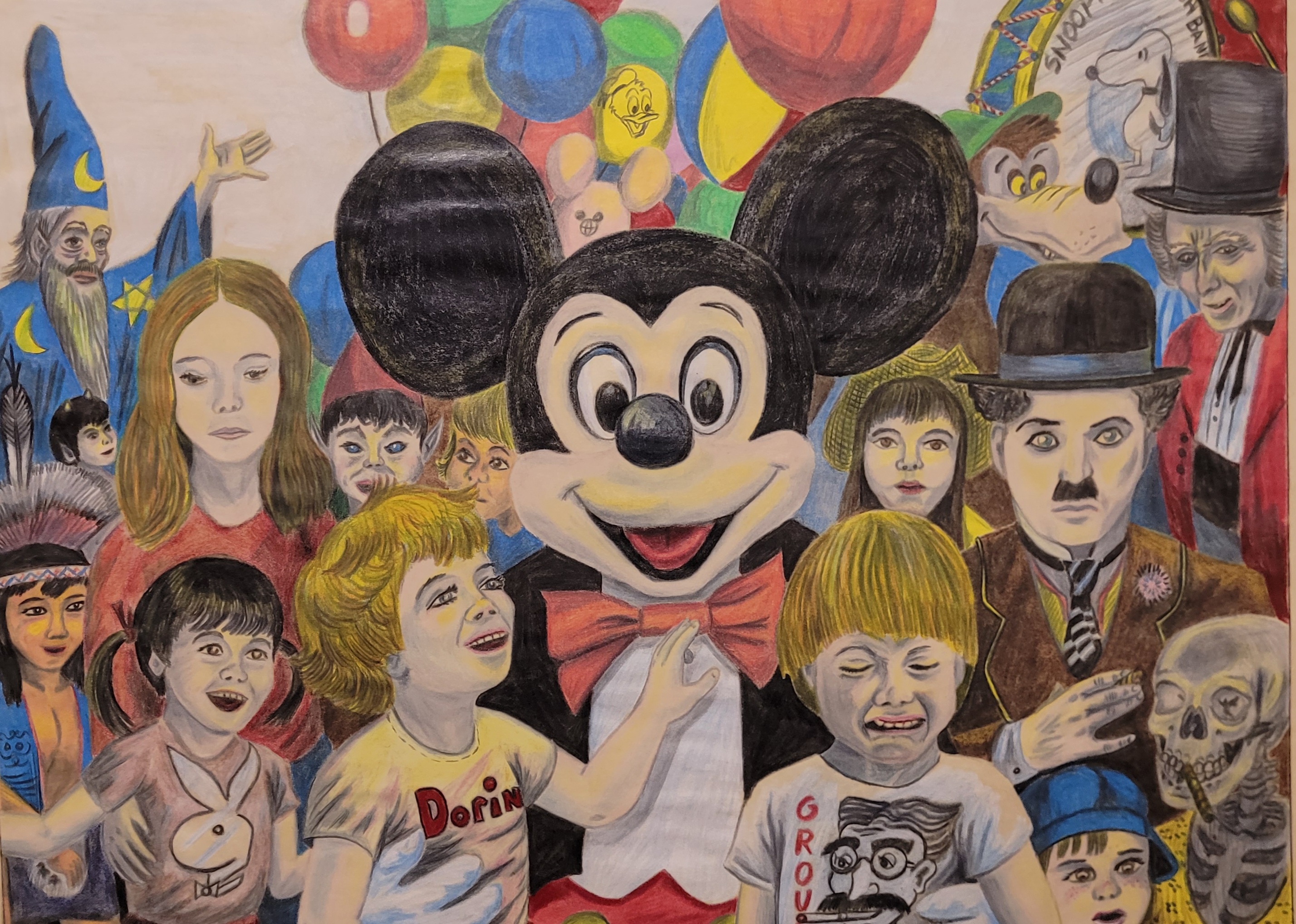
So, the question for today is, who, or possibly what, is Mickey?
I have been posting stuff every day for a few years now, and in that time, I have been much-visited on WordPress. Maybe not much-read, but then, you cannot actually tell if somebody read it or not. Most probably look only at the pictures. And, since I am also an artist of sorts, that can also be a good thing. Though, just like most artists, my nude studies are more popular than the pieces I value the most. But unless the looker makes a comment or leaves a “like”, you really have no idea if they read or understood any of the words I wrote. And you have no idea what they feel about the art. Maybe they just happened to click on one of my nudes while surfing for porn.
I rarely get below 50 views of something in my blog every day. The last three days were 86 views, 124 views yesterday, and 88 views already today. My blog has definitely picked up pace over the length of the coronavirus quarantine. But no definable reason seems obvious. Some of my posts are polished work, but Robin is right when he says today’s post is merely fishing with the process, which is true almost every day.
As a person I am quirky and filled with flaws, pearls of wisdom that result from clam-like dealing with flaws, strange metaphors that shine the pearls, and obsessions like the one I have with nudism that leaves me properly dressed for diving for pearls.
I have demonstrated throughout my life that I have an interest in and experience with nudism, though not the boldness to parade my naked self before the world outside of the writing that I do. I also spent most of my bachelorhood dating reading teachers and teachers’ aides, finally settling down and marrying another English teacher. I completed a thirty-one year career as an English teacher, which means I spent a lot of time teaching writing and reading to kids who were ages 12 to 18. Twenty-four of those years were spent in the middle school monkey house. And all of that led to being so mentally damaged that I wasn’t good for much beyond becoming a writer of YA novels or possibly subbing for other mentally-damaged teachers in middle schools around our house.
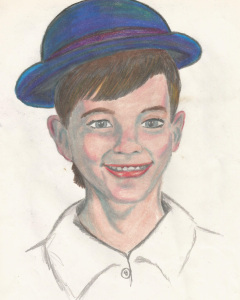
A real telling feature of what I have become is the fact that most of the characters I write about in my fiction are somehow a reflection of me. Milt Morgan, seen to the left, is illustrated here with a picture of me as a ten-year-old wearing a purple derby. Yes, I was that kind of geeky nerd.
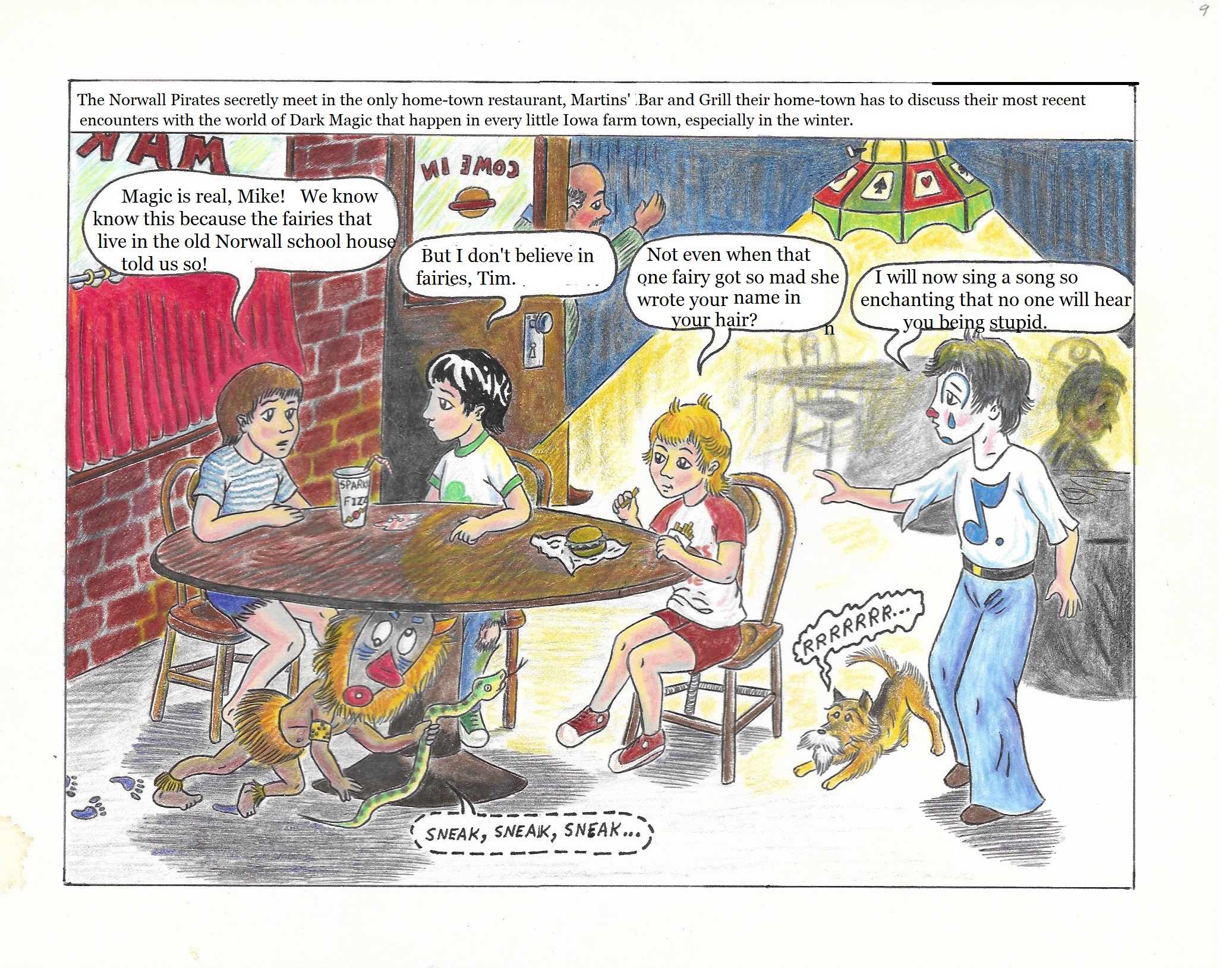
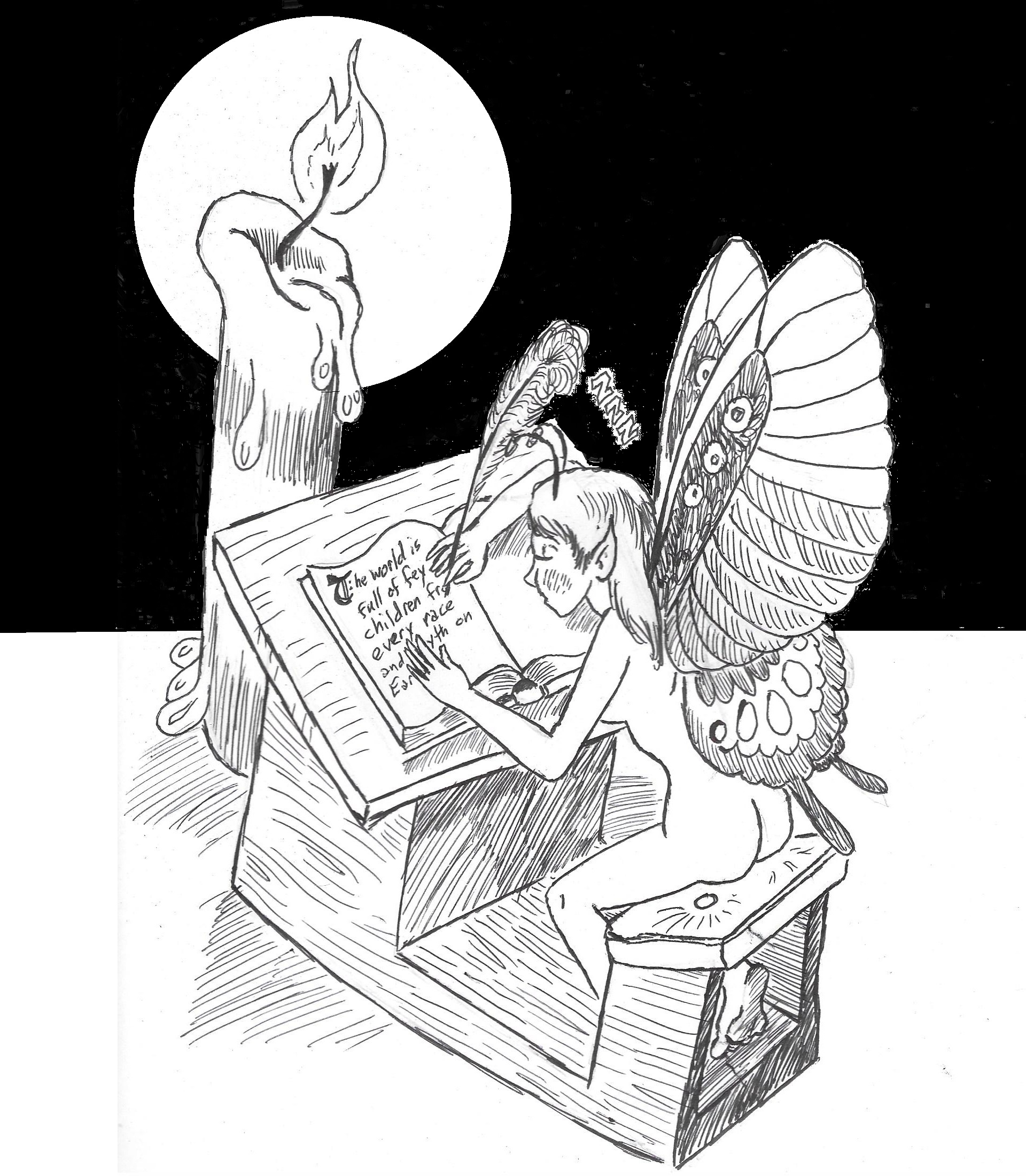
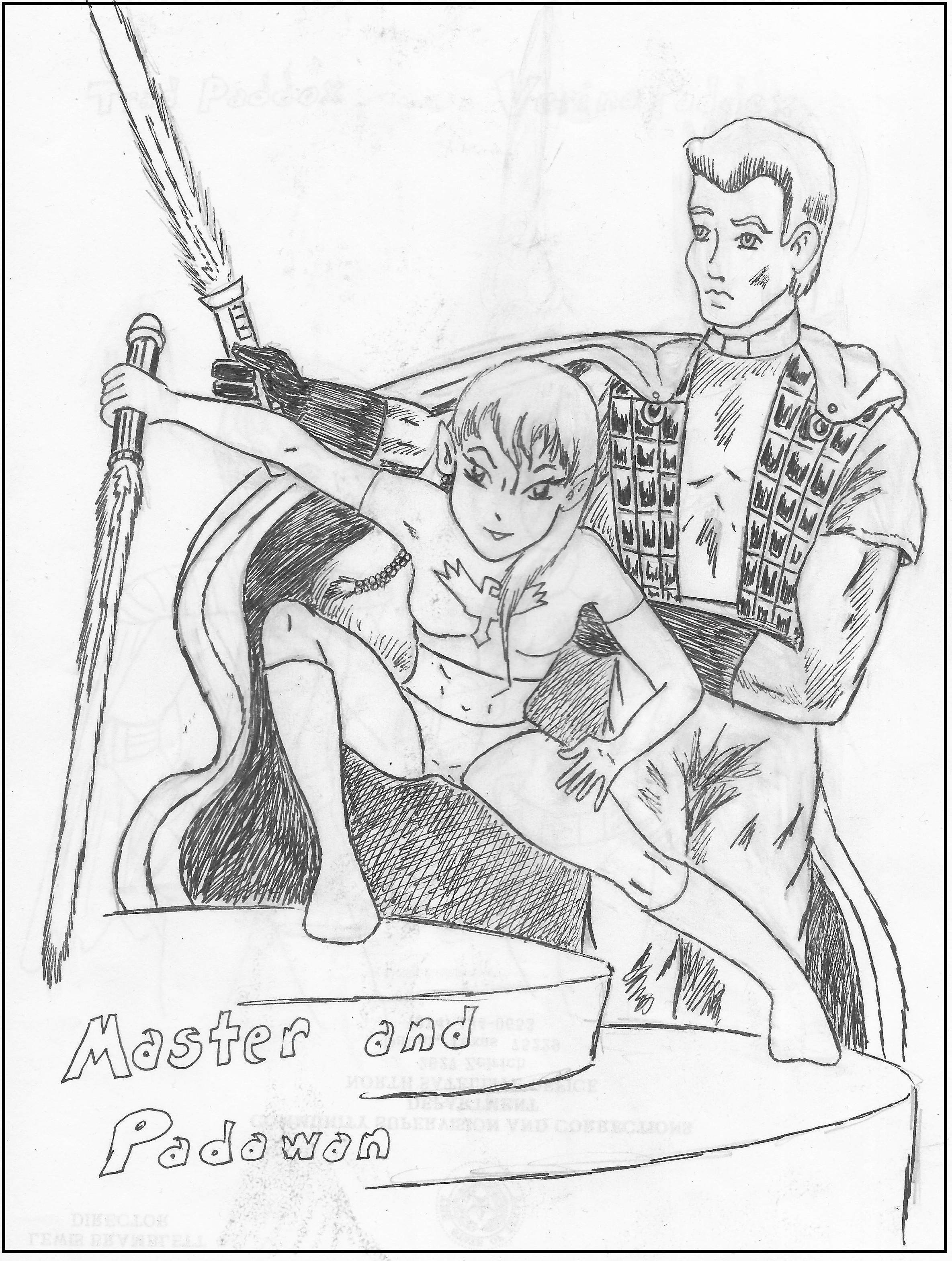
And most of the plots are based around things that happened to me as a child, a youth, or a young teacher. Many of the events in the stories actually happened to me, though the telling and retelling of them are largely twisted around and reshaped. And I am aware of all the fairies, aliens, werewolves, and clowns that inhabit my stories. Though I would argue that they were real too in an imaginative and metaphorical way.
So, here now is a finished post of Mickey staring into the metaphorical mirror and trying in vain to define the real Michael, an impossible, but not unworthy task.
I have been reading about the high school boy who rang the wrong doorbell when he was supposed to pick up his younger brothers from a friend’s house and got shot in the head because he was black. And shot a second time when he was on the ground. He lived. But only because his guardian angel was helping.
The shooter, an old white guy, was taken into custody only to be released within 24 hours.
And then I couldn’t help but remember Emmit Till. From before I was born. And I cried for half an hour.
If I were to pick the five kids I loved the most in the 31 years I was a teacher, two of them were black. Only one was a white kid.
How could we not have learned from that picture of Emmit in his open casket? Thank God it is in black and white.
Forgive me. I can’t write more. I have to cry some more….
This 2019-2020 school year was my first as a retired school teacher earning extra money by substitute teaching. It ended before I was ready. I not only didn’t get a chance to earn all the money I needed, I did not get the chance to see some of the kids in five different middle schools I subbed for that I had learned to like and hoped to see again before the year ended. I did put in enough time to get rehired for next year. I even got to keep my sub badge so that I can go back if the schools ever reopen again. But I despair a bit over what I have lost. My health may not be good enough to go back to the job I love so much. In fact, I don’t really expect miracles to happen that would let me survive this pandemic. If I do go back to school next fall, it is more likely to be in order to haunt the hallways than to teach again.
The last few nights I have been sleeping longer than I have at any time since I retired in 2014. And I have had vivid dreams of being a teacher in a classroom yet again. But always in schools that are only vaguely familiar and are obviously new jobs with new kids that I haven’t seen or trained before. And yet, as it always is with teaching, they are all the same classroom, all the same schools, all the same kids, just in new packages that I haven’t seen before.
One of the things that is hardest about being a substitute rather than a regular teacher is the fact that one day, one class period, is not long enough to build a relationship with every kid. You cannot get to really know them in such a short amount of time. That’s why going back to certain schools is so exhilarating because you get a chance to cover the same classes again, see the same kids, and work on being a good teacher for them in the way I used to do it for kids that were mine for an entire school year.
And I was one of those rare teachers who actually likes kids.
Many teachers never get over the difficulty of managing a classroom and doing discipline. It is for them a never-ending battle for order and quiet. They only manage it by becoming fearsome ogres or anal-retentive control freaks. Most of those only ever consider discipline to be punishing kids enough to make them mind.
Those sorts of teachers don’t believe me when I tell them that the way to do discipline is not by quashing behaviors and limiting behaviors through punishment, but by encouraging the behaviors that you want. And by leading them into the excitement of reading a good story or learning an interesting new thing.
As a sub I went into the classrooms of punishing teachers and weak-willed teachers who let students do whatever they will. Invariably you meet boys who are convinced they are stupid and doomed to fail. They suspect their parents don’t like them. And all they want to do is stop lessons from happening by being disruptive. And invariably you meet girls who think the only hope for them is to capture the right boy (without any earthly idea what the right boy will be like). And they suspect their parents don’t like them very much. And all they want to do is fix their make-up, talk about boys with other girls, and talk boys into disrupting lessons to show their manliness.
As a substitute, I also went into the classes of teachers who knew the secret and actually loved kids. They had positive posters on the wall that could be paraphrased as, “There are wonderful things to do in this life, and I believe you can do them. You should believe it too.”
And they will say to their kids things like, “Look at this wonderful thing you have done. You are really good at this. And when you do things like this, nobody can tell me you aren’t a good and wonderful person that makes the world a better place.”
Kids need to see the evidence and hear those things from their teacher. And if the teacher is giving them that, they will even behave well for the substitute with very little work on the part of the substitute.
So, I have been dreaming about being a teacher again. It is a thing that I love to do, and I fear that, because of this pandemic, I will never be able to do it again. Even as a substitute. And if that is the case, then I hope that at least one person reads this and discovers the answer to the question, “How do you become a good teacher?” Because I believe I have it right. I know it worked for me. And I think it is true even if no one ever believes me.
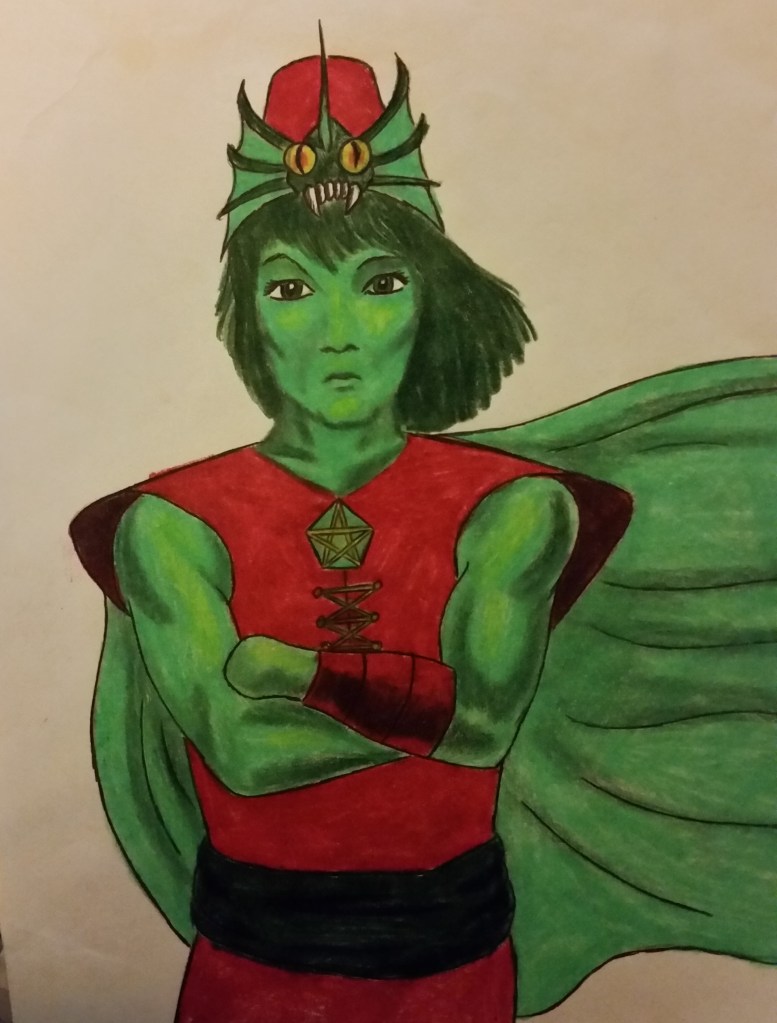
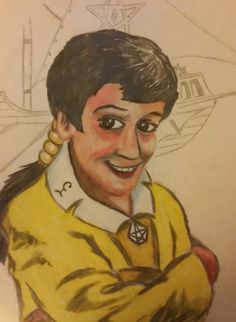
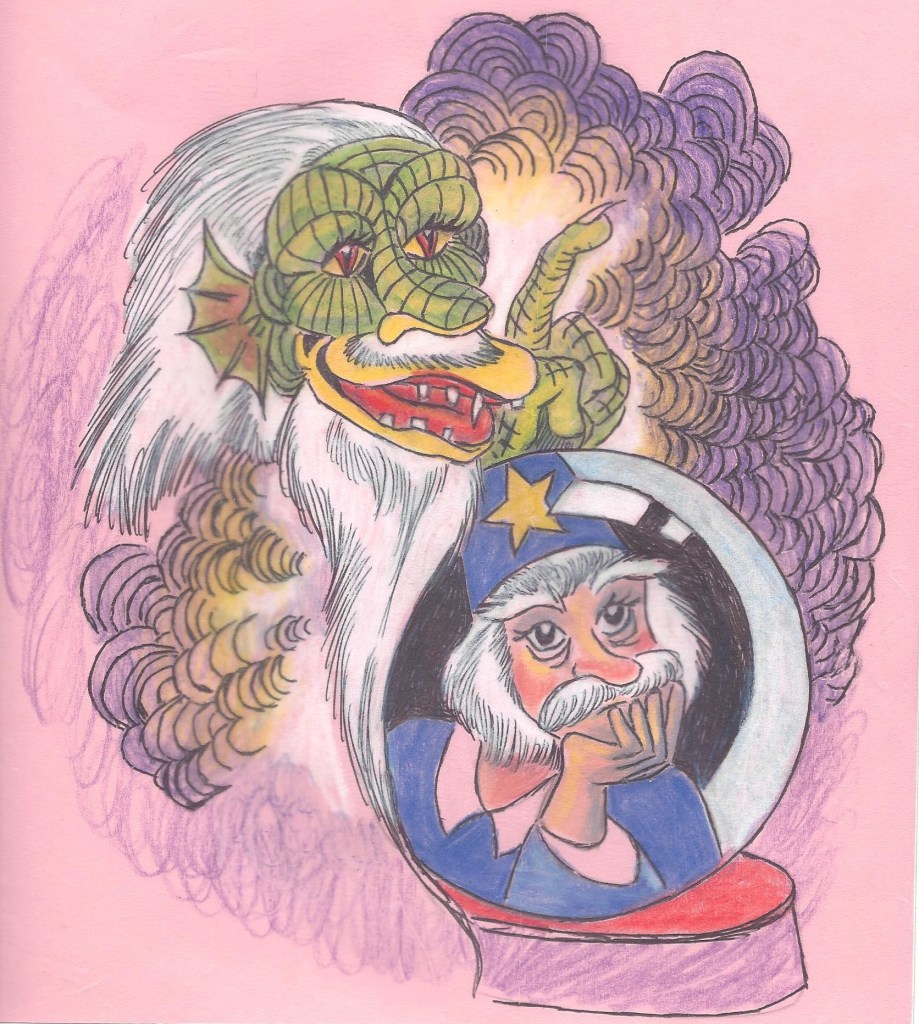
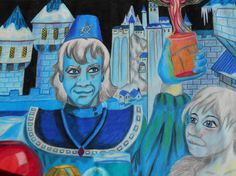
Here I am back to doing D&D and Traveller on Saturdays. All of the art in this post was once used in conjunction with RPGs played with former students, and my own kids. I was always the game master in the past, and I used drawings and illustrations to help the imaginary adventures come to life.
Zoran-Viktor was a Mirin Ice Wizard from the Talislanta D&D campaign. The player of this character was Victor, a gifted dancer and actor from the school’s theater department. The Lawgiver was a powerful Non-Player Character in both D&D and Talislanta. The character design came from a metal figure I painted myself. Zoric was a Talislantan Thaumaturge, the player character of a weird kid who told x-rated jokes better than any other high-school boy I ever met.
Harun the Charmer was only ever used as a player-character once. The boy whose character it was provided the face I modeled it after. He was an absolutely arresting boy that had such a winning personality that people fell in love with him almost instantly.
He spent way more time helping another teacher grade papers than he did playing Talislanta games with goofy old Mr. B.
And I promise, only one of the facts presented here about Harun is a lie, in attempt to protect this young gentleman’s identity. We unfortunately lost him back in the 1990’s.
Crane the Sorcerer was an NPC trapped inside his own crystal ball by his own evil familiar well before my kids met him in the D&D adventure.
Viktor, the Snow Wizard of Ice Keep, was the father of Zoran Viktor. Victor loved playing Talislanta.
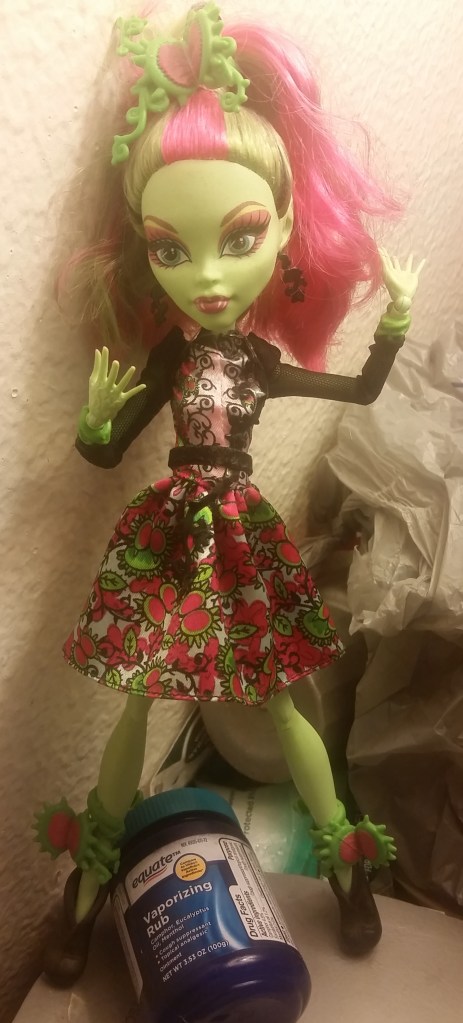
Venus Flytrap, my Monster High doll decorated with carniverous flowers, is the perfect pandemic mascot, as she guards the Vapo-Rub.
Stuck in the house all day with no outside activities to distract me, and limited socialization with the other denizens imprisoned in the house with me is more-or-less the perfect thing for a fiction writer with cancer of the imagination glands.
I have plenty of people to talk to, since , in this situation, imaginary people count too. And there is no end to the things I can talk about since ideas keep welling up in my head, even if many of them are totally silly ideas, and the rest are probably evil.
It helps to have a talking dog. Though my kids would argue that Jade isn’t really talking, that I am, instead, merely interpreting things I think she should be saying as if it were real speech. She does talk an awful lot about different kinds of meat and the moral imperatives of allowing your dog to eat people food. But I think it is only proper to commit to writing those things she says when we’re alone together, because, after all… a possible talking dog?
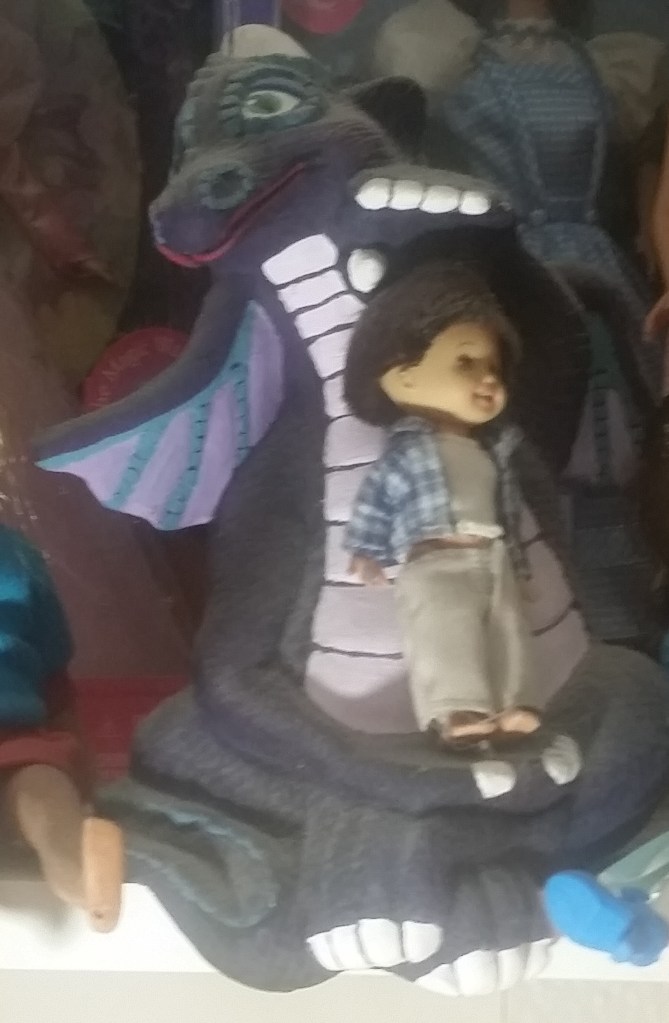
Everybody has a purple dragonette on the doll shelf that loves to play with dolls, don’t they?
But imagination is one of those things that sets people… I mean, human people, apart from all other life forms that we know. Imagination makes the man. What would we have made of ourselves and our world if we didn’t have it? Would we have invented the wheel? Fire? Term life insurance? I think not.
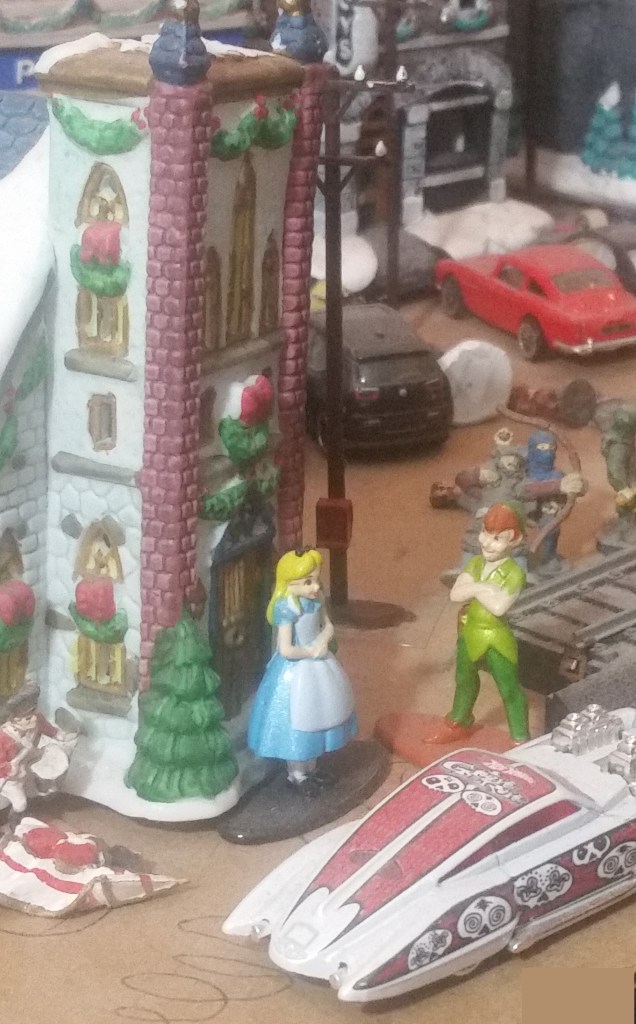
Peter Pan offers Alice a ride in his Skull-and-Bones Lowrider as ninjas attack Main Street Toonerville.
I may, in fact, be going a little stir crazy in the old hovel while trying like heck to avoid death by Coronavirus. I am easily as frayed around the edges as any hopeless hobo, with even my beard-trimming growing wildly erratic. Soon I may have to tell the imaginary people who surround me and question everything about me that it is not a beard any more. Rather, it is either a crocheted hippie neck-warmer rather than a beard, or maybe it has become a furred, frilly collar on my shirt like Shakespeare probably wore for the premiere of King Lear.
No, I am not going stir-crazy, or even a little bit insane. I am just letting the words unwind as they fill me up and demand to be unreeled in order to prevent an explosion in the brain.
Stan took Maria to the study and made her bring the decorative skull thing.
“It’s time we look for the miniature radio receiver,” Stan said.
“So, how will you do that?” Maria asked.
“With an exactor knife.”
“But, if you cut into it, you are doing what the owl guy said you can’t do.”
“Surely you don’t really believe in demons and curses?”
“I believe in Science, like you. But I also worry about things we might not know enough things about.”
Stan smiled at her. Typical teenager with some knowledge, but lots of superstition and ignorance on the other side of the teeter-totter of the mind.
He looked at the thing Maria had put into his right hand as his left hand picked up the razor knife. It was a beautiful piece of work. Shaped like a skull, it was decorated with flowers and vines in bright, looping lines. Someone had taken great pains to make this object worthy of its religious purpose. And even if you didn’t respect the dogma and arbitrary rules of religion, Stan did have to acknowledge that somebody in the world cared a lot more about it all than he did.
“Gringo, if you cut me, you will regret it for the rest of your shortened life,” said the skull clearly and in English.
“What? Maria, could you tell where that voice came from?”
“What voice?”
“You didn’t hear a voice?”
“Maria, I have a separate conversation to hold with you, Chica. But I have to threaten the stooge right now. Let me settle with him first.” Stan knew the voice was meant for both of them to hear that time.
“Okay, stupid one. There is a demon sealed into this paper skull. If you cut through the magical designs that hold it within, it will come out and possess you. You will kill pretty little Maria first, horribly with lots of blood, pain, and screaming. And then you will kill your wife even more horribly. And immediately call the police to confess your crime, not so you can pay for your crime, but to bring the police here to kill as many as you can, and then the demon will escape by possessing the cop who kills you.”
“Why is there a demon imprisoned inside of you?”
“He is bound there to provide the power I must use to perform the functions I have at Aunt Phillia’s. The things I must do for Maria to accomplish what she must accomplish among the Bones of the Lonelies.”
“Stan, maybe you should give the thing to me,” said Maria.
Stan was quietly thinking about any possible explanation that didn’t involve real demons to counter what the thing said, but he didn’t dispute it out loud. He put the thing in Maria’s hands.
“Maria, you know that Rogelio and Yesenia are both in the land of the dead though they are both still alive at this point.”
“Yes, I know…” She had tears in her eyes as she said it.
“There is a possibility that they will both die there and become permanent residents. You must now be honest about why you took Yesenia to the toy store to begin with.”
“I, uh… what do you mean?”
“You need to tell the Gringo Stan why you took Yesenia to the toy store.”
Maria looked at Stan. Stricken is the only possible word for how she looked.
“If you don’t admit it, you cannot go there and try to retrieve either of them.”
“I… I wanted her boyfriend to like me instead of her.”
“And what did you think would happen at the toy store when you took her there?”
She was ghostly pale. “I knew from the stories that something might happen to her that would separate her from Rogelio.
“And you got what you wanted. Why, then, did you take Rogelio there?”
She looked at Stan again. “I felt guilty. I had to…”
“You had to rescue her,” said Stan.
Her face crumbled and she was bawling.
“I can help you do that,” said the skull. “You will have to put your own life on the line to do it.”
Stan reached over to Maria and took hold of her shoulder. He pulled her to himself. She cried against his chest as he held her.
“Maria, it shows me you are a good person that you wanted to fix this.” Stan stroked the hair on the back of her head.
“You don’t hate me?” she sobbed.
“Of course not. You are my daughter now. No more question about that.”













 Catch a Falling Star
Vonnegut
My experience of the works of Kurt Vonnegut is limited to the reading of three books; Cat’s Cradle, Breakfast of Champions, and Slaughterhouse Five. But it was enough to make me love him and use him as a shaper of my soul.
I deeply apologize for the fact that even though he only wrote 14 books and a bunch of short stories, I have not read everything I could get my hands on by Kurt. Three novels and one short story (Harrison Bergeron) is not really enough to compare to the many, many things that I have read by Mark Twain, Terry Pratchett, Louis L’Amour, and Michael Crichton. I can’t begin to count how many books of each of those four I have read and reread. But it is enough that I read those three novels and have a lifelong regret of never buying and reading Slapstick when I had the chance. Vonnegut writes black humor. The ideas are painful, and burn away flesh from your personal body of being. And at the same time, you cannot help but laugh at the pure, clean, horrifying truths his ridiculous stories reveal.
If, in the course of telling a story, you can put the sublime, the ridiculous, and the horrendous side by side, and make the reader see how they actually fit together, then you can write like Vonnegut.
Let me give you three quick and dirty book reports of the Vonnegut I have read in the order I have read them;
I read Cat’s Cradle in college. I was young and idealistic at the time, foolishly convinced I could be a great writer and cartoonist who could use my work to change mankind for the better.
In the book, Dr. Felix Hoenikker (a fictionalized co-creator of the atomic bomb) is obsessively re-stacking cannonballs in the town square in pursuit of a new way to align water molecules that will yield ice that does not melt at room temperature. Much as he did with the A-bomb, Hoenikker invents a world-ending science-thing without any thought for the possible consequences. The narrator of the novel is trying to write a humanizing biography of the scientist, and comes to observe the inevitable destruction of the whole world when the oceans freeze into Ice-9, the un-meltable ice crystal. Before the world ends, the narrator spends time on the fictional Carribean island of San Lorenzo where he learns the fictional religion known as Bokononism, and learns to make love to a beautiful woman by pressing bare feet together sole to sole. It is a nihilistic picture of what humans are really like more savagely bleak than any portrayal Monte Python’s Flying Circus ever did on TV.
Needless to say, my ideals were eventually shattered and my faith in the world shaken.
I read Breakfast of Champions after I had been teaching long enough to buy my own house, be newly married, and a father to one son. It was probably the worst time of life to be reading a book so cynical, yet true.
In this story, the author Kilgore Trout, much published but mostly unknown, is headed to Midland City to deliver a keynote address at an arts festival. Dwayne Hoover is a wealthy business man who owns a lot of Midland City real-estate. Trout gives Hoover a book (supposedly a message from the creator of the universe) to read that suggests that all people (except for the reader of the book… meaning Hoover) are machines with no free will. Hoover takes the message to heart and tries to set the machines free by breaking them, beating up his son, his lover, and nine other people before being taken into custody.
The book contains devastating themes of suicide, free will, and social and economic cruelty. It makes you sincerely reflect on your own cog-in-the-machine reality.
Slaughterhouse Five is a book I bought and read when I missed my chance to buy Slapstick and needed something to take home from HalfPrice Books to make me feel better about what I missed. (Of the five books I had intended to buy that day, none were still on the shelves in spite of the fact that they had been there the week before.) It was fortuitous. This proved to be the best novel I had ever read by Vonnegut.
Like most of his work, the story of Billy Pilgrim is a fractured mosaic of small story pieces not presented in chronological order. It details Billy’s safe, ordinary marriage to a wife who gives him two children, but it is ironically cluttered with death, accidents, being stalked by an assassin, and being kidnapped by aliens. It also details his experiences in World War II where he is captured by the Germans, held prisoner in Dresden, kept in an underground slaughterhouse, and ironically survives the fire-bombing of Dresden by the Allies. Further, it details his time as a zoo exhibit on the alien planet of Tralfamadore.
It explores the themes of depression, post-traumatic-stress disorder, and anti-war sentiment. Vonnegut himself was a prisoner of war in Dresden during the fire-bombing, so real-life experiences fill the book with gravitas that it might not otherwise possess. Whether the author was ever kidnapped by aliens or not, I cannot say.
But Kurt Vonnegut’s desire to be a writer and portray himself as a writer in the character of Kilgore Trout, and even as himself in his work, has an awful lot to do with my desire to be a writer myself. Dark, pithy wisdom is his thing. But that wisdom, having been wrung from the darkness is all the more brightly lit because of that wringing. It is hard to read, but not hard to love.
Leave a comment
Filed under aliens, book reports, commentary, humor, reading, writing humor
Tagged as Kurt Vonnegut