
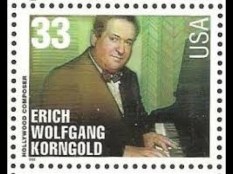
When I was in Cow College at Iowa State University I spent most of my study time listening to KLYF Radio in Des Moines. They would eventually transform into an easy-listening music station, but the time I truly lived a K-LYFe was when they played classical music. And it was there that I first fell deeply in love with the Saturday Matinee stylings of Erich Wolfgang Korngold, the first incarnation of John Williams of Star Wars fame. Yes, movie music. Classical movie music. And it seemed, mostly movie music for Errol Flynn movies.


My sister was always a lover of Errol Flynn movies, and when KGLO TV Channel 3 would play one on the Saturday Movie Matinee in the early afternoon, we would have to watch it, the whole thing, no matter how many times we were repeating the same four movies. Nancy would memorize the lines from the Olivia deHavilland love scenes. I would memorize the sword fight scenes with Errol and Evil Basil Rathbone (Good Basil was Sherlock Holmes, and we had to watch those too.) Early evenings on those Saturdays were all about playing pirate and Captain Blood adventures. Or better yet, Robin Hood.


But the music of adventure was by the composer Erich Wolfgang Korngold. He did the sound tracks for Captain Blood, Robin Hood, and the Sea Hawk.
I sincerely love the corny old movie matinee music because it was not only genius-level mood music and story-telling in a classical music instrumental masterpiece, but because even now it takes me back to the boy I was at twelve years old, playing pirate on Grandpa Aldrich’s farm. Making Robin Hood bows out of thin tree branches and arrows out of dried ragweed stalks. Sword fighting to the death with sticks with my cousin Bob, who was always Basil Rathbone in my mind. while I’m sure I was Basil Rathbone in his mind.
To be honest, there is much more to Korngold than I have relentlessly gushed about here like a hopeless nerdling fan-boy in the throws of a geeky movie passion. He was a musical child prodigy like Mozart. He wrote a ballet called Der Schneemann (the Snow Man) when he was only eleven, and became the talk of the town in Vienna, Austria in 1908. He became the conductor of the Hamburg Opera by 1921. He wrote some very fine classical music in the 20’s that still rings through orchestra halls to this day before coming to America in the early 30’s with film director Max Reinhardt. He scored his first film in 1935, adding music to Reinhardt’s Midsummer Night’s Dream. He was fortunate to escape Europe just as the Nazis were coming to power in Germany, and also at the right time to team up with new movie star sensation, Errol Flynn. He won his first Oscar for the musical score of the movie Anthony Adverse in 1936 and he won his second for The Adventures of Robin Hood in 1938. He died in 1957, a year after I was born. But I promise, I didn’t kill him. I was in college in the 1970’s when his music underwent a revival, complete with renewed popularity.
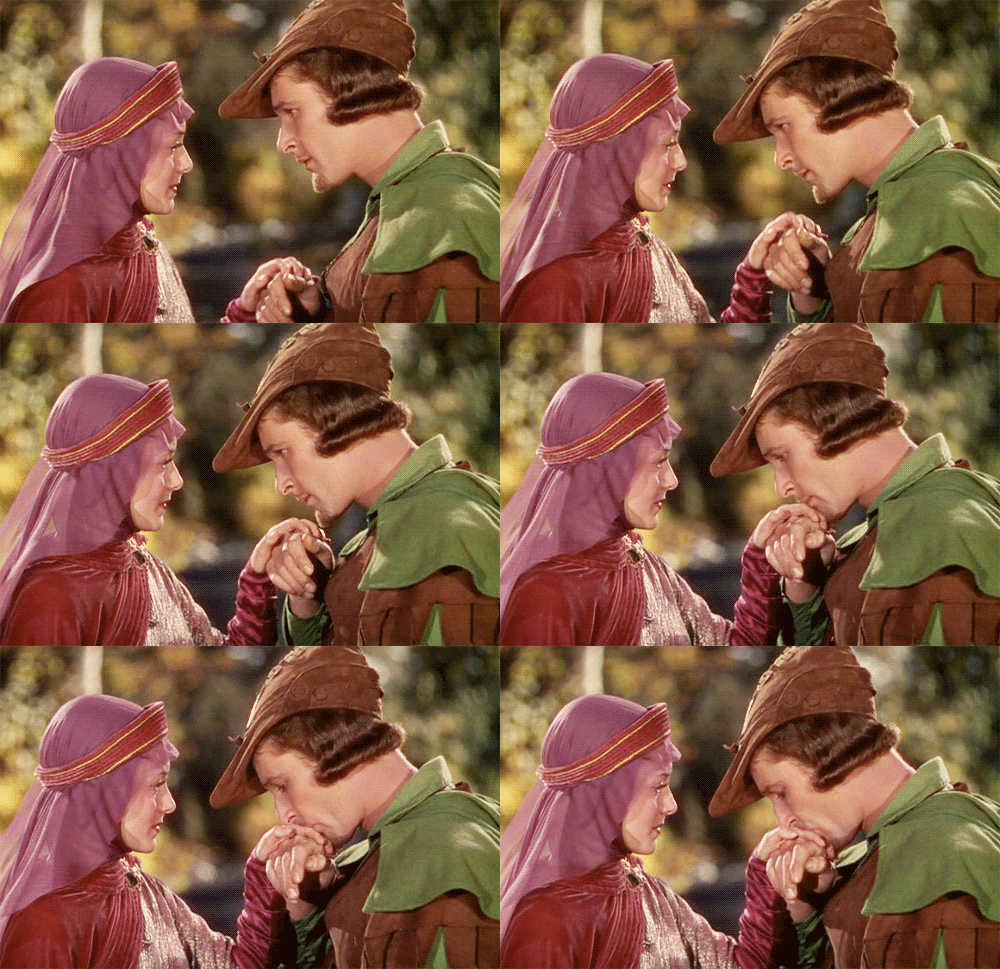
His music was pure gold to listen to in the fields of corn in Iowa in the 1970’s. It was just as good as that last pun was terrible. So, in other words, really, really, spectacularly good. It was the music that scored my childhood fantasy adventures.






 Catch a Falling Star
Albinoni’s Adagio in G Minor
You should listen to the music. Not only is it beautiful, it is the perfect description of the now. Yes, I am a touch depressed, and the music is deep blue. But there are such strains of the bittersweet and angelic light, that Albinoni must be speaking directly from his heart into mine. This music paints my soul.
The sky reflects my mood with lurking dark blues and obscuring clouds incapable of completely taking away the sun. I finally had enough money to visit the doctor today. I had an infection in throat and sinus. I got medicine to heal the sores, and the medicine will prevent pneumonia, and probably saved my life.
My family was whole and together for the holidays, though three of us were sick for a good share of it and unable to spend the time together as we would’ve liked. Still, even though we had to take number one son to DFW Airport in the rain and send him back to Marine world, we got to see him and share good times with him, no matter how short. Deep blue with angelic violins of musical light. He made it back safely. I have more days and probably more months to live and write. And the music of existence continues to quietly play.
I continue to collect photos of new dawns. Here is December 27th.
It is possible that Tomaso Albinoni did not write the Adagio in G Minor. It is believed that it was cobbled together as a sort of hoax by his chief transcriber, Remo Giazotto. He apparently took old Dresden manuscripts and made this beautiful piece as a reflection of the work of Albinoni. Albinoni,a prolific composer of the 1700’s, beloved by Johan Sebastian Bach, wrote opera scores that never quite got published, and so,even though he is a composer of many musical works, most of them are lost to history. Yet, how can such a thing be considered a fake? The music touches my soul. From Albinoni’s soul, through Giazotto’s, to mine, and, hopefully, thence to yours. Listen to it. Really listen. You can’t help but understand what I mean. Even if you can’t stand classical music. Though, if you truly can’t stand classical music… I weep for thee.
1 Comment
Filed under classical music, commentary, Depression, family, feeling sorry for myself, forgiveness, humor, illness, old art, review of music, strange and wonderful ideas about life
Tagged as adagio in g minor, classical music, depression and illness, Tomaso Albinoni