I am now confined to my bedroom for another couple of weeks. Me, alone with my imagination, having to put on a mask to go down to the kitchen to make soup or go to the restroom. And it is the second time. But this timek I am the one infected. Before it was number two son who brought it home from work and got us all locked up at home.
To be honest, I haven’t gotten a test yet to determine that it is truly Omicron. If I do, I have to have somebody help me get there as we do not yet have any home tests. That would put whoever volunteers at risk. Plus, an official diagnosis creates more days missed from work for my wife who already has to teach in a germ-filled middle school with a mask on all day.
So, since I am only assuming I have Covid Omicron, I get to take care of myself in isolation. And if it is not Omicron, for which I am triple vaccinated, I have to worry that the regular flu is probably more dangerous than Covid and could potentially kill me.
I tend to get sick from regular flu even when I am vaccinated.
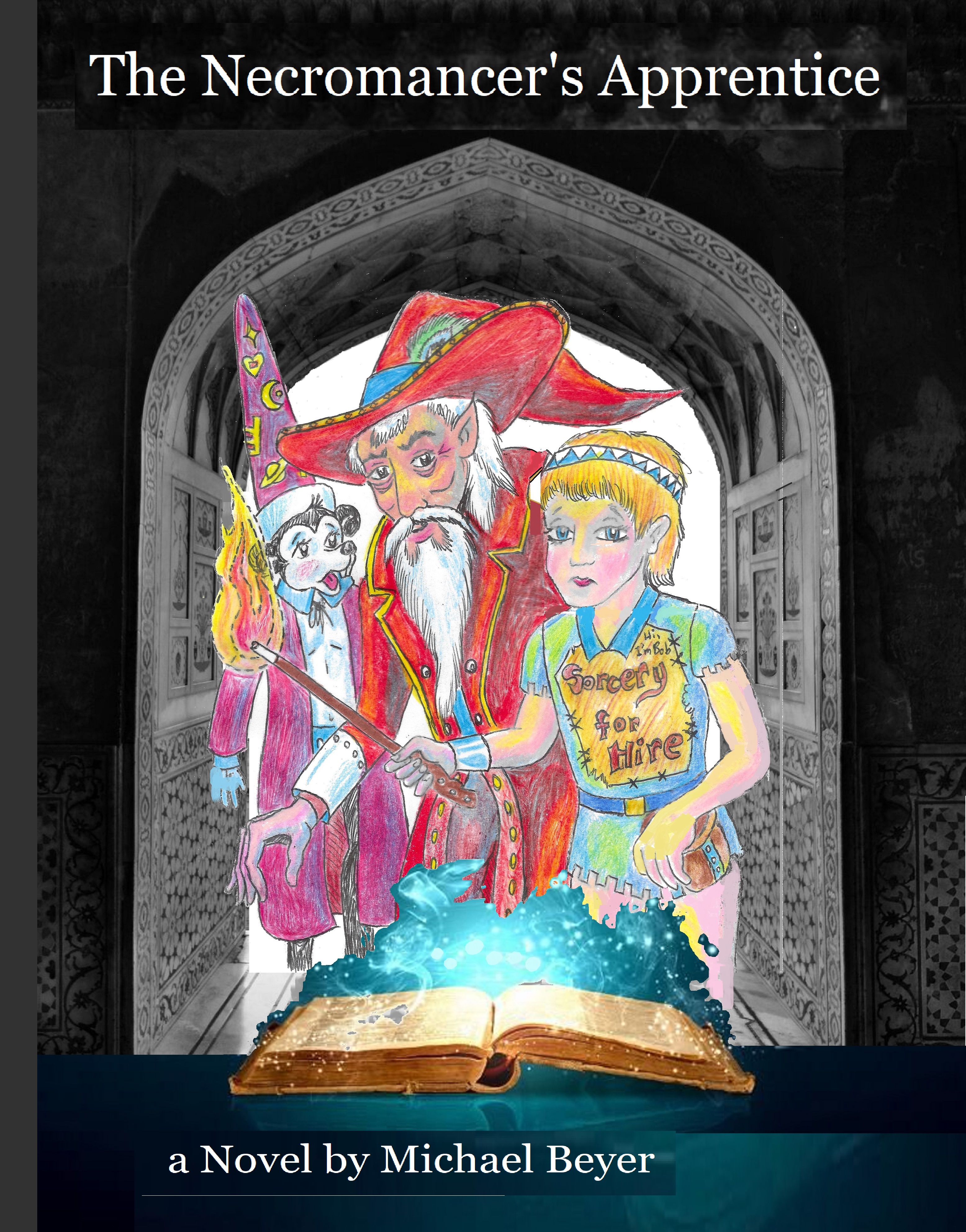
But while I am holed up with headaches and sore throat, I am finishing a novel, The Necromancer’s Apprentice. I have one chapter and two illustrations yet to finish.
This will be the first novel I have written set entirely in Tellosia, the kingdom of Fairies, Sylphs, Pixies, and Elves that exists just beyond the edges of the small town of Norwall, Iowa. All of the Fairy people and fairy animals are shrunk down by modern disbelief in them to a size where a six-foot person would be only three inches tall.
I hope to have it published in the next week. I, of course, now have additional time to work on it.
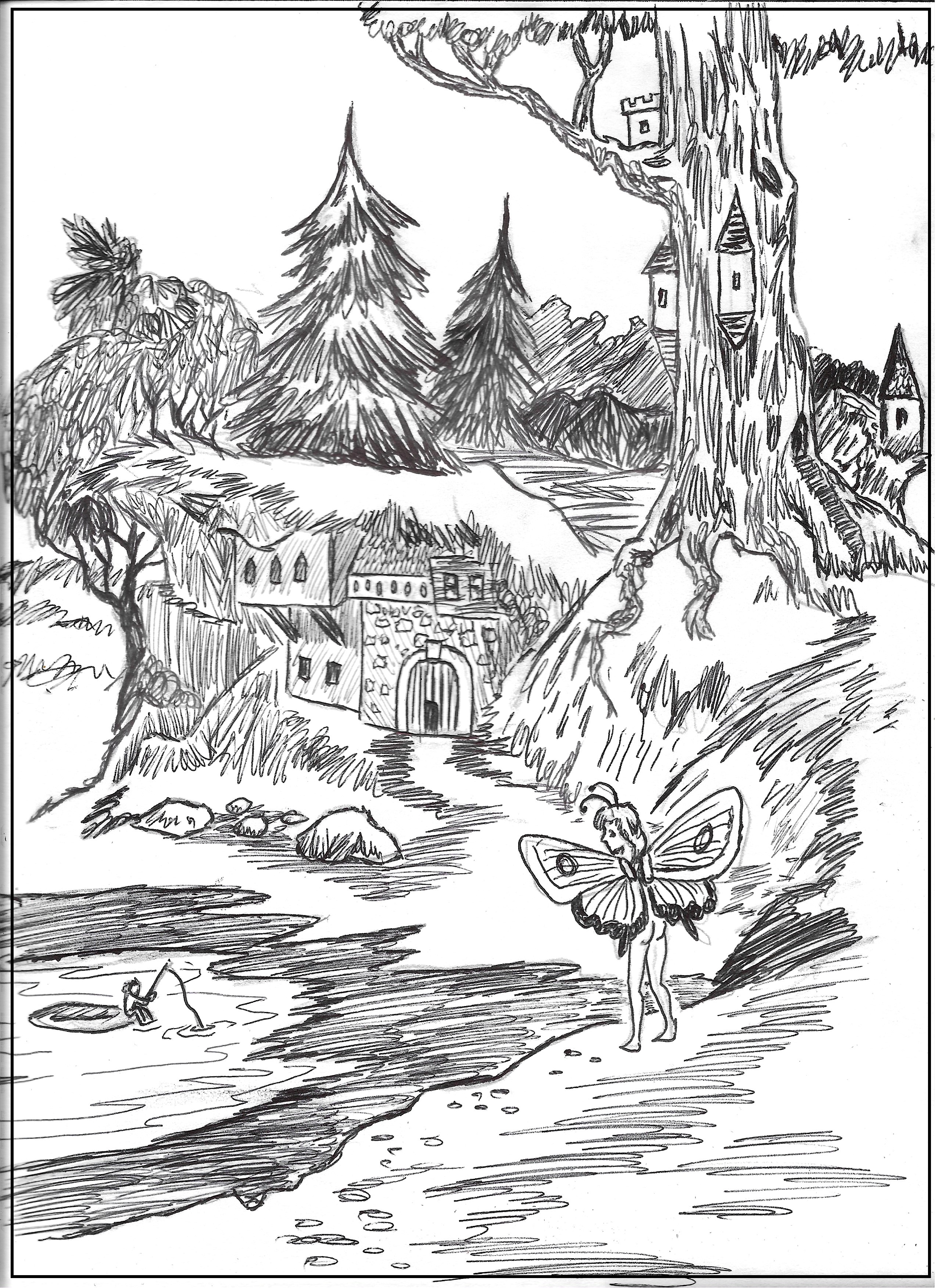
The Necromancer’s village of Mortimer’s Mudwallow
So, I have a choice. I can sit and suffer and watch TV, or I can get busy and write and publish.
I am not posting anything sick. I AM SICK. So, expect random pictures from my gallery file.
Cissy Moonskipper is now published and available on Amazon, along with Horatio T. Dogg, Super Sleuth, both of these being novellas. The Necromancer’s Apprentice is added to the soon to be published.So, now I have pieced together another post on a day when I feel awful with possibly-Omicron (though I am triple vaccinated.)
Yes, the graduating class of 1975 is somewhat in power now. Tom Hanks and Mel Gibson are both big names in movie making, and both were born the same year I was. Larry Bird, Joe Montana, and Sugar Ray Leonard have all made their marks in the sports of Basketball, Football, and Boxing already. They were all three born in 1956 too. Bill Maher, the comedian/talk show host shapes lots of political opinions with his show on HBO. He is also the same age as me. Unfortunately, Matthew Garber (the little boy in Mary Poppins), Carrie Fischer (Princess Leia in Star Wars) and now Bob Saget (the Full House dad) haven’t made it to this date alive. And Marcia Brady (as played by Maureen McCormick) has faded into obscurity while LaToya Jackson’s career has definitely suffered from her brother Michael’s notoriety. Those are all members of the group born with me and having the potential to be in my graduating class. But they are not exactly running the world at this moment.
Joe Biden is, I think, a member of Fred Flintstone’s graduating class. The geriatric crowd with Bernie Sanders, Donald Trump, and Hilary Clinton are still running the world, at least until they can no longer get the proper old-fashioned batteries for their pacemakers.
Mitch McConnell is pictured here with two of the things he fears most in life. The fact that he still rules the Senate in spite of being the MINORITY leader, is one of the biggest oxymorons I could ever hope to spot. I do believe he has been dead for longer than most of his Senate colleagues have been alive.
Life has become an oxymoron in 2022, and is now considered to be seriously funny.
Teachers are being valued just the way that corporations and economically-minded leaders like Governor Greg Abbott and Governor Ron DeSantis have always felt they should be valued… thoroughly expendable. We have passed laws against teaching actual social history in terms of racism, civil rights, and the evil deeds of former rulers who are rich white guys because learning about those things might hurt the feelings of white kids. And teachers should not be allowed to protest and leave their jobs just because the State Legislatures of Red States want to prevent requiring vaccinations and mask-wearing as necessary in schools. It is the violation of somebody’s rights somehow to make anyone get the proper shots before entering the teachers’ workplaces, because it is important that teachers teach in classrooms, but they cannot insist they have a right to be as safe as possible from dying of Covid variants or the bullets from a student’s AR-15.
People who aren’t rich enough to have opinions should all just be quiet.
And meanwhile, Mickey has put another one of his novels up for promotion as a free e-book until Tuesday, January 18th, You should click on the link and get yourself a free copy. It makes as much sense as anything does in these staid and lucid nonsensical times.
One really weird thing that teachers do is think about thinking. I mean, how can a person actually teach someone else how to think and how to learn if they don’t themselves understand the underlying processes? Now that I have retired from teaching and spend all my time feeling sorry for myself, I thought I would try thinking about thinking one more time at least. Hey, just because I am retired, it doesn’t mean I can’t still do some of the weird things I used to do as a teacher, right?
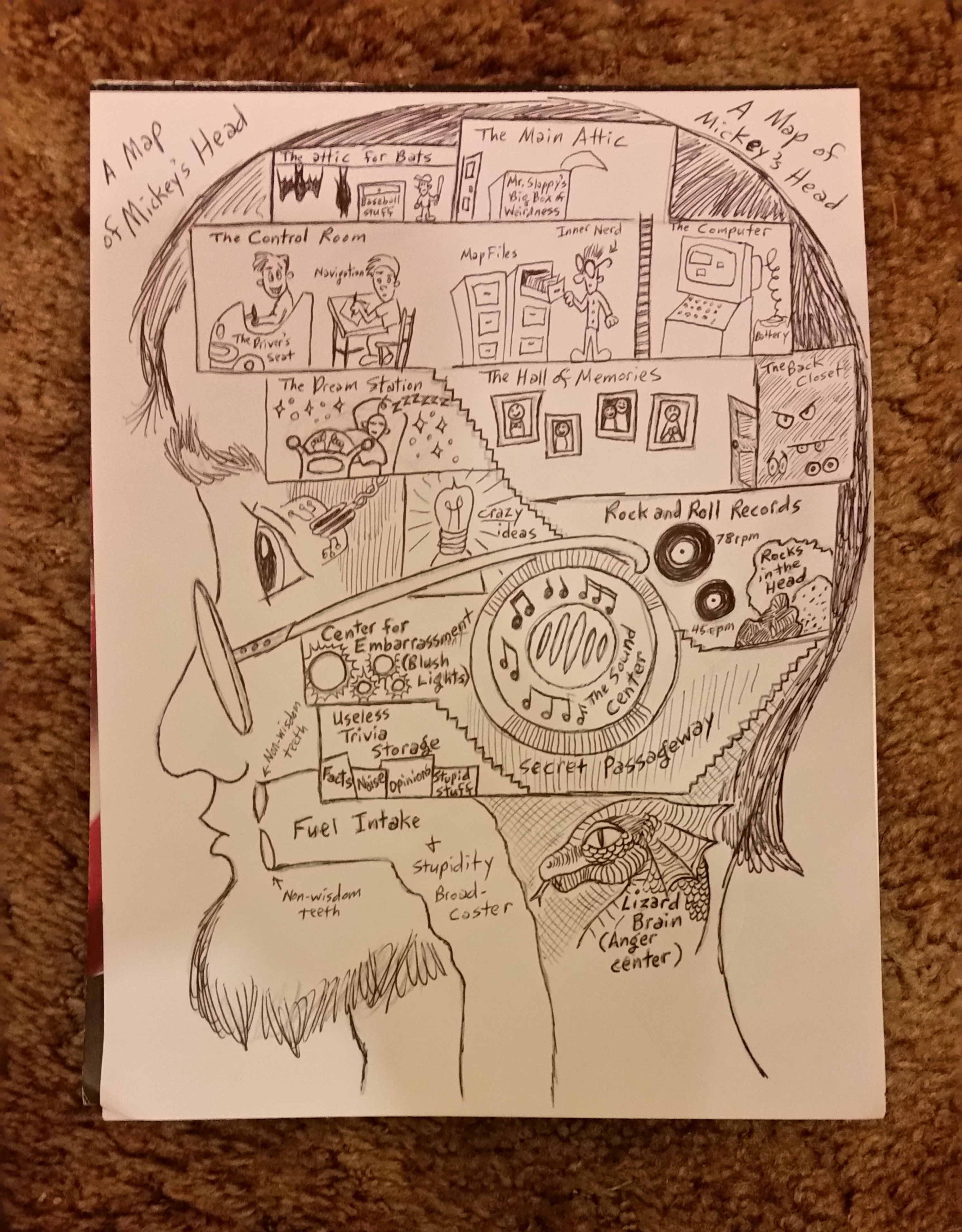
This time I made a map to aid me in my quest to follow the twists and turns of how Mickey thinks and how Mickey learns. Don’t worry, though. I didn’t actually cut Mickey’s head in half to be able to make this map. I used the magical tool of imagination. Some folks might call it story-telling… or bald-face lying.
Now, a brain surgeon would be concerned that my brain maps out in boxes. He would identify it as a seriously deformed brain. It is not supposed to be all rectangular spaces and stairs. It probably indicates a severe medical need for corrective surgery… or possibly complete amputation. But we are not going to concern ourselves with trying to save Mickey from himself right now. That is far too complex a topic to tackle in a 500-word daily post. We are just discussing the basics of operation.
You see the three little guys in the control room? They are an indication that not only did I steal an idea from the Disney/Pixar Movie Inside Out, but I apparently have too few guys doing the job up there compared to the movie version. (It probably makes sense though that a young girl like the one in the movie has a much more sensible configuration in her brain than someone who was a middle school teacher for 24 years. Seriously, that job can do a bit of damage.) The three little guys are not actually Moe, Curly, and Larry, though that wouldn’t be far from descriptive accuracy. They are Impulsive Ignatz, currently in the driver’s seat (or else I wouldn’t be writing this), Proper Percy the Planner, and Pompositous Felixian Checkerbob, the fact-checker and perfectionist (also labeled the inner nerd… I am told not everyone has one of these). They are the three little guys that run around in frantic circles in my head trying to deal with a constant flow of input and output, trying to make sense of everything, and routinely failing miserably.
I shouldn’t forget the other two little guys in my head, Sleepytime Tim in the Dream Center, and little Batty up in the attic. I have no earthly idea how either of them function, or what in the heck they are supposed to do. But there they are. The other three run up and down stairs all day, locating magic mushrooms and random knowledge in the many file cabinets, record collections, book stacks, and odd greasy containers that are stored all around in the many nooks and crannies of Mickey’s mind. They collect stuff through the eyes and ears, and it is also their responsibility to chuck things out through the stupidity broadcaster at various inopportune times. It is also a good idea for them to avoid the lizard brain of the limbic system in the basement. It is easily angered and might eat them.
So now you should be able to fully understand how Mickey thinks. (Or not… a qualifier I was forced to put in by Checkerbob.)
When I was still alive and still teaching, maximizing and managing time was an incredibly important part of the day. You had to activate learners with an attention step, a lesson focus that grabbed them. Usually that had to follow a warm-up, something you got them to do as soon as you had smiled at them at the doorway, offered to shake their hand, and then pulled them into the classroom to do some work for you. fifteen minutes at the start of the class to rev up mental engines and get the gears turning… shake out the rust and the cobwebs that accumulate the instant the final bell rang in the previous class. I timed that part of class down to the second with my pocket watch… or phone in later years. Then, once the engines started, the focus is in place, you introduce the learning objective. Never more than ten minutes… timed to the second… you give the explanation, the road map of the day ahead, the instruction. Then for the next ten to fifteen minutes you let them discover stuff. In groups, with a partner, teacher to class, student to class, or (rarely) individually, they must apply what you pointed out and figure something out. It could be complicated, but probably it was simple. All answers are welcome and accepted… because all answers will be evaluated and you learn more from wrong answers than you do from correct guesses. Evaluation comes in the five to ten minutes at the end when you evaluate. “What have I learned today?” You try your hardest to pin something new to the mental note-board hanging on the brain walls of each and every student. Depending on how much or how few minutes you are given before the final bell kills the lesson for the day, you have to put the big pink ribbon on it. That tightly-wound lesson cycle goes on all day, repeated as many times as you have classes. In that time you have to be teacher, policeman, friend, devil’s advocate, entertainer, counselor, psychotherapist, chief explainer, and sometimes God. And you time it to the second by your pocket watch.
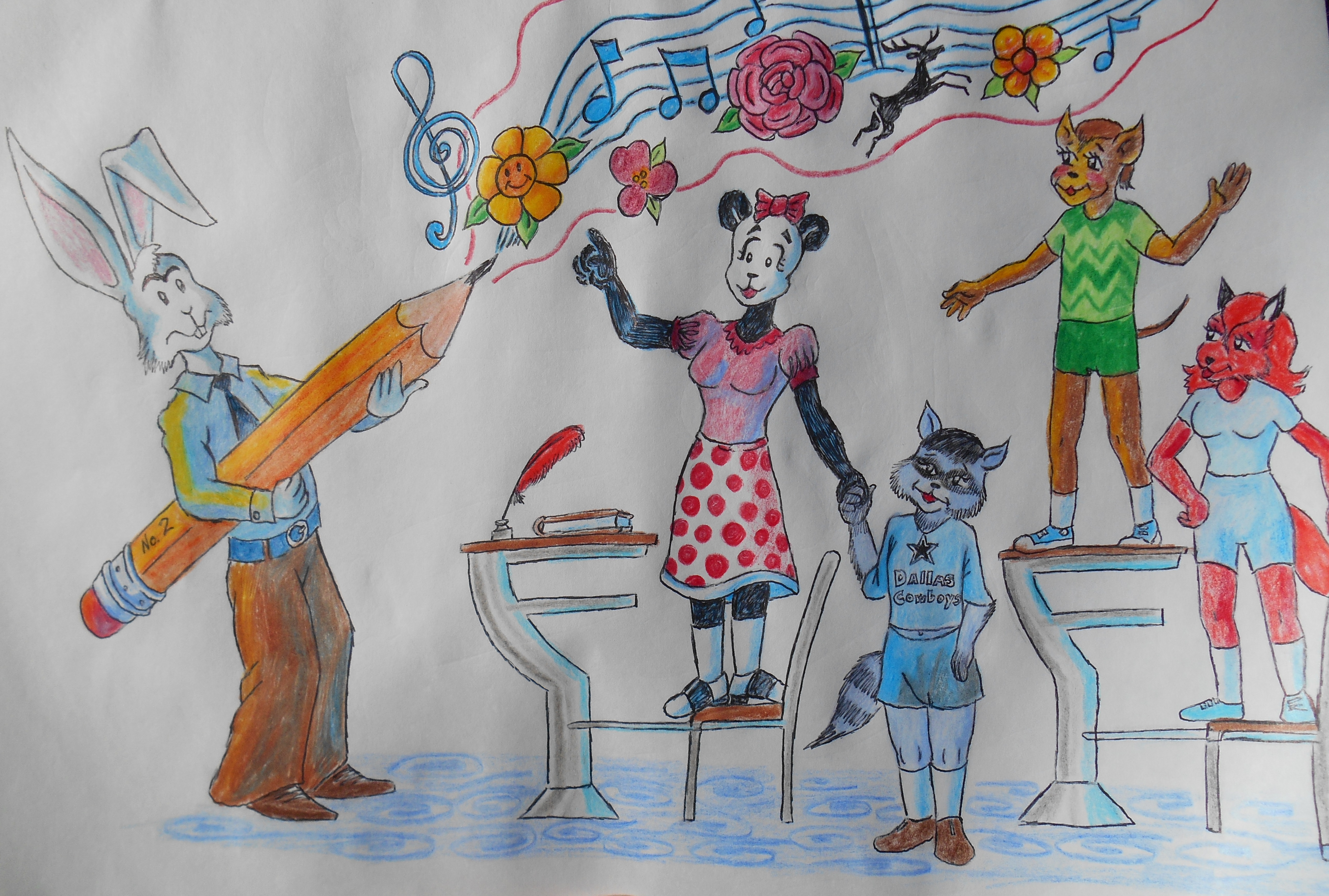
I miss being the rabbit holding the BIG PENCIL. Now that I am retired, I am no longer on the clock… no longer subject to careful time management. My pocket watch is broken and lying in a box somewhere in my library. I live now in non-consecutive time periods of sleep and illness and writing and playing with dolls. I have entered a second childhood now. Not really a simple one because of diabetes and arthritis and COPD and psoriasis and all the other wonderful things that old age makes possible. But a childhood free of school politics and mandates from the school board and from the State. A childhood where I can once again dream and imagine and create and play. That’s what this post is if you haven’t already figured it out. I am playing with words and ideas. They are my toys. Toys like this one;
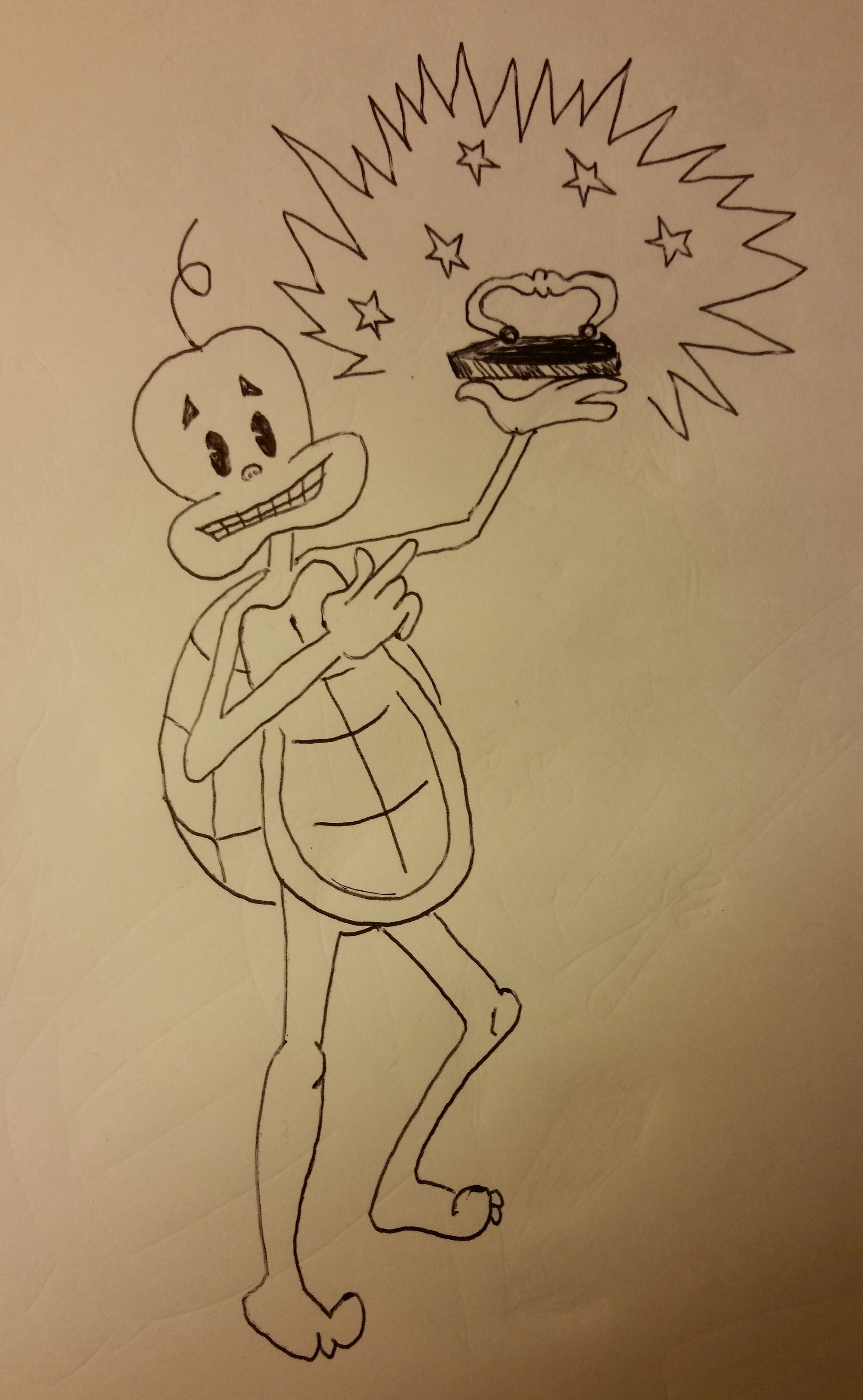
This, of course, is Tim, the turtleboy of irony, holding his magic flatiron that he uses for ironing out irony. He is flattening it out now with a cartoony Paffooney and wickedly waggled words. Ironically, I have often taught students to write just like this, making connections between words and pictures and ideas through free association and fast-writing. Have you learned anything from today’s retired-teacher post? If you did, it is ironic, because you were never meant to from the start.
Once in a while, though not often, it pays to be a wizard. It is easy to become a wizard. Socrates tells us that the key to wisdom is knowing that you don’t know anything at all. Most of us can handle that realization with ease. I myself question everything constantly. You know… because I don’t know anything.
Being a parent is a lot like that. Any idiot can make a baby. You don’t have to take any classes or get any kind of license. Heck, you have to have a license to go fishing in Texas and Fishing Police are very real.
Many babies happen totally by accident. And this is unfortunate because it is sorta like accidentally becoming a bomb squad technician. It is a very important job that could blow up in your face in many different ways and bring an end to everything important.
But I do remember one time when my oldest was a toddler and I was stuck taking care of him during an after-school teachers’ meeting. It is hard when the principal is talking about things you have to hear and the baby is colicky at the same moment. Fortunately, the Counselor’s daughter and her best friend were still hanging around the school cafeteria where the meeting was held. Wizard that I am, all I had to do was look pathetic and overwhelmed. My son was also cute enough that, once he got their attention, they actually volunteered to take over as temporary parents with the baby safely entertained in a sound-proof classroom nearby. And they didn’t charge me. And I was smart enough not to ask them to pay me for the privilege, because they enjoyed it so much they volunteered to do it again for any future meetings where I was in charge of him. That happened about three more times that year.
And I was able to use my wizardly powers to make my life as a substitute teacher easier the last time I did it during December. Students who had never seen me before took one look and started acting extremely polite, cooperative and helpful.
Of course, like a true wizard I had no idea at all why they were so keen on discussing new kinds of cell-phones with me, or whoever the heck Tommy Hilfiger was and why a gray t-shirt with his name on it was so much more valuable than an ordinary gray t-shirt.
And, like a wizard, I told a joke like this in more than one class;
“I overheard my Russian friend Rudolf arguing with his wife. It was snowing outside.”
“No, you are wrong. That is rain outside, dearest,So” said Rudolf.
“No, it isn’t. It is actually snow, dear informationally-challenged Rudolph.”
“Yes, it is rain. Rudolf the Red knows rain, dear!”
After they all groaned and sniggered, they all went immediately back to talking to me about Christmas shopping, but only while acting very, very good.
What was all of that about? I wondered. But the wizard in me kept thinking about buying lumps of coal.
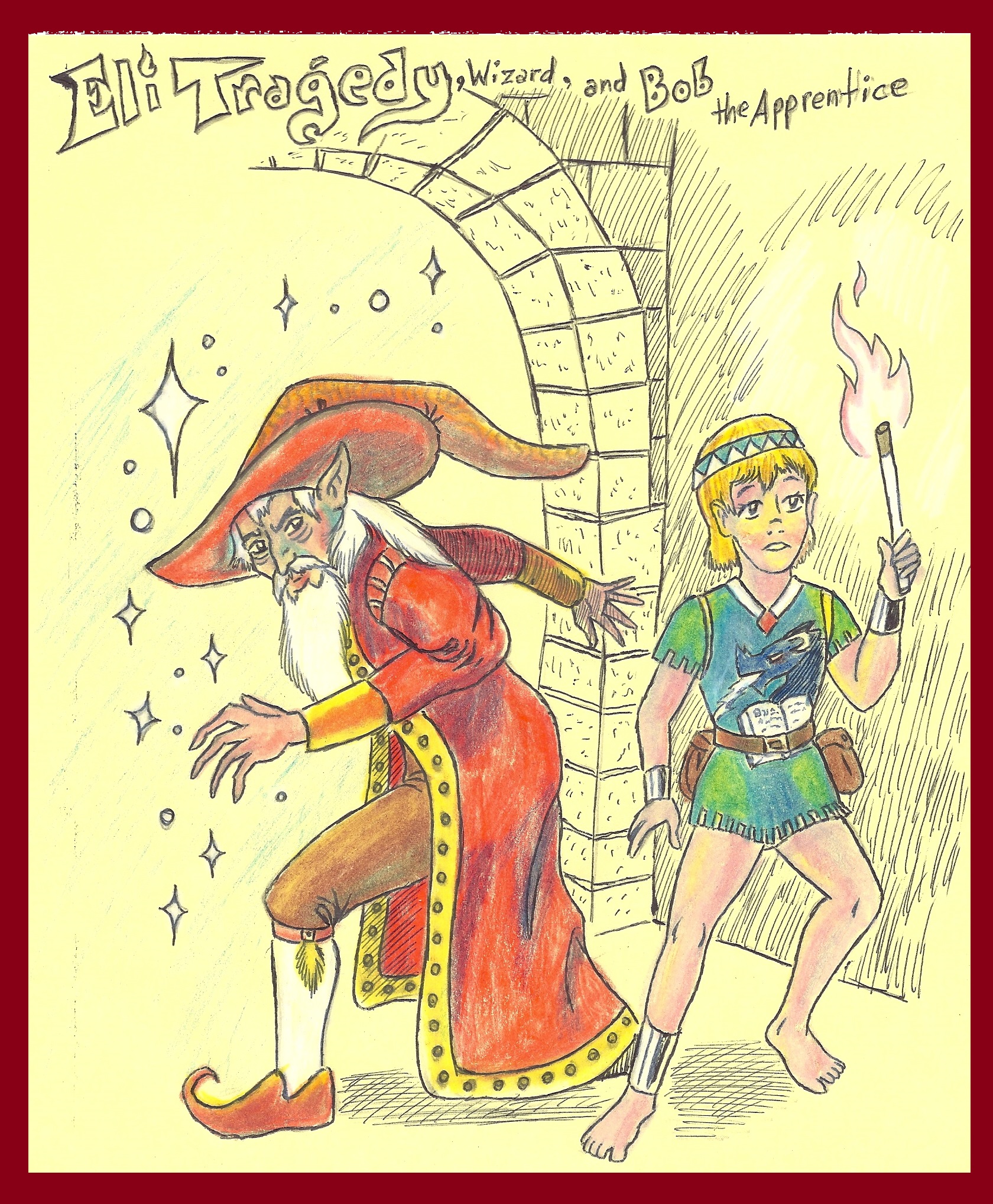
So, those are some of my best wizard tricks. Like the wizard in that first illustration. Fistandantalas Crane, the wizard, learned how to switch places with his avatar inside the crystal ball. This was a wizard move because in the crystal-ball world, Crane was immortal. But he didn’t invent a way to switch back with his avatar. And he found life in crystal-ball world very boring.
In light of Mark Zuckerberg’s recent innovations on Facebook, I sincerely hope he doesn’t read this post and get any ideas. I can imagine myself stuck in Facebook world, even more boring than the inside of a crystal ball. And even though my avatar is better looking than I am, I have to worry that everybody calls Mark Zuckerberg a wizard too. And I could be tempted by immortality.
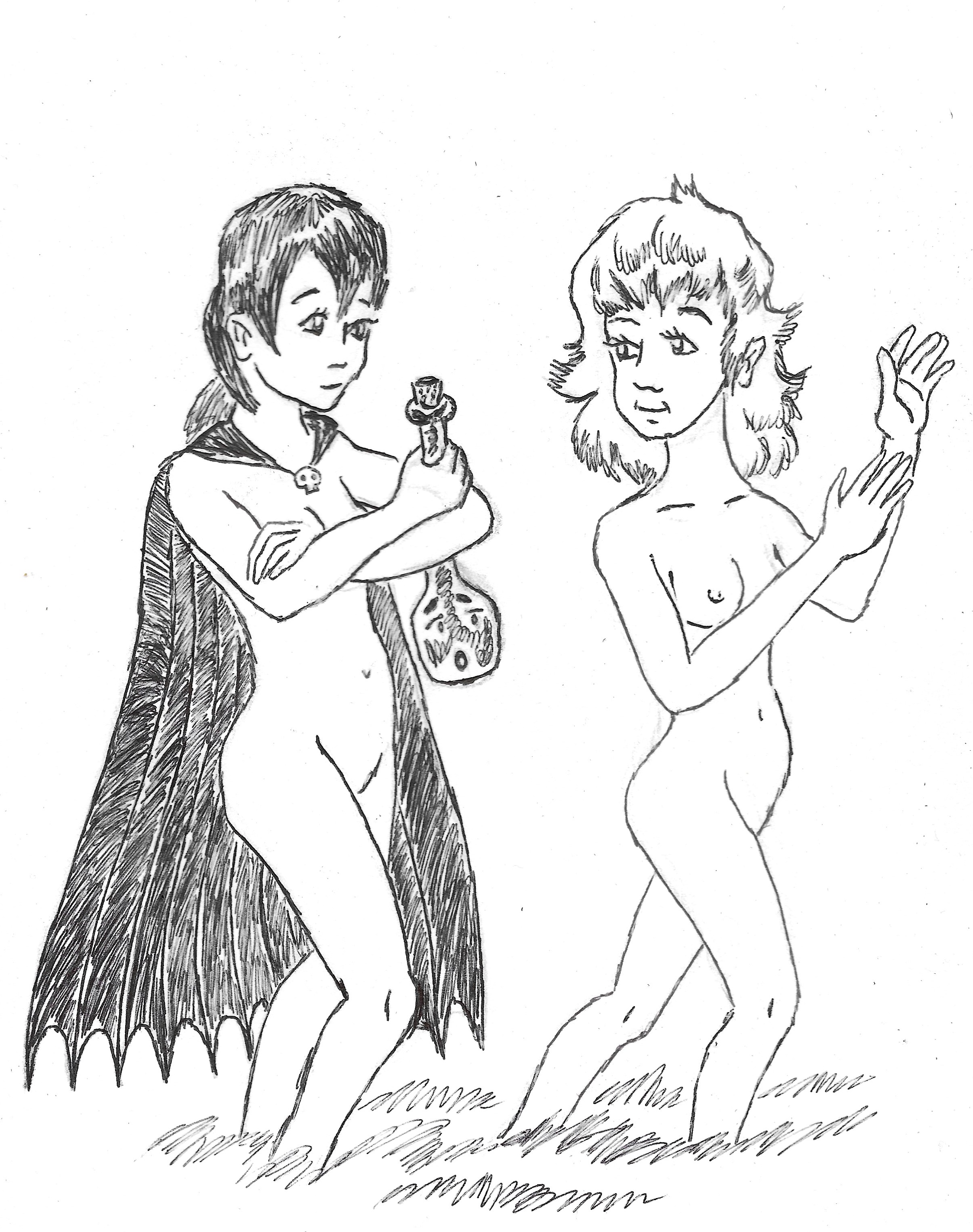
As we walked out of Master Tragedy’s Sorcerer’s tower toward the crafting district of Cair Tellos, I was carrying the huge jar of midnight shadows that Master Eli had given us to have a cape made from for Derfentwinkle. She was carrying the bottle imp, Kackenfurchtbar, in case I needed to test the truthfulness of what Derfie was telling us. But once on the stair to the Stitch-Witches’ Fabric and Sewing Shoppe, I turned to Derfie and set the jar down on a wooden step for a moment.
“Um, ah… Derfentwinkle?”
“Yes, Bob?”
“Can I… um… give you… ahem… I mean… would it be okay if I… gave you a…” I opened my arms before I said the actual words’
“A hug, Bob?”
I nodded silently, and she grabbed me with both arms and pressed my face against her bare bosom. I felt awkward, but I didn’t pull back. I put both of my arms around her and squeezed her just as hard.
“Because the Erlking’s Wizard nearly cut our heads off before we ever got a chance to…”
“Hug each other like this?” she finished my sentence. She used her empty hand to stroke the back of my head.
“Yeah…”
We held each other tightly for a few long minutes. Then, suddenly, Anneliese was there.
“Ah, Derfentwinkle, I see you’ve discovered how huggable the nicest Sylvan boy in all of Cair Tellos really is.”
“Are you jealous?”
“Of the hug, maybe. But I can surely share my best boy.”
“Best boy? Not, boyfriend?” Derfie asked.
“Anne is a Storybook and much older than me,” I said, reluctantly releasing my hold on the necromancer’s apprentice.
“Oh, right. Old enough to be your mother, I suppose?”
“Or his grandmother,” said Anneliese with a wrinkling of her nose above a puckish grin. “If you like my almost grandson, then that pleases me.””
“Did you come seeking us?” I asked her.
“Yes, I did. Master Eli told me where to find you two. A pretty little Butterfly Child named Dollinglammer has been asking about you in the residential towers. She seems intent on finding you. Especially you, Bob,”
“We have to go to the stitch-witches to get a cape made for Derfie. But if you come with us, you can take us to her afterwards,” I suggested.
“That would be lovely,” Anne said. “I have been interested to get to know this new Sylph friend of yours, Bob.”
Anneliese, nude as always, was absolutely beautiful. She had longish blond hair which curled wildly, and she never combed it. She was shaped like the fourteen-year-old human girl she was when the Nazis put her to death at Auschwitz. She was now an immortal Storybook thanks to a story her mother told about her, so her beauty would never fade or change.
She put an arm around my neck as I picked up the jar of shadows, and she put her other arm around Derfie, drawing us both close to her.
“Derfentwinkle, my powers as a Storybook are openness and honesty. If you ever need to talk to about the shadows that are inside of you, I’m your friend. I will talk about it with you as honestly as anyone can. And I say this as a guarantee, I can help you.”
Derfie looked down at the ground as we continued into the shop of the stitch-witches.
Bibby-Joon, the elder stitch-witch met us there. She was a Pixie with the upper torso of a youthful woman and the abdomen and spider legs of a large spider.
“We will have the cape done for you in a matter of minutes,” Bibby said. “It will be a very special Batwing Cape just as Master Eli ordered. It will not only protect you from mind control and influence spells, but it will turn into bat wings on command so you can fly. And if you wrap it all the way around you while standing in shadow, you will disappear and remain invisible as long as you do not move.”
We came out of the shop with Derfentwinkle wearing her new protective magic cape.
“It looks very becoming on you,” Anneliese told her.
“Kack? Is the necromancer’s mind control working on Derfie in any way?” I asked the bottle imp just as Master Eli had instructed me.
“No, Bob. Any evil she does now will be entirely her own doing.”
I think that answer made me frown or something. Anneliese put a comforting hand on the back of my neck and said, “Don’t worry, Bob. Everything is as it should be.” Derfie was smiling at the ground. And I couldn’t help feeling how beautiful she was… to me, at least. And worrying about how much control that gave her over me.
“Kaw-Liga”
KAW-LIGA, was a wooden Indian standing by the door
He fell in love with an Indian maid over in the antique store
KAW-LIGA – A, just stood there and never let it show
So she could never answer “YES” or “NO”.
He always wore his Sunday feathers and held a tomahawk
The maiden wore her beads and braids and hoped someday he’d talk
KAW-LIGA – A, too stubborn to ever show a sign
Because his heart was made of knotty pine.
[Chorus:]
Poor ol’ KAW-LIGA, he never got a kiss
Poor ol’ KAW-LIGA, he don’t know what he missed
Is it any wonder that his face is red
KAW-LIGA, that poor ol’ wooden head.
KAW-LIGA, was a lonely Indian never went nowhere
His heart was set on the Indian maiden with the coal black hair
KAW-LIGA – A, just stood there and never let it show
So she could never answer “YES” or “NO”.
Then one day a wealthy customer bought the Indian maid
And took her, oh, so far away, but ol’ KAW-LIGA stayed
KAW-LIGA – A, just stands there as lonely as can be
And wishes he was still an old pine tree.
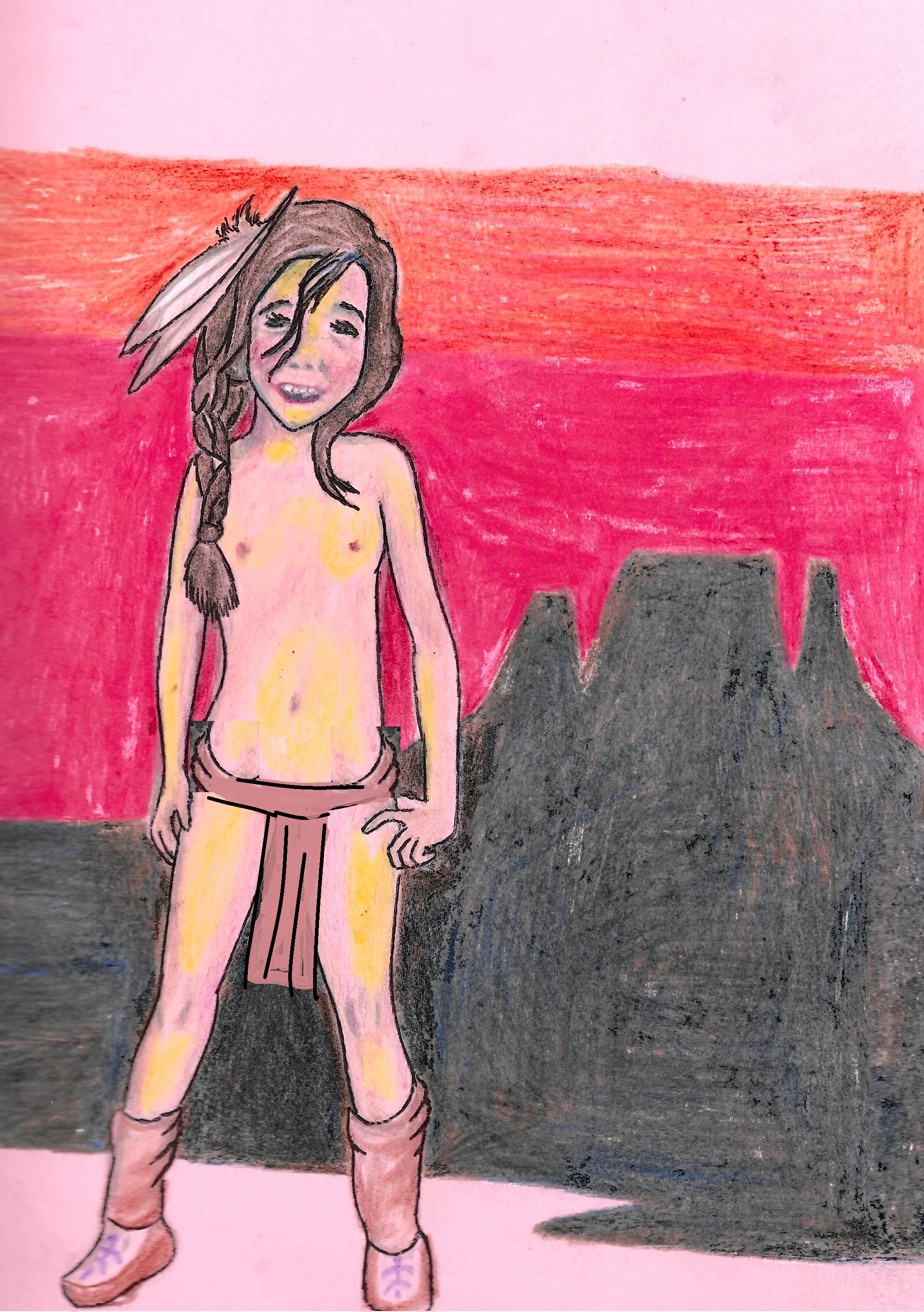
The quirky movie I reviewed, Moonrise Kingdom, reconnected me with a song I loved as a child. It was on an old 45 record that belonged to my mother’s best friend from high school. When the Retleffs sold their farm and tore down their house and barn, they had a huge estate sale. My mother bought the old record player and all the collected records that Aunt Jenny still had. They were the same ones my mother and her friend Edna had listened to over and over. There were two records of singles about Indian love. Running Bear was about an Indian boy who fell in love with little White Dove. They lived on opposite sides of a river. Overcome with love, they both jump into the river, swim to the middle, lock lips, and both drown. Together forever. That song, it turns out, was written by the Big Bopper, and given to Johnny Preston to sing, and released the year after the Big Bopper died in a plane crash along with Buddy Holly and Richie Valens.
Kaw-liga, by Hank Williams, was a wooden Indian sitting in front of a cigar store. His love story is even worse. As you can see from the lyrics above, he never even gets the girl. Dang, Indian love must be heck!
But I have come to realize that these aren’t merely racist songs from a bygone era. They hold within them a plea for something essential. They are a reminder that we need love to be alive.
When I was young and deeply depressed… though also insufferably creative and unable to control the powers of my danged big brain, I knew that I wanted love. There was one girl who went to school with me, lovely Alicia Stewart (I am not brave enough to use her real name), that filled my dreams. We were classmates, and alphabetical seating charts routinely put us near each other. She had a hypnotic sparkle in her eyes whenever she laughed at my jokes. She was so sweet to me… sweet to everyone… that she probably caused my diabetes. I longed to carry her books or hold her hand. I cherished every time she spoke to me, and collected the memories like stamps in a stamp album. But like the stupid cigar store Indian, I never spoke up for myself. I never told her how I felt. I was endlessly like Charlie Brown with the Little Red-Haired Girl. Sometimes you have to screw up your courage and leap into the river, even if it means your undoing. Because love is worth it. Love is necessary. And it comes to everybody in one way or another over time. I look at pictures of her grandchildren posted on Facebook now, and wonder what might have been, if only… if only I had jumped in that stupid river. I did find love. And I probably would’ve drowned had I done it back then. Life has a way of working things out eventually. But there has to be some reason that in the 50’s, when I was born, they just kept singing about Indian love.
It is quite normal to fear the future. Ironically, one of the things necessary to having a good future is to foresee the worst things that could happen, especially the bad things that are likely to happen, and prepare to do whatever is necessary to survive them. Science fiction that pictures a dark and dystopian future have been popular in recent years. And we are wise to believe they are popular for very good reasons. People with guns in Texas fantasize about a coming Civil War in which they can purge the places they call home of the people they believe they hate because all of their troubles are repeatedly blamed upon those people by propaganda engines like FOX News. Of course, those people being blamed are people of color, immigrants like my wife, and intellectuals like… well, me. So, if our current society were to collapse suddenly, I would be obliged to apply those preparations I have made to try to save my own life. Of course, I am not a prepper, so those preparations don’t actually exist at this time. My plan for that sort of apocalypse is to be one of the first to die.
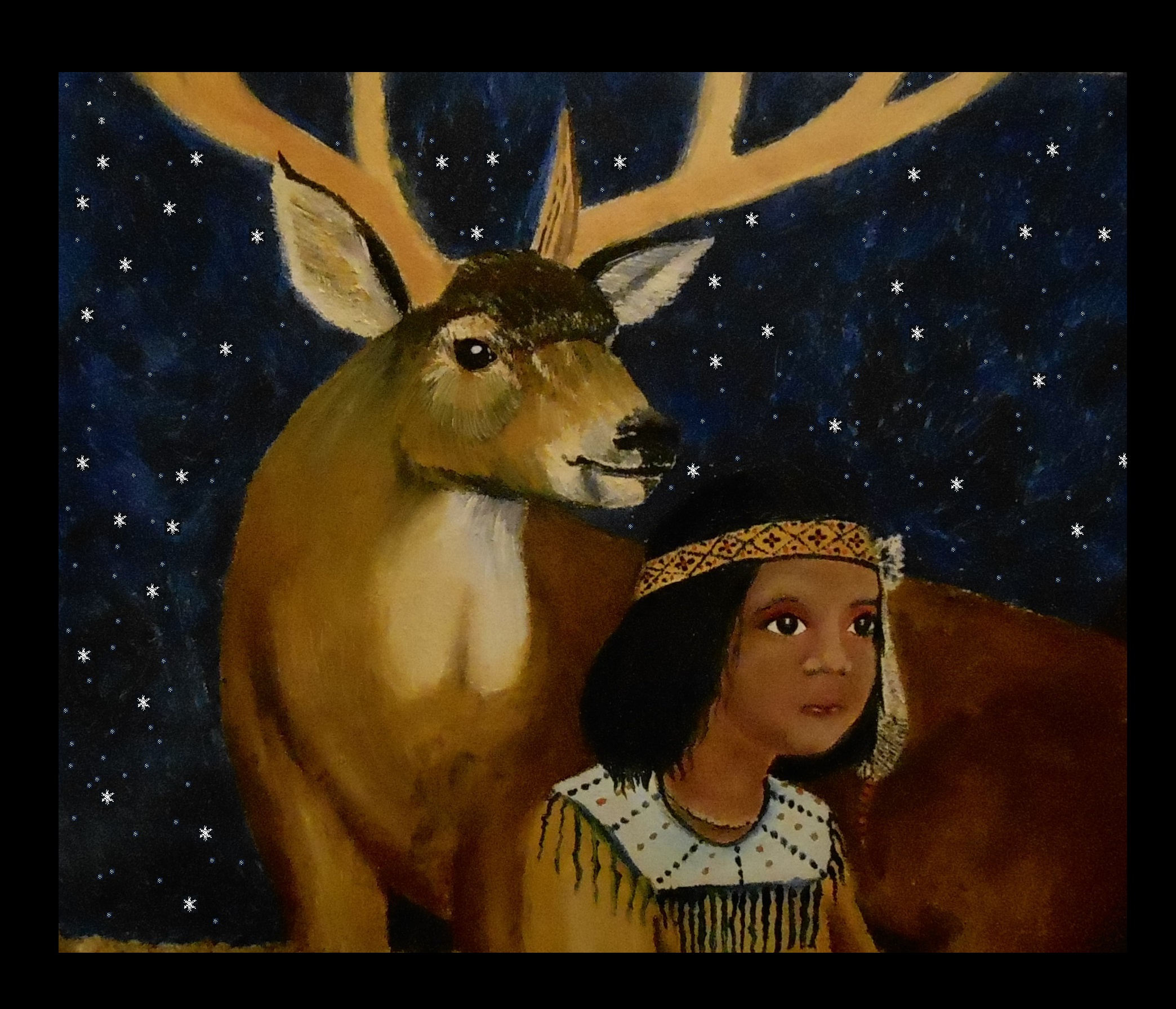
Among the Native American Dakota and Lakota peoples the magic-men, the Shamans, were self-identified by their dreams. If they dreamed of lightning, they were the ones tasked with ceremonial magic, the maintenance of the village’s spirituality. If they dreamed of the white bison, they were to be a great hunter/warrior, bringing home much venison, hides, and buffalo meat. But if they were a Stone Dreamer, that made them the prophet, the diviner of the possible and probable futures.
So, that’s what I think this essay is for. Stone Dreaming about the blackest of obsidian days to come.
Of course, the first thing to think about with black obsidian thoughts is the Covid pandemic. We already know that it has now evolved into an endemic viral problem. We may be obliged to get vaccinated once or twice or three times a year for the rest of our lives.
And the virus has mutated several times already. Thanks mostly to the fact that it is a world-wide epidemic that has visited high-population countries like China and India and Brazil where not nearly enough vaccinations are administered, especially to poor people. And in this country, there is a strong anti-vax sentiment that makes people express their patriotism and sense of freedom by refusing to get vaccinated and catching a lethal dose of Covid as a consequence of their chosen political values. The consequence could very well be that the human population of Earth is decimated by at least 80% when a Covid variant becomes both more deadly and more vaccine-defeating than it is now. That is a rough stone dream to swallow.
Another potential black obsidian stone dream is the looming threat of climate change and global warming. It is man-made despite what corporations choose to believe. And defeating it depends on those same corporations to stop adding more greenhouse gasses to the atmosphere, and then invent a time machine to take that resolve back in time fifty years. The Western United States is on fire now every Summer. And the oceans have begun to rise. Miami and Houston have already had over-large flooding problems from salt water. Coastal cities throughout the world will be completely underwater soon. Underwater domed cities, fish and seaweed farming, and travel by submersible need to already become reality rather than science fiction. This is the thing that we have to fear the most.
And how do we deal with these dreams of stone-cold reality? There are limits to what the ordinary citizen can do. We can try to live more simply. We can work to recycle more and reduce the amount of trash we generate. Picking up plastics, especially plastic bags to keep the oceans freer of micro-plastic shards will help. Wasting less clean fresh water will help. But unless we are directly related to Jeff Bezos or Elon Musk, we can’t do anything major individually. We must band together and care for the environment as stewards of the land more like the Native Americans once were.
We have to stop being corporate slaves, shopping to buy more stuff like we see on TV, and working harder and harder just to earn money to shop with.
And if we decide not to pay attention to these alarming stone dreams, we must be prepared like the Dakota warriors once were, ready to stake ourselves out on the plain and declare with no weapons in our hands, “Today is a good day to die!”













Wizard Wits and Tolerable Tricks
Once in a while, though not often, it pays to be a wizard. It is easy to become a wizard. Socrates tells us that the key to wisdom is knowing that you don’t know anything at all. Most of us can handle that realization with ease. I myself question everything constantly. You know… because I don’t know anything.
Being a parent is a lot like that. Any idiot can make a baby. You don’t have to take any classes or get any kind of license. Heck, you have to have a license to go fishing in Texas and Fishing Police are very real.
But I do remember one time when my oldest was a toddler and I was stuck taking care of him during an after-school teachers’ meeting. It is hard when the principal is talking about things you have to hear and the baby is colicky at the same moment. Fortunately, the Counselor’s daughter and her best friend were still hanging around the school cafeteria where the meeting was held. Wizard that I am, all I had to do was look pathetic and overwhelmed. My son was also cute enough that, once he got their attention, they actually volunteered to take over as temporary parents with the baby safely entertained in a sound-proof classroom nearby. And they didn’t charge me. And I was smart enough not to ask them to pay me for the privilege, because they enjoyed it so much they volunteered to do it again for any future meetings where I was in charge of him. That happened about three more times that year.
And I was able to use my wizardly powers to make my life as a substitute teacher easier the last time I did it during December. Students who had never seen me before took one look and started acting extremely polite, cooperative and helpful.
Of course, like a true wizard I had no idea at all why they were so keen on discussing new kinds of cell-phones with me, or whoever the heck Tommy Hilfiger was and why a gray t-shirt with his name on it was so much more valuable than an ordinary gray t-shirt.
And, like a wizard, I told a joke like this in more than one class;
“I overheard my Russian friend Rudolf arguing with his wife. It was snowing outside.”
Rudolf’s wife said, “It’s snowing outside, dear Rudolf.”
“No, you are wrong. That is rain outside, dearest,So” said Rudolf.
“No, it isn’t. It is actually snow, dear informationally-challenged Rudolph.”
“Yes, it is rain. Rudolf the Red knows rain, dear!”
After they all groaned and sniggered, they all went immediately back to talking to me about Christmas shopping, but only while acting very, very good.
What was all of that about? I wondered. But the wizard in me kept thinking about buying lumps of coal.
So, those are some of my best wizard tricks. Like the wizard in that first illustration. Fistandantalas Crane, the wizard, learned how to switch places with his avatar inside the crystal ball. This was a wizard move because in the crystal-ball world, Crane was immortal. But he didn’t invent a way to switch back with his avatar. And he found life in crystal-ball world very boring.
In light of Mark Zuckerberg’s recent innovations on Facebook, I sincerely hope he doesn’t read this post and get any ideas. I can imagine myself stuck in Facebook world, even more boring than the inside of a crystal ball. And even though my avatar is better looking than I am, I have to worry that everybody calls Mark Zuckerberg a wizard too. And I could be tempted by immortality.
Leave a comment
Filed under commentary, humor, Paffooney, wizards