
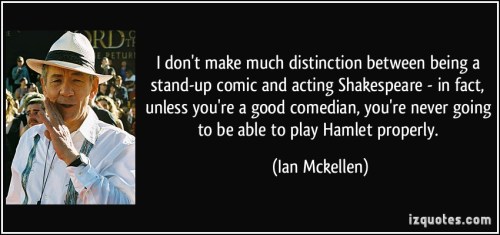
The fact that Shakespeare was a master of the art of creating and mocking fools does not really help decide the question of who Shakespeare really was. A stage actor who owned a theater in Elizabethan times and apparently focused on being the bit player, the butler, the second man on the castle wall in the great plays, would certainly know enough of flim-flam, being a con man, or artfully throwing turds at kings and queens in ways that get rewarded rather than beheaded. But a nobleman who has unpopular and unwelcome-but-probably-wise insights into the back-stabbing-goings-on of the royal court of England would equally be capable of putting the most memorable of critiques of humanity into the mouth of the fool or the clown in the great stage-play of life. Even the most depressing and violent of the Shakespearean tragedies is enhanced and made pointed by the presence of the fool and the comic relief. In some ways everything that Shakespeare wrote was a comedy.
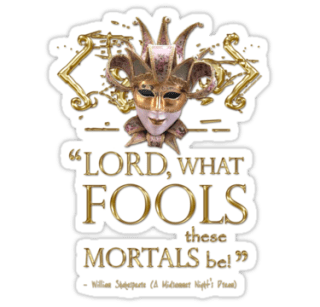
Whoever Shakespeare was, he shared Mark Twain’s overall assessment of “That damned human race” and often declared all men fools in the eyes of the playwright. Puck’s observation on humanity is delivered about not only Bottom and the other poor players who carry on their vain attempts at performing Pyramus and Thisbe while Bottom magically wears the head of an ass, but also the easily fooled lovers who mistake their true loves for one another, and even the clueless mortal King Theseus of Athens.
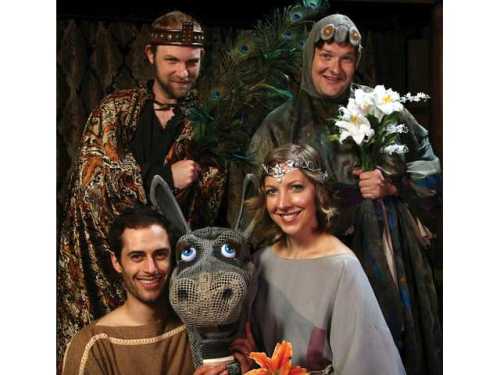
In the play within a play, Nick Bottom wants to be not only his own role, Pyramus the romantic lead, but argues that he should be Thisbe, the lion, and Pyramus all at once, making a satire of human nature and its overreaching ways that we could only pray Donald Trump will one day watch and magically understand. In fact, Shakespeare’s entire body of work is an extended investigation of foolishness versus wisdom, and with Shakespeare, the verdict always goes to the fool.
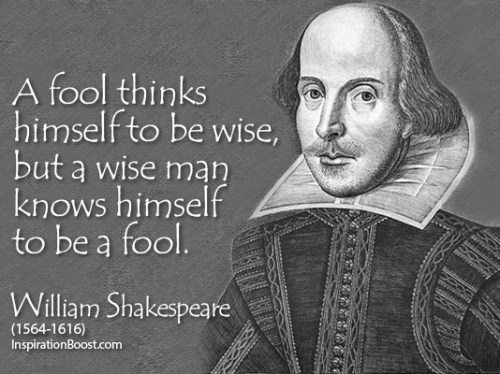
The plays of William Shakespeare are filled with fools doing foolish things… and fools being accidentally wise. (Think Jacques in As You Like It giving his famous “All the world’s a stage” soliloquy in which he elucidates the seven ages of man.) There are fools too who prove to be wise. (Think of the ironic advice given by the jester Touchstone in As You Like It, or the pithy commentary of King Lear’s fool). The fools in Shakespeare’s work are not merely the comedy relief, but the main point that Shakespeare makes about humanity.
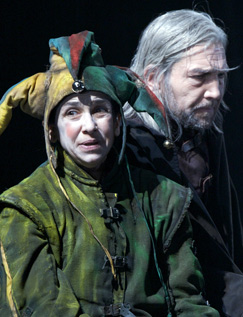
Whoever the man was who wrote the plays of Shakespeare, he was someone who had a deep understanding of the basic irony underlying all of human life. And someone with that vital sense of the bittersweet, a philosophy of life that encompasses the highest heights and lowest depths that a soul can reach, is someone who has suffered as well as known great joy, someone who has experienced loss as often as profit, and has known real love as well as real hatred. It is the fool that Shakespeare shakes us by the neck with to make us recognize the fool in all of us which makes the plays resonate so deeply within us. It is watching the path of the fool unfolding that makes us shake our head and say to ourselves, “Yes, that is what life is really like.”











 Catch a Falling Star
Do Not Crush the Butterfly…
Art on the bedroom wall, with Christmas lights being used as a night light.
Talking to a school administrator the other day about the challenges my children and I have been facing in the last year, I had one of those experiences where you get a look at your own life through someone else’s eyes. “Wow, you have really been on a difficult journey,” he said. I just nodded in response. Financial difficulties, health problems, dealing with depression… life has been tough. But you get through things like that by being centered. Meditation tricks. Things you can do to smooth out the wrinkles and keep moving forward.
I always return in the theater of my mind to a moment in childhood where I learned a critical lesson. My life has been one of learning how to build rather than destroy. It has been about creating, not criticizing.
Electric lights have come to Toonerville, helping to light the darkness.
When I was a boy, I was a serious butterfly hunter. It started when Uncle Don gave me a dead cecropia moth that he had found in the Rowan grain elevator. It was big and beautiful and perfectly preserved. Shortly thereafter, I located another cecropia in the garage behind the house, a building that had once been a wagon shed complete with horse stalls and a hay loft. I tried to catch it with my bare hands. And by the time I had hold of it, the powder on its wings was mostly gone. The wings were broken in a couple of places, and the poor bug was ruined in terms of starting a butterfly collection.
A cecropia moth
Undeterred by tragedy, I got books about butterfly collecting at the Rowan Public Library and began teaching myself how to bug hunt. I learned where to find them, and how to net them, and how to kill and mount them.
I discovered that my grandfather’s horse pasture had thistle patches which were natural feeding grounds for red admiral butterflies (pictured top left) and painted lady butterflies (top right). But if you wanted to catch the rarer mourning cloak butterfly (bottom picture), you had to stake out apple trees, particularly at apple blossom time, though I caught one on the ripening apples too.
The tiger swallowtail was the butterfly that completed my collection, and it was finished when one of my cousins caught one and gave it to me because she knew I collected them.
But then, one day, while I was sitting on a blanket under a maple tree in the back yard with my notebooks open, writing something that I no longer even recall what I wrote, the backyard tiger swallowtail visited me again. In fact, he landed on the back of my hand. I dropped the pencil I was writing with, and slowly, carefully, I turned my hand over underneath him so that he was sitting on my palm.
I could’ve easily closed my hand upon him and captured him. But I learned the lesson long before from the cecropia that catching a butterfly by hand would destroy its delicate beauty. I would knock all the yellow and black powder off his exquisite wings. I could not catch him. But I could close my hand and crush him. I would be victorious after a summer-long losing battle.
But that moment brought an end to my butterfly hunting. I let him flutter away with the August breeze. I did not crush the butterfly. It was then that I realized what beauty there was in the world, and how fragile that beauty could be. I could not keep it alive forever. But it lasted a little big longer because I chose to let it.
So, here is the lesson that keeps me whole. Even though I had the power, I did not crush the butterfly.
Leave a comment
Filed under commentary, compassion, feeling sorry for myself, healing, humor, insight, inspiration, wisdom
Tagged as bug hunting, butterflies, wisdom