I do write poetry. But I must admit, I am not a serious poet. I am a humorist at heart, so I tend to write only goofy non-serious poems like this one;
So here is a poem that rhymes but has too much “but-but-but” in it. A poem about pants should not have too many “buts” in it. One butt per pair, please. So this is an example of spectacularly bad poetry. Why do we need bad poetry? Because it’s funny. And it serves as a contrast to the best that poetry has to offer.
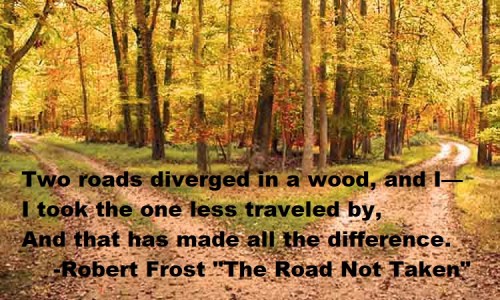
As a teacher I remember requiring students to memorize and recite Robert Frost’s poem, “The Road Not Taken”. Now this sort of assignment is a rich source of humorous stories for another day. Kids struggle to memorize things. Kids hate to get up in front of the class and speak with everybody looking at them. You get a sort of ant-under-a- magnifying-glass-in-the-sun sort of effect. But in order to truly get the assignment right and get the A+, you have to make that poem your own. You have to live it, understand it, and when you reach that fork in the road in your own personal yellow wood, you have to understand what Frost was saying in that moment. That is the life experience poetry has a responsibility to give you.
Hopefully I gave that experience to at least a few of my students.
Bad poetry makes you more willing to twirl your fingers of understanding in the fine strands of good poetry’s hair. (Please excuse that horrible metaphor. I do write bad poetry, after all.)
But all poetry is the same thing. Poetry is “the shortest, clearest, best way to see and touch the honest bones of the universe through the use of words.” And I know that definition is really bad. But it wasn’t written on this planet. (Danged old Space Goons!) Still, knowing that poetry comes from such a fundamental place in your heart, you realize that even bad poetry has value. So, I will continue writing seriously bad poetry in the funniest way possible. And all of you real poets who happen to read this, take heart, I am making your poetry look better by comparison.
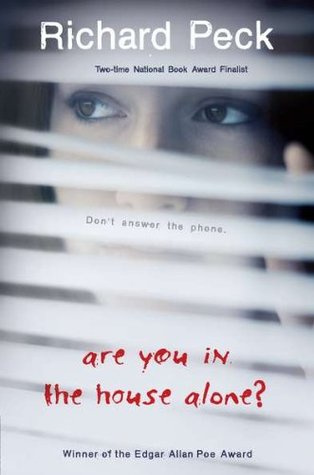
Yes, I read this book. Yes, it scared the poop out of me. Yes, it made me cry. This is a uniquely horrific horror story that is so realistic that you know that it has actually happened in real life somewhere, sometime. Only the names of the characters would be different.
I have a deep abiding respect for Richard Peck as a writer. He earned that with his books A Year Down Yonder and A Long Way from Chicago. Those books made me laugh so hard it blew chocolate milk out of my nose. And, yes, I was drinking chocolate milk at the time. They are so realistic because the people in those stories are real people. I know those people personally. Of course, they have different names in real life.
But Are You In the House Alone? is a very different book from those other two masterpieces. It tears your heart out and eats your liver because it is a first person narrative in the voice of a high school girl being stalked by a sexual predator. Everything that happens to Gail in the high school, at home, and at the house where she babysits is hyper-real with horror movie levels of attention to detail. I don’t wish to be a spoiler for this well-written book, but the narrator does not die in the book and it definitely does not have a happy ending. For anyone who has the amount of empathy I do, and in many ways becomes the narrator-character by reading, reading a book like this can physically hurt. A teacher like me has lived through horrible things like this happening to students before, it even happened to me as a boy, and it adds the slings and arrows of those things being re-lived as you read.
This is not the only book that has ever done this sort of damage to my heart strings. I remember the pain from the conclusion of Dickens’ The Old Curiosity Shop. You root for Little Nell and boo Daniel Quilp. But the bad guy wins. No happy ending can linger in the harp-strings of your memory-feeling song as long as a tragic outcome does. I was there with Scout in that ridiculous costume in the dark when Bob Ewell was attacking her brother Jem in Harper Lee’s To Kill a Mockingbird. That story was filled with wise and laughable things, but the stark horror of that climactic moment nearly wiped all the good feelings away, if not for the heroics of ghostly Boo Radley whose timely intervention brings it all back before the novel ends. It horrifies me to admit it, but I was there, too, in the moment when the boys all turn on Simon on the beach with their sharpened sticks in William Golding’s Lord of the Flies. They mistook him for the monster. I still haven’t fully recovered from that reading trauma.
The thing about books that hurt to read which makes it essential that I never try to avoid them, is that they can add more depth and resonance to your soul than any light and fluffy piece ever could. Life is much more like Lord of the Flies than it is Chitty Chitty Bang Bang. I am sadder but wiser for having read Are You In the House Alone? I am recommending it to other readers like me who don’t so much live to read as they read in order to live. Not because it is easy and good to read, but because it is hard and essential to read. It will hurt you. But it will leave you like it leaves its narrator, damaged, but both alive and purely resolved to carry on.
I was a school teacher for thirty-one years, and in spite of the immense amount of brain damage that builds up over time, especially as a middle-school teacher, I think I know what we’ve been doing wrong.
We need to take a look at an education system where things are working better than they are here.
Now, I know you probably didn’t click on the boring video about school. Heck, you probably aren’t even reading this sentence. But I can summarize it and put it in easy-to-understand words. Finland does not have to educate as many poor and disadvantaged kids as this country does. The video gives five ways that Finland does it better, but all of them boil down to the basic notion that the country is more homogeneous and uniformly middle-class than ours is. Still, we can learn things from them.
The first of the five ways that Finland does it better is a difference in government. While U.S. governmental safety-net programs blame people who need food stamps for being lazy (even though some of them work 40-hour work weeks in minimum-wage jobs), Finland gives a huge package to parents of everything they might need as soon as their child is born. As long as the child is in school, the government does many things to support the family’s efforts to educate them. Imagine what we could accomplish here if we invested some of the vast fortune we give to corporations in subsidies into educating poor black and Hispanic children instead. Children have a hard time learning in school when they come to school hungry. If we could only feed them better, the way the Fins do, we would revolutionize our classrooms.
The second point the video makes is the biggest suds-maker every time I get on my teacher’s soap box. They don’t give kids homework and they only give them one standardized test when they leave high school. I have recently covered this topic more thoroughly in a post in which I was able to ridicule Florida governor Rick “Skeletor” Scott. (Boy, did I enjoy doing that.) But I won’t go into all of that again here.
The third thing is respecting teachers. In Finland they treat teachers with the kind of respect that they give to doctors and lawyers. How cool is that? In Texas, calling someone a teacher is an epithet. If a teacher is liked or even loved by their students, administrators are encouraged to keep a closer eye on them to figure out what’s wrong. Students are supposed to hate their teachers and sit all day filling out mind-numbing test-preparation worksheets. Imagine what it could be like if teachers weren’t the scum of the earth. They might actually have students convinced that learning goes on in their classrooms.
The fourth point is that Finland does not try to cram more and more memorized details into young brains so they can spit it all back out on a test. They take students thoroughly into the subject of study, and at a slower, easier pace. They dive deep into the river of learning instead of wade through the wide and shallow parts. All questions get answered. And by that, I mean, student questions, not teacher questions. The learning is student-centered.
Finally, the video states that Finland simply has fewer social ills in their country to get in the way of good quality education. But even though the work is harder in this country, the potential is really there to go far beyond what Finland is capable of. We have a natural resource that is totally untapped in this nation. We don’t develop the minds of a majority of our children in any meaningful way. And I can tell you from having done it, you can teach a poor or disadvantaged child to think. You can give them the tools for academic, economic, and personal success. You can make them into valuable human beings. But you should never forget, they are already precious beyond measure. We just ignore and trash that inherent value. So, the information is out there about how to do a better job of educating our children. We need to follow through.
The criminal was led into the courtroom in chains and forced to sit in a box made of metal bars so his influence would not reach out and harm anyone by drawing their sympathy in.
“Mr. Prosecutor,” said the learned judge, “what terrible crime has the perpetrator been charged with?”
“The alleged perpetrator!” objected the defense attorney, a mousy old man who looked like a cross between Santa Clause and Robert E.Lee because of his white beard, stern face, and a twinkle in his eye.
“Shut up please, Mr. Badweather. You will have your turn to speak.” The judge banged his gavel smartly to emphasize the shut-up-ness of his overruling.
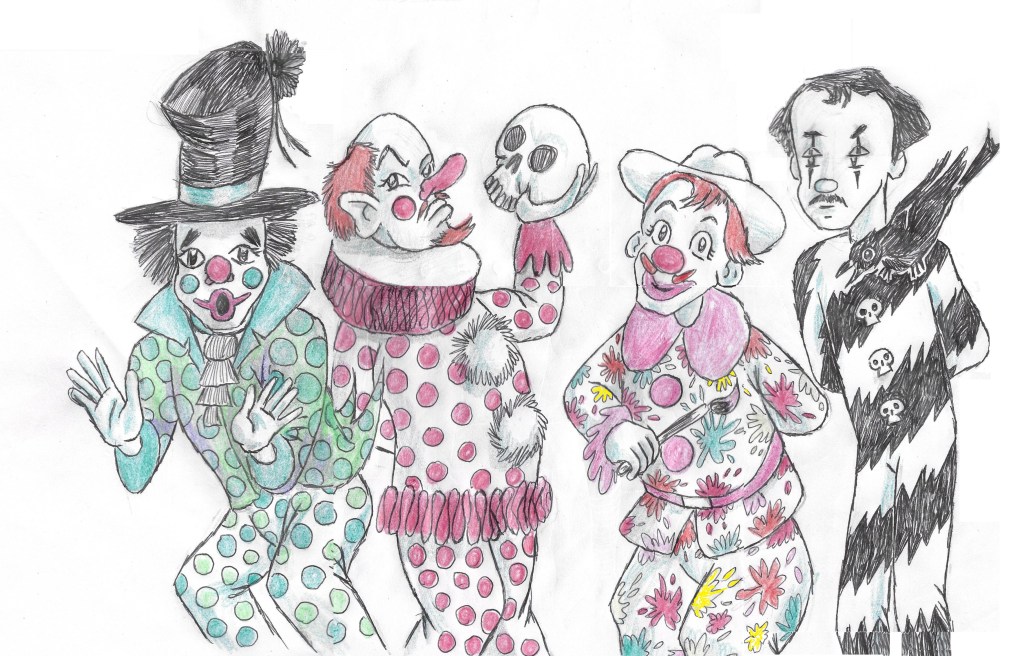
“Your honor,” said the prosecutor, “Mister Pennysnatcher Goodlaughs stands accused of being a clown.”
“The people of the State of Texas, home of the free, land of the brave, and place where cowboys can hang their hat on the antlers of a moose they shot in Canada, will prove that Mr. Goodlaughs did willfully, and with malice of forethought, commit acts of supposed humor in order to make people laugh. And we will further prove that in a time of very serious things, he intentionally made light of very serious matters and the very serious men who try to turn those serious things to their exclusive… err, sorry, I mean… everyone’s benefit.”
“Your honor,” said the defense attorney, looking like a cross between Mark Twain and Colonel Sanders, “I would like to request a new venue for this trial. My client will not get a fair trial here.”
“Sir, your stupid request is rejected on the grounds that Mr. Goodlaughs cannot get a fair trial anywhere. We are all conservatives, and are therefore incapable of having a sense of humor. Continue, Mr. Prosecutor.”
“We will show numerous instances of Mr. Goodlaughs putting paint on his face to hide his true features or assume the identity of a character not his own. He has repeatedly used false noses, large shoes, and floppy hats to exaggerate his flaws and scare young children. He repeatedly wears polka-dotted clothing to simulate terrible taste and ridiculous lack of fashion-sense. He employs pratfalls and slapstick humor in his performances, things that, if any school-age child would imitate the behavior, might lead to serious injury or even death. And he has even dared to make fun of our glorious leaders, implying that they make mistakes and may even have hurt people. That they act without thinking about anything but their own pocketbooks. In other words, this clown has knowingly made jokes in order to get people to not take things seriously.”
“Your honor, I object to this jury. I object to the fact that it is made up of fifty percent rednecks and fifty percent kangaroos! My client demands a new, more impartial jury!” cried the defense attorney, looking like a cross between Captain Kangaroo and Ronald Reagan.
“Has anybody noticed?” asked the judge, “that this attorney looks like he could influence this jury unfairly? He looks like two people who could lead the two halves of this jury to the wrong conclusion. Bailiff! Take the defense attorney out back and execute him by firing squad.”
After the entire courtroom heard the gunshots go off, the judge then turned to the prisoner.
“It seems, Mr. Goodlaughs, that the defense’s opening statement is now entirely up to you. Do you have anything to say in your own defense?
“I do, your honor. Ladies and gentlemen, kangaroos and Reagan Republicans of the jury, I submit to you that I have never actually been a circus clown, or wore face paint. Not that I wouldn’t if the opportunity presented itself. I merely claim the right to laugh at anything I think is funny… or can be made funny. Whether I am being what you call a clown, a humorist, a cartoonist, a comedian, a fool, a village idiot, or a witty fellow, I believe I have the right to make light of anything. Life is always better when you can laugh. Especially if you can laugh at yourself.”
“I’ve heard enough,” said the judge. “What say you, jury?”
“Guilty!”
“Yes. And I preemptively waive the prisoner’s right to appeal. Sir, you are guilty, and you shall be executed immediately.”
Everyone in the courtroom breathed a long-awaited sigh of relief.
While visiting in Iowa, I ran into an old high school friend at a local eatery. I remember how in high school and junior high, I played basketball on the same team with him, I listened to his exaggerations about a probably non-existent sex life, and helped him on one or two occasions to get answers on Math homework (even then the teacher in me wouldn’t let me just give him the answers, I always made him work out the answers step by step).
Now he is a judgmental and basically crabby old coot. He is a Trump supporter, hater of immigrants who take American jobs, and an unpleasant arguer of politics. And the sorest point about his intractable coot-i-ness is the fact that, as a classmate, he is the same age as me and I am, therefore, just as intractably coot-y as he is.
So, how exactly do you talk to a mean old coot?
Well, you have to begin by realizing that it is not like the dialogue in a novel or TV show. This is a real person I was talking to. So, I had to proceed by accepting that he thinks I am an idiot and anything I say and think is wrong. Not merely wrong, but “That’s un-American and will lead to a communist takeover of our beloved country!” sort of wrong. I can then laugh off numerous Neo-Nazi assertions by him, make snarky comments about his praises for the criminal president, and generally get along with him like old friends almost always do. I play my part just as furiously as he plays his, and we both enjoy the heck out of it.
We are both of us crazy old coots, likely to say just about anything to get the other one’s goat. Getting goats is apparently vital to the conversations of real people. But we have more in common than we have as differences. We don’t keep score in our world-shaking debates, nor do we count how many goats we get. And that is how you talk to real people.
When you know someone has an imaginary friend, something like Elwood’s six-foot invisible rabbit called Harvey, don’t you immediately think that person is crazy? I do. But I have imaginary people as friends. I think most writers do. So am I crazy? Probably. But hopefully it is a good kind of crazy.
It began with imaginary friends from books. The Cat in the Hat was my friend. Jim Hawkins was my friend, as was Mowgli and all the members of the Swiss Family Robinson. They entered my dreams and my daydreams. I told them my troubles the same way I listened to theirs through their stories.
I began to have imaginary friends that came from my own imagination too.
I used to tell my mere human friends about my friend Davalon from outer space. I told them that he was real and secretly visited me at night to talk about being able to learn about humans on earth by walking around invisibly and watching them. I got so involved with these stories that my sixth grade class began saying, “Michael is from Mars.”
When I was a teenager, I began having conversations with a faun. His name was Radasha. He was a creature from Greek Myth, a sensual Dionysian creature who, in his child body, was both younger than me and way older than me. I didn’t realize until much later in life that he was the result of my repressed memories of a childhood sexual assault that I was the victim of. I could talk to him about my fear of nakedness. I could tell him about my blossoming interests in naked girls and their bodies. I could talk to him about all the things I was somehow too terrified to talk to my male friends about, even though none of them had the same reluctance to discuss sex. Ra was imaginary. But he helped me heal.
Then the story-telling seriously began. I used Davalon as one of the main characters in my novel Catch a Falling Star. I created Torrie Brownfield, the baby werewolf to express the feelings I had as a boy about being a monster and secretly terrible and deformed. Torrie is a normal boy with a condition called hypertrichosis. I am working on The Baby Werewolfnow. And then there’s lovely Valerie Clarke. She is the main character of Snow Babies which is a finished novel, edited and proofread and ready to publish. It is I book I will have to find another way to publish since the recent death of PDMI Publishing. She is not a me-character, based on my own thoughts and feelings. She is based on former classmates and students who told me things that express the sadness and isolation of growing up female. So she is even more imaginary than my other characters.
They become real people to me. They have their own point of view. They talk to me and I learn things from them. But they are imaginary. So am I crazy? Yes… as a loon. And happy as Elwood P. Dowd to be that way.
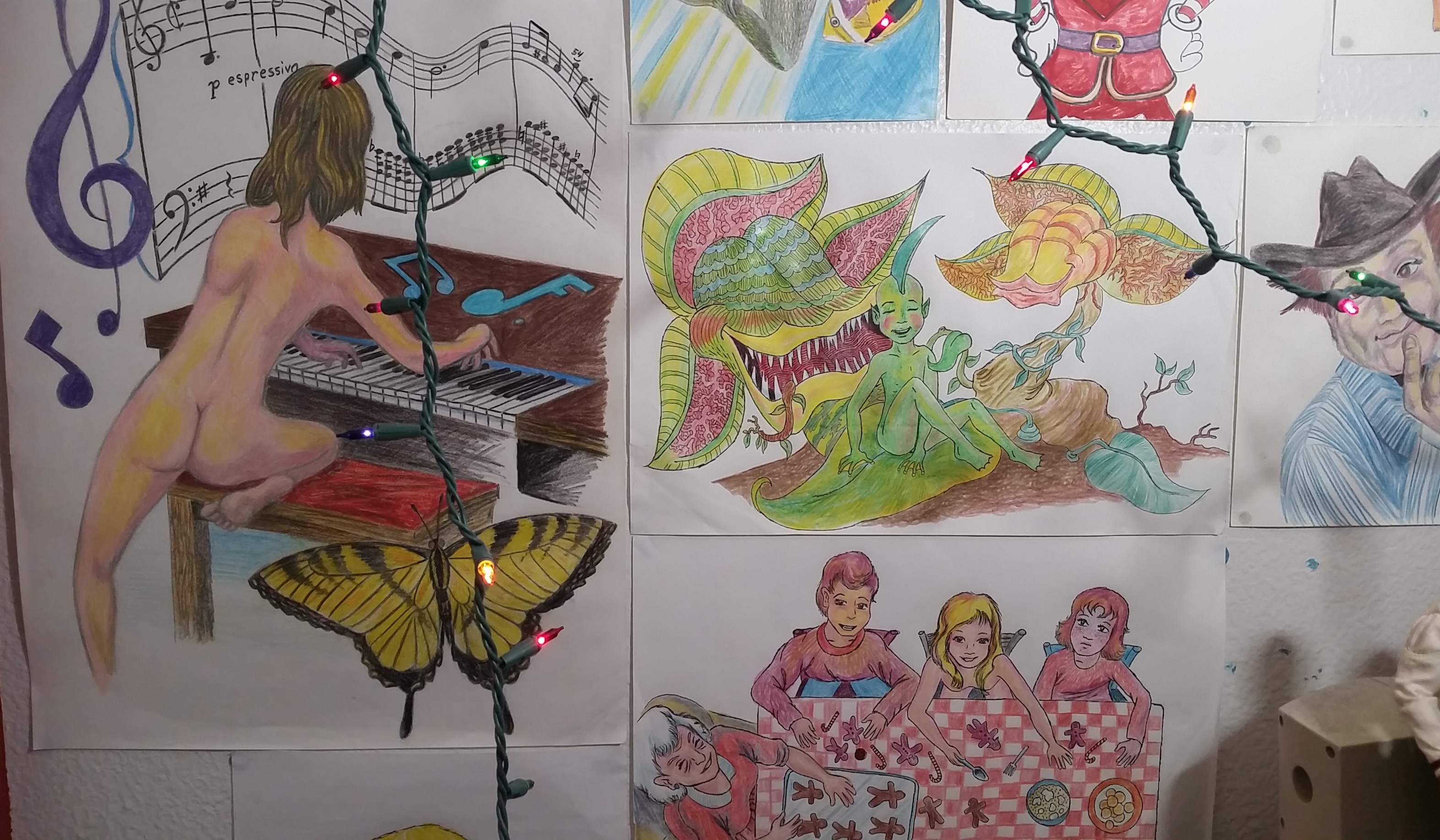
Art on the bedroom wall, with Christmas lights being used as a night light.
Talking to a school administrator the other day about the challenges my children and I have been facing in the last year, I had one of those experiences where you get a look at your own life through someone else’s eyes. “Wow, you have really been on a difficult journey,” he said. I just nodded in response. Financial difficulties, health problems, dealing with depression… life has been tough. But you get through things like that by being centered. Meditation tricks. Things you can do to smooth out the wrinkles and keep moving forward.
I always return in the theater of my mind to a moment in childhood where I learned a critical lesson. My life has been one of learning how to build rather than destroy. It has been about creating, not criticizing.
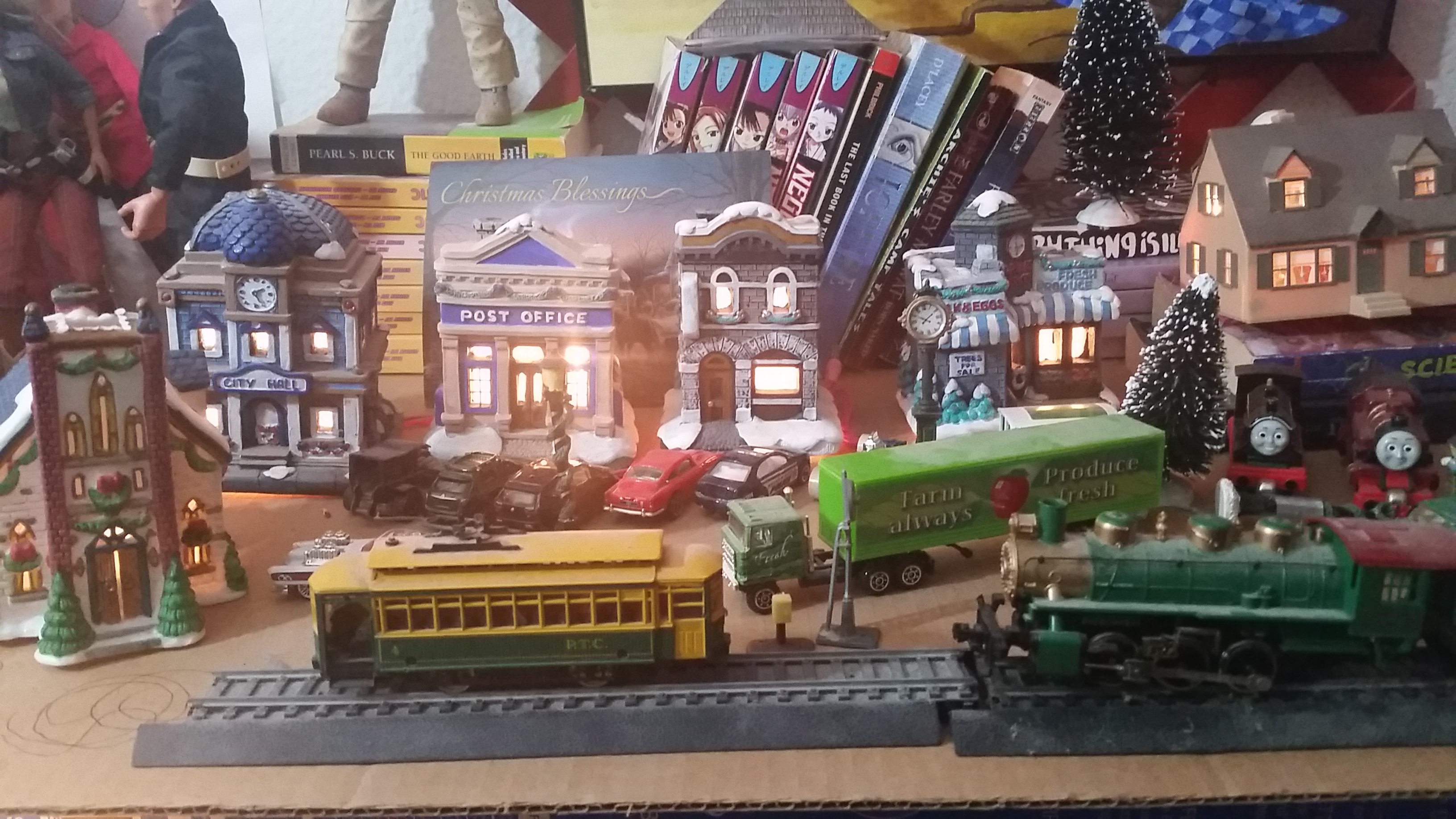
Electric lights have come to Toonerville, helping to light the darkness.
When I was a boy, I was a serious butterfly hunter. It started when Uncle Don gave me a dead cecropia moth that he had found in the Rowan grain elevator. It was big and beautiful and perfectly preserved. Shortly thereafter, I located another cecropia in the garage behind the house, a building that had once been a wagon shed complete with horse stalls and a hay loft. I tried to catch it with my bare hands. And by the time I had hold of it, the powder on its wings was mostly gone. The wings were broken in a couple of places, and the poor bug was ruined in terms of starting a butterfly collection.
A cecropia moth
Undeterred by tragedy, I got books about butterfly collecting at the Rowan Public Library and began teaching myself how to bug hunt. I learned where to find them, and how to net them, and how to kill and mount them.
OLYMPUS DIGITAL CAMERA
I discovered that my grandfather’s horse pasture had thistle patches which were natural feeding grounds for red admiral butterflies (pictured top left) and painted lady butterflies (top right). But if you wanted to catch the rarer mourning cloak butterfly (bottom picture), you had to stake out apple trees, particularly at apple blossom time, though I caught one on the ripening apples too.
But my greatest challenge as a butterfly hunter was the tiger swallowtail butterfly. They are rare. They are tricky. And one summer I dueled with one, trying with all my might to catch him. He was in my own back yard the first time I saw him. I ran to get the butterfly net, and by the time I got back, he was flitting high in the trees out of reach. I must’ve watched him for half an hour before I finally lost sight of him. About five other times I had encounters with him in the yard or in the neighborhood. I learned the hard way that some butterflies are acrobatic flyers and can actually maneuver to avoid being caught. He frustrated me.
The tiger swallowtail was the butterfly that completed my collection, and it was finished when one of my cousins caught one and gave it to me because she knew I collected them.
But then, one day, while I was sitting on a blanket under a maple tree in the back yard with my notebooks open, writing something that I no longer even recall what I wrote, the backyard tiger swallowtail visited me again. In fact, he landed on the back of my hand. I dropped the pencil I was writing with, and slowly, carefully, I turned my hand over underneath him so that he was sitting on my palm.
I could’ve easily closed my hand upon him and captured him. But I learned the lesson long before from the cecropia that catching a butterfly by hand would destroy its delicate beauty. I would knock all the yellow and black powder off his exquisite wings. I could not catch him. But I could close my hand and crush him. I would be victorious after a summer-long losing battle.
But that moment brought an end to my butterfly hunting. I let him flutter away with the August breeze. I did not crush the butterfly. It was then that I realized what beauty there was in the world, and how fragile that beauty could be. I could not keep it alive forever. But it lasted a little big longer because I chose to let it.
So, here is the lesson that keeps me whole. Even though I had the power, I did not crush the butterfly.
Journey back with me to the 1980’s, and hear once again the music of escape.
There was a time when I was young when I did not know where I would be when the next new dawn came. Yes, I once took the midnight train (except it was a bus) and I arrived in a teaching career in deep South Texas. I crossed borders into another culture, another way of life, another journey made of words and pictures that hasn’t reached the final station yet.
At the outset, we all take a risk. Born and raised in South Detroit (although it was really North Central Iowa) I passed through established procedures, rules, and regulations to do things that desperately needed doing for people who could only help themselves in very limited ways.
Some spoke mostly Spanish. Some lived in broken homes. One boy lived for a while under the bridge of the Nueces River, but attended school every day because he was hungry to learn, and because free school lunch was the majority of the food he got to eat. He got on a midnight train, and I never saw him or heard from him again. His sister, though, lived with a tia who treated her like a daughter, and grew up to be a school teacher. I let her teach the lesson for me during one class period, as part of an educational experiment, and it put her on her own midnight train.
It was a train going on the same track I followed. Not because of me and what I did for her. But because she came to realize it was the right journey to take for her. It was the perfect anywhere for her.
But there is danger inherent in getting on a midnight train going anywhere. You don’t know who is waiting for you down the line, or what your circumstances will be at the next station along the way. There may be strangers waiting up and down the boulevard, their shadows searching in the night. I befriended other teachers, mentored some, learned from many, even married one. I had a run in or two with people who sell drugs to kids. I had all four of my car tires slashed one night. I had a car window broken out. I had a boy once tell me he would kill me with a knife. I later had that boy tell me he had a good job and a girlfriend and he was grateful that I talked him out of it and never turned him in to the police.
And we end up paying anything to roll the dice just one more time… At one time or another we have all been there, aboard that midnight train to anywhere. There is a moment in everyone’s life when… well, some will win, and some will lose. Some were born to sing the blues. I have been there. I have done that. And it occurs to me, that song plays on in my head still. I am still on that journey. And I won’t stop believing. Because it goes on and on and on and on…
The T. S. Eliot poem “The Hollow Men” talks about the disappointing nature of human beings and ends with a dire four lines quoted more often than any poem’s end in the history of poetry.
This is the way the world ends
Not with a bang but a whimper.
Now I have revealed this particular truth more than once. I am not prescient. I am an idiot. And the only things I know for certain about the future are that I will die one day, and so will everyone else. But knowing those things is wisdom. Especially the idiot part.
And I can see how things are progressing. I know what people are like at their core. If humanity is doomed to die out in the next century, or even the next decade, it will not be because of nuclear war. It will be something sneakier, quieter, and more permanently lethal.
It will be the fact that people are capable of heartlessness and cruelty. Adolf Hitler turned the full power of government-focused hatred on those he defined as less than human; Jews, gypsies, gay people, Jehovah’s Witnesses, and the mentally handicapped. He used that focus to burn those peoples out of existence. But many forces in the human character rose up to shield the victims, saving some and avenging the others. Hitler learned the hard way that he was not the end of the world… from a bullet, in a bunker, having lost an empire.
Now, the Republican clown show in the United States is turning into Killer Klowns from Outer Space.
They show lack of concern for anything but corporate profits. They will undo Medicare and cancel the Meals on Wheels program because, according to evil leprechauns in charge of the budget, we can’t afford to feed people, or educate people, or do anything to dry up the painful ocean of poverty capitalism is creating. No, we must bury our pots of gold and any magic they have left in them.
They have changed the laws on environmental protections to allow themselves to profit by pouring pollutants into rivers and water supplies. They pull out of world-wide agreements to work towards saving the environment from climate change.
They may have found a way to focus hatred through the lens of indifference. Hitler’s mistake was in thinking most humans could be manipulated only through fear and hatred for those who were different. Trump’s troll army has added stupidity and greed to the lenses the light can be filtered through. And so, they may well succeed where Nazis failed.
This is the way the world ends
Not with a bang but a whimper.
As If It Weren’t Enough…
THE WISDOM OF THE LITTLE FOOL
A fool can’t really sum up all of life in a sentence.
But a fool tries.
A fool can’t really say something in immortal words.
Because a fool dies.
A fool can’t really do the job of the wise.
But never-the-less, the fool applies.
But a fool can write a really dumb poem,
And let it sit to draw some flies.
Leave a comment
Filed under commentary, foolishness, goofy thoughts, humor, insight, inspiration, photo paffoonies, poem, poetry, strange and wonderful ideas about life