The criminal was led into the courtroom in chains and forced to sit in a box made of metal bars so his influence would not reach out and harm anyone by drawing their sympathy in.
“Mr. Prosecutor,” said the learned judge, “what terrible crime has the perpetrator been charged with?”
“The alleged perpetrator!” objected the defense attorney, a mousy old man who looked like a cross between Santa Clause and Robert E.Lee because of his white beard, stern face, and a twinkle in his eye.
“Shut up please, Mr. Badweather. You will have your turn to speak.” The judge banged his gavel smartly to emphasize the shut-up-ness of his overruling.
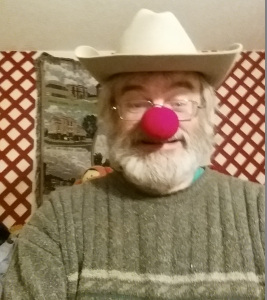
“Your honor,” said the prosecutor, “Mister Pennysnatcher Goodlaughs stands accused of being a clown.”
“The people of the State of Texas, home of the free, land of the brave, and place where cowboys can hang their hat on the antlers of a moose they shot in Canada, will prove that Mr. Goodlaughs did willfully, and with malice of forethought, commit acts of supposed humor in order to make people laugh. And we will further prove that in a time of very serious things, he intentionally made light of very serious matters and the very serious men who try to turn those serious things to their exclusive… err, sorry, I mean… everyone’s benefit.”
“Your honor,” said the defense attorney, looking like a cross between Mark Twain and Colonel Sanders, “I would like to request a new venue for this trial. My client will not get a fair trial here.”
“Sir, your stupid request is rejected on the grounds that Mr. Goodlaughs cannot get a fair trial anywhere. We are all conservatives, and are therefore incapable of having a sense of humor. Continue, Mr. Prosecutor.”
“We will show numerous instances of Mr. Goodlaughs putting paint on his face to hide his true features or assume the identity of a character not his own. He has repeatedly used false noses, large shoes, and floppy hats to exaggerate his flaws and scare young children. He repeatedly wears polka-dotted clothing to simulate terrible taste and ridiculous lack of fashion-sense. He employs pratfalls and slapstick humor in his performances, things that, if any school-age child would imitate the behavior, might lead to serious injury or even death. And he has even dared to make fun of our glorious leaders, implying that they make mistakes and may even have hurt people. That they act without thinking about anything but their own pocketbooks. In other words, this clown has knowingly made jokes in order to get people to not take things seriously.”
“Your honor, I object to this jury. I object to the fact that it is made up of fifty percent rednecks and fifty percent kangaroos! My client demands a new, more impartial jury!” cried the defense attorney, looking like a cross between Captain Kangaroo and Ronald Reagan.
“Has anybody noticed?” asked the judge, “that this attorney looks like he could influence this jury unfairly? He looks like two people who could lead the two halves of this jury to the wrong conclusion. Bailiff! Take the defense attorney out back and execute him by firing squad.”
After the entire courtroom heard the gunshots go off, the judge then turned to the prisoner.
“It seems, Mr. Goodlaughs, that the defense’s opening statement is now entirely up to you. Do you have anything to say in your own defense?
“I do, your honor. Ladies and gentlemen, kangaroos and Reagan Republicans of the jury, I submit to you that I have never actually been a circus clown, or wore face paint. Not that I wouldn’t if the opportunity presented itself. I merely claim the right to laugh at anything I think is funny… or can be made funny. Whether I am being what you call a clown, a humorist, a cartoonist, a comedian, a fool, a village idiot, or a witty fellow, I believe I have the right to make light of anything. Life is always better when you can laugh. Especially if you can laugh at yourself.”
“I’ve heard enough,” said the judge. “What say you, jury?”
“Guilty!”
“Yes. And I preemptively waive the prisoner’s right to appeal. Sir, you are guilty, and you shall be executed immediately.”
Everyone in the courtroom breathed a long-awaited sigh of relief.
Yesterday my 89-year-old father went into the hospital. He suffers from Parkinson’s Disease and a heart no longer strong enough to keep his blood pressure up. Apparently yesterday he lost the ability, possibly only temporarily, to recognize my mother.
This is not a good time to lose my father. There is never a good time, but now my health is failing. I had to make deals with relatives to get someone to drive me up to Iowa for the annual visit to the family farm during the pandemic which is now spiraling out of control in Texas. My wife and I are both diabetics and at risk. If we accidentally take COVID 19 up to Iowa, I could wipe out all four of us. And I developed a cough and chest pain overnight. At least now I can make a case for getting a COVID test.
I know a post like this goes against the rules for a good blog post. It is entirely too personal and self-focused. But it is necessary sometimes to confess your fears before you confront them. I have had my father and mother in my life for the entirety of my 64 years. They have both lived good, long, and fruitful lives. And a time for passing comes to us all. I have been far luckier in holding back the night than the vast majority of people. But the only immortality we can ever hope to have is through passing on the small part of the universal story that belongs only to each of us individually. “I am a child of the universe. No less than the trees and the stars, I have a right to be here. And whether or not it is clear to me (And at this moment… it is not) the universe is unfolding… as it should” – a paraphrase from Desiderata.
To be a wizard is to be wise. Look at the word origin if you don’t believe me.
wizard (n.) early 15c., “philosopher, sage,” from Middle English wys “wise” (see wise (adj.)) + -ard . Compare Lithuanian žynystė “magic,” žynys “sorcerer,” žynė “witch,” all from žinoti “to know.” (Wisely plagiarized from http://www.etymonline.com/word/wizard)
Mickey, the old fool that he is, thinks of himself as a wizard
Mickey is a wizard. He writes down foolish things like that because he knows that the beginning of wisdom is to recognize that you are no more than a fool. You can laugh, but it’s true. Some wise guy that I am paraphrasing here said so. So, that makes it true
Don’t believe me? Want to debate me?
Have you taken the step yet of recognizing your own foolishness?
How can you be wise if you never take the first step down the path to wisdom?
And what defines a wizard, is that a wizard writes. He must write his wisdom down. Otherwise there are no fruits of his wisdom. I tend to write mostly strawberry wisdom. That kind of fruit is tart and sweet in season, but sours easily and spoils in hot weather and dry kitchens. Blueberry fruits are probably better. They become tarter and sweeter with dryness, kinda like good humor and subtle jokes. But enough of the fruit-metaphor nonsense. The best fruit of wisdom is the Bradbury fruit. I confess to having eaten often of Bradbury Pie. Dandelion Wine and The Illustrated Man leap to mind, but there are far more Bradbury Pies than that.
My latest published Beyer-berry Pie.
So, if Mickey is a wizard, and wise wizards write wisdom, then where do we get Beyer-berry Pie?
The strawberry-flavored pies are found in the My Books page of this blog, though the author’s page on Amazon is a more up-to-date list.
Recently the fool of a wizard, Mickey, planned to set up a free-promotion weekend for A Field Guide to Fauns.
The foolishness begins tomorrow.
Of course, I probably can’t give away a single copy. Potential readers will see that there are naked people in this book about nudists and automatically think that Mickey is too weird and crazy to be a good writer. But good writers like Ray Bradbury and Kurt Vonnegut can be bizarre in their writing too. (I wonder what Vonnegut-berry Pie would taste like? I must read Cat’s Cradle again, for the third time.) Probably at least blueberry-flavored, if not gooseberry.
But even failed wizards can write wizardly writing if they write with wit and, possibly, with real wisdom,
If I have any wisdom at all to share in this post about wisdom, it can be summed up like this;
Writing helps you with knowing, and knowing leads to wisdom. So take some time to write about what you know.
Writing every day makes you more coherent and easier to understand. Stringing pearls of wisdom into a necklace comes with practice.
Writing is worth doing. Everyone should do it. Even if you don’t think you can do it well.
You should read and understand other people’s wisdom too, as often as possible. You are not the only person in the world who knows stuff. And some of their stuff is better than your stuff.
The stuff you write can outlive you. So make the ghost of you that you leave behind as pretty as you can. Someone may love you for it. And you can never be sure who that someone will be.
So, there you have it. The full measure of the wacky wizard’s wisdom written down by the wise-fool-wizard Mickey.
I have been feeling ill for three days now. Every morning I wake up feeling that I must’ve caught the Coronavirus. Head all congested, body aching, chest hurting and giving me breathing difficulty, and possibly fever…
And yet, every day, my head clears, my chest stops hurting. No fever is detected. Who knows? I have lived yet another day.
I have honestly been treating every day as if it were my last. I have been doing that for six years now. One day at a time. I have convinced myself that it is the only way to live. Careful of my fragile mortality, yet savoring the music of every single day.
Who knows if tomorrow will be another day? I will do as I must tomorrow if tomorrow is given, and I am thankful for today.
In my time living every single day as my last one, I have written a number of stories. This is one of the good ones that I cherish. It has nudists and Nazis in it. It has gingerbread men (and girls) in it who magically come to life. There are also fairies. And one old German woman with some stories to tell to children. It is built of the sweet memories and cookies and milk from my own boyhood. And it may offend some people. But everyone who will admit to me that they read it, loves it. I love it. Twitter nudists think it represents naturism well.
And the next book I write, if I can string together enough last days at 500 words a day, will be nothing like it, completely different, and maybe better.
And so, on the chance that today really is the last, here is the wisdom that I would leave behind as my legacy.
Words, if chosen wisely, have meaning. And meaning, applied to life, is a priceless treasure. But only if you give it away when you find it.
All people are worth knowing. The unpleasant ones have even more to teach you than the ones who love you. But do not fail to make time for those you love.
Live in the moment. Sing your best. Dance whenever you can. There’s no time like now. At least until tomorrow becomes now.
Hopefully this gift of wisdom is enough for now. If it isn’t, then may the next day make me wiser so that I will do better.
Farmer, truck driver, registered nurse, school teacher, and many more are professionals who deserve more respect and compensation than they ever get. The pandemic has in many ways underlined and reintroduced us to the truth of their value. Jobs like these are not often recognized as being life-or-death in nature the way fireman, policeman, doctor, and paramedic obviously are, but we are in a situation now that proves that they are.
Teachers are much more than mere babysitters. You can tell by figuring out how much you would actually owe them if you paid them the same amount per child and per hour as you do a babysitter. Some teachers have to supervise thirty children per hour for six hours per day. That works out to 180 kids per day. If you paid them only two dollars an hour for each kid, a price no competent babysitter would ever work for, they would still bring home $66,000 per year, a wage that would top any yearly wage I ever brought home by more than $10,000. And a teacher does a lot more than manage classrooms for six hours a day. I would list all those other things in this essay, but it would come out far too long for the purpose of this one paragraph.
As a teacher working with kids under the age of 18, and as a writer of YA novels for kids under 18, I have come to see the hard truth of one stark and horrifying fact. All kids face hard things in their life. Some have divorced parents. Some are abused, sexually, emotionally, psychologically, physically, or any combination, including all of those. Many kids have substance- abuse problems. Many kids battle crippling depression. Depression even kills far too many of them. Most kids live in fear of school shooters, gang shootings, bullying, beatings, and other kinds of violence that specifically targets them. I remember one boy who attended my classes while living out of a paper bag under a bridge. And despite all these terrible things, most kids turn out good and kind and capable of loving others. In fact, the hard truth is, they turn out good BECAUSE of what they have lived through. You will find this same correlation throughout human history. In truth, most of the heinous and evil villains in history come from families where they were mostly protected from hardships. They often turn to evil because the first time they face these things after having been coddled, spoiled, and protected, they are not prepared to deal with them and see themselves only as a victim, no matter how badly they react.
In this essay I have probably not told you anything you don’t already know. In fact, you probably ;agree with most of it. But times like these make you think about what hard lessons you have learned because you have endured hard things.
Every writer, whether he or she writes fiction or non-fiction, is really writing about themselves. The product originates within the self. So, that self has to gaze into the mirror from time to time.
So, the question for today is, who, or possibly what, is Mickey?
I have been posting stuff every day for a few years now, and in that time, I have been much-visited on WordPress. Maybe not much-read, but then, you cannot actually tell if somebody read it or not. Most probably look only at the pictures. And, since I am also an artist of sorts, that can also be a good thing. Though, just like most artists, my nude studies are more popular than the pieces I value the most. But unless the looker makes a comment or leaves a “like”, you really have no idea if they read or understood any of the words I wrote. And you have no idea what they feel about the art. Maybe they just happened to click on one of ;my nudes while surfing for porn.
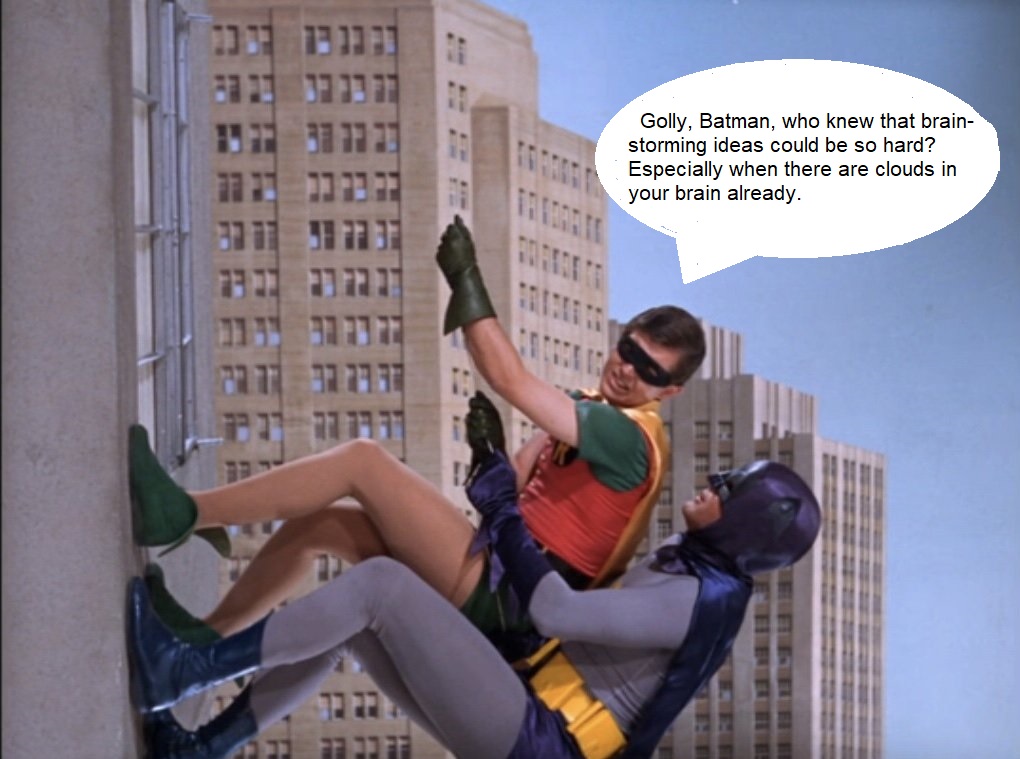
I rarely get below 50 views of something in my blog every day. The last three days were 86 views, 124 views yesterday, and 88 views already today. My blog has definitely picked up pace over the length of the coronavirus quarantine. But no definable reason seems obvious. Some of my posts are polished work, but Robin is right when he says today’s post is merely fishing with the process, which is true almost every day.
As a person I am quirky and filled with flaws, pearls of wisdom that result from clam-like dealing with flaws, strange metaphors that shine the pearls, and obsessions like the one I have with nudism that leaves me properly dressed for diving for pearls.
I have demonstrated throughout my life that I have an interest in and experience with nudism, though not the boldness to parade my naked self before the world outside of the writing that I do. I also spent most of my bachelorhood dating reading teachers and teachers’ aides, finally settling down and marrying another English teacher. I completed a thirty-one year career as an English teacher, which means I spent a lot of time teaching writing and reading to kids who were ages 12 to 18. Twenty-four of those years were spent in the middle school monkey house. And all of that led to being so mentally damaged after all that I wasn’t good for much beyond becoming a writer of YA novels or possibly subbing for other mentally-damaged teachers in middle schools around our house.
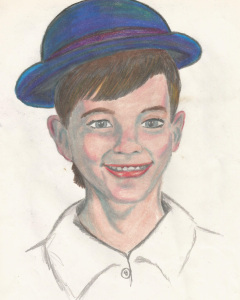
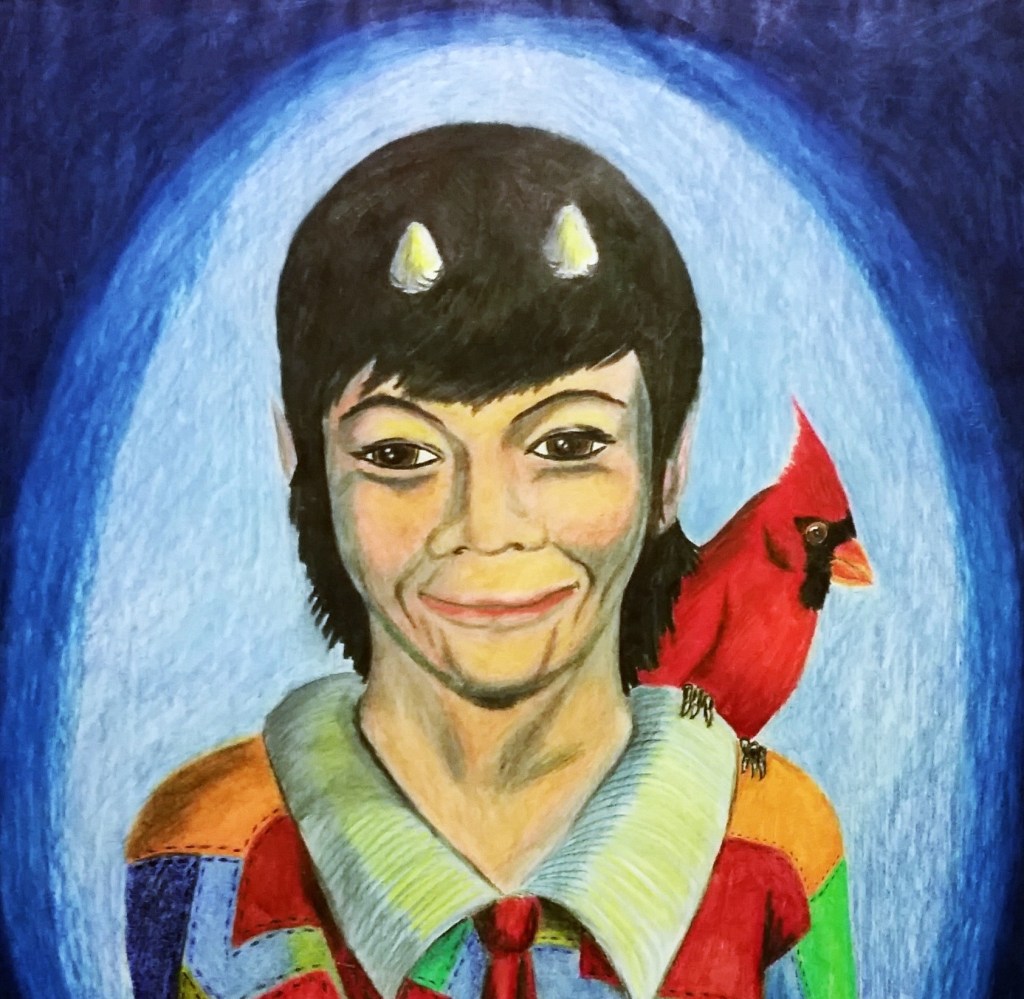
A real telling feature of what I have become is the fact that most of the characters I write about in my fiction are somehow a reflection of me. Milt Morgan, seen to the left, is illustrated here with a picture of me as a ten-year-old wearing a purple derby. Yes, I was that kind of geeky nerd.
And most of the plots are based around things that happened to me as a child, a youth, or a young teacher. Many of the events in the stories actually happened to me, though the telling and retelling of them are largely twisted around and reshaped. And I am aware of all the fairies, aliens, werewolves, and clowns that inhabit my stories. Though I would argue that they were real too in an imaginative and metaphorical way.
So, here now is a finished post of Mickey staring into the metaphorical mirror and trying in vain to define the real Michael, an impossible, but not unworthy task.
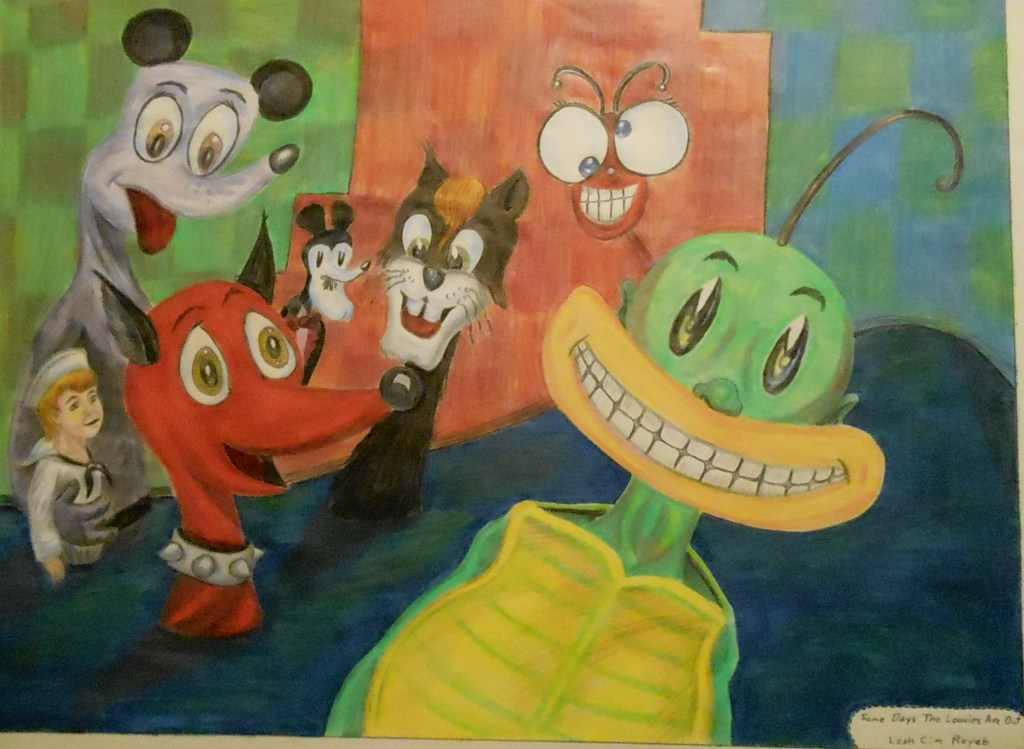
Today’s artworks for Saturday Art Day are all filled with random things put together by chance and whimsy in order to mishmash together some kind of point about surrealism. This would be because this is a surrealist blog, and I am a surrealist artist and writer. Either that or it is because if you put fish in your ears, the color of the sky changes to swirling gold and purple. Those are some powerful fish!
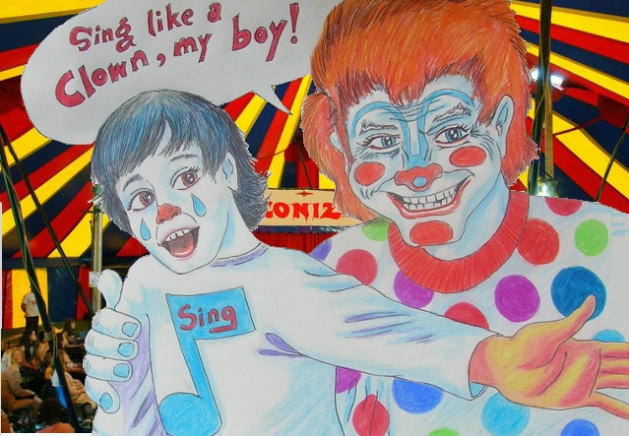
Clowns and dreams and singing sad songs for love in the circus tent of your dreams.
Of course, Surrealism is more than just a pile of random things. As Salvador Dali did it, the random images were made as realistic as possible and connected together. There was some reason behind the juxtaposition of these otherwise unrelated things (like the line-up of weird uncles you get at the Thanksgiving table when your great grandma had nine kids, seven of whom grew old enough to have families of two or more kids, and everyone within driving distance is invited to grandpa’s farm house for a big-family family meal (even if they had to put a second kids’ table in the storm cellar).
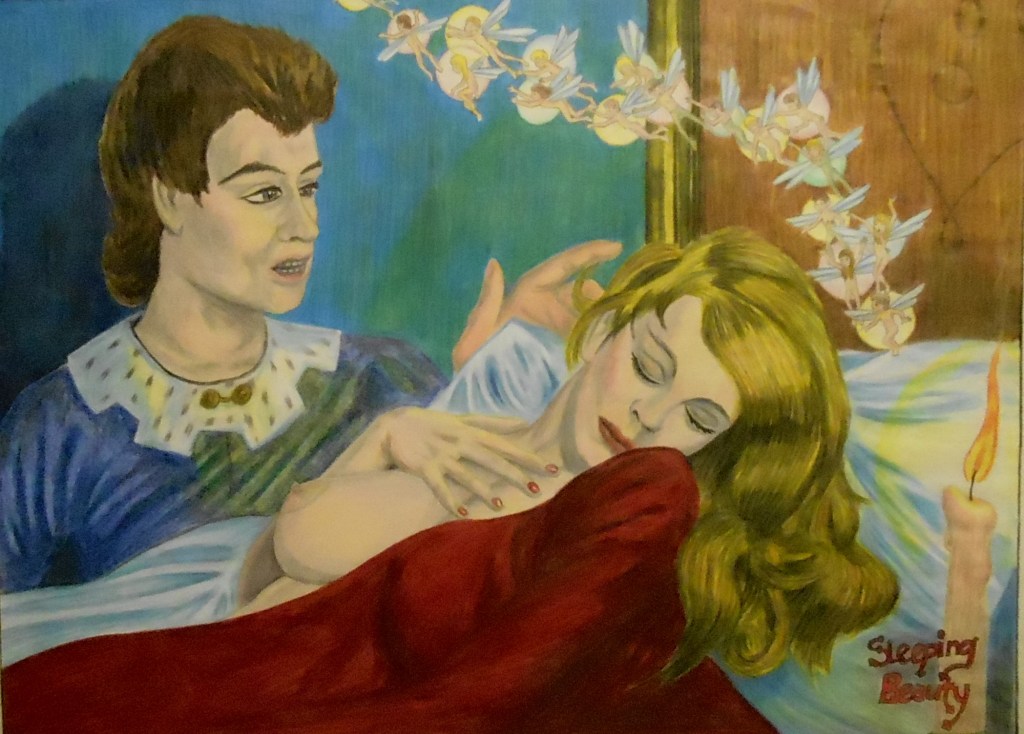
Do candles, a naked breast, flying children, and Prince Young John Travolta mean anything?
Of course, the meaning that ties it all together can be a secret or hidden meaning. Salvador Dali was deeply in love with his wife Gala, who was thirty years younger than he. He had an older brother who died before he was born, making him forever feel like a “replacement child”. These things are expressed in his paintings. Did you ever discern that from his paintings of melted clocks and discarded masks being kissed on the lips by giant ants?
And what the hell does this even mean?
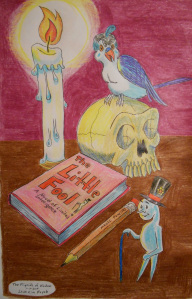
The Little Fool?
Subtitled; a novel of limited intelligence?
And it is a colored-pencil drawing of a candle, an empty skull, a budgie, a book, and a weird little goofy ghost dressed like Mr. Peanut… without the monocle or spats… does that make him naked?
And a pencil? Why?
Can you tell from my artwork that I chose a career of being a public-school English teacher over becoming a commercial artist or a cartoonist? Or that I was the victim of a sexual assault at the age of ten and then never told anybody about it until the guy who assaulted me was dead? Or that I was so afraid of my own body when I was young that I eventually had to become a closet nudist as an adult? And what does my artwork have to say about all of that?
And do you understand why Salvador Dali is an artistic hero of mine? And I love the movies of Stephen Spielberg for the exact same surrealist reasons?
If you regularly read this blog, or even just look at the pictures, you may have seen all of these pictures and heard all of these ideas before. I didn’t make this post from anything new. The only thing that is new… is how I randomly chose to put all of these things together in a way I haven’t done before.
Being a pessimist sometimes makes planning for the future difficult. I knew that the biggest argument against me going back into classrooms as a substitute was the fact that I could easily die the next time the germ factory that is your average middle school or high school is hit with a flu outbreak. And as a pessimist, I know the coronavirus is going to hit in a big way. So, part of the plan has to include dying in 2020.
Watching the way Democratic debates get reported in the media, I also have to live with the knowledge that Donald Trump will win in November. (That, of course, will lead to him making himself Emperor after his eight years are up, and then Don Jr. gets the Empire by birthright and rules us with a very stupid ham-fist until he is either assassinated by school teachers or the world ends from climate change.)
We may be on the way to losing the house we have owned since 2005, since property taxes are soaring beyond my ability to pay them in the middle of my Chapter 13 Bankruptcy. So, I will be planning to make my way through life in the near future living under a Fascist dictatorship while being both homeless and dead.
There are too many bad things coming that I cannot control. So, as the tidal wave draws nearer, I need to put on shark repellent and prepare my surfboard.
So, my priorities need to be adjusted since continued survival is probably not achievable. Living longer isn’t the most important thing after all.
So, here are my current priorities;
Savor the time I have left with my family, however long or short that may be. I will live each day as if it were the last day of my life on Earth.
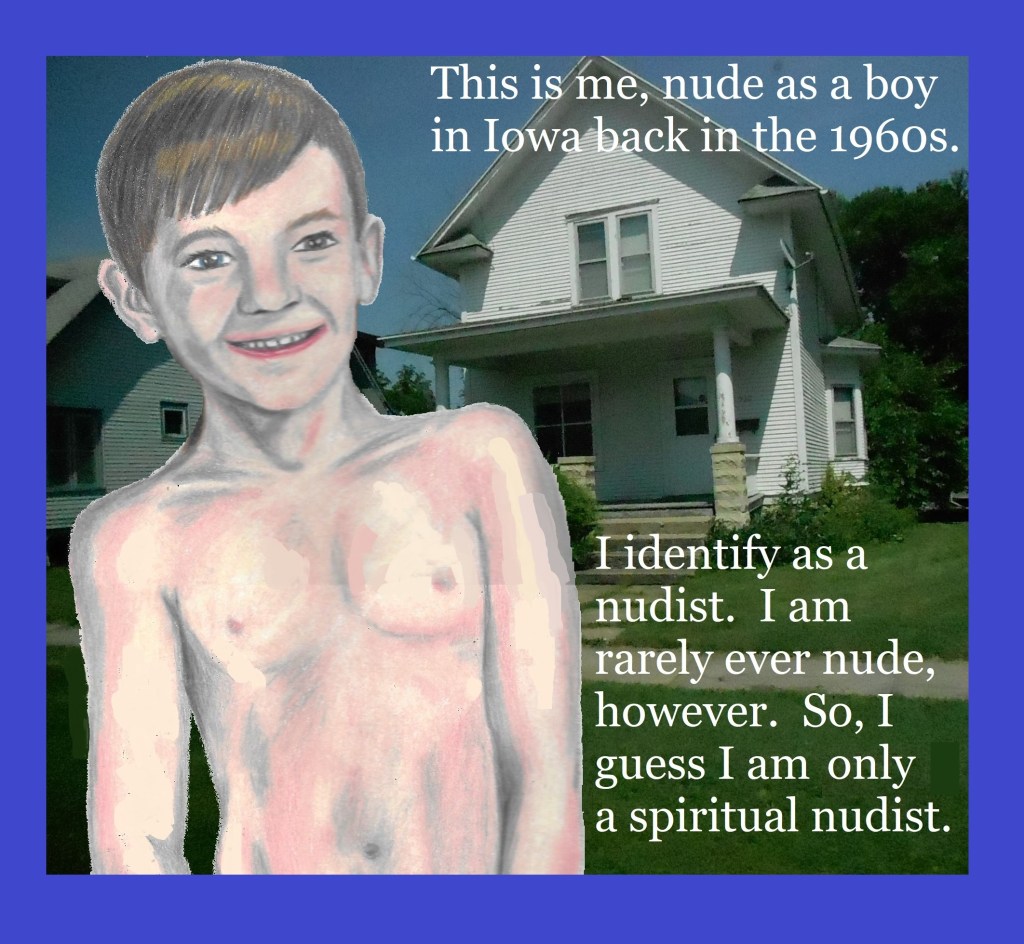
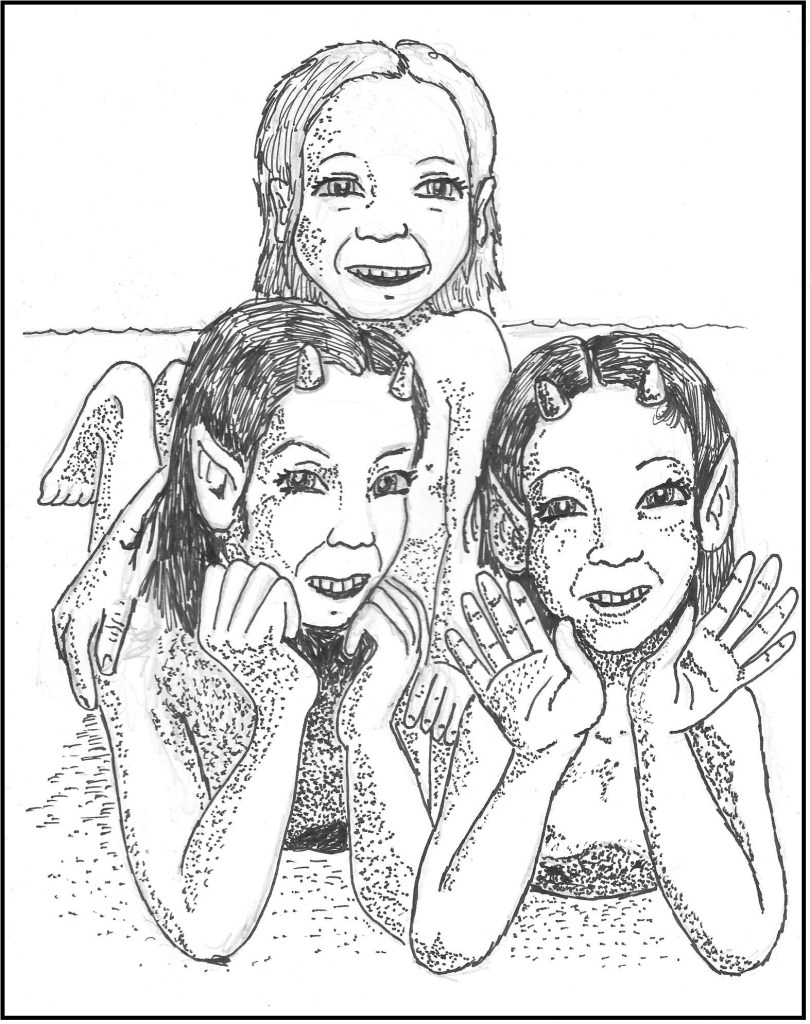
Continue to write and share my writing with whoever cares enough to read it. This blog needs to be kept up as near to every day as possible. My work in progress is called A Field Guide to Fauns and it is set in a nudist park, but is really about families and how they survive domestic abuse and divorce. The picture above is an illustration from that book The next novel will most likely be The Wizard in His Keep if I am blessed with the time to write it.
I will continue to be a substitute teacher as much as I physically can. Not only do I need the money from it, each day spent with kids, helping them to learn, or at least helping them not to kill and eat another substitute teacher, is priceless as an addition to my treasure-chest-full of teaching experiences.
And I will face whatever comes without fear or regret. I have lived a good long life. I have shared a lot of things with a lot of people, and I really have committed no sins, crimes, nor sorrows that I must feel regret over.’
I have given myself things to think about in the time remaining. And, possibly, I have given you things to reflect upon too. My reality is that there is a great deal more past in my life than there is future, so let me not waste the present I have been given.
I believe one of the primary reasons that art exists at all is because we are thinking creatures with a need to spend serious time in deep minding of the consequences of existence. We need to question everything. And art helps us do that by depicting the thoughts that existed first in the mind of the artist, and then must be translated through experiencing into the mind of the viewer.
Landscapes are very useful for contemplation. They present an interpretation of the real world you can mentally walk around in.If you are walking around mentally in a work of art, you are seeing more than just a place. You are walking mentally through the mind and the perceptions of the artist. You see what he or she has seen, even if you see it differently. Even if it is a photo the artist took. The people, places, and things your viewer-eyes encounter when mentally walking around in a work of art have to have some overall meaning. Some purpose. Some reason for being.What do you suppose the picture above means? I can’t tell you, even though I drew it. You, the viewer, must give it meaning.
On Wednesday I subbed again for a science teacher at Long Middle School. They were eighth graders, the chest-thumping apes at the top of the monkey-house food chain. There was an AVID class with too many at-risk and under-disciplined kids in it. And the Long ESL classes contain too many rabid monkeys who don’t understand monkey-English well and are liberally dispersed through-out the harried eighth-grade teachers’ day. In other words, the Wednesday job caused me brain damage from which I haven’t recovered from fully at this writing.
So, today I am obsessed with finding the magic necessary to avoid having any more teacher-meltdowns and brain injuries like that 6th period debacle. (“Debakkil” is a magic word, but it is an evil magic word),
In the Disney animated classic Cinderella, the Fairy Godmother uses a magic spell called (in a song) “Bibbety Bobbity Boo”. In the course of singing the song, the old F-G turns a pumpkin into a carriage and mice into horses, the swayback horse into a driver, and the dog into a groom. I need a spell like that to remedy the monkey-house meltdown syndrome that I was victimized by.
So, here is how “Dibbletey Dobbletey Doo” will work.
The spell is cast initially on a male student, a monkey-like being swinging from the light fixtures, but obviously smarter than the other male monkey-students. You could magically turn his raggy clothing into a ball gown and embarrass him completely (which would be true to the metaphor, but would turn him into your worst nightmare)… but don’t. Instead, tell him that he is smart enough to be a leader. Put him in a position of power, making him in charge of a group, and telling him his consequences will be either a reward for good leadership, or the blame for the bad behavior of the group. Remind him that he has natural leadership skills. If he speaks to others respectfully, they will be respectful to everybody. If he shows them how to behave properly, they will use him as a positive example. He will get the credit for the good things they will do.
“Dibbletey Dobbletey Doo!”
It works. We had a poster project to do in groups of four. They were supposed to create a diagram of the mechanics of the four seasons of the year, with a sun and four representations of the earth with its axis and equator tilted properly in relation to the sun. That’s the kind of assignment that can result in the explosion of the science lab or the total cannibalization of the substitute. But I made it successfully work in four out of five classes.
Why did it go wrong in that last period? 1. Classes that are out of control for the regular teacher are impossible for even the best sub to control. 2. Too many students in one classroom are impossible to control when you have more groups than work tables. 3. Supplies run out at the end of the day, and empty pens and markers become projectiles. 4. Eighth graders all need to take mandatory naps in the afternoon (using sedative darts and a dart gun when necessary) but no school or principal is aware of that fact. 5. Cranky afternoon baboons grow longer fangs than they had in the morning.
So, Mickey must revise and rework this particular spell for the afternoons. And he must refuse the next job coming from this particular teacher.











 Catch a Falling Star
The Case for the Clown
The criminal was led into the courtroom in chains and forced to sit in a box made of metal bars so his influence would not reach out and harm anyone by drawing their sympathy in.
“Mr. Prosecutor,” said the learned judge, “what terrible crime has the perpetrator been charged with?”
“The alleged perpetrator!” objected the defense attorney, a mousy old man who looked like a cross between Santa Clause and Robert E.Lee because of his white beard, stern face, and a twinkle in his eye.
“Shut up please, Mr. Badweather. You will have your turn to speak.” The judge banged his gavel smartly to emphasize the shut-up-ness of his overruling.
“Your honor,” said the prosecutor, “Mister Pennysnatcher Goodlaughs stands accused of being a clown.”
“The people of the State of Texas, home of the free, land of the brave, and place where cowboys can hang their hat on the antlers of a moose they shot in Canada, will prove that Mr. Goodlaughs did willfully, and with malice of forethought, commit acts of supposed humor in order to make people laugh. And we will further prove that in a time of very serious things, he intentionally made light of very serious matters and the very serious men who try to turn those serious things to their exclusive… err, sorry, I mean… everyone’s benefit.”
“Your honor,” said the defense attorney, looking like a cross between Mark Twain and Colonel Sanders, “I would like to request a new venue for this trial. My client will not get a fair trial here.”
“Sir, your stupid request is rejected on the grounds that Mr. Goodlaughs cannot get a fair trial anywhere. We are all conservatives, and are therefore incapable of having a sense of humor. Continue, Mr. Prosecutor.”
“We will show numerous instances of Mr. Goodlaughs putting paint on his face to hide his true features or assume the identity of a character not his own. He has repeatedly used false noses, large shoes, and floppy hats to exaggerate his flaws and scare young children. He repeatedly wears polka-dotted clothing to simulate terrible taste and ridiculous lack of fashion-sense. He employs pratfalls and slapstick humor in his performances, things that, if any school-age child would imitate the behavior, might lead to serious injury or even death. And he has even dared to make fun of our glorious leaders, implying that they make mistakes and may even have hurt people. That they act without thinking about anything but their own pocketbooks. In other words, this clown has knowingly made jokes in order to get people to not take things seriously.”
“Your honor, I object to this jury. I object to the fact that it is made up of fifty percent rednecks and fifty percent kangaroos! My client demands a new, more impartial jury!” cried the defense attorney, looking like a cross between Captain Kangaroo and Ronald Reagan.
“Has anybody noticed?” asked the judge, “that this attorney looks like he could influence this jury unfairly? He looks like two people who could lead the two halves of this jury to the wrong conclusion. Bailiff! Take the defense attorney out back and execute him by firing squad.”
After the entire courtroom heard the gunshots go off, the judge then turned to the prisoner.
“It seems, Mr. Goodlaughs, that the defense’s opening statement is now entirely up to you. Do you have anything to say in your own defense?
“I do, your honor. Ladies and gentlemen, kangaroos and Reagan Republicans of the jury, I submit to you that I have never actually been a circus clown, or wore face paint. Not that I wouldn’t if the opportunity presented itself. I merely claim the right to laugh at anything I think is funny… or can be made funny. Whether I am being what you call a clown, a humorist, a cartoonist, a comedian, a fool, a village idiot, or a witty fellow, I believe I have the right to make light of anything. Life is always better when you can laugh. Especially if you can laugh at yourself.”
“I’ve heard enough,” said the judge. “What say you, jury?”
“Guilty!”
“Yes. And I preemptively waive the prisoner’s right to appeal. Sir, you are guilty, and you shall be executed immediately.”
Everyone in the courtroom breathed a long-awaited sigh of relief.
Leave a comment
Filed under clowns, comedians, commentary, foolishness, humor, insight, Paffooney, pessimism
Tagged as clowns