
“Kaw-Liga”
KAW-LIGA, was a wooden Indian standing by the door
He fell in love with an Indian maid over in the antique store
KAW-LIGA – A, just stood there and never let it show
So she could never answer “YES” or “NO”.
He always wore his Sunday feathers and held a tomahawk
The maiden wore her beads and braids and hoped someday he’d talk
KAW-LIGA – A, too stubborn to ever show a sign
Because his heart was made of knotty pine.
[Chorus:]
Poor ol’ KAW-LIGA, he never got a kiss
Poor ol’ KAW-LIGA, he don’t know what he missed
Is it any wonder that his face is red
KAW-LIGA, that poor ol’ wooden head.
KAW-LIGA, was a lonely Indian never went nowhere
His heart was set on the Indian maiden with the coal black hair
KAW-LIGA – A, just stood there and never let it show
So she could never answer “YES” or “NO”.
Then one day a wealthy customer bought the Indian maid
And took her, oh, so far away, but ol’ KAW-LIGA stayed
KAW-LIGA – A, just stands there as lonely as can be
And wishes he was still an old pine tree.
“The Complete Hank Williams” (1998)
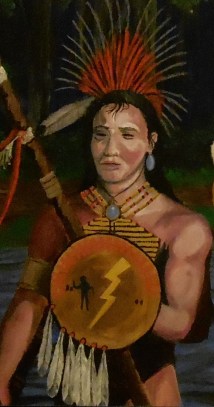
The quirky movie I reviewed, Moonrise Kingdom, reconnected me with a song I loved as a child. It was on an old 45 record that belonged to my mother’s best friend from high school. When the Retleffs sold their farm and tore down their house and barn, they had a huge estate sale. My mother bought the old record player and all the collected records that Aunt Jenny still had. They were the same ones my mother and her friend Edna had listened to over and over. There were two records of singles about Indian love. Running Bear was about an Indian boy who fell in love with little White Dove. They lived on opposite sides of a river. Overcome with love, they both jump into the river, swim to the middle, lock lips, and both drown. Together forever. That song, it turns out, was written by the Big Bopper, and given to Johnny Preston to sing, and released the year after the Big Bopper died in a plane crash along with Buddy Holly and Richie Valens.
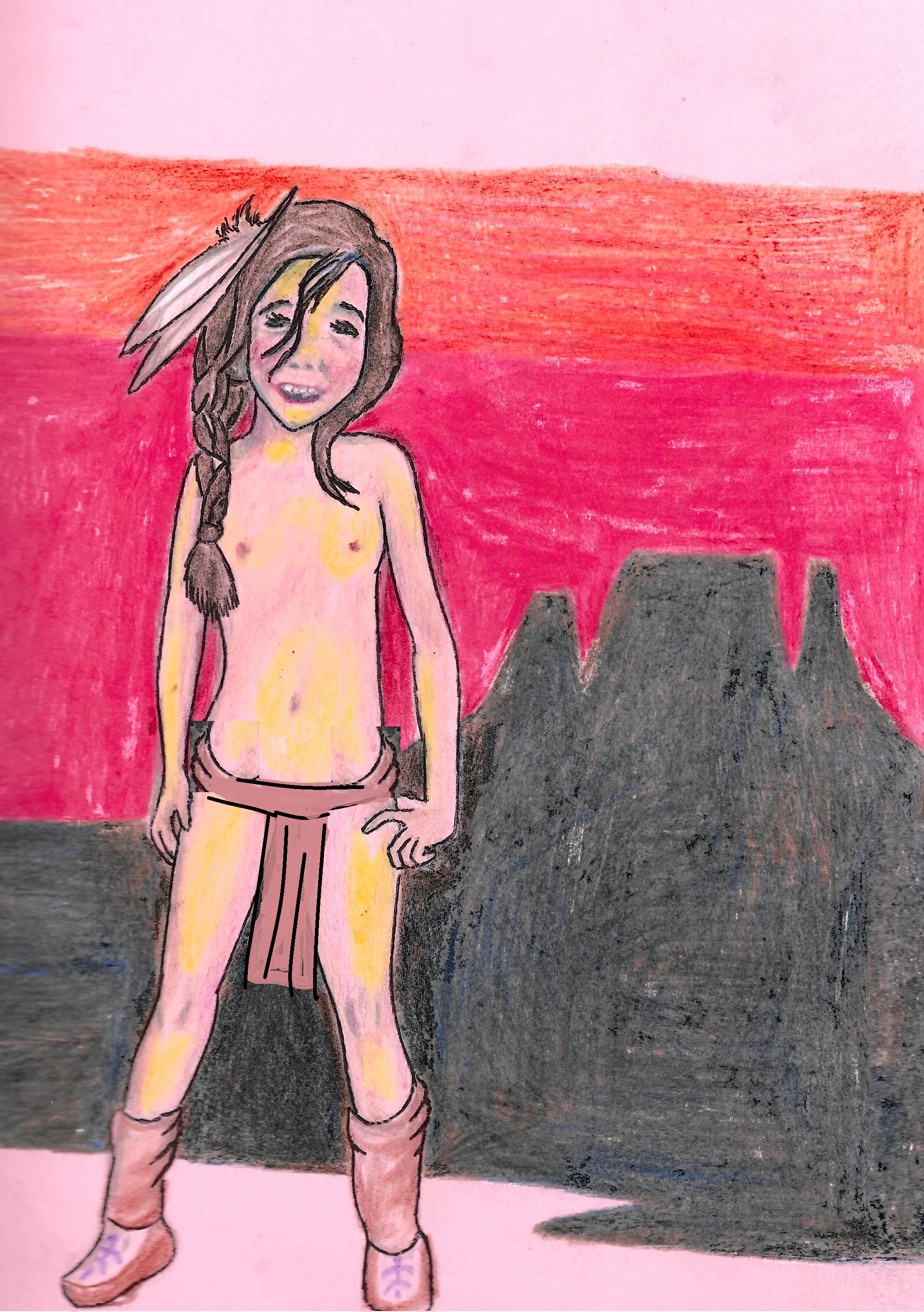
Kaw-liga, by Hank Williams, was a wooden Indian sitting in front of a cigar store. His love story is even worse. As you can see from the lyrics above, he never even gets the girl. Dang, Indian love must be heck!
But I have come to realize that these aren’t merely racist songs from a bygone era. They hold within them a plea for something essential. They are a reminder that we need love to be alive.
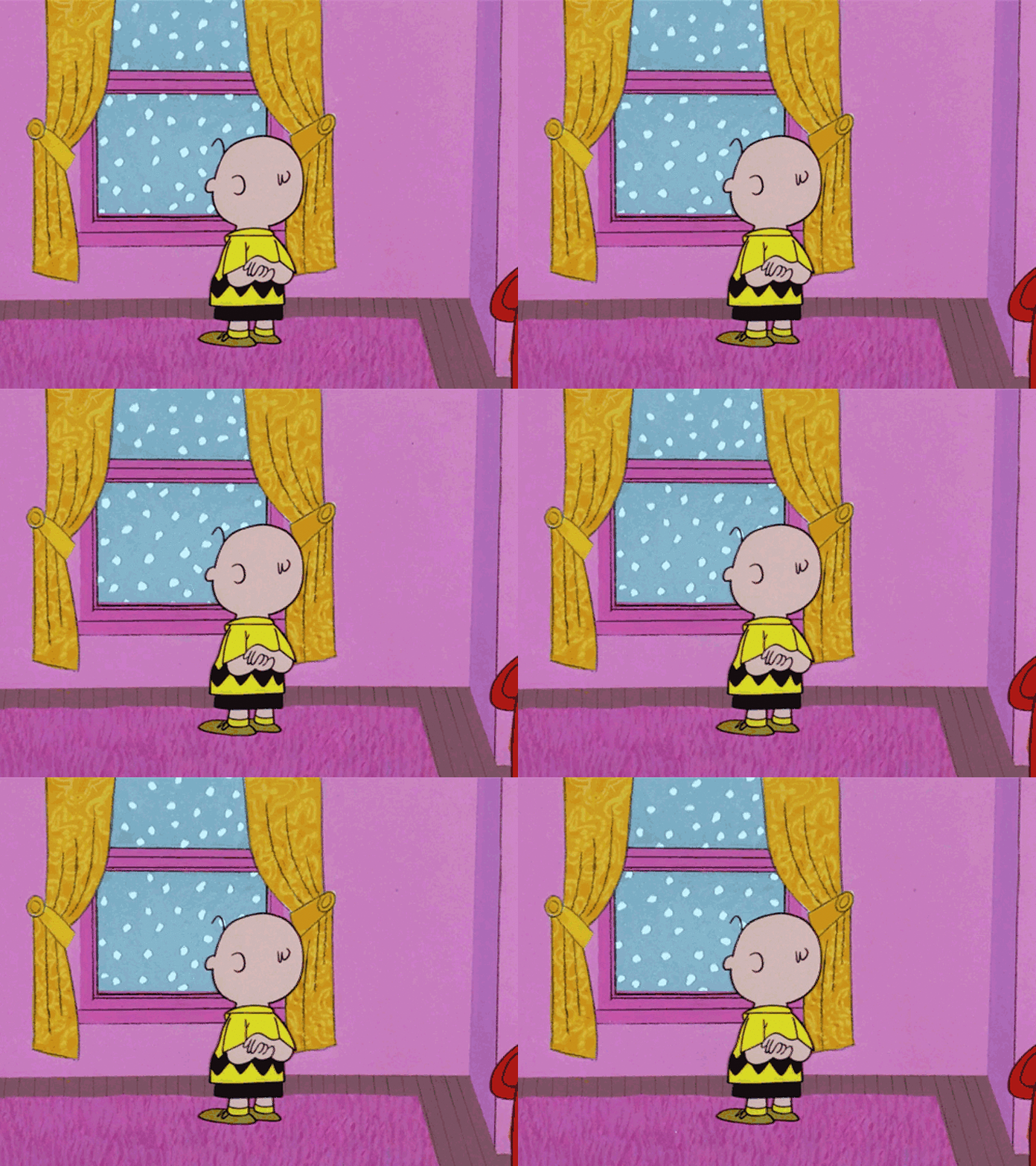
When I was young and deeply depressed… though also insufferably creative and unable to control the powers of my danged big brain, I knew that I wanted love. There was one girl who went to school with me, lovely Alicia Stewart (I am not brave enough to use her real name), that filled my dreams. We were classmates, and alphabetical seating charts routinely put us near each other. She had a hypnotic sparkle in her eyes whenever she laughed at my jokes. She was so sweet to me… sweet to everyone… that she probably caused my diabetes. I longed to carry her books or hold her hand. I cherished every time she spoke to me, and collected the memories like stamps in a stamp album. But like the stupid cigar store Indian, I never spoke up for myself. I never told her how I felt. I was endlessly like Charlie Brown with the Little Red-Haired Girl. Sometimes you have to screw up your courage and leap into the river, even if it means your undoing. Because love is worth it. Love is necessary. And it comes to everybody in one way or another over time. I look at pictures of her grandchildren posted on Facebook now, and wonder what might have been, if only… if only I had jumped in that stupid river. I did find love. And I probably would’ve drowned had I done it back then. Life has a way of working things out eventually. But there has to be some reason that in the 50’s, when I was born, they just kept singing about Indian love.













Infinite Monkeys
The theorem goes, “If you sit an infinite number of monkeys behind an infinite number of typewriters and let them tap away at random for an infinite amount of time, they will eventually come up with all the works of Shakespeare, and in addition to that, all the works of literature that have ever been written and ever will be written.”
Now, that is a daunting theorem. All the great works of literature by Mickey will be recreated by monkeys? And even worse, they will probably produce much better versions of all of it. Plus versions of it written in German, Mandarin Chinese, Urdu, and Californian (a really difficult language to translate.) All languages ever created on all the planets of the universe, as a matter of fact. The proof is there. It hinges on the mathematically precise definition of “Infinite.”
But you have to remember, infinite is the biggest number there is.
So many variations will be there in the truthfully infinite amount of stuff that infinite monkeys will produce that one version of Shakespeare’s Hamlet will have a final act where, instead of everyone dying or accidentally killing themselves, Hamlet will talk them all into putting on yellow chicken costumes and dancing with hula hoops as a means of acquiring absolution for their sins.
And a version of it will also exist where all the letter “B’s” will be replaced by “P’s” and all the vowels will be doubled so that Hamlet’s famous soliloquy will begin, “Too pee oor noot too pee, thaat iis thee quueestiioon…”
Accurately imagining the conditions required to have infinite monkeys tapping out infinite works of literary art means that any ridiculous thing that Mickey thinks of will have to actually be typed out by one or more (or infinite) monkeys in all of that infinite monkey writing. Somewhere Eugene Ionesco’s play Rhinoceros will have nothing but characters who are rhinoceroses at the beginning of the play who turn into human beings by the end of the play. (That is the exact opposite of the real French absurdist’s play, for those of you who did not have to read such stuff in college literature courses.)
In fact, in order to think up all the ridiculous variations of every work of literature would take Mickey an infinite amount of time. Mickey probably doesn’t really want to live that long.
‘
And then there is also the question of the physics of infinity. Is the universe itself, I mean, the one we all live in presently, actually infinite? Astrophysicists don’t think so according to current observable data on the astronomical model of this universe. And then you have the problem of infinite monkeys made of infinite matter. The universe would be filled to overflowing with infinite monkey-matter. And that leaves no matter or space to be used for infinite typewriters. The whole universe would be monkey-matter. And that would also mean no room for bananas, or, in fact, any monkey food of any kind. What is going to motivate the infinite monkeys to work for an infinite amount of time on their monkey literature which they won’t have typewriters to write on anyway?
And then there is another horrible thought that occurs to me. In this picture to the left, do you see the evil monkey? Believe me, if you have an infinite amount of monkeys, one or two (or possibly an infinite number of them) will definitely be evil geniuses.
And evil monkeys do evil monkey-business.
At least one or two (or possibly… you know…) evil monkey geniuses will disassemble infinite typewriters to make infinite doomsday devices. Typewriters will be re-engineered into computers and will become filled with monkey-viruses that will rewrite the operating software of the universe. And then, everything becomes an infinite monkey-villain paradise where the evil geniuses among the monkeys will live the perfect life for monkey criminals full of monkey crimes and monkey debauchery and the kind of infinite chaos that infinite monkey-villains enjoy.
This thinking about infinite monkeys leads to one very definite infinite-monkey conclusion; WE DO NOT WANT TO MESS WITH GIVING INFINITE TYPEWRITERS TO INFINITE MONKEYS!!!
2 Comments
Filed under commentary, goofiness, goofy thoughts, humor, philosophy, strange and wonderful ideas about life