


Yes, I am, perhaps, a bit of a fool for believing Edward de Vere, the 17th Earl of Oxford, is the writer behind the works of William Shakespeare. How do you prove something is true when it is so obvious that someone worked really hard to keep it a secret for all this time? Is it a betrayal of the man to go against his apparent wishes and try to out him for his incredible secret? It is hard for me to judge. After all, I know I am a fool.
But even if he is not Shakespeare, and just sits at the apex of a mountain of coincidences, I am fascinated by the historical character of Edward de Vere.
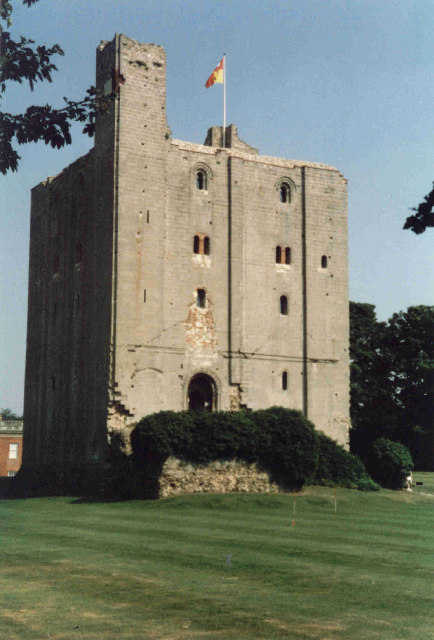
The keep at Hedingham Castle, the de Vere family seat in Essex (photo by David Phillips)
He was born the only son of John de Vere, the 16th Earl of Oxford, and heir to the second oldest title among English nobility. His father stood by Elizabeth when she was under house arrest under the reign of Bloody Mary, and went with her as a court favorite to the throne of England when she survived the ordeal. So naturally Edward was a favorite of Elizabeth’s since childhood. Later stories would suggest he became the Queen’s secret lover, but the rumors of the Virgin Queen’s harlotry were most likely the invention of Philip of Spain and other nobility in Catholic Europe who plotted endlessly against her because she chose to adopt her father’s protestant Anglican religion instead of returning England to Catholicism like her half-sister Mary before her. Elizabeth’s personal integrity may not have been perfect, but the love she bore for young Edward was probably not the improper kind that the movie Anonymous by Roland Emmerich suggested.
But even though de Vere was born lucky, I would not say he was particularly lucky in life. He was only twelve when his father (though having completed his will) died. The result being that he was made ward to Queen Elizabeth herself. She was not exactly the foster-mother type, however. She sent the boy to be raised in the home of her Secretary of State and chief adviser, William Cecil (later made Lord Baron Burghley). Meanwhile Elizabeth took possession of some of his estates in payment for the wardship and bestowed them on Robert Dudley (her childhood friend and probable one true love, though he was married to someone else). Young Edward was a difficult student. His tutor, the famous scholar Laurence Nowell, resigned in frustration, probably because the boy was too bright and far-reaching for the antiquarian scholar to deal with, possibly himself being a bit dumber than advertised. Edward quickly developed a reputation for love poetry at Elizabeth’s royal court. He was a gifted, though somewhat conflicted, prodigy.
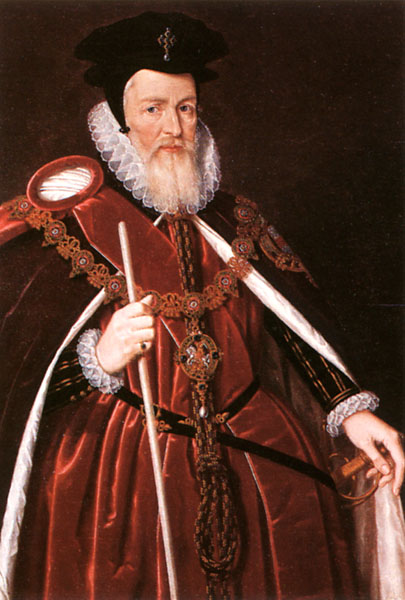
William Cecil, 1st Baron Burghley
And here is what I find most fascinating about his life story. As you reread it, keeping the works of Shakespeare in mind, you begin to see Shakespeare’s source material coming to life. Edward would end up marrying Cecil’s young daughter Anne, so that Lord Burghley was not only a man who raised him, but also his father-in-law. But marrying off your offspring to nobility was an accepted manner of social climbing, and Cecil wasn’t entirely sure he couldn’t do better for his daughter. And the meddlesome, lecturing, and self-righteous nature of the man comes out in Shakespearean characters like Polonius in Hamlet who spies upon the suicidal prince because he fears the effect Hamlet’s love for his daughter Ophelia might have on her reputation, causing him to spout all manner of cliches and stuffy, self-important advice.
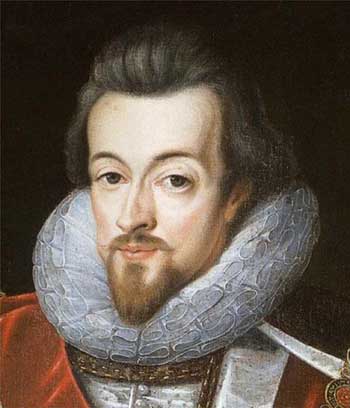
Robert Cecil, Lord Salisbury
Cecil’s son Robert, the hunchbacked boy who grows up to take over his father’s office as adviser to both Elizabeth and James I, is a crafty statesman and plotter who is the undoing of the Earl of Essex in a real-life plot against the throne of Elizabeth. It is hard not to read about his real-life exploits without seeing the connections to Iago in Othello and the conniving hunchback Richard III.
So, once again I have overshot my target length in this essay because I get so wound up in the details of my discoveries. There are numerous things written and published about the connections between de Vere and the Bard himself. I have only begun to scratch the surface in this telling of it. But I am just a fool with a humor blog. If it interests you at all, I encourage you to go to as many of the available sources as you can possibly google. I haven’t yet finished doing that myself. And I do hope I haven’t told anything here that makes Shakespeare turn over in his grave (if, indeed, a grave could ever really hold him.)






















 Catch a Falling Star
326 and Counting
Twice before I have gone through a year posting something on this blog every single day of the year. And not just by scheduling the publication wisely to cover every day, but by writing something and publishing something every single day. At this point, I have now written something and posted it for 326 days in a row, and being past the holidays and funeral for my mother, I am probably going to make 365 again for the third time.
This is a man who also wrote something every single day. He was a former journalist who worked as an ambulance driver during World War I, for the Italian Army, where he was wounded and won a medal for his service to the Italian government.
He developed a writing style with no author commentary, sparse but crucial details, and a reliance on the reader’s intelligence to figure out the themes of his writing.
His best work is the Novel, The Sun Also Rises.
I hold that opinion because I have not only read it, but I have also read and compared it to For Whom the Bell Tolls, The Old Man and the Sea, A Farewell to Arms, and several of his short stories. His writing is fiction, but highly autobiographical which makes his stories so realistic and accessible to all readers.
This is also a man who wrote every single day. He started out writing for newspapers, but starting with his first major success as a fiction storyteller, The Pickwick Papers, he began writing mostly comic stories for monthly magazines.
He is noted for long paragraphs of vivid and plentiful details, and especially relatable and memorable characters.
His best work is the novel, A Tale of Two Cities.
I make that judgement after reading it three times, and also reading Oliver Twist, Nicholas Nickleby, A Christmas Carol, Great Expectations, David Copperfield, and The Old Curiosity Shop. There are also autobiographical features in the Boz’s works but he was a wonderfully astute people-watcher, and that dominates his narratives far more than his own personal story does.
.
This writer is known particularly for his sense of humor. It should be mentioned, however, that his fiction is not only filled with humor, but was very keenly realistic. His use of author commentary probably makes him the opposite of Hemingway, but he still carries that journalistic quality of writing it exactly how he sees it… full of irony and irrationally-arrived-at truth.
I don’t know for a fact that he wrote every single day. But he probably did. He always said, “The writing of the literary greats is like fine wine, while my books are like water. WIne is good for those that can afford it, but everybody drinks water.” You can’t have writing that is as plentiful as water without writing fairly often.
His best book is The Adventures of Huckleberry Finn. I am not the only one who thinks so. Hemingway wrote, “All American Literature began with one book, Huckleberry Finn.”
I have also read, Tom Sawyer, Pudd’nhead Wilson, The Prince and the Pauper, A Connecticut Yankee in King Arthur’s Court, Roughing It, and The Autobiography of Mark Twain.
So, what’s the point of all this literary foo-foo? Hemingway would expect you to figure that out for yourself. But I’m addicted to topic sentences, even if I wait til the end to reveal it. If you want to be a writer, you need to read a lot of really good writing. And even more important, you need to write every day.
3 Comments
Filed under artists I admire, commentary, Mark Twain, novel writing, strange and wonderful ideas about life, writing, writing humor, writing teacher