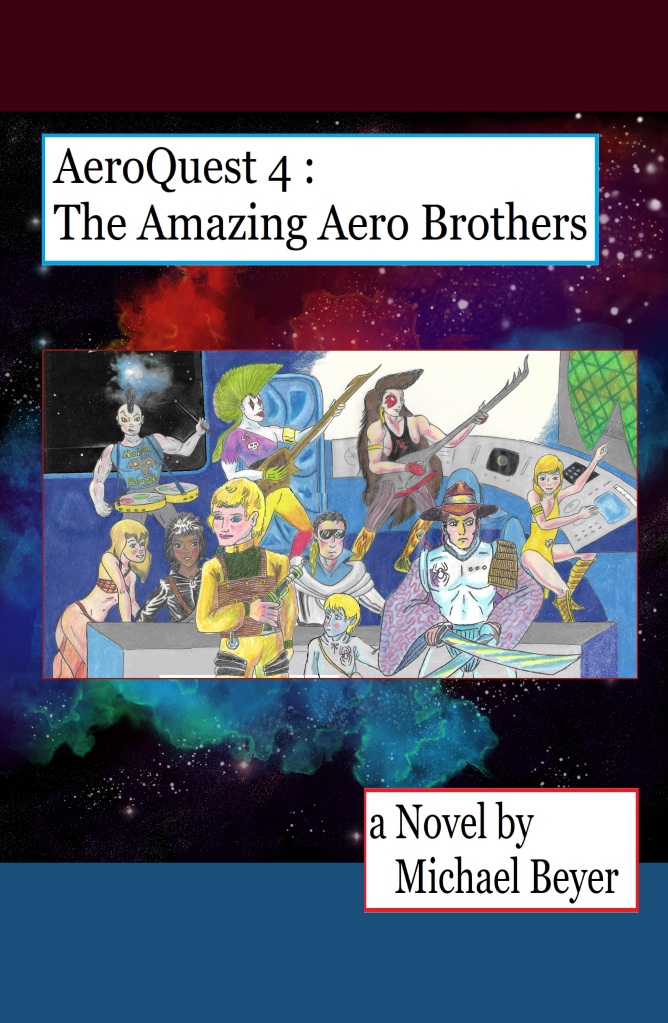
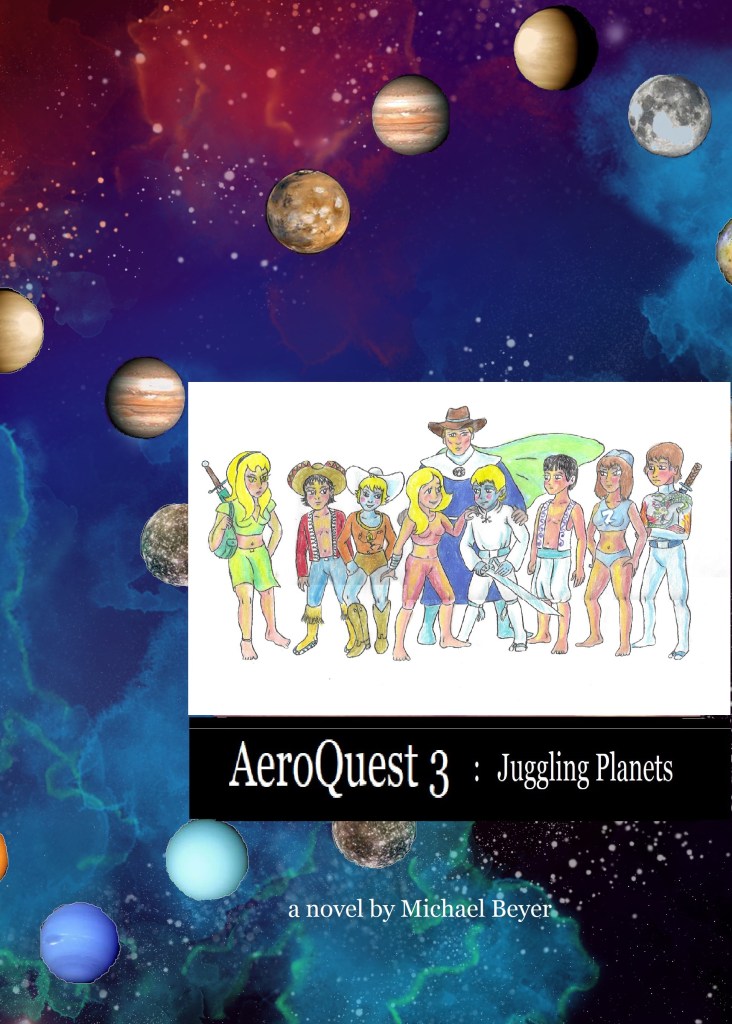
I have not yet finished AeroQuest 3 : Juggling Planets, but the groundwork is being laid already for part 4 in the AeroQuest Saga. The series is, after all, the rewrite of my out-of-print, 2007 novel, AeroQuest. So, the overall structure of the story already exists. I am merely expanding and revising that 350-page book into a better series of four or five books. In fact, there might have to be even more than that. I basically am too inventive for my own good, and there are just too many characters and plot threads for one book. And it may take six books to work it all out correctly.
This, then, is not so much a novel project as a hobby. Or maybe an artifact of an old hobby.
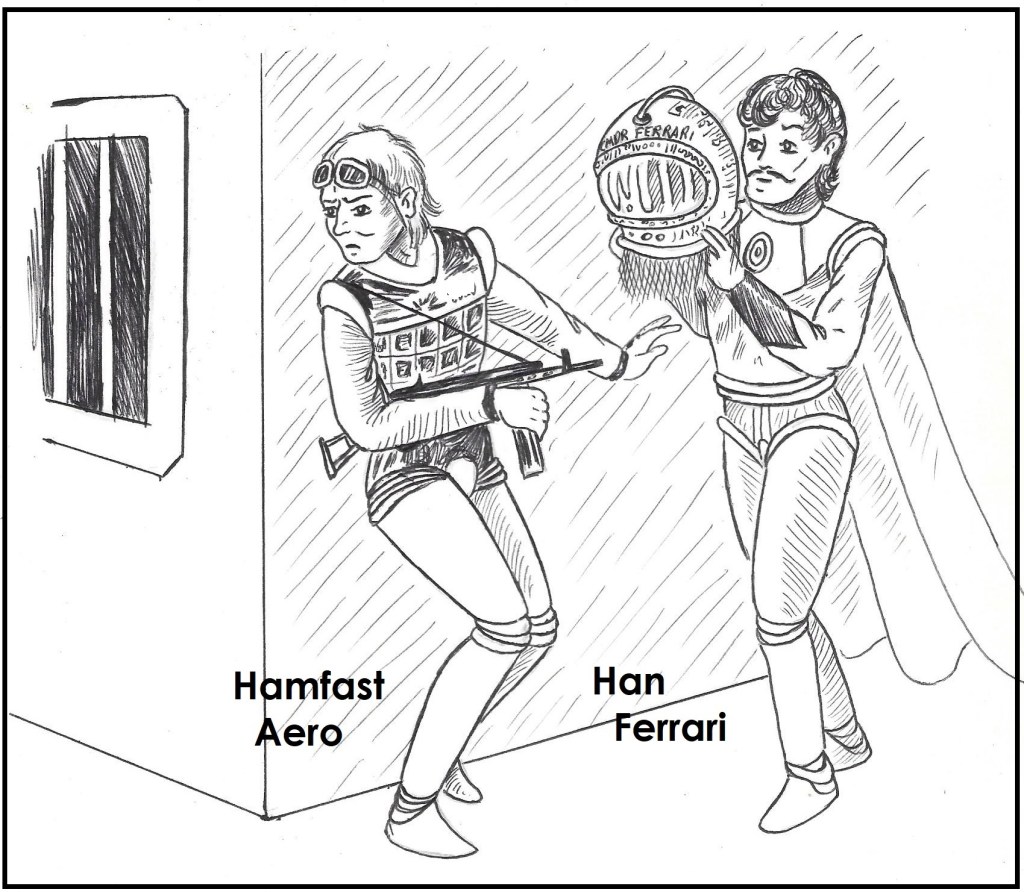
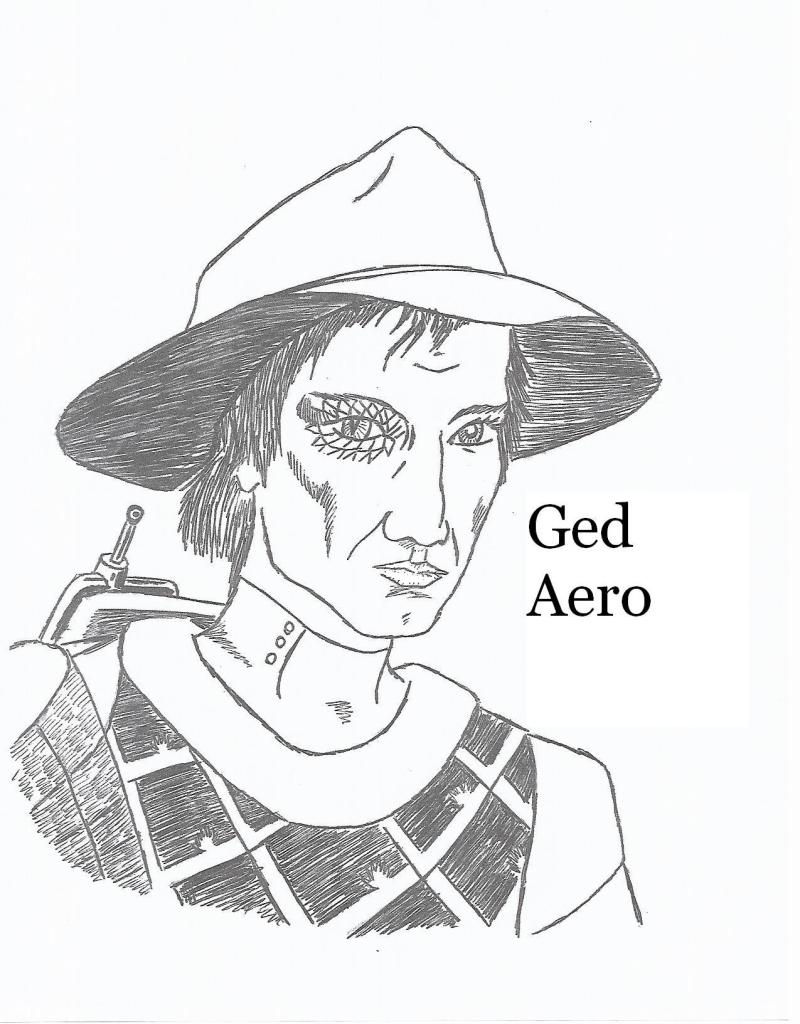
You see, AeroQuest was a story made from the notes I kept of my ongoing Traveller Role-playing game of the 80’s and early 90’s. Hamfast Aero, a main character, was a player character created by one of the first gang of players I had in the 80’s. In fact Ged Aero, Trav Dalgoda, Tron Blastarr, Xavier Tkriashav, Vince Neill (the player’s misspelling, not mine), Cold Death, King Killer, and Duke Han Ferrari were all player characters and strongly reflect the personalities and style of their original players. The plot is bizarre because of some of the creative problem-solving decisions made by the group of nerds who played the game. It had to be a comedy because we always had that over-the-top jokeability as a guiding principal of game play.
I am past page 100 in Book 3, and I have passed 27,000 words. It will end up being at least 135 pages and at least 35,000 words when it is finished. Book 4, if it ends the series, will have to be more than twice that. That’s why I am thinking five books instead of four.
The inspiration for the book was the foolish idea of combining Douglas Adams’ Hitchiker’s Guide to the Galaxy wackiness with Frank Herbert’s Dune huge-book-with-many-short-chapters style. I guess the rewrite has given up on the Herbert format, if not the multitude of characters and subplots that went with it.
Anyway, I will have Book 3 published before I move on to the next writing project. The goal has never been to make money and be famous as a writer. But telling stories and writing them as novels has never been a choice. And, as painful as some of it is to give birth to, there is fulfillment to be had just from the simple act of writing.
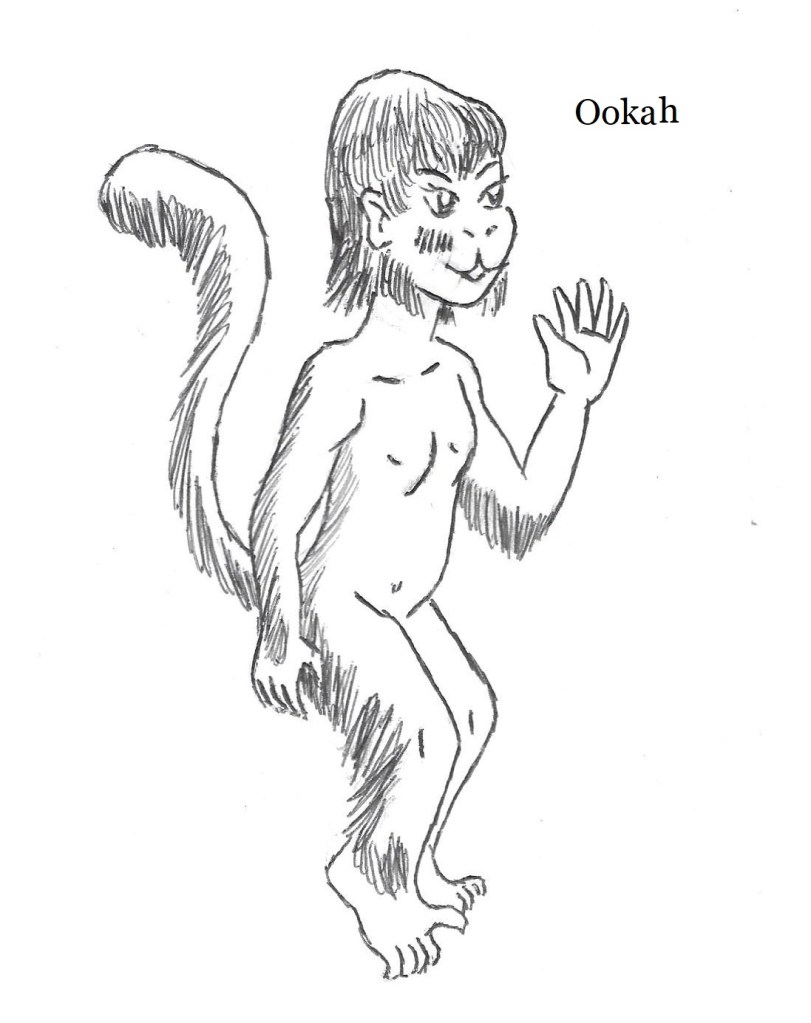
Lemurians were shaped like human children except for the thumbs on each foot and the long prehensile tail. Most sentient aliens and Unhumans treated them like mere animals mostly because they wore no clothing and spoke no discernable language. Of course, nakedness made them much more like the Classical Worlders rather than apes. They were covered in soft tan and chocolate fur, but it covered up no more of their bodies than the oil that a naked athlete from the planet Mantua might wear.
And lack of language didn’t necessarily make them any less of a person than the vast numbers of humans that fell under the general heading of “stupid people”. Emperor Slythinus, though, the deposed Emperor of the Galtorr Imperium, had discovered a telepathic ability that he shared with the monkey people. He called it the “shining” because it was more a matter of reading colored auras and electrical impulses around the monkey people than reading actual words from their minds. It was a primitive brain-to-brain language that served as a sort of pre-telepathy. It allowed him to translate for the Lemurian people.
Ookah, the Lemurian leader, now stood in front of King Killer, Dr. Hooey, and Slythinus naked as the day he was born and radiating green-colored lies.
“How could you not tell me about this?” raged Slythinus. “You have been my most trusted friend. Better than my top advisors on Galtorr.”
The monkey man shined an answer that was intended to be soothing and conciliatory, but ended up being a transparent form of lie.
The blind Emperor turned to King Killer and Dr. Hooey. “They found the device when they first came through,” he said, interpreting. “They found it from the other side because they did not originate here. Ookah and his friends sought to keep the knowledge of it from me because they feared I would be hurt by the place’s guardian, some villain they “shine” at me as being a “white man”.”
“Interesting!” cooed Hooey. “These little monkey people have developed a real fondness for you, a man mostly snake by nature. Tell me, did you have your eyes when you first met them?”
“No, of course not! Prince Ali blinded me before he marooned me here.”
“I wonder if they would’ve had an atavistic fear of those eyes if they had seen them.”
“What I want to know,” said King Killer, “…is where is the dang thing, and how do we use it?”
Slythinus took a moment to “shine” back at Ookah. The little simian looked quite agitated as the answer came back.
“He says he will take us to the place. He has no other way to tell us.”
Ookah turned and gestured to the monkey people who surrounded the tree house sitting in each and every one of the trees around it. They began jumping up and down on branches and shouting raucously, sounding more like upset children than alien primates. Eerily, it almost sounded like a series of swear words.
“They don’t like it,” interpreted Slythinus, “but they promise to take us there and help us defeat the white man.”
“Natives defeating the white man?” said King dubiously. “That doesn’t sound like something that happens too often in History.”
Hooey laughed aloud. “Now the skeptic thinks he knows History better than a Time Knight! Wait and see. And remember the Little Bighorn.”
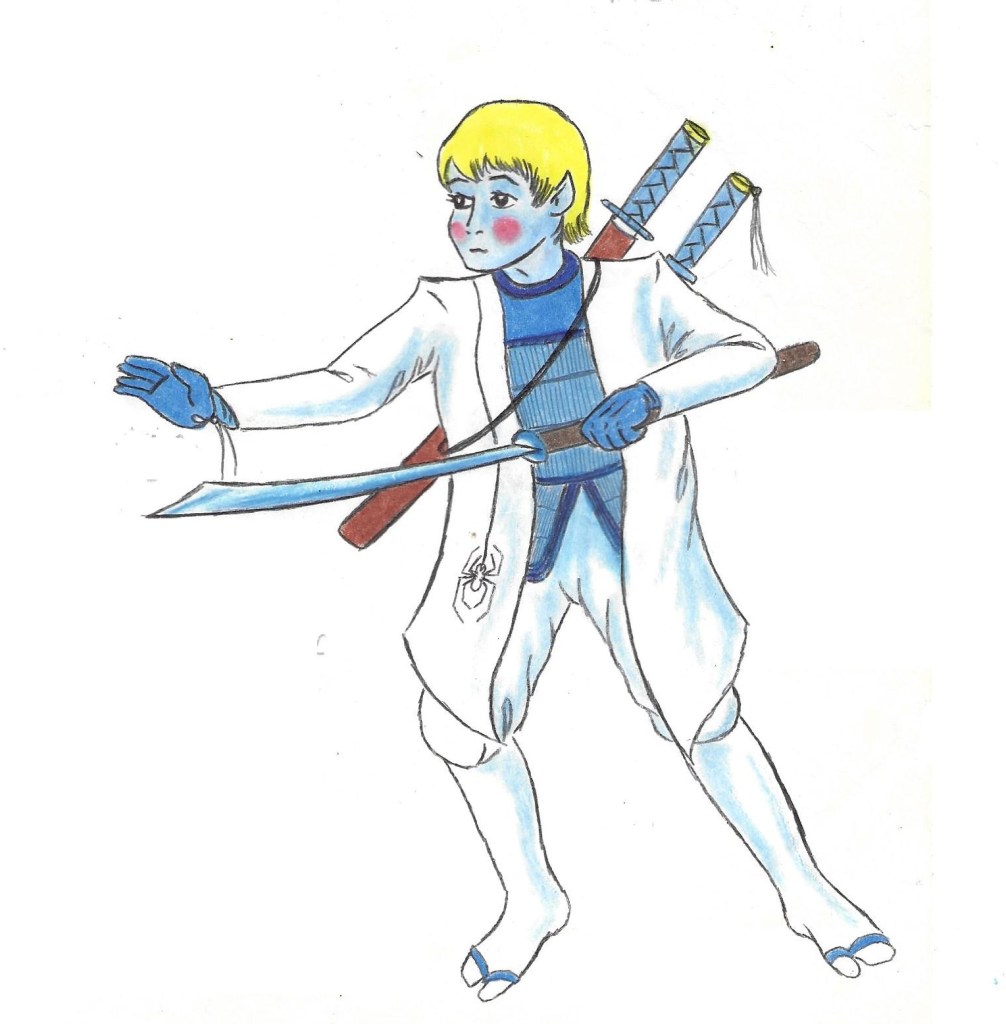
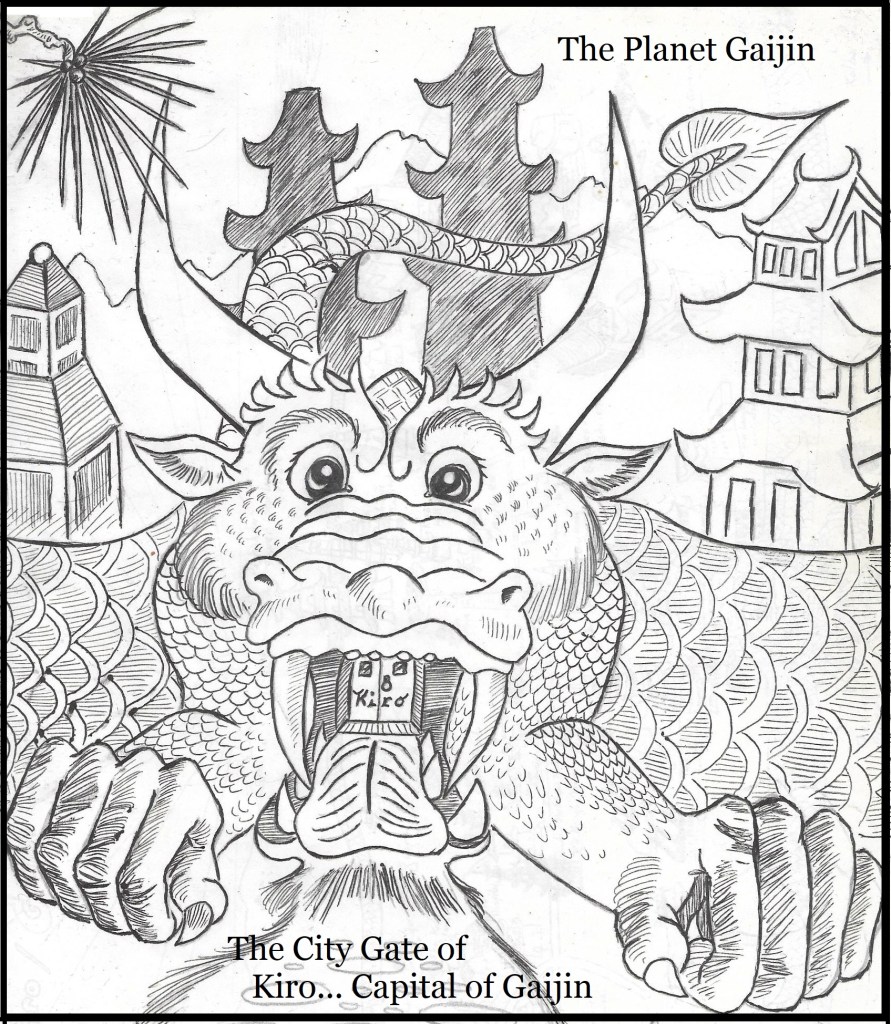
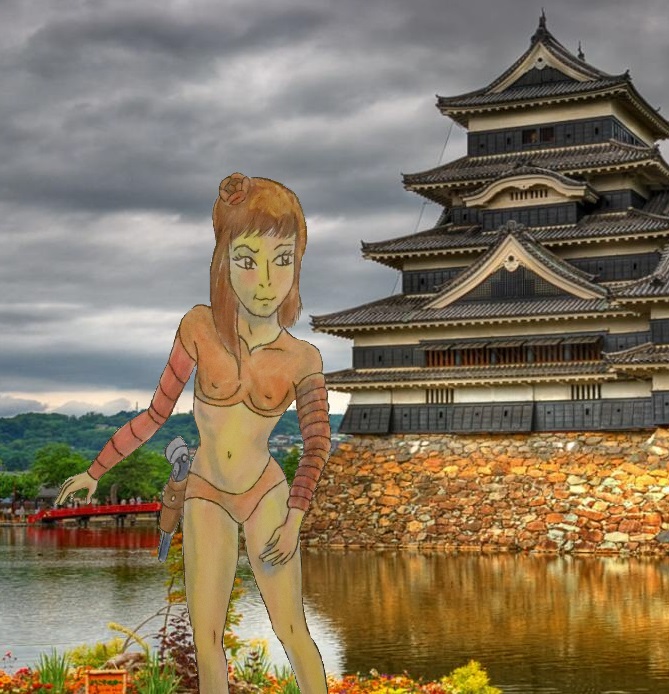
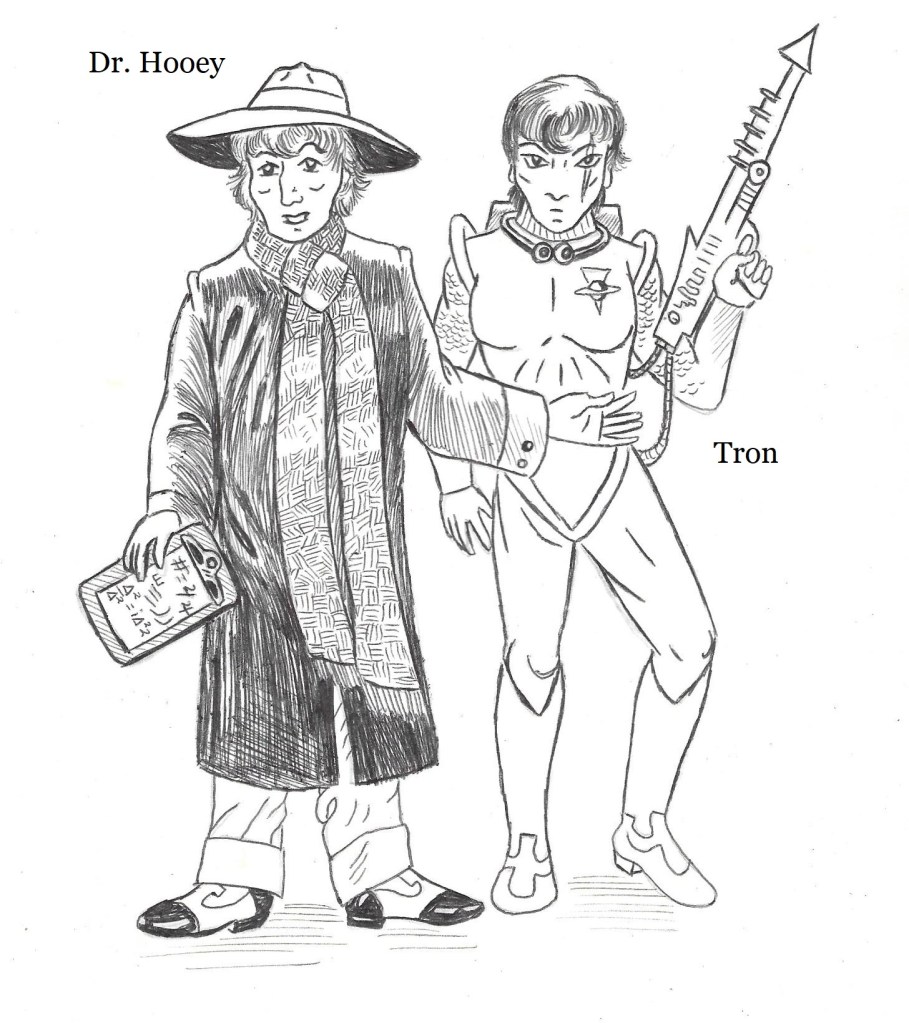
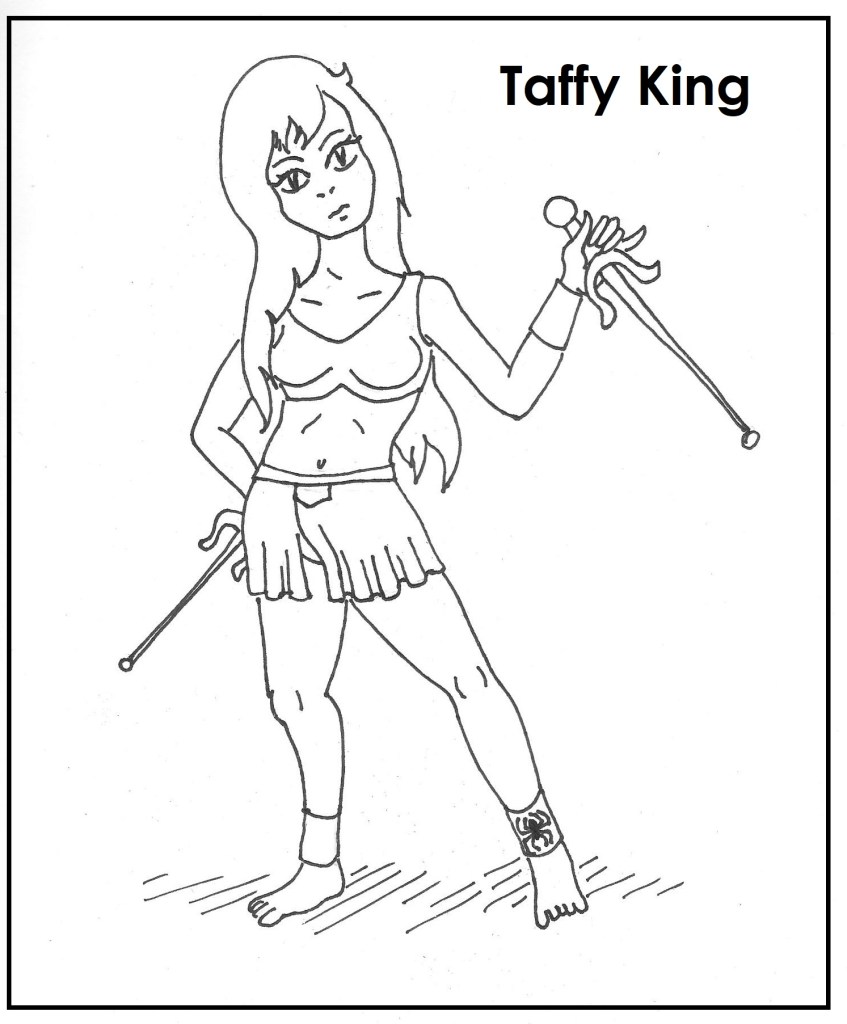
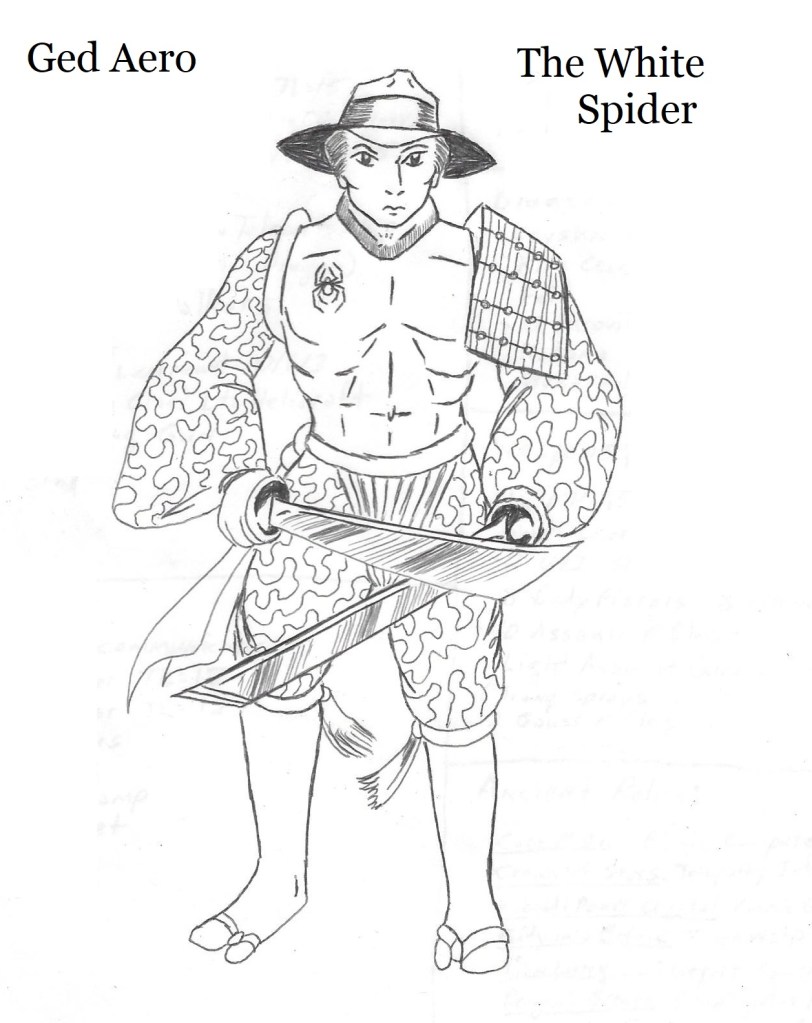
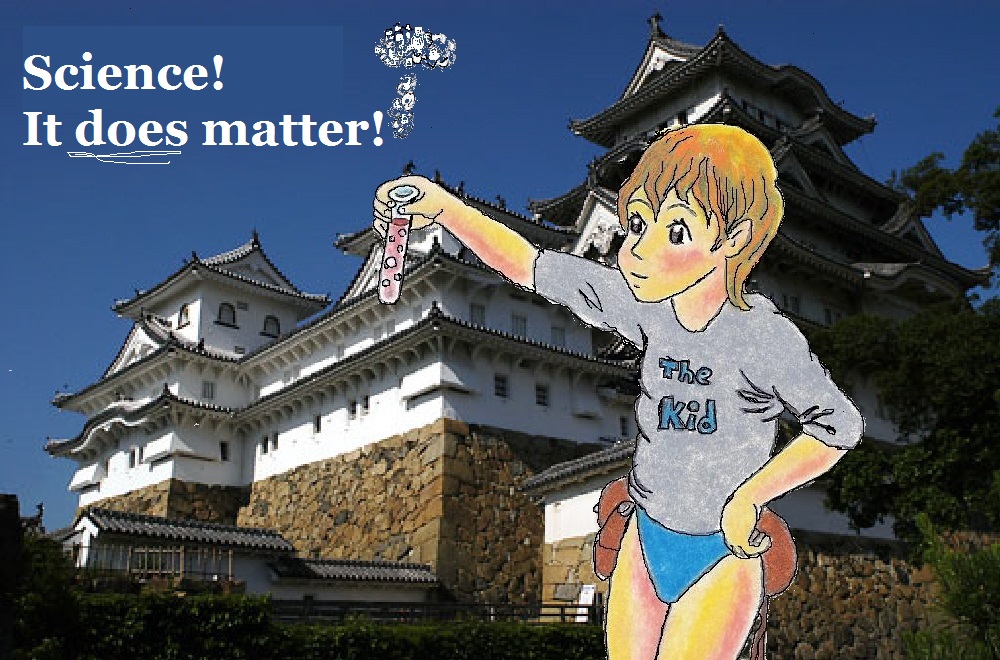
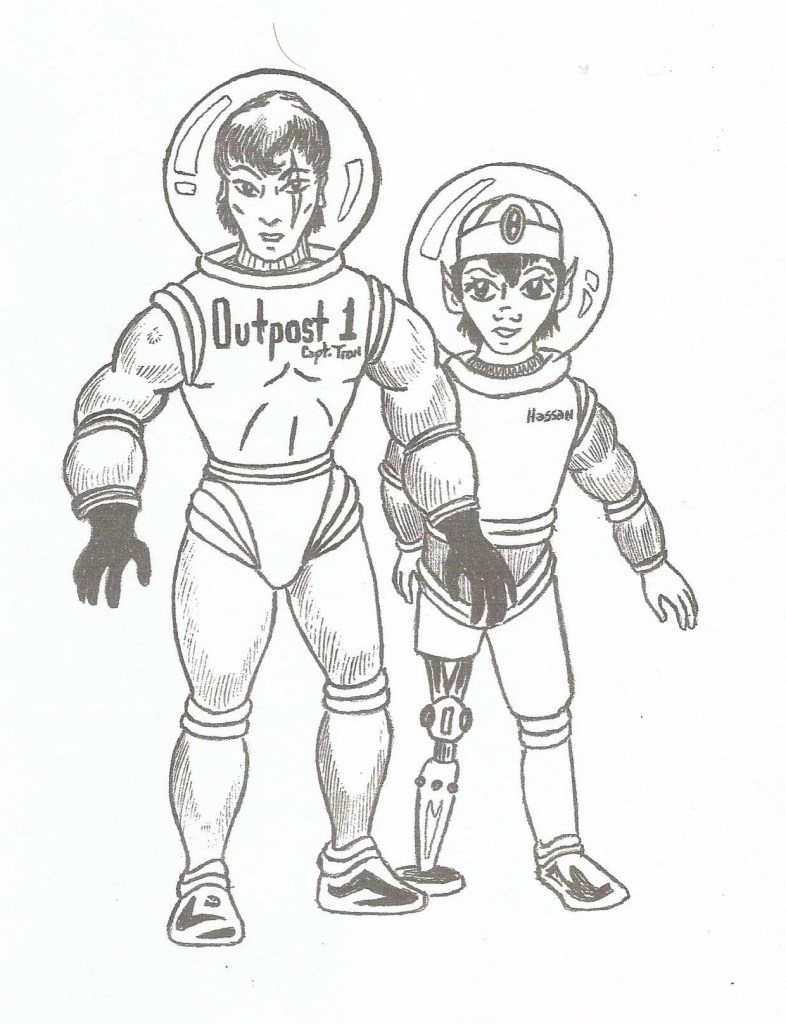
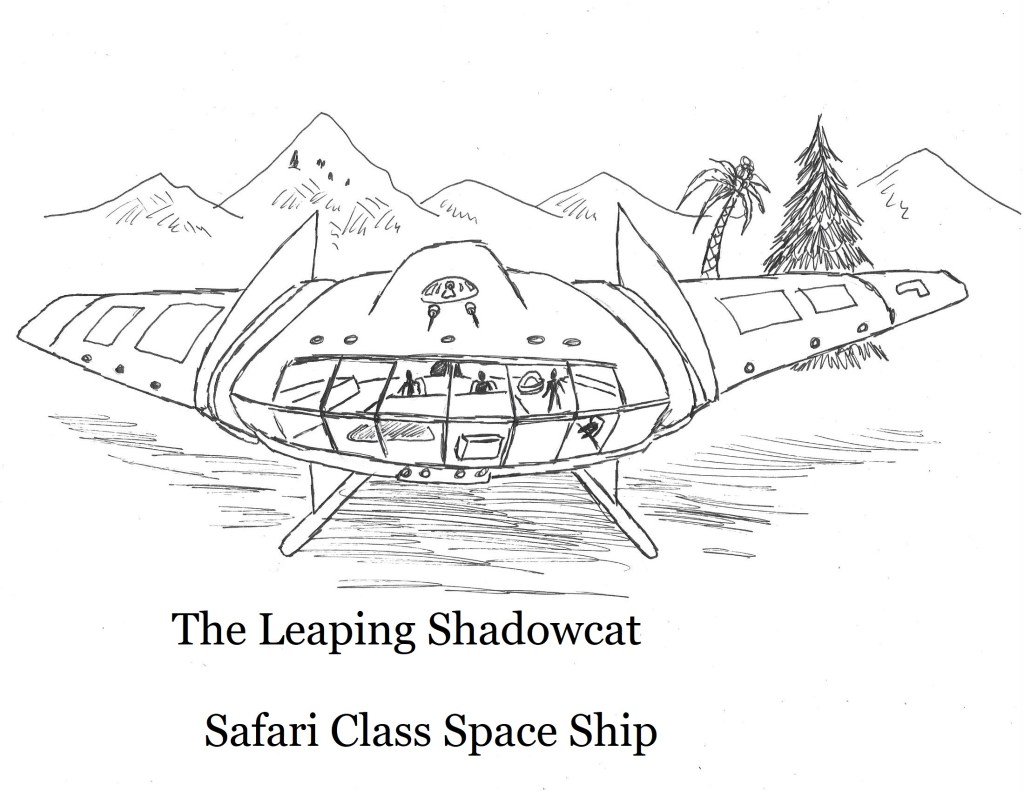
In the 80’s and early 90’s I played a lot of the science-fiction-role-playing game called Traveller. Those hours and hours of gaming produced the characters and stories I turned into my novel AeroQuest, now AeroQuest 1, 2, and very soon3. So, most of this artwork is either for the game and was used as a part of it, or the book, used as an illustration.
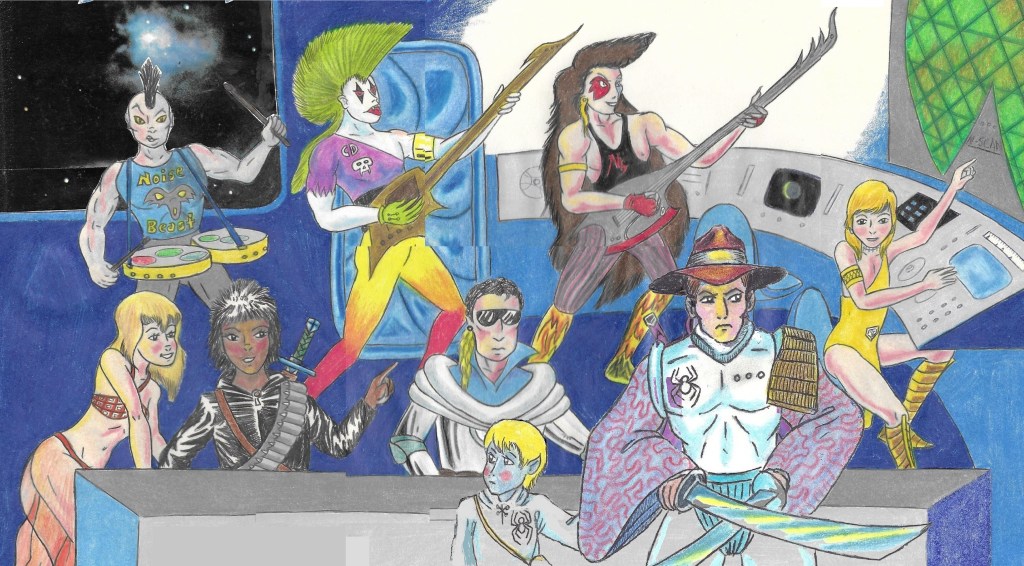
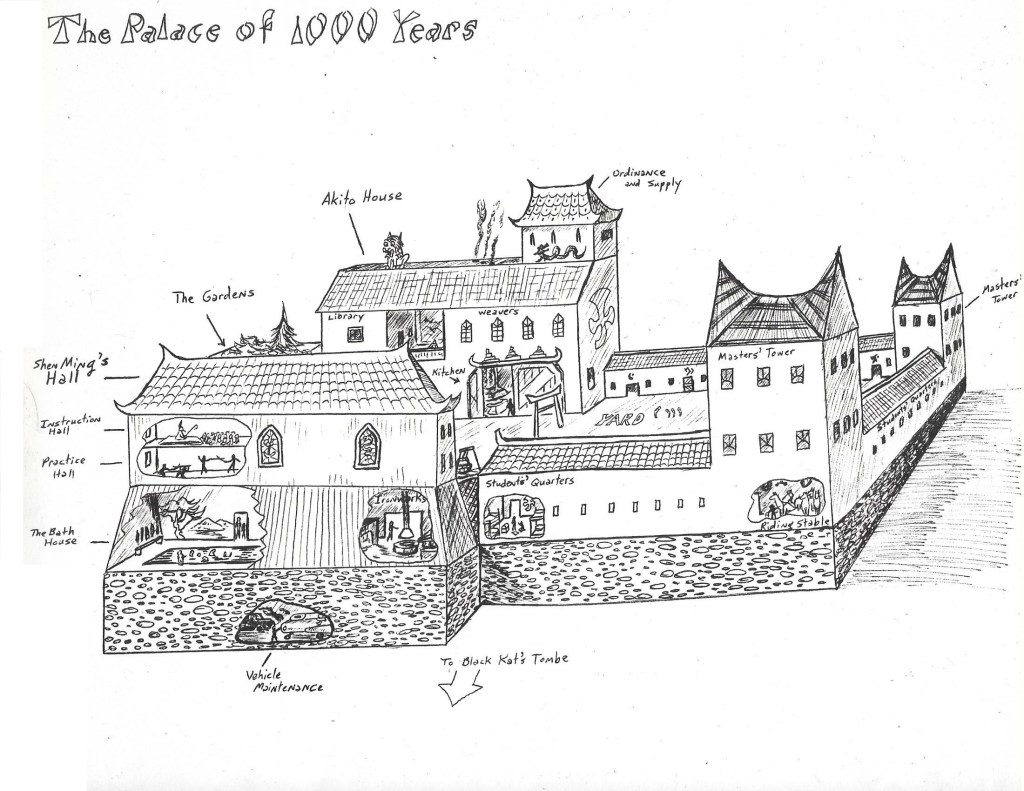
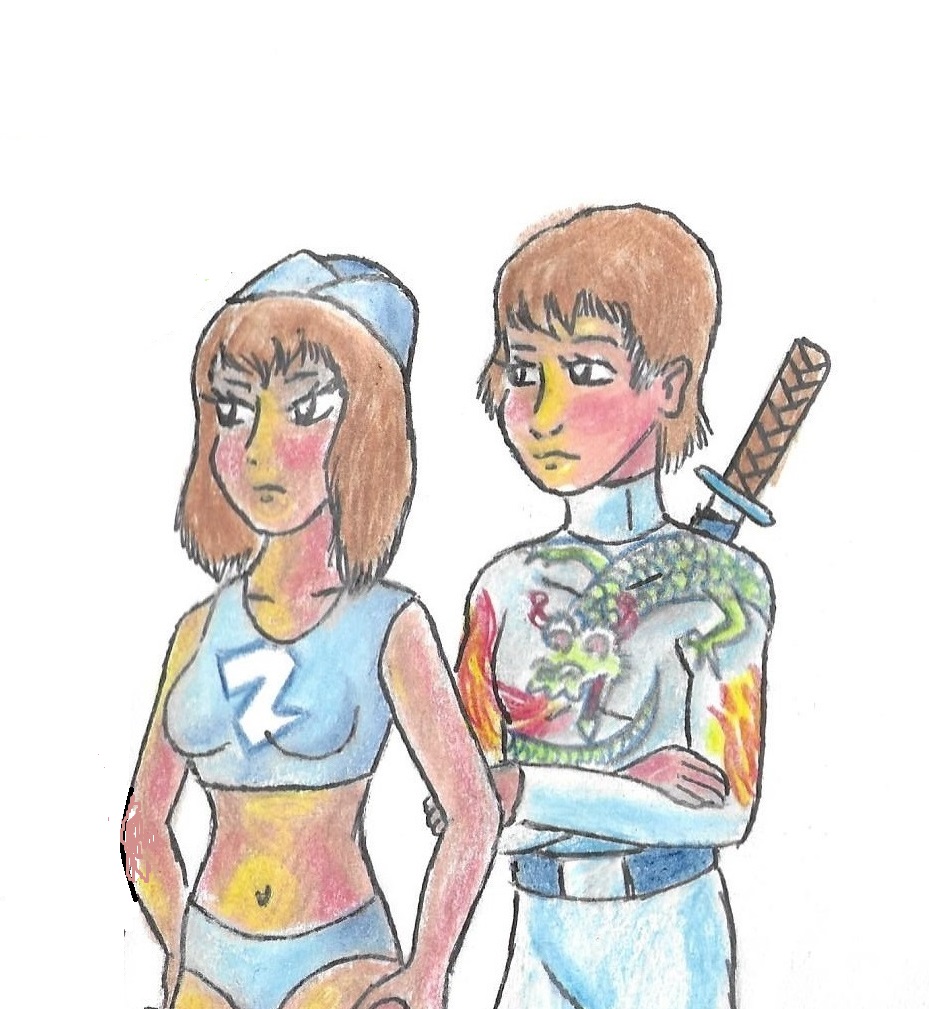
The Megadeath starship with her motley crewJunior AeroMai Ling on the planet GaijinShen Ming’s Palace on the planet Gaijin
Jadalaqstbr the teleporter and Alec Songh
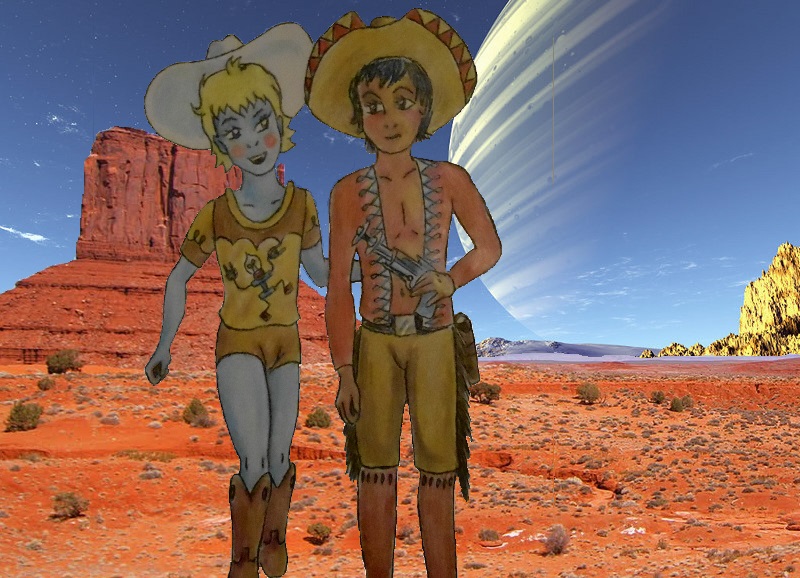
Gyro the Nebulon and Shaman Billy Iowa
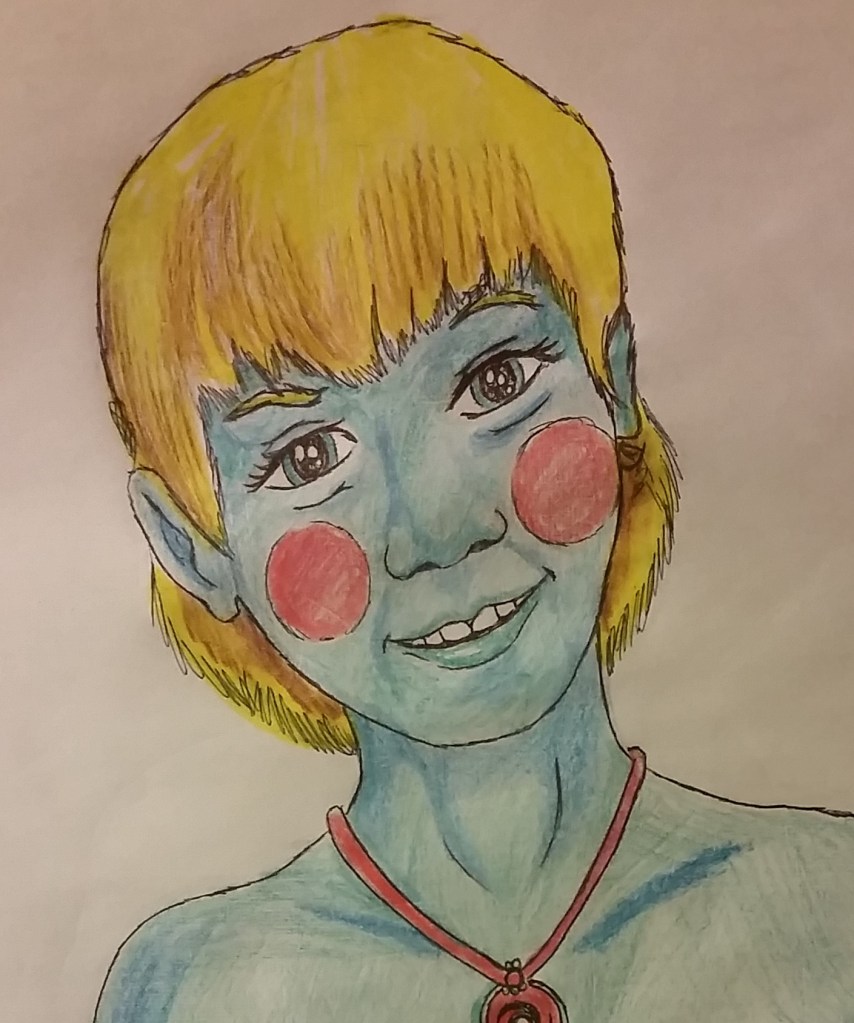
Tiki Astro is an artificial robot boy that looks fully human.
Tron Blastarr and Hassan the Peri ElfJunior Aero, Nebulon adopted son of Ham Aero
Nocturne 7 – The Prophecy Fulfilled (the White Thread)
Ged returned to the Palace of 1,ooo Years with a lot on his mind. But, in truth, the last thing he was thinking of was becoming a biological father.
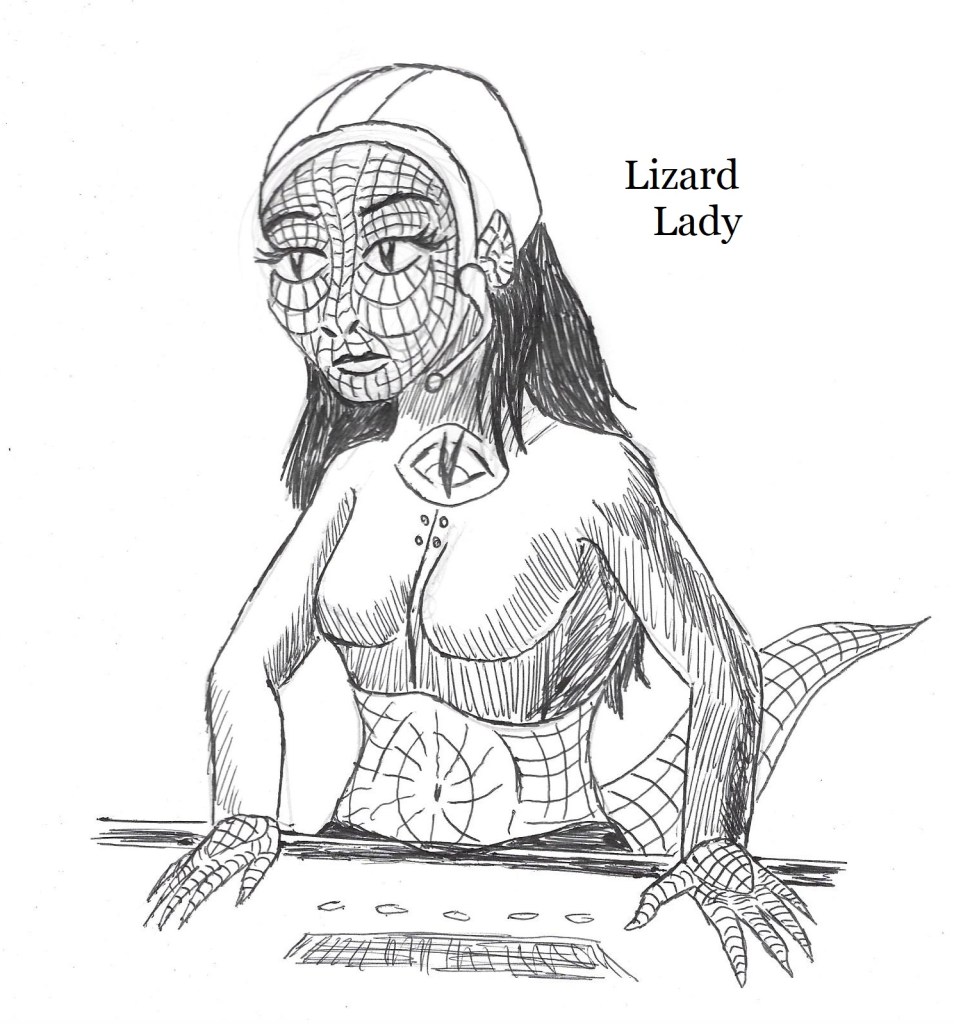
As he was entering the apartment that he shared with the Lizard Lady, he was surprised to see her sitting at the table with her feet folded under her and a large green egg on the tabletop in front of her.
“What is this, Liz?”
“You have been busy, my love.”
“I have, yes.”
“So have I.”
Ged suddenly had an eerie feeling about what this all meant.
“Is that…?”
“It is. You must say hello to your firstborn son.”
“But that is an egg.”
“One cannot fool the White Spider.”
“Galtorrian females lay eggs?”
“We do. Its gestation still has another six lunars to go.”
“Six Gaijinese lunars? Ten Earther months?”
“That is correct. You were in Galtorrian form when he was conceived. He will be as pure-blooded as any Galtorrian ever is.”
“How do you know it is a boy? Is he already formed in the egg that way?”
“That I do not know. But this is the child of the prophecy. This will be Lizardboy Aero, heir of the White Spider.”
“You will tend the egg like a bird? On a nest?”
“Not quite. Shen Ming has the necessary incubators to raise a Galtorrian cub. Lizardboy will not be the first eggborn delivered on this planet.”
Ged knelt on the opposite side of the table.
“May I hold it?”
“Certainly. You are his father.”
Ged carefully took the leathery but firm egg from her. He turned it over and over in his hands, examining it carefully.
“My mother on Questor would never have believed this of her son if she were still among the living.”
“May Zhan keep her soul, and may she be blessed by her grandson from another world.”
“Are all Galtorrian purebloods born by eggs?”
“Not all. There is much Earther DNA in Galtorrians. They have been intertwined for more than three thousand of your Earth years. Possibly from a time even before our two home-worlds were ever aware of each other.”
“I know fusions like Phoenix and Taffy King were born the way Earth humans are born.”
“Yes. All fusions are born the Earther way. That is why they are so much more human-looking than I am.”
“Ah, but you are beautiful too. I admit, I never felt it at the beginning, but I do love you now. And I will love this boy as well.”
“Now comes the hard part, my love.”
“What do you mean?”
“If it hadn’t been for the Prophecy of Zhan, I would never have met you. But my part in the prophecy is not yet ended. I am still a spy in the service of the Imperium, and I still have a destiny to fulfill.”
“So… what does that mean for the two of us?”
“We must part for now. I will leave in the morning, heading back into the Imperium.”
“In what ship? There is only the Dragon and the Rooster on this planet now.”
“The prophecy says a scout ship will arrive tomorrow. I must be on it when it leaves.”
“How will I raise our son without his mother?”
“You will be a wonderful father. And young Sara Smith is not the only lovely little lady that will happily play mother to our son.”
Ged’s head was swimming with emotion. This parting was completely unexpected and unwanted.
Most star systems in both the Imperium and what would become the New Star League are generally referred to by their primary world, the planet in the system with the most population, highest technology, and/or the dominant culture. Between the worlds of Djinnistan, Houris, and the three moons of the inner gas giant that had habitable atmospheres and ecosystems, namely Pan, Eblis, and Surtur, Djinnistan took first place not by population or culture, but because it was one of the three heart-worlds of Faulkner Genetics.
Now, I have never contended that I am any sort of expert on genetics and the science of DNA manipulation, but I do understand the dominant role that heart-worlds had in the creation of the kind of beings known as Freaks.
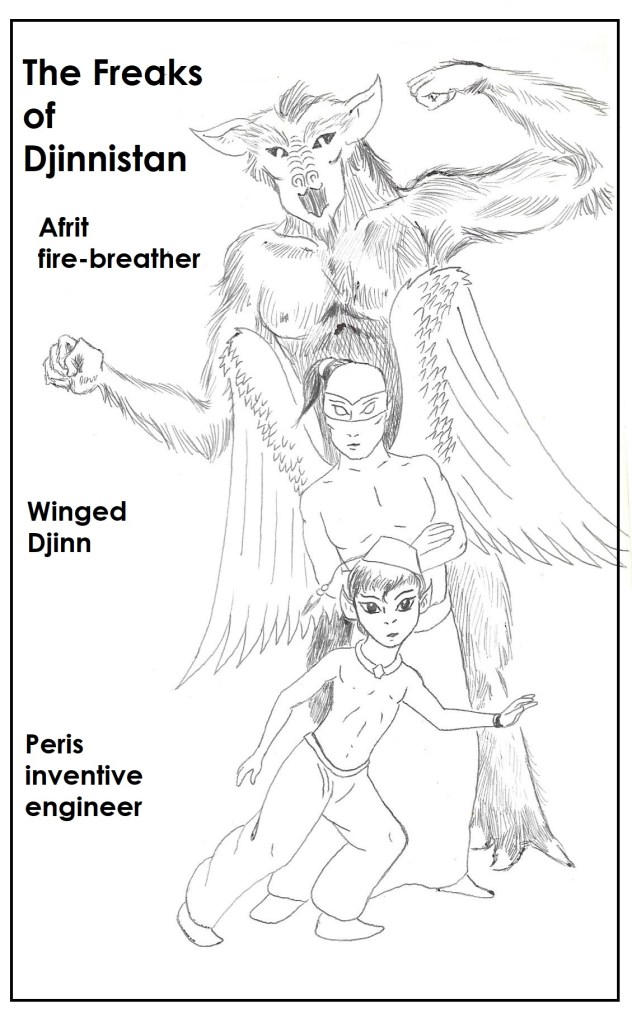
Freaks were genetically engineered slave races bred mostly from human DNA, though also including recombinant lifeforms made from other viably sentient creatures. They ranged from the Longlegs Speedsters of the planet Martin Faulkner’s Dream, to the Man-bull living bulldozers of Sword-World Prime, to the fire-belching Afrits of Djinnistan.
Djinnistan was the science playground of Faulkner Genetics’ number-two man, Dr. Havir Bludlust. He was a man capable of grafting and gene-splicing his own body to achieve a sort of immortality, and doing any necessary horrible thing to other beings to get the specific genetic effects he wanted in a special slave. It is rumored that he had genetically amplified his own brain and given himself two giant bird claws in place of feet. Many claim that his self-manipulations drove him to insanity, but the masters of gene-splicing were all a little bit insane to begin with.
On Djinnistan, Dr. Bludlust produced three different kinds of Freaks with a decidedly Arabian Knights sort of theme.
The little halfling-like creatures, called Peris by Dr. Bludlust, were bred for extreme creativity. They had basically the bodies of a human child with a slightly larger-than-normal head. Their eyes were large and very clear-sighted. And they thought in very innovative and eccentric ways.
One Peri engineer designed a ground car with chicken legs instead of wheels, capable of hopping over rough terrain and running smoothly at about the hunting speed of a velociraptor, providing the most common vehicle on Djinnistan because it was a design loved dearly by all Peris.
Another Peri engineer created a material-synthesizer cannon that could instantly create any kind of aquatic lifeform in the barrel and shoot it out to a distance of one hundred meters. This “fish-gun” was not particularly useful on a desert world like Djinnistan, but became a popular “trout gun” for the mountain streams of Houris. It was also used as a “barracuda gun” on more violent water-worlds like Design and Dancer.
Besides being wildly creative, Peris were also prolific. A Peri female was capable of having one baby a year for 280 years out of a normal 320-year lifespan. That’s how you end up with baby names like, “Another Danged Boy Number 152” whom I may talk about later in this epic tale.
A second main form of Djinnistani Freak is the Winged Djinn race of humanoids with hollow bones and avian wings. These people are capable of extra-vehicular flight within the atmosphere, creating slaves capable of reaching all sorts of difficult-to-reach places on jungle planets, mountainous regions, and extra-large air spaces aboard some of the largest cargo cruisers in space.
These winged beings were the most numerous peoples residing on Houris, Pan, and Eblis. They were second only to the Peris on Djinnistan, and even the third most common residents of the magma-filled world of Surtur.
The hulking and sulfurous Afrits were a unique race designed to have fire-breathing capabilities. They were not blessed with high intelligence, but they made excellent warriors, and even better artillery pieces. They were capable of vomiting napalm-like material from their own stomachs as far as half a mile away with deadly accuracy. They were also fire-proof enough to survive a direct hit from a plasma rifle fifty percent of the time. Of course, they were most common on Surtur, but found on all the worlds of the Djinnistan System.
So, this was the planetary system that Arkin Cloudstalker, Black Fly, and Lazerstone came to in order to invade, with just the three of them to conquer the entire star system.
My experience of the works of Kurt Vonnegut is limited to the reading of three books; Cat’s Cradle, Breakfast of Champions, and Slaughterhouse Five. But it was enough to make me love him and use him as a shaper of my soul.
I deeply apologize for the fact that even though he only wrote 14 books and a bunch of short stories, I have not read everything I could get my hands on by Kurt. Three novels and one short story (Harrison Bergeron) is not really enough to compare to the many, many things that I have read by Mark Twain, Terry Pratchett, Louis L’Amour, and Michael Crichton. I can’t begin to count how many books of each of those four I have read and reread. But it is enough that I read those three novels and have a lifelong regret of never buying and reading Slapstick when I had the chance. Vonnegut writes black humor. The ideas are painful, and burn away flesh from your personal body of being. And at the same time, you cannot help but laugh at the pure, clean, horrifying truths his ridiculous stories reveal.
If, in the course of telling a story, you can put the sublime, the ridiculous, and the horrendous side by side, and make the reader see how they actually fit together, then you can write like Vonnegut.
Let me give you three quick and dirty book reports of the Vonnegut I have read in the order I have read them;
I read Cat’s Cradle in college. I was young and idealistic at the time, foolishly convinced I could be a great writer and cartoonist who could use my work to change mankind for the better.
In the book, Dr. Felix Hoenikker (a fictionalized co-creator of the atomic bomb) is obsessively re-stacking cannonballs in the town square in pursuit of a new way to align water molecules that will yield ice that does not melt at room temperature. Much as he did with the A-bomb, Hoenikker invents a world-ending science-thing without any thought for the possible consequences. The narrator of the novel is trying to write a humanizing biography of the scientist, and comes to observe the inevitable destruction of the whole world when the oceans freeze into Ice-9, the un-meltable ice crystal. Before the world ends, the narrator spends time on the fictional Carribean island of San Lorenzo where he learns the fictional religion known as Bokononism, and learns to make love to a beautiful woman by pressing bare feet together sole to sole. It is a nihilistic picture of what humans are really like more savagely bleak than any portrayal Monte Python’s Flying Circus ever did on TV.
Needless to say, my ideals were eventually shattered and my faith in the world shaken.
I read Breakfast of Champions after I had been teaching long enough to buy my own house, be newly married, and a father to one son. It was probably the worst time of life to be reading a book so cynical, yet true.
In this story, the author Kilgore Trout, much published but mostly unknown, is headed to Midland City to deliver a keynote address at an arts festival. Dwayne Hoover is a wealthy business man who owns a lot of Midland City real-estate. Trout gives Hoover a book (supposedly a message from the creator of the universe) to read that suggests that all people (except for the reader of the book… meaning Hoover) are machines with no free will. Hoover takes the message to heart and tries to set the machines free by breaking them, beating up his son, his lover, and nine other people before being taken into custody.
The book contains devastating themes of suicide, free will, and social and economic cruelty. It makes you sincerely reflect on your own cog-in-the-machine reality.
Slaughterhouse Five is a book I bought and read when I missed my chance to buy Slapstick and needed something to take home from HalfPrice Books to make me feel better about what I missed. (Of the five books I had intended to buy that day, none were still on the shelves in spite of the fact that they had been there the week before.) It was fortuitous. This proved to be the best novel I had ever read by Vonnegut.
Like most of his work, the story of Billy Pilgrim is a fractured mosaic of small story pieces not presented in chronological order. It details Billy’s safe, ordinary marriage to a wife who gives him two children, but it is ironically cluttered with death, accidents, being stalked by an assassin, and being kidnapped by aliens. It also details his experiences in World War II where he is captured by the Germans, held prisoner in Dresden, kept in an underground slaughterhouse, and ironically survives the fire-bombing of Dresden by the Allies. Further, it details his time as a zoo exhibit on the alien planet of Tralfamadore.
It explores the themes of depression, post-traumatic-stress disorder, and anti-war sentiment. Vonnegut himself was a prisoner of war in Dresden during the fire-bombing, so real-life experiences fill the book with gravitas that it might not otherwise possess. Whether the author was ever kidnapped by aliens or not, I cannot say.
But Kurt Vonnegut’s desire to be a writer and portray himself as a writer in the character of Kilgore Trout, and even as himself in his work, has an awful lot to do with my desire to be a writer myself. Dark, pithy wisdom is his thing. But that wisdom, having been wrung from the darkness is all the more brightly lit because of that wringing. It is hard to read, but not hard to love.
The spaceship known as The Magic Carpet landed gracefully in the desert downport of the planet Djinnistan. But even as graceful as the landing was, clouds of sand were kicked up in all directions.
“That was a beautiful landing,” Arkin Cloudstalker said to the Black Fly. She smiled at him. She was a stunning beauty without the black mask on.
“Thank you, Captain. You see now why the argument about who flies this ship was pointless?”
“Oh, yes. In fact, when this is all over, I want to recruit you to fly with the Lady Knights.”
“Ah, you flatter me, Captain. I am apparently good enough to fly with a troop of space pirates and criminal rim-world scum.”
“You know what I mean,” he said with a laugh, rising from the copilot’s chair on the bridge.
“Captain?” Lazerstone entered the bridge. “We seem to be under siege by a hoard of children of your species.”
“Oh?” Arkin looked out the viewport and down at the monitors. Child-sized humanoids, both male and female, were everywhere. Some were placing weather-clamps on the landing gear. Others were polishing everything they could reach, and with a strange group of what appeared to be robotically animated ladders, there was no surface on the Magic Carpet they couldn’t reach, even if it meant hanging upside down. Some even seemed to be probing at electrical connections with unidentifiable tools.
“Those are Peris, one of the species of Freaks created and mass-produced on this planet.” Black Fly seemed unconcerned at what was happening to her ship.
“Do you think they might break something, or do damage?”
“No. Dr. Bludlust created them with brains more facile than any computer, and much more creative than any human being, even human beings on psychedelics.”
“They are scanning things,” said Lazerstone. “I hope you have no secrets to conceal.”
“Well, scanners don’t read minds. And the ship itself has no real secrets at this planet’s tech level anyway.”
“The point is, they must not scan me. And I can feel some very uncomfortable scanning frequencies already.”
“They can read your mind or something that way, my friend?” Arkin asked.
“No. But they could disrupt me and cause me to explode with the wrong frequency.”
“How big of an explosion?” asked Black Fly.
“Twenty thousand megatons of thermonuclear energy, depending on how many harmonic stones surround us for my death to activate.”
“That sounds like a potential problem,” Arkin said.
“I have the word of a time knight that such an event will not take place,” Black Fly calmly told them.
Three of the small Peri creatures entered the bridge at that moment. One was a boyish male, and two were childlike girls.
“Greetings, travelers. We welcome you to the enchanted planet of Djinnistan. How may we be of service to you?” said the red-haired girl Peri.
“Well, to be honest,” said the Black Fly, “We have come to liberate this planet so that it can join the New Star League.”
“Oh, that sounds very ambitious,” said the boy Peri. “You do realize that you will have to defeat the minions of Dr. Havir Bludlust, right?”
“Yes, and are you sure it is a good idea to tell these natives that we are invading?” Arkin asked Black Fly.
“Oh, of course. These are not so much natives as they are slaves. Many of them not happy with how they were created, exploited, and abused. We will be calling them our army soon enough.”
Outpost was abuzz with activity. The airless world had only limited defense from attack. The primary protection had always been the secret of its location. As an airless world, the surface could easily be lasered or bombarded with no atmosphere to interfere with the destructive force. Tron had ordered the mirror fields raised, hoping that some laser fire could be reflected back into the surrounding darkness. He knew, however, that the only hope he had was in his fleet. If they could somehow destroy enough of Admiral Tang’s fleet to make him feel the losses were no longer worthwhile, then maybe the groundside installations could survive intact.
There were still very talented corsairs able to fly fighting ships. Elvis the Cruel and Apache Scout were both peerless star warriors. But Tron had to believe that Admiral Tang had a few potent killers left to his name too. There was every chance that the situation was hopeless and would end in massacre.
Still, there were a few unknowns on Tron Blastarr’s side. The crazy alien star ship known as the Megadeath was the most agile killing machine that Tron had ever seen. The goofball rock-and-roll crew that flew it for Trav Dalgoda was now very adept at handling the alien thing, and Tron had kept them to help in his mad last stand. They were not smart enough to be scared of the upcoming battle.
He was able to send his son onward to Ged Aero on the unknown planet Gaijin, where little Artran would be safe and well-cared-for long after Tron and Maggie’s bones littered the airless sands of Outpost. He had put Artran on the scout ship himself with the somewhat strange courier that had come with the ship from Don’t Go Here. This Bill the Postman really worried Tron. The man was not entirely right in the head somehow.
“Boss,” said Hassan the Elf, breaking Tron’s train of thought, “I have made something that I think might be of help.”
Tron looked at the child-like Peri and the invention he was now holding up. “A suit of armor?”
“Yes, boss. A special kind of suit of armor. It is made up of nanites.”
“What? Nanites?”
“Yes, microscopic robots that share a command pulse and can reform themselves into any sort of armor that might be needed.”
Tron looked quizzically at the bluish suit of nanite armor. “How do you make it work?”
“Well… for instance, if you want it to form an anti-grav pack on the back, you just say FLIGHT-PACK.” The suit rearranged itself at Hassan’s command, and an anti-gravity flight-pack instantly took shape on the back side of the armor’s breastplate.
“Does it have weapons?”
“FUSION-GUN!” said the elf with a grin. A man-portable fusion generator and its discharge-barrel formed on the pauldron.
“That’s really good, Elf. That will help. But one isn’t going to be enough to save us.”
“Oh, that’s the best part,” said the Peri. “Nanites can replicate themselves from raw metal ore. Since the planet is mostly metal and crystal, we can set them to making a million copies of themselves in an hour. You have to specify the number, though. We wouldn’t want the little buggers transforming the entire planet.”
“Amazing,” sighed Tron. “If only I had a million commandos to fill them with.”
At that moment Maggie came trotting up to him with a handheld communicator. “The call is for you,” she said, looking grim. “Arkin Cloudstalker has found some allies to help us fight. He says he will visit one more planet and then be on his way to this system. Admiral Tang is sure to follow.”
“Yes. Sure to follow,” said Tron automatically, still gazing at the grinning elf and his newest invention.
Canto 84 – The Lords of the Jungle (the Green Thread)
King Killer returned to consciousness in the midst of an elaborately built tree house. His right arm and shoulder were burning with excruciating pain. His vision was somewhat blurry, but he could make out two smiling faces looking at him, neither of which was familiar in any way. The boy was nearly nude, wearing only some kind of fur loin-cover that really wouldn’t have covered anything if he had had anything to cover. His red hair was wild and uncut, something like a lion’s mane with tangles. The woman was dressed in an expensive leather suit, the kind nobles often wore in order to tour the more dangerous parts of resort planets. She was a beauty with large red lips and liquid brown eyes. Her hair was well kept and perfectly arranged in this steamy jungle.
“Who… are you?” King finally spit out.
“I am the former movie star known as Wicked Wanda,” said the woman. “You may have seen me in the holo-epic AllSpaceways Lead to Galtorr, or the romantic comedy The Corsair’s Wife.”
“Um, no.”
“That’s okay. I know my fame and talent haven’t reached all the way to the frontier, yet.”
King looked around. Hooey and Willie Culver were sitting a short distance away, talking to a man in a black robe with a hood over his head. He wanted to get up and go over there so he could kick Hooey in the head for doing this to him.
“What’s wrong with me? Why can’t I get up from here?”
“You have a terrible infection in the wound from the creature’s carnivorous mouth. I’m a pretty good medic as well as a holo-epic star, so I’ve been trying to treat it without antibiotics.”
King looked at the boy. “I guess I owe you my life,” he said soberly. “Thank you.”
“Me Randy,” said the Jungle Boy, pounding his chest with one fist.
“That’s all he can say,” said Wanda. “He was apparently the only one to survive from his crashed spaceship, and the monkey people of this planet raised him.”
“Monkey people?”
“The Lemurians. They live on several jungle planets, or the jungle parts of medium life-belt planets. They have a whole city here in the trees. They built this place. If Admiral Tang knew they were here and rescuing some of the people he maroons here, he’d probably throw a mechanoid fit.”
“Yes, I owe them too. I have to survive this place to get revenge on Tang.”
Wicked Wanda smiled a sinister smile. “Revenge is not a good enough motivation for most people, but I can tell it fits you perfectly.”
“Yeah, I’m a dangerous man.”
“Sure you are.”
“How smart are these Lemurians?”
“Oh, they are very clever. They can’t talk though, unless Oook means something in monkey-talk.”
“You can’t communicate with them?”
“Oh, we can. Slythinus over there can use some kind of telepathy on them.” She pointed at the man in the robe.
“Slythinus? As in Emperor Slythinus?”
“Yeah, that’s him. Mr. Golly Bigdeal is a prisoner here just like the rest of us.”
“How? I mean, he’s still the Emperor, isn’t he?”
“Not really any more…” Wanda looked at him sadly. “There was a coup by some guy called Prince Ali. Slythinus was left here to die while other people took over his empire. I understand the Imperium belongs mostly to Mechanoids and Galtorr-Human Fusions now. That’s how I got here, taking pity on a human leader that had fallen out of favor with his planet. You may have heard of him. You know, Duke Ferrari of the Coventry Sector?”
“I’ve heard the name. Don’t know much about the man, other than the fact that we freed him from a dungeon on the planet White Palm. I guess that’s how Tron’s Pinwheel Corsairs got our behinds handed to us in a basket, payment from the Imperium for freeing the Duke.”
“He’s free? Oh! I love you for that!” Wanda leaned in and planted a big, passionate kiss on King. He was instantly surprised and embarrassed.
“Well, well, well,” said Dr. Hooey. “I see you’ve met your future wife already.”
“I swear, Hooey, I will kill you one day.”
“Oh, no you won’t. I’ve read the proof in one of King Ryan Beowulf’s books about the future.”
“The future?” Wanda was puzzled.
“Oh, yes,” said King sarcastically. “Dr. Hooey here is a Time Knight, and destined to get us all off this planet.”
“Really?” said Wanda, obviously contemplating another thank-you kiss. King found that he hated that idea. “How will we get off?” she asked.
“There’s a certain device hidden in the ruins,” said Hooey.
“What ruins?” asked the robed man, walking up to King also. “I know of none.”
As Slythinus approached, King could see that his Galtorrian lizard eyes were gone. The former Emperor was now blind. “Your monkey friends know,” said Hooey. “Although, I have to wonder why they’ve kept the knowledge from you. It is the way they have gotten from planet to planet, you know.”
Canto 83 – Star Nomads Revealed (The Silver Thread)
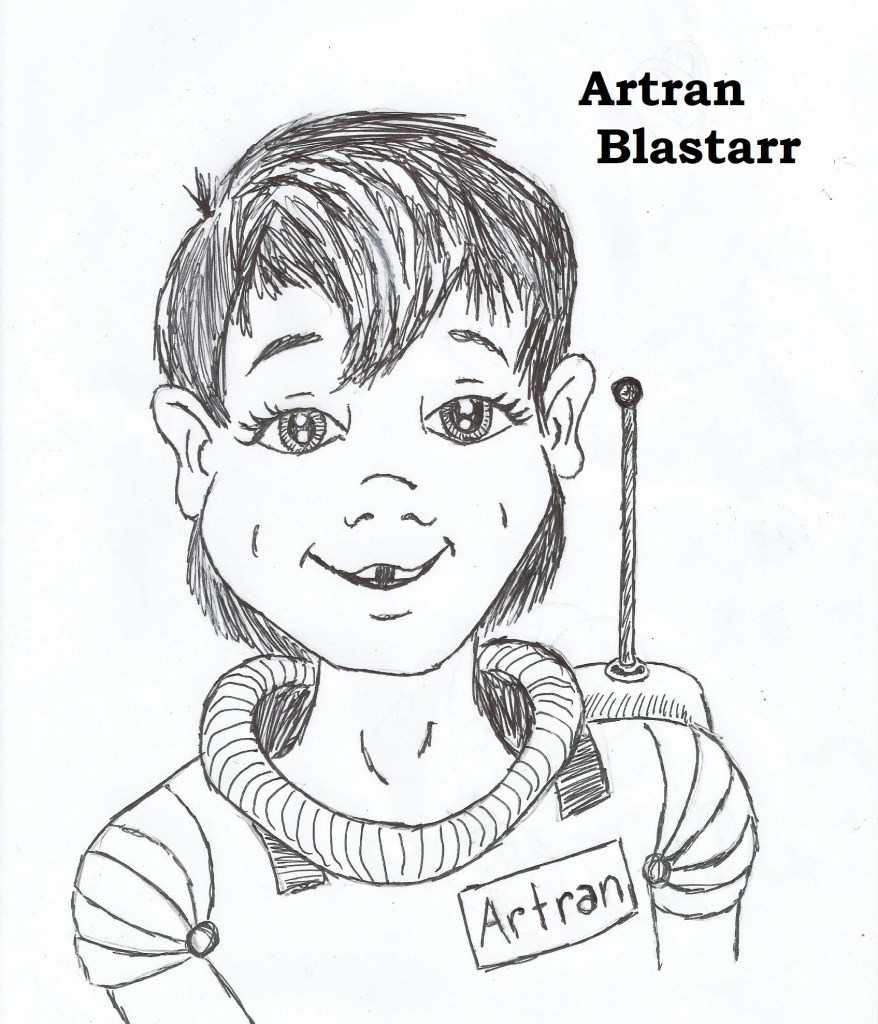
Artran Blastarr, the eight-year-old son of space pirates, and Tiki Astro, the robot-boy, stood holding hands on the docking bay floor next to the somewhat unreliable yet amazingly effective Bill the Postman (Scarpigo Snarcs in his current secret identity).
From the portal opposite, on the far side of the docking bay, three gigantic humanoid figures dressed in metallic armor of some kind emerged.
“Who… who are those?” gasped Artran.
“Those are Star Nomads. If I don’t miss my best guess, it is the Black Knight, the Dark Traveler, and the Magnificent Wanderer,” said Bill.
They slowly approached, each a massive figure in armor that completely covered their entire bodies, completely obscuring even their faces, no matter what race or configuration they actually represented. The Black Knight was all in gleaming black armor with a razor-edged hook for a crest on his faceless helmet. The Dark Traveler was all decked out in metallic green armor. And the Magnificent Wanderer, as Bill pointed out, was armored entirely in gleaming silver.
Drawing close enough to speak, the Magnificent Wanderer’s voice boomed out like a thunderclap on a rainy planet. “So, you have brought us the chosen one, Scarpigo Snarcs.”
“Yes, oh Magnificent One. But please refrain from using my real name in front of those who might not be stupid enough to misremember it.”
“I will never fully understand why demi-humans like this one insist on their comic prevarications the way this one does,” said the Dark Traveler.
“Indeed,” said the Wanderer. The Black Knight remained silent.
“Who is this chosen one?” asked Tiki Astro meekly.
“The human child born on the planet known as Outpost.” The Traveler nodded at Artran.
“Me?” squeaked Artran.
“Of course, you,” said the Wanderer. “We need an authentic discoverer of worlds for our purpose.”
“…And you know the boy thinks that’s the silliest thing he ever heard,” said Bill.
“Of course, he does. We pulled him out of the time stream well before he was ready to set foot on his first planet. Who better to use for the purpose, than the one fated to it?”
“Yes, you are right,” admitted Bill quickly. “You are always right.” Bill rolled his eyes when the Wanderer’s featureless face was turned away.
“So, Tiki and I are supposed to be here? This wasn’t just an accident?”
“The robotic child-construct is fated to be elsewhere. You alone are the chosen one, Artran Blastarr.” The Wanderer pointed his armored finger at Artran’s breastbone.
“No! I won’t go anywhere without my friend Tiki!” Artran began to leak emotion-induced wetness from his childish eyes. Of course, the Star Nomads would never give in to any such emotional nonsense.
“The Metaloid boy belongs to the White Spider,” said the Black Knight in what can only be described as a dark black voice. “He must be there when the critical time comes. The universe decrees it.”
“You can count on me,” said Bill, not actually adding, “because I must be some sort of human abacus.”
“You are not actually human,” said the Wanderer, apparently answering Scarpigo’s thoughts.
“What if I don’t agree to go to this White Spider?” asked Tiki.
“Then we invoke protocol alpha in your programming,” said the Wanderer.
“Oh. Sorry, Artran. I have to be going. It’s a robot thing.”
By this time Artran was beside himself with misery. “Bye, Tiki. I love you.”
The real boy and the robot boy briefly hugged before Bill (Scarpigo) the Postman led Tiki Astro back to the X-boat.
Artran looked up at the Wanderer with tear-filled eyes.
“So, are you gonna eat me now?” he said in a fully resigned voice.
“We no longer consume food of any sort. We will now take you to civilized planets that you will learn about and then give to the newly-formed alliance that is to become the New Star League.”

 Catch a Falling Star
Vonnegut
My experience of the works of Kurt Vonnegut is limited to the reading of three books; Cat’s Cradle, Breakfast of Champions, and Slaughterhouse Five. But it was enough to make me love him and use him as a shaper of my soul.
I deeply apologize for the fact that even though he only wrote 14 books and a bunch of short stories, I have not read everything I could get my hands on by Kurt. Three novels and one short story (Harrison Bergeron) is not really enough to compare to the many, many things that I have read by Mark Twain, Terry Pratchett, Louis L’Amour, and Michael Crichton. I can’t begin to count how many books of each of those four I have read and reread. But it is enough that I read those three novels and have a lifelong regret of never buying and reading Slapstick when I had the chance. Vonnegut writes black humor. The ideas are painful, and burn away flesh from your personal body of being. And at the same time, you cannot help but laugh at the pure, clean, horrifying truths his ridiculous stories reveal.
If, in the course of telling a story, you can put the sublime, the ridiculous, and the horrendous side by side, and make the reader see how they actually fit together, then you can write like Vonnegut.
Let me give you three quick and dirty book reports of the Vonnegut I have read in the order I have read them;
I read Cat’s Cradle in college. I was young and idealistic at the time, foolishly convinced I could be a great writer and cartoonist who could use my work to change mankind for the better.
In the book, Dr. Felix Hoenikker (a fictionalized co-creator of the atomic bomb) is obsessively re-stacking cannonballs in the town square in pursuit of a new way to align water molecules that will yield ice that does not melt at room temperature. Much as he did with the A-bomb, Hoenikker invents a world-ending science-thing without any thought for the possible consequences. The narrator of the novel is trying to write a humanizing biography of the scientist, and comes to observe the inevitable destruction of the whole world when the oceans freeze into Ice-9, the un-meltable ice crystal. Before the world ends, the narrator spends time on the fictional Carribean island of San Lorenzo where he learns the fictional religion known as Bokononism, and learns to make love to a beautiful woman by pressing bare feet together sole to sole. It is a nihilistic picture of what humans are really like more savagely bleak than any portrayal Monte Python’s Flying Circus ever did on TV.
Needless to say, my ideals were eventually shattered and my faith in the world shaken.
I read Breakfast of Champions after I had been teaching long enough to buy my own house, be newly married, and a father to one son. It was probably the worst time of life to be reading a book so cynical, yet true.
In this story, the author Kilgore Trout, much published but mostly unknown, is headed to Midland City to deliver a keynote address at an arts festival. Dwayne Hoover is a wealthy business man who owns a lot of Midland City real-estate. Trout gives Hoover a book (supposedly a message from the creator of the universe) to read that suggests that all people (except for the reader of the book… meaning Hoover) are machines with no free will. Hoover takes the message to heart and tries to set the machines free by breaking them, beating up his son, his lover, and nine other people before being taken into custody.
The book contains devastating themes of suicide, free will, and social and economic cruelty. It makes you sincerely reflect on your own cog-in-the-machine reality.
Slaughterhouse Five is a book I bought and read when I missed my chance to buy Slapstick and needed something to take home from HalfPrice Books to make me feel better about what I missed. (Of the five books I had intended to buy that day, none were still on the shelves in spite of the fact that they had been there the week before.) It was fortuitous. This proved to be the best novel I had ever read by Vonnegut.
Like most of his work, the story of Billy Pilgrim is a fractured mosaic of small story pieces not presented in chronological order. It details Billy’s safe, ordinary marriage to a wife who gives him two children, but it is ironically cluttered with death, accidents, being stalked by an assassin, and being kidnapped by aliens. It also details his experiences in World War II where he is captured by the Germans, held prisoner in Dresden, kept in an underground slaughterhouse, and ironically survives the fire-bombing of Dresden by the Allies. Further, it details his time as a zoo exhibit on the alien planet of Tralfamadore.
It explores the themes of depression, post-traumatic-stress disorder, and anti-war sentiment. Vonnegut himself was a prisoner of war in Dresden during the fire-bombing, so real-life experiences fill the book with gravitas that it might not otherwise possess. Whether the author was ever kidnapped by aliens or not, I cannot say.
But Kurt Vonnegut’s desire to be a writer and portray himself as a writer in the character of Kilgore Trout, and even as himself in his work, has an awful lot to do with my desire to be a writer myself. Dark, pithy wisdom is his thing. But that wisdom, having been wrung from the darkness is all the more brightly lit because of that wringing. It is hard to read, but not hard to love.
6 Comments
Filed under aliens, book reports, commentary, humor, reading, writing humor
Tagged as Kurt Vonnegut