
Adagio 25 – Pirates and the Importance of Words
Now you finally get to sample a bit of my genius at historical analysis. I will lay on you one of the theories of history that I created, and which has had a profound effect on the whole debate over whether History is a Science, or merely a gathering of talking idiots and puppets of the governments who won the wars.
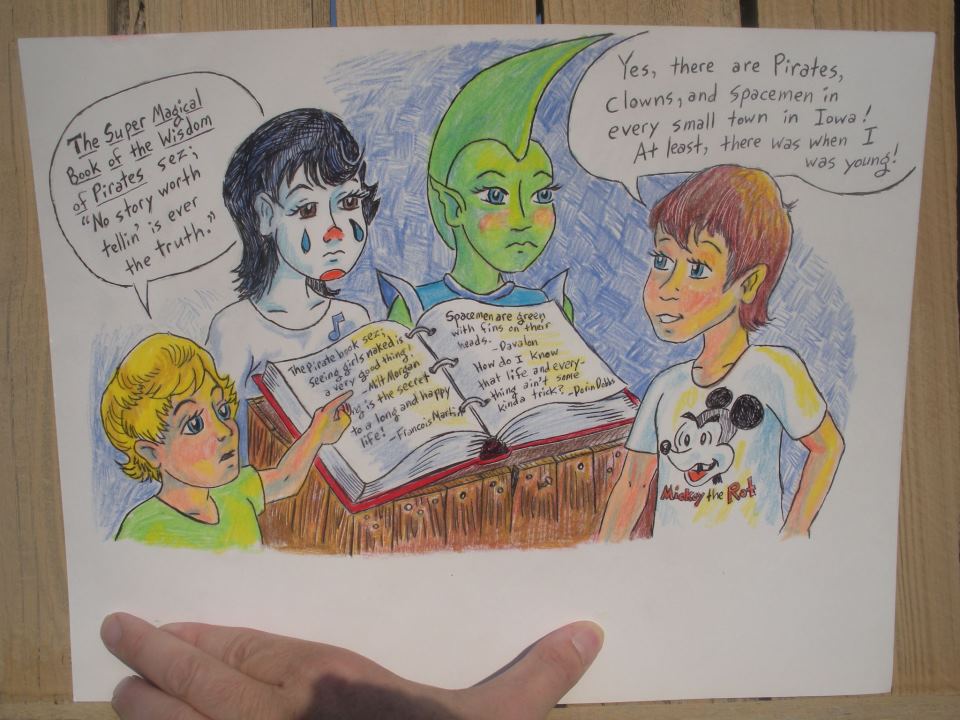
The theory is this; History is always about pirates. I know that statement probably alarms you, or makes you simply dismiss me as a loony, bald-headed goofball who just likes to talk and is meant to be ignored by you. Don’t be alarmed, and I am NOT a goofball.
History is never really written about the builders and creators who craft a society or a civilization. The occasional Albert Einstein, Thomas Edison, Gragg of Mars, or Googol Marou gets mentioned in a history book, but it is always the man, men, or peoples who see the civilization, want the civilization, and then either take the civilization for themselves or totally destroy the civilization who ultimately get the notice and the credit for making History happen. History is not about making something, but about taking something that is already there.
Consider how this played out in the history of the Orion Spur of the Milky Way Galaxy. It truly began with the Ancients who colonized the entire galaxy and then, for reasons unknown, totally disappeared from it, leaving only powerful and dangerous artifacts behind. They were creators and makers, so the story could never really be about them.
The story then would have to proceed to the gentle alien folk called the Sylvani. Now, they may actually be the Ancients, we have no way of knowing, but they don’t actually make History happen either. They created jump drives and interstellar travel, particle readers and material synthesizers (as well as the Skortch beams and disintegrators that can be derived from them), and anti-gravity technology. They did not colonize the stars. They had the bad sense to leave everything as they found it and live their lives in relative peace. The fools!
The amphibianoid people known as the Tellerons were the first to colonize and make an empire in the Orion Spur. These prolific frog-men of Telleri spread their form of civilization to eleven worlds. They wouldn’t have been able to do this, however, if they had never made contact with the Sylvani people while the latter were peacefully exploring the world of Telleri. The frog-men imprisoned the Sylvani explorers and forced them to yield up the all-important space travel technologies they had created. It was an act of space piracy. They basically stole all the knowledge and equipment needed to make a star empire.
Now, the Tellerons were basically fools themselves. They were ruthless explorers and conquerors but were a bit shallow in the thinking end of their gene pool. They were not adaptable and had to carefully recreate their swampy home-world environment everywhere they went. Thus, they were easily conquered themselves when they met far more adaptable races like the Galtorrians from the Delta Pavonis star system and the Earthers from the Sol system.
Words are what basically conquered the Telleron Star Empire. When they reached the Galtorrian homeworld of Galtorr Prime, they got themselves hooked on an alien cultural anomaly caused by TV broadcasts from Earth. The Galtorrians had been receiving and decoding the television signals of Earth for twenty years. A virulent black market existed there for pirated episodes of a TV show called “I Love Lucy”. Reruns of that TV show became a model for both the Galtorrians and the Tellerons who tried to conquer them.
Truth be told, the Tellerons began worshipping the character of Fred Mertz being played by an actor named William Frawley. Frawley’s frog-like mouth and toad-like wit made the fin-headed frog-men think Fred Mertz was a god. The Galtorrians had already adapted the English Language from the show because it was similar in sound patterns to Galtorr-speak. It had become the language of, not only entertainment, but of commerce and diplomacy. Now, English is a twisted and demented sort of language, capable of double meanings, puns, and irony. There are no sacred rules of grammar, word-formation, or spelling, and so the language can be shaped to suit the nefarious purposes of those sinister professionals known as “writers”. Galtorrians were able to trick Tellerons with the so-called “Word of Fred Mertz” into giving them the secrets of space travel, Skortch rays, and material synthesis.
So, space travel and the Telleron Empire fell into the hands of the Galtorrians by piracy. They stole the empire from the rival alien race. They then ruthlessly expanded their new empire. Being a pirate was the thing that created the History.
Now, a very similar process also happened on Earth. Tellerons, easily tricked by Earthers, also lost control of their stolen technology when they tried to invade Earth in about the year 1990 A.D. They tried to invade using invisibility technology acquired by showing their Sylvani slaves old episodes of Star Trek with Romulans in them. The Sylvani succeeded beyond the wildest dreams of Gene Roddenberry. Of course, this backfired, because it is hard to intimidate someone you are trying to conquer with armies and weapons that cannot be seen. The Tellerons managed to lose their devices and Skortch themselves during an invasion that almost no one knew was happening. Again, the technology was pirated from them. I firmly believe that it was one of my own ancestors, a genius named Orben Wallace who reverse-engineered all the alien devices and brought the technology to Earth.
The empire of all humanoid and intelligent life forms in the Orion Spur would be taken and retaken using the stolen technologies and the stolen words of what would become known as “Galanglic,” Galactic English. So, you can see, I have brilliantly proven my theory. All History is about pirates.














 One must end the year on a note that is either upbeat or regretful. A heartfelt, “Meh,” just won’t cut it.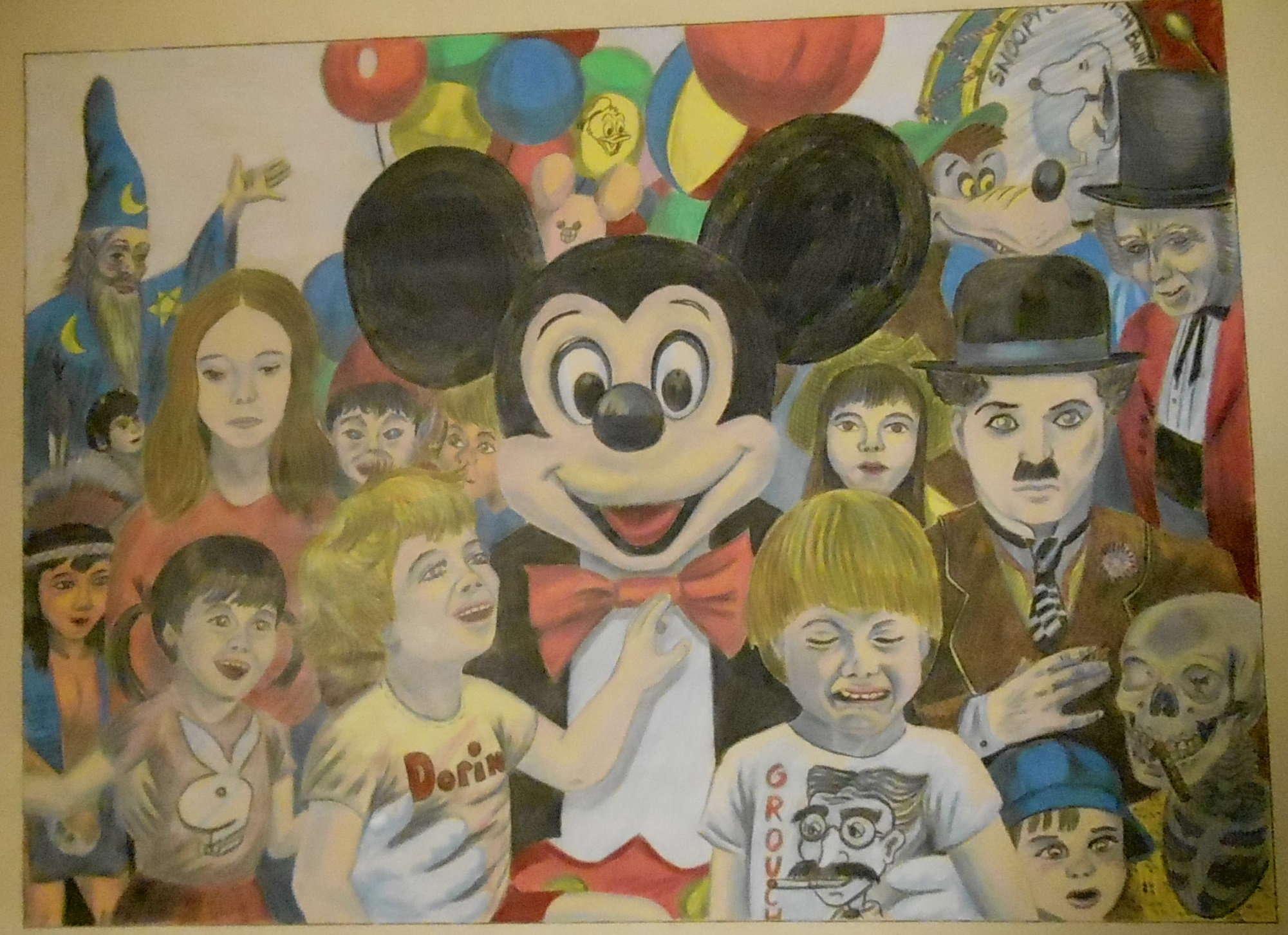







Who Do You Listen To?
There was a time when you could turn on the TV news and listen to what you were fairly confident was actually news. Walter Cronkite on CBS always seemed to really “Tell it like it is.” He never seemed to put a spin on anything. No one doubted anything he said when he reported space missions from NASA or the assassination of JFK. You never had to wonder, “What is Cronkite’s real agenda?” His agenda was always to tell me the news of the day.
The question of politics and ideas was always one of, “Which flavor tastes best in my own personal opinion?” Because I was weirdly and excessively smart as a kid, I often listened to some of the smartest people accessible to a black-and-white RCA television set.
William F. Buckley Jr. and Gore Vidal were both identifiably smarter than me. I loved to listen to them argue. They were equally matched. They respected each other’s intellect, but they hated each other with a passion. Buckley was a Fascist-leaning conservative ball of hatred with a giant ego. Vidal was a self-contradictory Commie-pinko bastard child of liberal chaos with an equally giant ego. I never agreed with either of them on anything, but their debates taught me so much about life and politics that I became a dyed-in-the-wool moderate because of them. They were the key evidence backing up the theory that you needed two sides in the political argument to hammer out good ideas of solid worth. And, though I didn’t trust either side of the argument fully, I always trusted that both were basing their ideas on facts.
When I was young I identified as a Republican like my father, and thought George Will was a reasonable opinion-leader. After all, a man who loves baseball can’t be a bad guy.
Then along came Richard Nixon and the faith-shaking lies of Watergate. The media began to be cast as the villain as they continued to show the violence and horrors of Vietnam on TV and tell us about campus unrest and the terrible outcomes of things like the Kent State Massacre. The President suggested routinely that the media was not using facts as much as it was using opinions to turn people away from the Nixon administration’s answer to the problems of life in the USA. I tried to continue believing in the Republican president right up until he resigned and flew away in that helicopter with his metaphorical tail between his legs (I am trying to suggest he was a cowardly dog, not that I want to make a lewd joke about poor Dick Nixon… or is that Little Dick Nixon, the man who let me down?)
And then along comes Ronald Reagan, the man acting as a “Great President” because he was a veteran actor and knew how to play the part. And with him came Fox News.
Roger Ailes, a former adviser to Nixon, got together with media mogul Rupert Murdoch, a man who would commit any crime necessary to sell more newspapers, and created a news channel that would pump out conservative-leaning propaganda that would leave Joseph Goebbels envious. I make it a rule to only listen to them and their views on anything when I feel the need to get one-foot-hopping, fire-spitting mad about something. So, since, I am a relatively happy person in spite of a long, hard life, you can understand why I almost never watch Fox News. They are truly skilled at making me mad and unhappy. And I suspect they do the same for everyone. They deal in outrage more than well-thought-out ideas.
News media came under a cloud that obscured the border between facts and partisan opinions. And conservatives seemed to have a monopoly on the shouty-pouty angry news. So, I began to wonder where to turn for a well-reasoned and possibly more liberal discussion of what was politically and ethically real. I found it in the most surprising of places.
I turned to the “Excuse me, this is the news” crews on Comedy Central where Jon Stewart and Stephen Colbert were busy remaking news reporting as a form of comedy entertainment. It is hard work to take real news and turn it into go-for-the-chuckles statements of fact that make you go, “Hmm, that’s right, isn’t it?” Stewart and Colbert consistently examine how other news organizations hurl, vomit forth, and spin the news, and by so doing, they help you examine the sources, get at the truth, and find the dissonance in the songs everyone else is singing. And these are very smart men. As I said, the intellectual work they do is very difficult, harder than merely telling it like it is. I know because I have tried to do the same myself. And is it really “fake news”? It seems to me like it is carefully filtered news, with the poisons of propaganda either surgically removed, or neutralized with antidotes of reason and understanding.
So, Mickey listens to comedians to get his news. Is that where you expected this article to end up? If not, where do you get your news?
Leave a comment
Filed under angry rant, commentary, conspiracy theory, humor, insight, politics, review of television, strange and wonderful ideas about life
Tagged as News, news media, news reporting, Walter Cronkite