

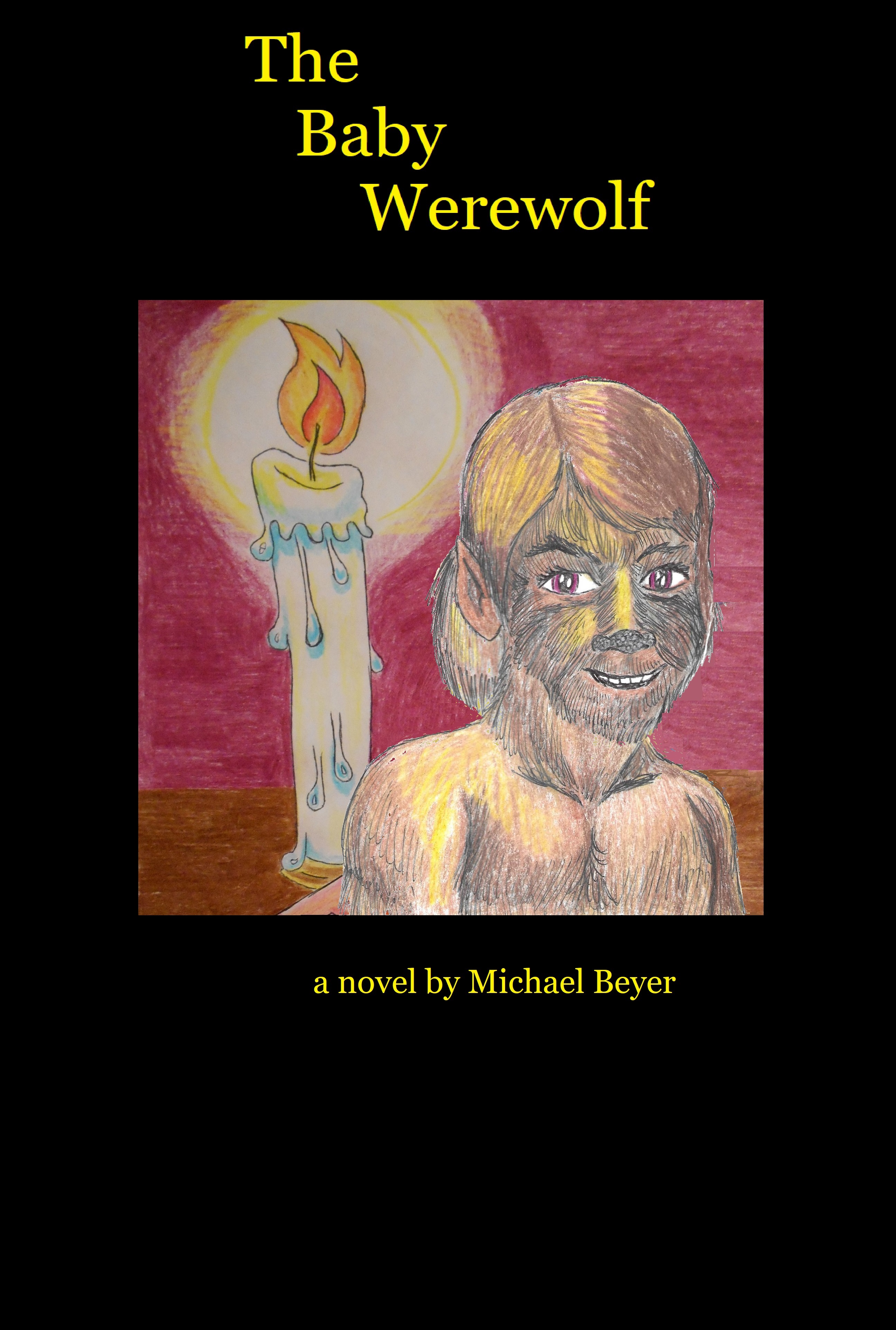
As I continue to draw nearer to publishing my comic horror novel, The Baby Werewolf, busily polishing paragraphs and tweaking the format, I had to find time to do some drawing, some colored pencil cartooning, actually, in order to draw even closer to a comprehensive understanding of the title character, Torrie Brownfield.
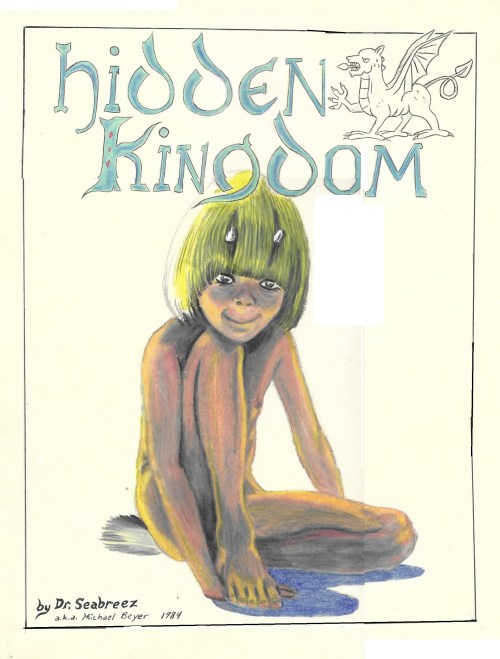
I decided that what I wanted to draw was a full-bodied portrait of Torrie, displaying in short pants the full impact of his “werewolf hair” caused by his full-body hypertrichosis syndrome, a genetic hair-growth disorder.

So, I began by printing out a reduced version of the scan of Torrie’s face and shoulders that I created from the drawing I made of him back when the story itself was merely in outline form. I pasted that colored print onto a larger piece of drawing paper and first penciled and then inked the rest of his body. I then used my colored pencils to go all Crayola on the bulk of it, ending up with the complete Torrie Brownfield, holding the one and only copy of Dr. Horation Hespar-White’s recipe book for Magical Airborne Elixir.

Now it doesn’t make sense to create an image like this for no particular reason. Was it just something I was doing to keep my hands busy while watching Netflix? Well, yes, but I did get something out of it after all. I was able to think seriously about my monster theme as heavy-handedly I continue to beat the reader over the head with it. I am obsessed with this particular portrait because, minus the facial fur, it actually looks like and reminds me of the charming little former student the character in the book is actually based on. He was a thirteen-year-old Hispanic boy, naive, innocent, and thoroughly sweet-natured. And he shared with me a history of abuse during childhood. He was not sexually abused, but psychologically and physically abused. And that, of course, led me to the revelation while drawing that the monster of my horror story is not a real werewolf. Not even the murderer who is the villain of the book. The real monster of the story is a systematic abuse of children. It can have two possible results. It can make you into a sweet-natured determined survivor like Danny was, and like Torrie is. Or it can turn you into a vengeful psychotic potential serial killer lashing out because of mental scars and lingering pain. Believe me, I knew a couple of that kind of kid too. Drawing can, in fact, lead you to revelations about yourself and the universe around you. And so, this little obsession has done that very thing for me.

So, I end with this scan of the completed artwork so you can get a better look at it than you can from my crappy photography skills. Drawing something obsessively does have its uses.







Winsor McCay
One work of comic strip art stands alone as having earned the artist, Winsor McCay, a full-fledged exhibition at the Metropolitan Museum of Art in New York City. Little Nemo in Slumberland is a one-of-a-kind achievement in fantasy art.
Winsor McCay lived from his birth in Michigan in 1869 to his finale in Brooklyn in 1934. In that time he created volumes full of his fine-art pages of full-page color newspaper cartoons, most in the four-color process.
As a boy, he pursued art from very early on, before he was twenty creating paintings turned into advertising and circus posters. He spent his early manhood doing amazingly detailed half-page political cartoons built around the editorials of Arthur Brisbane, He then became a staff artist for the Cincinnati Times Star Newspaper, illustrating fires, accidents, meetings, and notable events. He worked in the newspaper business with American artists like Winslow Homer and Frederick Remington who also developed their art skills through newspaper illustration. He moved into newspaper comics with numerous series strips that included Dreams of the Rarebit Fiend and Little Nemo in Slumberland. And he followed that massive amount of work up by becoming the “Father of the Animated Cartoon” with Gertie the Dinosaur, with whom he toured the US giving public performances as illustrated in the silent film below;
The truly amazing thing about his great volume of work was the intricate detail of every single panel and page. It represents a fantastic amount of work hours poured into the creation of art with an intense love of drawing. You can see in the many pages of Little Nemo how great he was as a draftsman, doing architectural renderings that rivaled any gifted architect. His fantasy artwork rendered the totally unbelievable and the creatively absurd in ways that made them completely believable.
I bought my copy of Nostalgia Press’s Little Nemo collection in the middle 70’s and have studied it more than the Bible in the intervening years. Winsor McCay taught me many art tricks and design flourishes that I still copy and steal to this very day.
No amount of negative criticism could ever change my faith in the talents of McCay. But since I have never seen a harsh word written against him, I have to think that problem will never come up.
My only regret is that the wonders of Winsor McCay, being over a hundred years old, will not be appreciated by a more modern generation to whom these glorious cartoon artworks are not generally available.
2 Comments
Filed under art my Grandpa loved, artists I admire, artwork, book review, cartoon review, cartoons, comic strips, commentary
Tagged as Little Nemo in Slumberland, Winsor McCay