Monthly Archives: January 2017

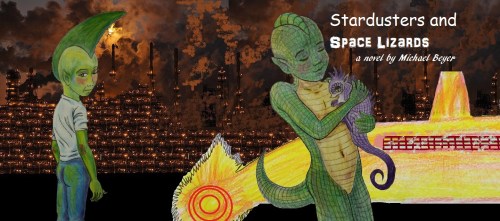
Stardusters… Canto 32

galtorr-primex-1

Canto Thirty-Two – In the Main Flower Garden of the Bio-Dome

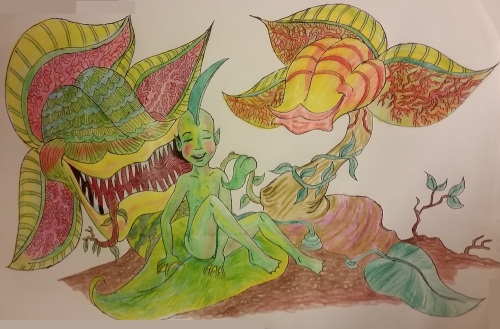
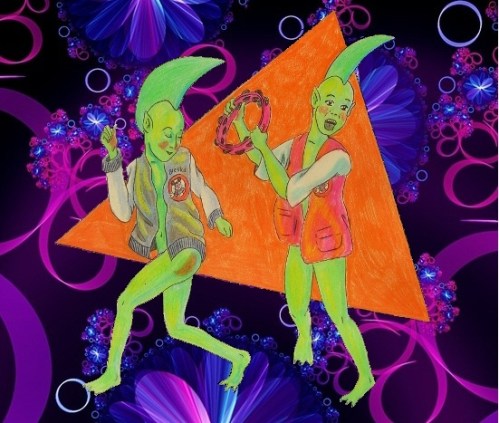
There were three large red-and-yellow blossoms on robust stalks in the center of the garden.  Everything else was either withering and brown or completely dead.  George Jetson felt slightly creeped out by the three giant, healthy plants in the center of so much death and rot.  Still, he didn’t object as Brekka and Menolly danced and sang as they moved towards the bright colors of the three blossoms.

“Georgie?  Why aren’t you dancing with us?” sang Brekka.

“Yeah, why not?” added Menolly.

“I don’t need to dance with goofy girls right now.  I… I’m supposed to guard you and keep bad things from happening.”

The girl tadpoles scoffed and continued to dance towards the blossoms.

George watched the leaves of the flowers, easily the size of dinner plates, begin to twitch and move.  It was almost as if they were trying to detect something either by feel, maybe of vibrations in the air, or possibly by smell.  George knew from his educational programming that leaves had openings called “stoma” that sniffed the air as they breathed carbon dioxide in and oxygen out.  It wasn’t an important fact, was it?

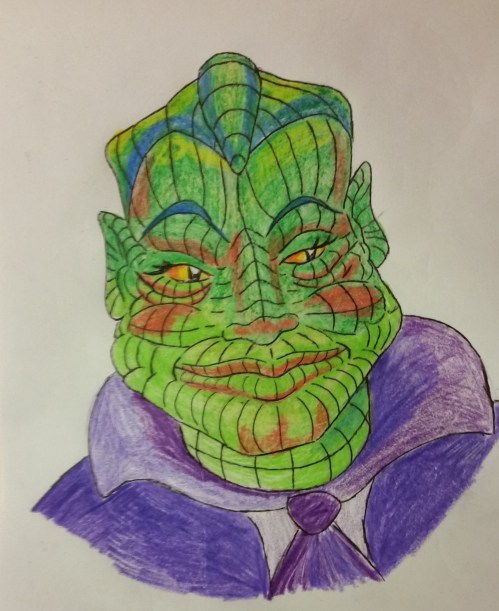
Suddenly there was a large, burly lizard man bursting in through the far door into the flower garden.  He was completely naked, for reasons unknown.  He was also obviously a scabby with the tell-tale white, filmy eyes and desiccated patches on his naked scales.

“George!  Help!” cried Brekka.  She had danced so far towards the three live flowers that the interrupting scabby had her cut off from Menolly and George.  George leaped forward to engage the monster in hand-to-hand combat, but pulled up short when he noticed the huge teeth and long, scimitar-like claws on both hands.

“Brekka!  Run away!  We will catch up to you on the other side!” screamed George.  “Menolly!  Come here to me!”

Brekka broke toward the flowers and ran.  The scabby followed her.  Menolly reached George and threw both of her green arms around his neck, making him unable to either flee or fight.  Both of them watched the pursuit of Brekka with absolute horror.

The largest of the three blossoms moved its huge flower-face closer to the fleeing Brekka.  The four main petals of the blossom formed into two sets of opposing jaws.  As Brekka moved close enough, the blossom engulfed her entire body and lifted her into the air.  Her screams were muffled by the blossom that seemed much more like a gigantic mouth.

“Oh!  No!  Brekka is gone!” cried Menolly, sagging against George Jetson.

“It ate her!”  George was too stunned to move.

The flowers were still in motion.  The two remaining blossoms grabbed the scabby, one seizing its head, and the other grabbing a leg.  The two blossoms pulled in opposite directions, splitting the unfortunate lizard man in two, then settling down to munch contentedly and smack their petal-lips.

Menolly was devastated and sobbing uncontrollably.  George didn’t know an awful lot about the hugging and kissing stuff that Earth humans did on their television shows, but he felt the urge to try.  He held Menolly tightly with both arms and pressed his mouth to hers.

“Mmmph!  What are you doing?” Menolly moaned.

“I’m comforting you, dummy.”

“Well, don’t stop!”

When the blossom that had engulfed Brekka began making retching noises, George was almost too lost in the entire kissing thing to respond.  He felt rather funny in his lower stomach as the two tadpoles pulled apart.

The blossom vomited Brekka onto the walkway.  She was clearly still alive, but covered with sticky-looking goo.

“Ooh,” moaned Brekka, “that was not very fun.”

*****
My Art

20161024_210707

1 Comment

Filed under aliens, humor, novel, NOVEL WRITING, Paffooney, science fiction, Uncategorized

Malevolent Marx Brothers’ Movies

8_1

“I wanna thank you for meeting with me in this super-secret high-level meeting in the White House, okay.  I brought you here… I am really good at bringing people and stuff together, by the way… I brought you here so we could make the Marx Brothers great again, okay?  We are going to make a new Marx Brothers’ movie.  It’s going to be great… really tremendous.”

“Wotta you sayin’, boss?  The Marx Brothers is dead.  How you gonna make a movie with dead guys?  You gonna dig ’em all up and do a Frankenstein number on ’em, or what?”

“No, no…  We will play the roles ourselves.  I’ll be Groucho, you know… the really smart one… the one with an amazing mind.  I really am very smart you know.  Everyone says so.”

“And who am I gonna play?”

“Steve, you get to be Chico.  You know, the fast-talking Wop guy.  You think of the greatest plans.  They are really great, you know.”

“Okay, boss, I got one already.”

“Really?  What is it?”

mv5bmtu4ote4mzgyn15bml5banbnxkftztgwnzy5mtm4mte-_v1_ux148_cr00148216_al_

“I think we gotta do an executive order.”

“Executive order?  What’s that?”

“It’s a order you give like Obama did, you know?  You take a pen and phone and say something in writing that everybody’s gotta do, and then, because it’s an executive order and you signed your name to it, you gotta execute somebody.”

“Ooh!  I like the sound of that.  We’ll call the movie Horsefeather Soup.  It’ll be tremendous.  The most tremendous thing people have ever seen.”

“Yeah, and the executive order will say we are banning Muslims from random countries.  You know, just the ones where you don’t have hotels.  And we can say we are doing extreme vetting so we are keeping America safe from terrorists.”

“Ooh!  Yeah!  Extreme vetting, rhymes with bed-wetting.  Tremendous.   But what if people say I’m being racist again?”

“We say we intend to protect Americans from those really bad people you keep talking about, you know?  We’ll claim that nobody who’s innocent will get hurt.  And the good thing is, the immigration people will just know that anybody who is a Muslim is a bad person.  We’ll get everybody that way.”

“Good one, Steve, I mean… Chico.”

duck-soup-and-beyond-the-3-best-marx-brothers-movies-image-4

LAX after the executive order.  (Possibly people waiting to be executed.)

“Wait a minute, boss, who do I get to be in this movie?”

“Rinse, you get to be Harpo, okay?”

“My name is Reince, boss.”

“Oh, yeah, sorry, Reence.”

“REINCE!”

“Okay, Harpo doesn’t talk, so shut up, Rinse!  Here, take this bicycle horn and, when you go on Chuck Todd’s show and he doesn’t let you talk either, just honk it at him.  It will be really great.”

“And me, boss?”

“Oh, Kellyanne.  I almost forgot about you.  What’s the name of that other brother?  Dumbo?  You get to be that one.”

“Hey boss, we gotta get goin’ on this executive order crap.  Somebody needs to get executed in the worst way.”

“Oh, yeah!  The worst way to execute is the best way.  I feel the need tweet about it.  This new Marx Brothers’ movie will be the best, just the best.  It will be so bestest that America will get tired of bestiness.”

go-west-marx-bros

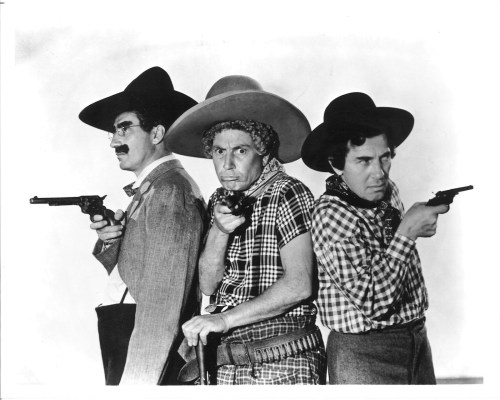
Trump, Rinse, and Steve ready for Muslims, Mexicans, and protesters.

2 Comments

Filed under angry rant, humor, politics, satire

Special Snowflakes

snowflake12

When conservative cultural warriors, Twitter Trolls, or dyspeptic gasbags like Rush Limbaugh call you a “Special Snowflake”, I have discovered, to my chagrin, that they don’t mean it as a compliment.  In their self-centered, egotistical world you have to be as emotionally tough and able to “take it” as they believe (somewhat erroneously to my way of thinking) they themselves are.  They have no time for political correctness, safe spaces, or, apparently, manners polite enough not to get you killed on the mean streets where they never go.  Being a retired school teacher who was once in charge of fragile young psyches trying to negotiate a cruel Darwinian world, I think I disagree with them.

in-snow-big

Have you ever tried to draw a snowflake?  Believe me, it is difficult.  Snowflakes are hexagonal star-shapes with enough lace and  filigrees in them to make it a nightmare to draw it with painfully arthritic hands.  The one above took me an hour with ruler and compass and colored pencils, and it still doesn’t look as good as a first grader can create with scissors and folded paper.  Much better to use a computer program to spit them out with mathematical precision and fractal beauty.  That’s how all the tiny ones in the background were created.  But even a computer can’t recreate the fragile, complicated beauty of real snowflakes.

You see how the fragile crystalline structures will break in spots, melt in spots, attach to others, and get warped or misshapen?  That is the reason no two snowflakes are alike, even though they all come from the same basic mathematically precise patterns generated by ice crystals.  Life changes each one in a different way.

4f0f6392eb9ed-image

And that, of course, is the reason this essay is really about people rather than mere physical artifacts of cold weather.  Our fragilities and frailties are earned, and they make us who we are.  I have a squinky eye like Popeye from playing baseball and getting hit by a pitch.  I have a big toe that won’t bend from playing football.  They both represent mistakes that I learned from the hard way.

As a teacher, I learned that bipolar disorder and anxiety disorders are very real things.  I lost a job once to one of those.  And I spent a long night talking someone out of suicide one horrible December.  Forgive me, I had to take fifteen minutes just there to cry again.  I guess I am just a “special snowflake”.  But the point is, those things are real.  People really are destroyed by them sometimes.  And they deserve any effort I can make to protect them or help them make it through the night.

snowflake1

But people are like snowflakes.  They are all complex.  They are all beautiful in some way.  They are all different.  No two are exactly the same.

snowflake13

And I really think boorish bastards have no right to insist that we need to take safe spaces and sanctuaries away from them.  Every snowflake has worth.  Winter snow leaves moisture for seedlings to get their start every spring.  If you are a farmer, you should know this and appreciate snowflakes.  And snowflakes can be fascinating.  Even goofy ones like me.

snowflake_with_cartoon_face_0521-1012-0818-0641_smu

1 Comment

Filed under 1000 Voices Speak for Compassion, artwork, battling depression, commentary, compassion, humor, metaphor, Paffooney, self portrait, Snow Babies, strange and wonderful ideas about life

How To Write A Mickian Essay

mickeynose

I know the last thing you would ever consider doing is to take up writing essays like these.  What kind of a moronic bingo-boingo clown wants to take everything he or she knows, put it in a high-speed blender and turn it all into idea milkshakes?

But I was a writing teacher for many years.  And now, being retired and having no students to yell at when my blood pressure gets high, the urge to teach it again is overwhelming.

So, here goes…

c360_2017-01-02-10-17-06-058

Once you have picked the silly, pointless, or semi-obnoxious idea you want to shape the essay around, you have to write a lead.  A lead is the attention-grabbing device or booby-trap for readers that will draw them into your essay.  In a Mickian essay, whose purpose is to entertain, or possibly bore you in a mildly amusing manner, or cause you enough brain damage to make you want to send me money (this last possibility never seems to work, but I thought I’d throw it in there just in case), the lead is usually a  “surpriser”, something so amazingly dumb or off-the-wall crazy that you just have to read, at least a little bit, to find out if this writer is really that insane or what.  The rest of the intro paragraph that is not part of the lead may be used to draw things together to suggest the essay is not simply a chaotic mass of silly words in random order.  It can point the reader down the jungle path that he or she can take to come out of the other end of the essay alive.

Once started on this insane quest to build an essay that will strangle the senses and mix up the mind of the reader, you have to carry out the plan in three or four body paragraphs.  This is where you have to use those bricks of brainiac bull-puckie that you have saved up to be the concrete details in the framework of the main rooms of the little idea-house you are constructing.  If you were to number or label these main rooms, this one you are reading now would, for example, be Room #2, or B, or “the second body paragraph”.  And as you read this paragraph, you should be thinking in the voice of your favorite English teacher of all time.  The three main rooms in this example idea house are beginning, middle, and end.  You could also call them introduction, body, and conclusion.  These are the rooms of your idea house that the reader will live in during his or her brief stay (assuming they don’t run out of the house screaming after seeing the clutter in the entryway).

Teacher

The last thing you have to do is the concluding paragraph.  (Of course, you have to realize that we are not actually there yet in this essay.  This is Room C in the smelly chickenhouse of this essay, the third body paragraph.)  The escape hatch on the essay that may potentially explode into fireworks of thoughts, daydreams, or plans for something better to do with your life than a read an essay written by an insane former middle school English teacher at any moment, is a necessary part of the whole process.  This is where you have to remind them of what the essay is basically about, and leave them with the thought that you want to haunt them in their nightmares later.  The last thing that you say in the essay is the thing they are the most likely to remember.  So you need to save the best for last.

So, here, finally, is the exit door to this masterfully mixed-up Mickian Essay.  It is a simple, and straightforward structure.  The introduction containing the lead is followed by three or four body paragraphs that develop the idea and end in a conclusion that summarizes or simply restates the overall main idea.  And now you know why all of my former students either know how to construct an essay, or have several years left in therapy sessions with a psychiatrist.

Leave a comment

Filed under commentary, education, humor, Paffooney, teaching, writing, writing teacher

Oxfordian Rationalizations

Yes, I am, perhaps, a bit of a fool for believing Edward de Vere, the 17th Earl of Oxford, is the writer behind the works of William Shakespeare.  How do you prove something is true when it is so obvious that someone worked really hard to keep it a secret for all this time?  Is it a betrayal of the man to go against his apparent wishes and try to out him for his incredible secret?  It is hard for me to judge.  After all, I know I am a fool.

But even if he is not Shakespeare, and just sits at the apex of a mountain of coincidences, I am fascinated by the historical character of Edward de Vere.

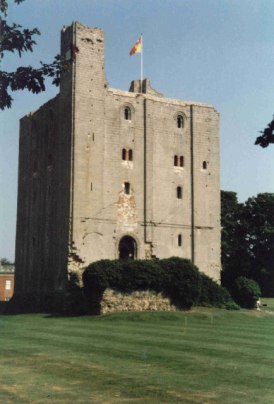
the_keep_at_castle_hedingham_-_geograph-org-uk_-_30510

The keep at Hedingham Castle, the de Vere family seat in Essex (photo by David Phillips)

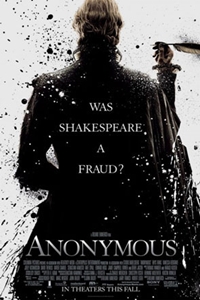
He was born the only son of John de Vere, the 16th Earl of Oxford, and heir to the second oldest title among English nobility.  His father stood by Elizabeth when she was under house arrest under the reign of Bloody Mary, and went with her as a court favorite to the throne of England when she survived the ordeal.  So naturally Edward was a favorite of Elizabeth’s since childhood.  Later stories would suggest he became the Queen’s secret lover, but the rumors of the Virgin Queen’s harlotry were most likely the invention of Philip of Spain and other nobility in Catholic Europe who plotted endlessly against her because she chose to adopt her father’s protestant Anglican religion instead of returning England to Catholicism like her half-sister Mary before her.  Elizabeth’s personal integrity may not have been perfect, but the love she bore for young Edward was probably not the improper kind that the movie Anonymous by Roland Emmerich suggested.

But even though de Vere was born lucky, I would not say he was particularly lucky in life.  He was only twelve when his father (though having completed his will) died.  The result being that he was made ward to Queen Elizabeth herself.  She was not exactly the foster-mother type, however.  She sent the boy to be raised in the home of her Secretary of State and chief adviser, William Cecil (later made Lord Baron Burghley).  Meanwhile Elizabeth took possession of some of his estates in payment for the wardship and bestowed them on Robert Dudley (her childhood friend and probable one true love, though he was married to someone else).  Young Edward was a difficult student.  His tutor, the famous scholar Laurence Nowell, resigned in frustration, probably because the boy was too bright and far-reaching for the antiquarian scholar to deal with, possibly himself being a bit dumber than advertised.   Edward quickly developed a reputation for love poetry at Elizabeth’s royal court.  He was a gifted, though somewhat conflicted, prodigy.

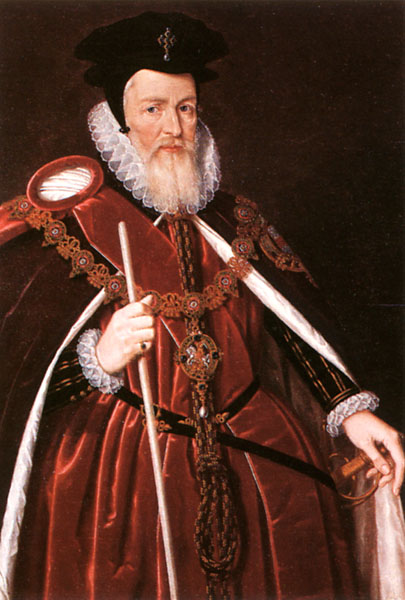
cecilwilliam1bburghley04

William Cecil, 1st Baron Burghley

And here is what I find most fascinating about his life story.  As you reread it, keeping the works of Shakespeare in mind, you begin to see Shakespeare’s source material coming to life.  Edward would end up marrying Cecil’s young daughter Anne, so that Lord Burghley was not only a man who raised him, but also his father-in-law.  But marrying off your offspring to nobility was an accepted manner of social climbing, and Cecil wasn’t entirely sure he couldn’t do better for his daughter.  And the meddlesome, lecturing, and self-righteous nature of the man comes out in Shakespearean characters like Polonius in Hamlet who spies upon the suicidal prince because he fears the effect Hamlet’s love for his daughter Ophelia might have on her reputation, causing him to spout all manner of cliches and stuffy, self-important advice.

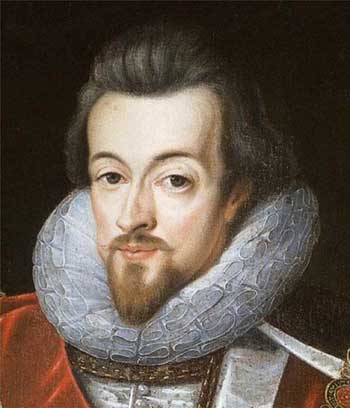
cecil

Robert Cecil, Lord Salisbury

Cecil’s son Robert, the hunchbacked boy who grows up to take over his father’s office as adviser to both Elizabeth and James I, is a crafty statesman and plotter who is the undoing of the Earl of Essex in a real-life plot against the throne of Elizabeth.  It is hard not to read about his real-life exploits without seeing the connections to Iago in Othello and the conniving hunchback Richard III.

So, once again I have overshot my target length in this essay because I get so wound up in the details of my discoveries.  There are numerous things written and published about the connections between de Vere and the Bard himself.  I have only begun to scratch the surface in this telling of it.  But I am just a fool with a humor blog.  If it interests you at all, I encourage you to go to as many of the available sources as you can possibly google.  I haven’t yet finished doing that myself.  And I do hope I haven’t told anything here that makes Shakespeare turn over in his grave (if, indeed, a grave could ever really hold him.)

2 Comments

Filed under artists I admire, conspiracy theory, foolishness, humor, strange and wonderful ideas about life, William Shakespeare

Shakespeare Knows Fools

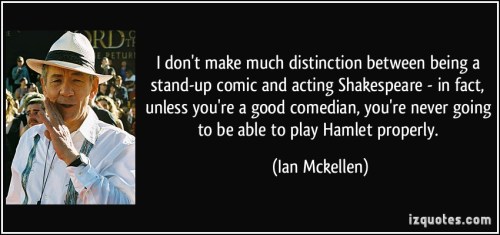
quote-i-don-t-make-much-distinction-between-being-a-stand-up-comic-and-acting-shakespeare-in-fact-ian-mckellen-124331

The fact that Shakespeare was a master of the art of creating and mocking fools does not really help decide the question of who Shakespeare really was.  A stage actor who owned a theater in Elizabethan times and apparently focused on being the bit player, the butler, the second man on the castle wall in the great plays, would certainly know enough of flim-flam, being a con man, or artfully throwing turds at kings and queens in ways that get rewarded rather than beheaded.  But a nobleman who has unpopular and unwelcome-but-probably-wise insights into the back-stabbing-goings-on of the royal court of England would equally be capable of putting the most memorable of critiques of humanity into the mouth of the fool or the clown in the great stage-play of life.  Even the most depressing and violent of the Shakespearean tragedies is enhanced and made pointed by the presence of the fool and the comic relief.  In some ways everything that Shakespeare wrote was a comedy.

sticker375x360-u2

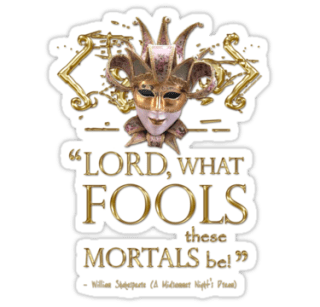
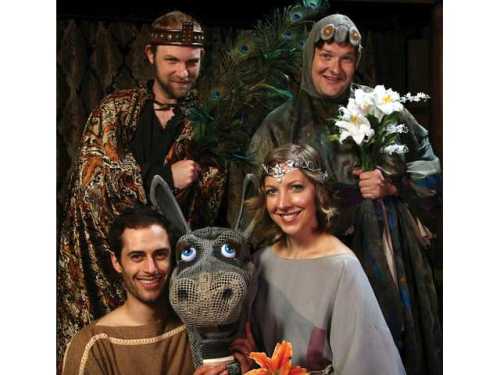
Whoever Shakespeare was, he shared Mark Twain’s overall assessment of “That damned human race” and often declared all men fools in the eyes of the playwright.  Puck’s observation on humanity is delivered about not only Bottom and the other poor players who carry on their vain attempts at performing Pyramus and Thisbe while Bottom magically wears the head of an ass, but also the easily fooled lovers who mistake their true loves for one another, and even the clueless mortal King Theseus of Athens.

0716-go-midsummer-dream_

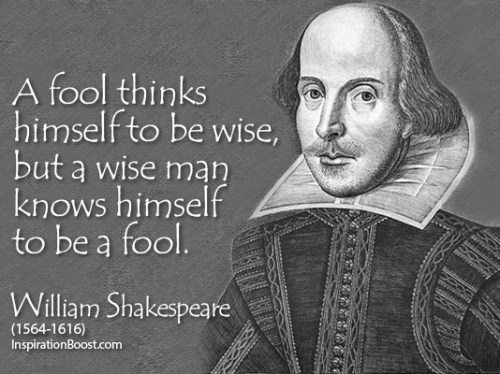
In the play within a play, Nick Bottom wants to be not only his own role, Pyramus the romantic lead, but argues that he should be Thisbe, the lion, and Pyramus all at once, making a satire of human nature and its overreaching ways that we could only pray Donald Trump will one day watch and magically understand.  In fact, Shakespeare’s entire body of work is an extended investigation of foolishness versus wisdom, and with Shakespeare, the verdict always goes to the fool.

a-fool-thinks-himself-to-be-wise-but-a-wise-man-know-himself-to-be-a-fool-william-shakespeare

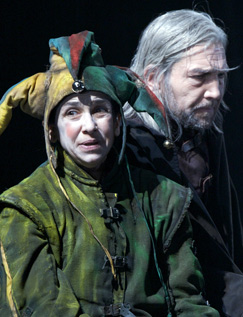
The plays of William Shakespeare are filled with fools doing foolish things… and fools being accidentally wise. (Think Jacques in As You Like It giving his famous “All the world’s a stage” soliloquy in which he elucidates the seven ages of man.)  There are fools too who prove to be wise.  (Think of the ironic advice given by the jester Touchstone in As You Like It, or the pithy commentary of King Lear’s fool).  The fools in Shakespeare’s work are not merely the comedy relief, but the main point that Shakespeare makes about humanity.

207a65d14f2a61bd4a4ef178e88609bb

Whoever the man was who wrote the plays of Shakespeare, he was someone who had a deep understanding of the basic irony underlying all of human life.  And someone with that vital sense of the bittersweet, a philosophy of life that encompasses the highest heights and lowest depths that a soul can reach, is someone who has suffered as well as known great joy, someone who has experienced loss as often as profit, and has known real love as well as real hatred.  It is the fool that Shakespeare shakes us by the neck with to make us recognize the fool in all of us which makes the plays resonate so deeply within us.  It is watching the path of the fool unfolding that makes us shake our head and say to ourselves, “Yes, that is what life is really like.”

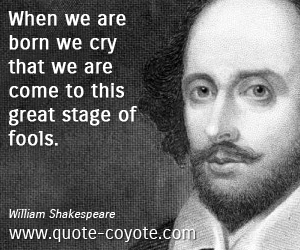
when-we-are-born-we-cry-that-we-are-come-to-this-great-stage-of-fools-william-shakespeare

Leave a comment

Filed under clowns, comedians, conspiracy theory, foolishness, goofy thoughts, inspiration, philosophy, strange and wonderful ideas about life, William Shakespeare

The Oxford Obfuscation

queen-elizabeth-iIf you are going to entertain a completely absurd notion like, “Shakespeare wasn’t really written by Shakespeare”, then you have to have some knowledge of the times and the context within which such a profoundly counter-intuitive thing could possibly be true.  And it also helps to understand more precisely what the “writing of Shakespeare” actually means.  Now, I know it is not particularly fair to confuse you, dear reader, right before I try to dazzle you with my complicated and over-thunk lackwit conspiracy theory, but that is, after all, what obfuscation actually means.

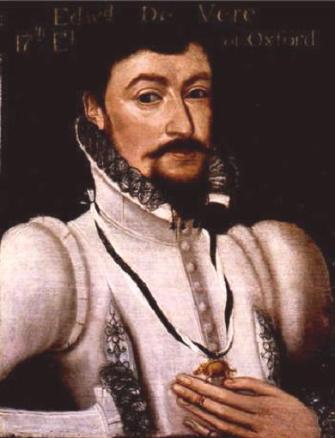
The plays, sonnets, and other poetry of William Shakespeare reveal the mind of a genius.  Whoever wrote the works has to be a complicated man living a complicated life.  He has to be a sensitive, empathetic, highly intelligent, observant, and troubled man.  You don’t write the dark and deeply troubled suicidal tragedy of Hamlet without ever having thought of taking your own life.  You cannot portray the madness of King Lear without ever having experienced the turmoil of the mind that threatens to tear your soul apart.  And you don’t write about the complexities of love found in As You Like It or Romeo and Juliet without ever having experienced the massive thunderstorms of the mind that go along with falling in love.  And we are talking true love, not necessarily the domestic love you have for the wife you are stuck with.   You see what I did just there?  I put you into the head of the writer, and started you thinking like you yourself are Shakespeare.  As goofy a mental gymnastic exercise as that is, bear with me and keep thinking it.

At the time of Shakespeare’s ascendancy as the Bard Laureate of English Literature, England was not a safe place to be either a noble or a playwright.  Queen Elizabeth’s mother had her head cut off for bad politics even though she was married to the King of England at the time.  Lady Jane Gray, one of Elizabeth’s predecessors, lost her head when she was no more than a sixteen-year-old girl.  During Elizabeth’s reign, one of her court favorites, Robert Devereaux, Earl of Essex, attempted to seize the queen herself after a riot fomented by a performance of Shakespeare’s play, Richard II, at which eleven of Essex’s noble supporters were said to be present stirring up the emotions of the crowd.  It was a near thing for the writer of the play (about the life of a king whose reign ended in controversy about succession and which led eventually to the War of the Roses) to escape without also being caught up in the rebellion’s failure and round of executions that separated Essex from his head.  Elizabeth banned numbers of plays with religious or political content, bans that never seemed to touch the writer of Shakespeare’s plays, even when they touched on political themes.  You didn’t have to rebel against the Queen to lose your head either.  Elizabeth was trying to reinstate Anglican Protestantism against the critical tides of Catholic Europe.  You could be banished, put to death, or impressed  by force into the English Navy for being suspected of ideas that were too Catholic.  And witchcraft, or consulting with witches, as Macbeth depicts, earned you a nice warm fire in the public square to cleanse your immortal soul.

edwarddevereattribmarcusgheeraerts

Edward de Vere, 17th Earl of Oxford

So, if one were to be both a playwright and a nobleman, known to and beloved by Queen Elizabeth, might there not be good reason to write under a pseudonym?  And numerous people who write about Edward de Vere mention the fact that he wrote poetry and plays, and the plays were very popular.  Some scraps of poetry by the Earl of Oxford still exist, but whatever happened to the manuscripts of his plays?  It is a conspiracy theory so delicious, that I have to take at least one more bite.  (You understand, I try to stick to a 500-word target for these posts, and even this 600+ is really too long.  So that means there has to be an Earl of Oxford Part II at least.)

Leave a comment

Filed under conspiracy theory, foolishness, humor, politics, William Shakespeare

Stardusters… Canto 31

galtorr-primex-1

Canto Thirty-One – Moonbase Gundahl

Commander Biznap was a capable pilot and Farbick admired the way he simply turned the Golden Wing in the air and took off towards the mother ship.  Simple and elegant was always the mark of skill.

“Now that your commander has gone and left you to die…” said Stabharh, the scrawny little Galtorrian lizard-man enforcer, “you need to show us how to work the space tech devices.  And hurry because I know some Galtorrians that are dying to eat you.”

“Have you ever eaten a Telleron before, Stabbie?” asked the cruel and obese Lord Bahbahr.

“Of course not.  But we haven’t had food in so long, I was beginning to consider eating you, my lord.  And don’t call me Stabbie.”

“Ah, we will have none of that!  You are required to lay down your life to serve me.   It is the law, and I own you body and soul.”

“Who besides me is left to enforce the law?” asked the skinny lizard with an evil grin.

The smile vanished from the face of the corpulent Galtorrian ruler.  Farbick carefully noted the malevolent glares passing between the two lizard-men and vowed secretly to himself to take maximum advantage of such a situation.

“What device would you like to learn about first, my lord?” asked Farbick with a timely interruption.  Then he strategically added, “the skortch pistols perhaps?”

“I am much more interested in the force-field thingy that kept the cannonballs from destroying that spaceship.  You have no idea how useful that could be if Senator Tedhkruhz learns that we have returned here.”

The little enforcer seemed to whole-heartedly agree with Bahbahr.  So Farbick moved near to the force-field control and activator box lying at the foot of the pile of Telleron tech.

“That is a very wise choice,” said Farbick as Starbright looked on encouragingly.  “May I turn it on and demonstrate?”

“Please do,” said Bahbahr.

Farbick ignited the control box with the click of a button and a sudden electrical humming noise that sounded reassuring and powerful.

“By adjusting the three-dimensional coordinates like this,” said Farbick, “I can place an invisible shield around you and Stabharh.  You can’t see it, but it is impervious to kinetic attacks and weak energy attacks.  Gunpowder will never pierce it.  Show them, please, Starbright.”

“How?”

“Pick up that chair there and hit Stabharh over the head with it.”

“Now, hold on there, frog-boy!” growled the lizard man.

Before Stabharh could even flinch, Starbright picked up the chair and threw it at him.  It shattered in the air as it encountered the generated field.

“Impressive!” said Bahbahr.

“Do you want to know what I find most impressive?” said Farbick, laughing.  “It can be shaped in the form of a box.  Just as the chair can’t penetrate the walls of the force field, neither can the two of you.  You are our prisoners now.”

The two lizard-men seemed stunned.  It was entirely possible that Farbick had won the day already.  He could now pick up a skortch pistol and finish these two threats in a blink.  Yet, somehow, that didn’t feel right.  He could not do a deed that was just as bad, if not worse, than what the lizard-men themselves were capable of.

From the courtyard above in the ruined fortress, Farbick and Starbright suddenly heard voices and the sound of someone scrambling hastily through rubble.

“I thought we were alone on this moon,” said Starbright, horrified.

“We were…” said Stabharh with a sneer, “at least we were not burdened with anyone who counts.  But the remaining inhabitants of Gundahl are coming now, because of my silent alarm.  And hopefully they have weapons to kill you two with.  Who is the clever fellow now, hmm?”

*****

senator-tedhkruzh

1 Comment

Filed under aliens, humor, novel, NOVEL WRITING, Paffooney, science fiction

The Heart of Shakespeare

3a8307f6bb01311fc90478857d32e891

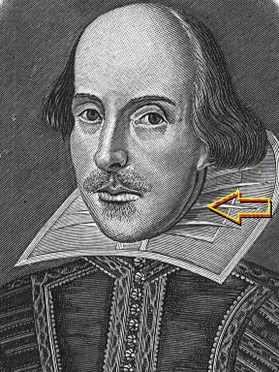
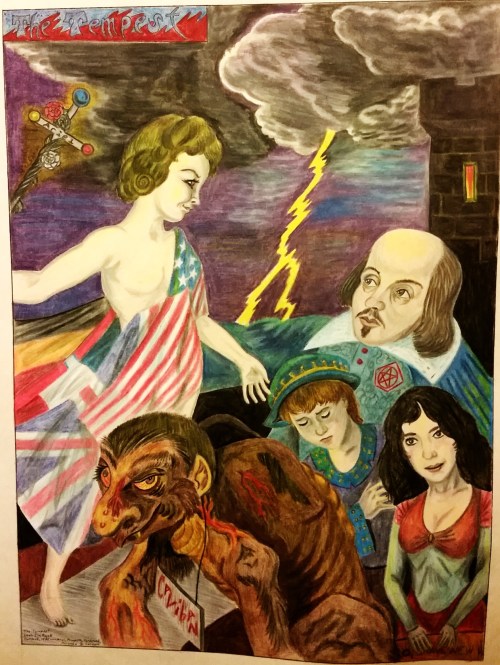
Despite my skepticism about the accepted wisdom in regard to the historical William Shakespeare, I do deeply love the body of work that is Shakespeare.  My most favorite play is The Tempest, the final play in the canon.  I also have read and loved As You Like It, Romeo and Juliet, Hamlet, A Midsummer Night’s Dream, The Merchant of Venice, Henry V, Richard III, Julius Caesar, Macbeth, Othello,  and King Lear.  I know that is not all of the plays, but that is probably more than most people have read.  And of course, as an English major in college, and later as a teacher, I have actually analyzed, compared, studied, and taught some of these plays.  So, the Shakespeare I know is the Shakespeare of the writer’s own mind, his communicated wit and wisdom, imagination and intellect.

shakespeare

And I do not have any disdain or disrespect to give the Stratford guy.  To say that, in the Elizabethan world, the actor son of a tradesman with only a grammar school education could not have been the mind behind the literary masterworks is foolish.  The Stratford guy owned and operated the Globe theater at a time when “the play was the thing”.  All of London society, rich and poor, gloried in the theater, and Shakespeare did for Elizabethan plays what Babe Ruth did for baseball.  He was a good enough business man to make himself a decent fortune.  Although, apparently, this world-shaking author didn’t spend any of his money on owning books, which in my experience is extremely rare among writers.  His life, bound up in an urban existence that never traveled outside of the country also somehow produced great works that were set in places in Europe, especially Italy, that described those settings in accurate detail.  As a working actor, he also apparently had the time to study law and somehow learn the inner workings of the royal courts of more than one country.  And the plots were not original.  He took existing stories that already were a part of European literature and lore and wove them into rich tapestries of human striving, laughable foibles, and a deep understanding of basic human character.  But I do have doubts that the businessman and actor from Stratford was the real writer of the plays.

I have already told you that I don’t believe Sir Francis Bacon was secretly Shakespeare.  Christopher Marlowe wasn’t either.  And I have unsuccessfully made a case against Shakspere, the Stratford guy.  So who could possibly be the real William Shakespeare?  Well, I am not going to be able to make a decent case for him in the 100 words that I have left to end this essay with.  So there has to be more to come.  (And stop screaming obscenities at the computer screen.  I am going to reveal the name before the end of this essay.  And I promise not to make my case for him in coming days too boring and horrible.)  I have to show why I believe that the true heart of Shakespeare could only have beaten within the body of Edward deVere, the Earl of Oxford.


6 Comments

Filed under conspiracy theory, goofy thoughts, humor, strange and wonderful ideas about life, William Shakespeare

Green and Fuzzy Blue Brainwork

100207H1

There is reason to believe I have to reroute some of the back roads on the road map of my thinking parts.  I have been spending a lot of time in Elizabethan England lately due to my obsession with who I think Shakespeare really was.   There are a lot of dark alleys to be plumbed on that section of the map.  I really admire the Roland Emmerich film Anonymous about Edward deVere, the Earl of Oxford being the real writer behind the works of Shakespeare, but I do recognize that it is a work a fiction, and an altered-history work of fantasy fiction at that.    So I find myself not yet ready to tackle that particular essay in the Shakespeare series as yet.  More think time and creative-mixing time is needed.  I need to stop at one of the quaint little mental inns on that particular Elizabethan back road and get some much needed rest for my Elizabethan conspiracy muscles.

Meanwhile back in the real world, Trumpzilla has been busy wrecking the world I live in with a bleak inauguration speech written by Steve Bannon that works its fire-breathing magic to blacken the hearts and perceptions of people I love and care about who also happen to be staunch conservatives.  My Facebook feed is up in arms about how many people actually attended the inauguration ceremony and how unfair the media is for trying to make it seem like Trump’s celebration parade was a deserted wasteland when in reality it was… well…  what’s a synonym for deserted wasteland that won’t offend conservatives who will bend or break any truth to defend Trumpzilla’s turkey-tweets?

trumpasaurus

But then, as I was going to QT for my morning caffeine-addict’s fix of Diet Coke, I heard Lionel Richie’s song “Say You, Say Me” playing on the radio.  Ah, the perfect metaphor.  It is a song used as the theme song from the 1986 movie White Nights about a Russian ballet star who has defected to the US during the Cold War and then was in a plane accident-incident that put him back in the Russians’ clutches.  The movie stars Mikhail Baryshnikov, an actual Russian ballet star turned defector, and Gregory Hines, the American tap dancer.  It is a beautiful movie that features amazing dance sequences, Russian conflict of interests because the dancer wants to be free and yet misses his homeland and culture, and a resolution involving intrigue and escape.  In many ways, the plot, centered around a Russian threat and dark days in a place where the sun doesn’t set, is exactly what we are going through with Trumpzilla.  But the song is about two people communicating and eventually “coming together, naturally”.

It started me thinking about the purpose of this blog.  I mean, you obviously know that this blog is really about me talking to myself about myself, if you are one of those crazy few who actually read this far through a goopy blog post like this.  I use this blog to think about myself, the world around me, and even sometimes, like now, to think about thinking.  Yet, I have a duty to the reader to reach that point where our thinking comes together, naturally.  If not, then why bother to post and publish at all?

So here’s what I think about the Shakespeare question, written in the tavern room at the inn on parchment… with a quill pen.  The real Shakespeare was a writer just like me, writing for himself.  And he discovered through the play-writing process that he had to share that writing for himself with the great wide world, because the Prospero’s magic of it could change the world for everybody.  That is the real purpose of Shakespeare’s existence, no matter who he really was.  And that is the real purpose of my existence as well, even if I turn out to be nothing more than one of the top hundred best writers that no one ever actually read.

c360_2017-01-13-19-11-50-170


1 Comment

Filed under blog posting, conspiracy theory, feeling sorry for myself, goofy thoughts, humor, sharing from YouTube, soliloquy, strange and wonderful ideas about life, William Shakespeare